
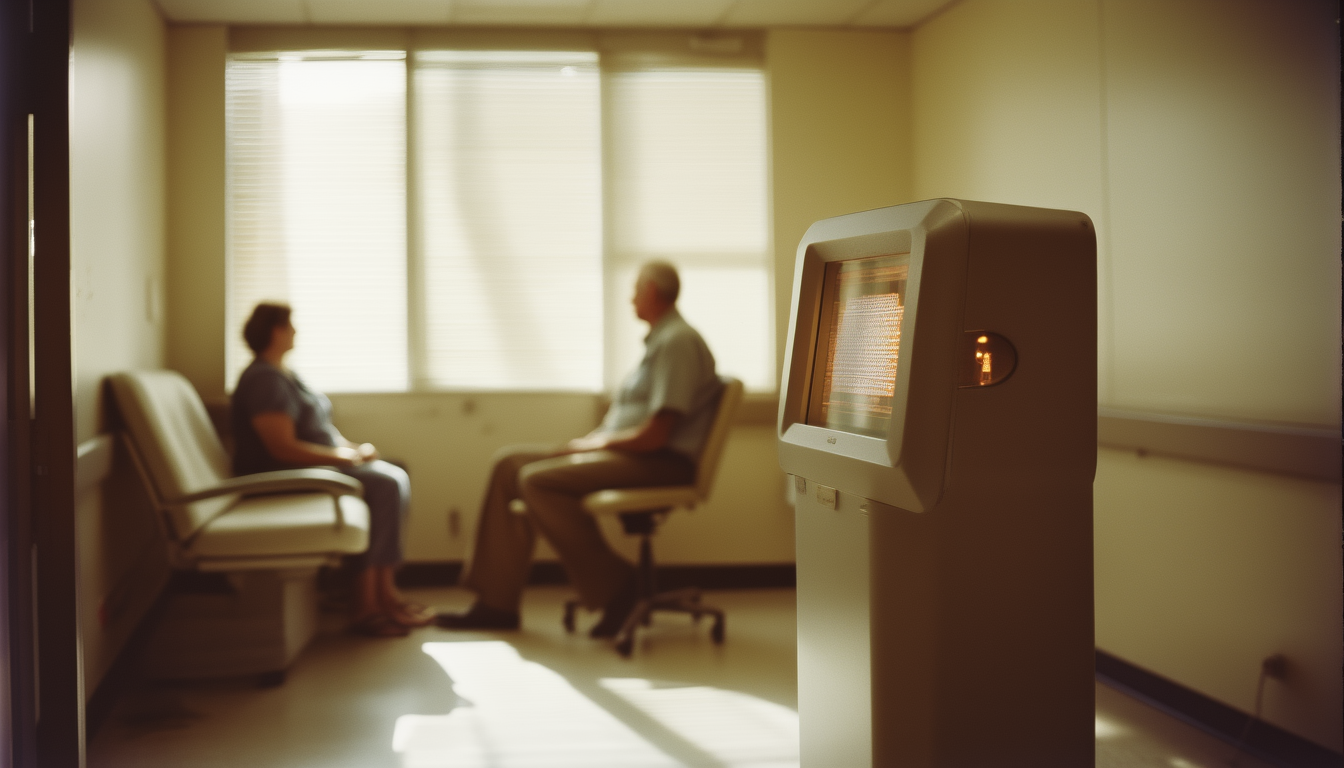
It is a Tuesday in 2036, and Dr. Sarah Chen is sitting very still in a clinic chair while a device the size of a small speaker reads her heart through her sweater.
No electrodes. No cold gel. No technician threading wires across her chest the way she once threaded them across her own patients. The pedestal just hums, its diamond sensor array listening to the faint magnetic field her cardiac cells throw off every time they contract — a signature, the manual says, as individual as a fingerprint. Chen is a cardiologist. For fifteen years she ordered scans like this one; she has never been on this side of it.
The reading takes ninety seconds. Then the voice from her phone, gentle and synthetic, tells her there is an early stress pattern in her left ventricle, and a number she will not be able to unhear.
She is thirty-four. She runs five miles before rounds. She feels, by every signal her body sends her, completely fine.
The promise
The pitch was always mercy. Catch it early, and you get to act.
For most of medicine's history the heart hid its troubles until the troubles arrived. Chen's grandmother died at fifty-nine of a cardiac arrest no one saw coming — no warning, no scan, just a Sunday morning that didn't continue. The quantum magnetocardiograph in the corner of the exam room was built, in spirit, to make that kind of death rarer.
The underlying trick is real and, by 2036, ordinary. Your heart is electrical, and anything electrical throws off a magnetic field. Capture that field finely enough and you watch the heart's wiring directly. The old way — superconducting SQUID sensors — needed liquid-helium cooling and a shielded room, which is why almost no one had one.1 The new sensors are room-temperature optically pumped magnetometers small enough to sit on a cart, and by the mid-2020s researchers were already pulling clean cardiac signals out of an unshielded room.2 The shielded basement and the cardiology tech's tray of electrodes simply stopped being necessary. A speaker on a pedestal now reads you across the room.
This is the part the brochures led with: the enhancement. Quantum sensing took the most delicate measurements in physics — fields a billionth the strength of a fridge magnet — and made them cheap, portable, non-contact. A field worth around $156 million in 2024, forecast to grow nearly ninefold by 2034 on exactly this promise: precision, everywhere, for everyone.3
The mechanism
What makes Chen's scanner work is a flaw.
Inside the sensor sits a sliver of diamond seeded with nitrogen-vacancy centers — spots where a nitrogen atom sits beside a missing carbon atom. Hit them with green laser light and they glow red, and the shade of that glow shifts with any magnetic field nearby. A single one of these defects can register the field of a single electron.4 Pack millions into a thin film and you map magnetic fields at room temperature with sensitivity that used to need a basement full of cryogenics.
That same flaw is why the machine cannot be polite. It does not screen for heart disease so much as simply hear the heart, completely, whether or not you asked. The same sensor class flies planes when GPS is jammed — the jamming that pushed hundreds of Black Sea ships onto phantom positions in 20249 — with SandboxAQ's airborne system holding position to within seventy-four meters and no satellites at all,5 and finds submarines the ocean used to hide.6 A technology this sensitive does not stay in its lane. Point it at a chip and it finds the defect. Point it at a person and it finds the heartbeat through a wall.
The turn
Here is what nobody put in the brochure.
A signature you cannot hide is a signature you cannot protect. Your heart's field extends past your skin; any sensitive enough sensor within a few meters reads it. For a few giddy years, security firms loved this — cardiac authentication, a password made of you. Then someone realized the obvious: a password made of you is one you can never change. A fingerprint can at least stay in your pocket. The heart broadcasts.
And the mirror does not stop at the heartbeat. The magnetic field your heart throws off shifts with your state — stress, fear, the small physiological tells of a lie. A sensor fine enough to catch a failing ventricle is, by physics, fine enough to catch a flinch. The instrument sold as the end of dying-without-warning turned out to be, pushed to its limit, the end of the private interior. Early detection reversed into permanent exposure — the heart read not once a year by your own doctor, but continuously, by anyone with the hardware.
That is the cost the grandmother never paid. She died without warning — but she lived fifty-nine years without a number hanging over them. The technology was sold as the end of that old, frightening ignorance; what it quietly brought back was the case for ignorance. Handed an asymptomatic "early" finding, many people go on to develop genuine anxiety and depression — harm with no disease attached, the diagnosis itself doing the wounding.7 The mirror shows you the future. It will not tell you whether the future was ever going to arrive.
Back in the chair
Chen sat in the clinic parking lot afterward, engine running, the number still blinking on her phone. Sixty-three percent, within seven years. Her insurer had pre-approved the medication before she'd left the building; her employer's wellness plan offered a premium discount for starting it. Everyone — including the version of herself who used to order these scans — wanted her on the drug.
She thought about the side effects, the decades of treating a disease that might never come, her grandmother who got no choice at all. And she thought about the sensor in the garage ceiling, the wellness-monitoring kind, quietly logging the heartbeat of everyone who drove past — including the cardiologist sitting very still in a parked car, trying to decide whether knowing was a gift or a sentence.
The open question
By 2036 the law is finally moving — biometric-privacy regimes in the EU and California beginning to treat a quantum-readable heartbeat as the kind of protected, sensitive data you must consent to having read.8 It arrives late, the way it always does, after the sensors were already in the doorframes and the ceilings.
Chen never decided whether the mirror was mercy. She decided something smaller. She kept the appointment, started the drug, and asked the clinic to delete the raw field data — not the diagnosis, just the recording, the part that was unmistakably her. They said they would. She is a cardiologist. She knows a signature when she sees one, and she knows you only get the one.
Author's Note
This is speculative journalism, set in 2036 and reported as if from there. Dr. Sarah Chen is a fictional composite and her scenes are imagined. Everything underneath them is real and sourced: unshielded room-temperature magnetocardiography, nitrogen-vacancy diamond sensing down to a single electron spin, GPS-denied quantum navigation, drone-mounted quantum submarine detection, the documented harm of asymptomatic "early" findings, and biometric-privacy law. The 2036 specifics — cardiac authentication at scale, ceiling sensors logging passers-by, a 63% risk score — are extrapolation, not prediction: one plausible trajectory, offered as a caution.