
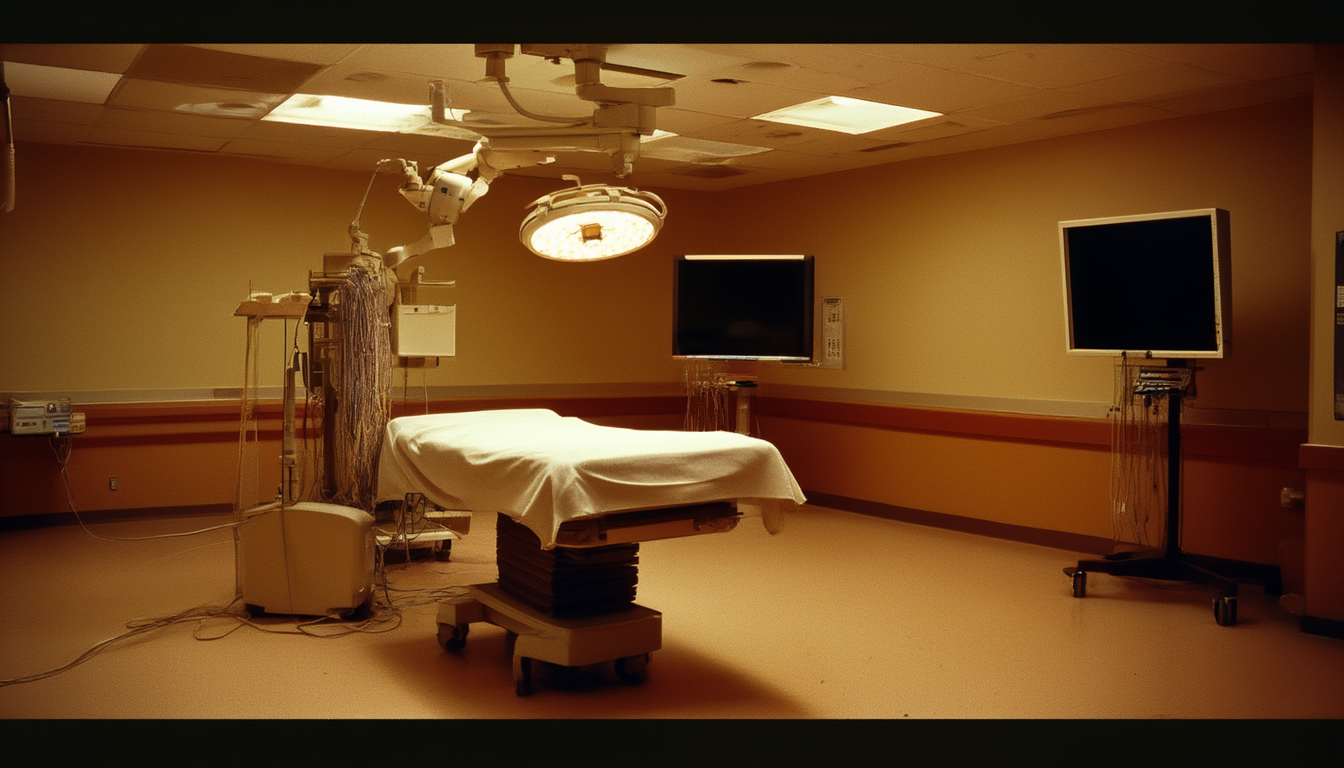
At 3:14 in the morning the room in Elko smells like warm electronics, and Alma Reyes is the only person in it who is actually in it.
The patient is a fifty-eight-year-old man who was talking normally at eleven and stopped being able to find his wife's name at one. The neurointerventionalist driving the case is in Denver, seven hundred kilometers east, on a console Alma has never seen. Alma is forty-four, a radiologic technologist, nineteen years at this hospital. She got the access, she loaded the wire, she positioned the magnet head. From here on she is the hands and the eyes in a room where the person doing the procedure has neither.
The magnet is a rounded white mass on a column beside the table, roughly the footprint of a vending machine. It does not move much. It does not have to. Everything it does happens in the field it throws, and the field reaches the man's carotid without anything in the room appearing to touch him.
On the screen above Alma's shoulder, a thin bright line advances through the neck. That line is not a photograph. It is an estimate.
How the field got into the room
Magnetic catheter steering is old enough to have a failed first act.
Stereotaxis put its Niobe robotic magnetic navigation system into hospitals starting in 2003, aimed at cardiac arrhythmia work. The physics was sound and the business was hard. The magnets were enormous, the rooms had to be rebuilt around them, and for two decades the technology stayed a specialty item in a small number of well-funded labs.
The second act came out of a robotics lab. The Multi-Scale Robotics Lab at ETH Zurich spent years on electromagnetic navigation systems, or eMNS: arrays of electromagnetic coils that generate a shaped, fast-changing magnetic field, and instruments whose tips carry a permanent magnet or a magnetic polymer so the field can pull and twist them directly. No pull wires. No stack of nested support catheters. The tip goes where the field says.
By the middle of the 2020s the lab's work had been spun out to Nanoflex Robotics and shrunk to something a hospital could accept: a mobile floor-mounted platform about 1.2 meters by 0.8, wheeled in beside the table, no structural anchoring, no rebuilt room.
Then the results started arriving quickly.
In a 2025 bench study, a magnetically steered guidewire was used to catheterize the renal artery in a silicone model of the human aorta, twenty procedures, half magnetic and half conventional. Technical success was one hundred percent in both arms. The magnetic median procedure time was 105 seconds against 181. Fluoroscopy time and dose both trended down, 65 seconds against 101, though neither of those reached statistical significance in a study that small.
In November 2025 an ETH team led by Fabian Landers reported magnetic microrobots navigating blood vessels and cerebrospinal fluid in live pigs and sheep, releasing a drug payload correctly in more than ninety-five percent of cases tested.
And in August 2025, Nanoflex ran a thrombectomy across an ocean. A neurosurgeon in Arizona retrieved clots from the arteries of a study animal at Inselspital in Bern, more than nine thousand kilometers away, with full navigation and retrieval success. It was an animal, and the company's first human trials were planned as bedside procedures, not remote ones. Everyone understood what the demonstration was for.
Twelve million people have a stroke every year. The thing that kills the tissue is time.
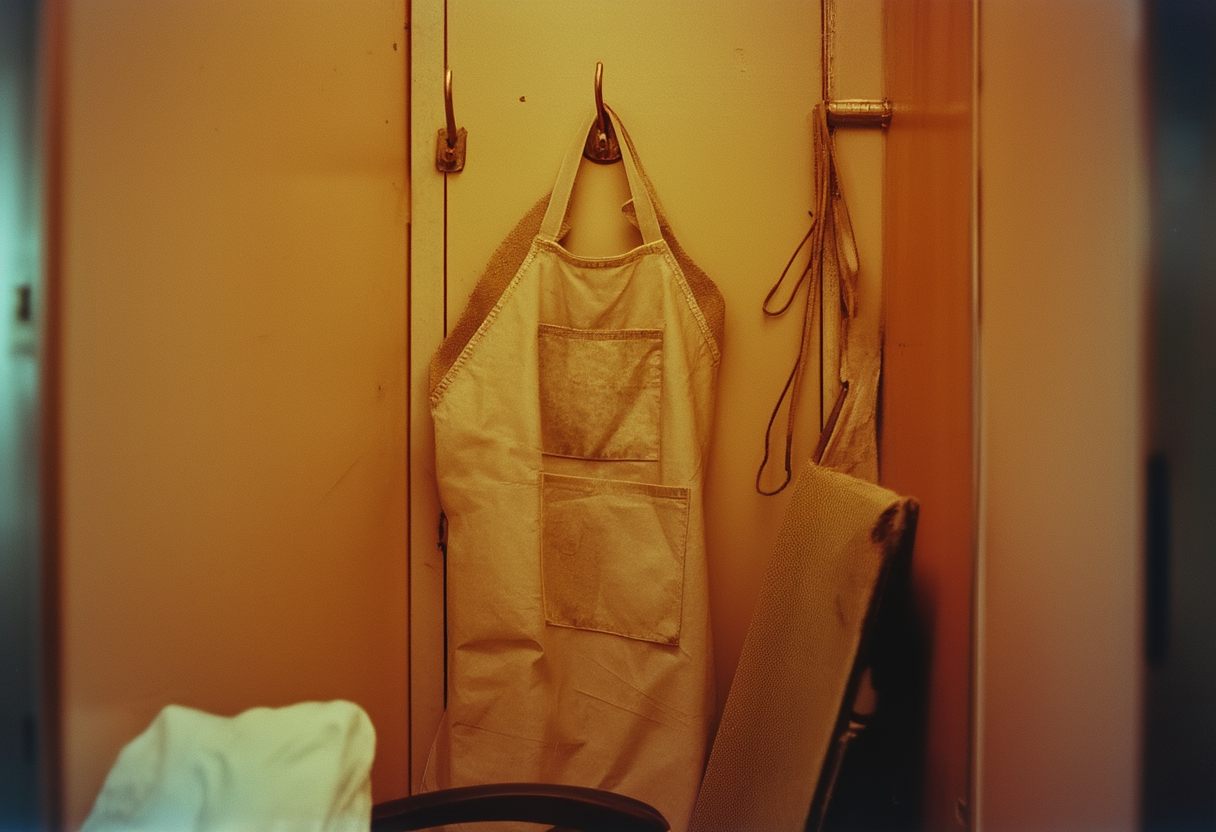
Figure 1. Control alcove, Elko, Nevada, 2036. The apron is still on the hook, and the dust along the shoulder seam is the point.
The case for it, made honestly
Elko is four and a half hours by road from a comprehensive stroke center, and weather closes that road. Before the magnet room, a man like the one on the table tonight was a transfer, and a transfer is a clock running with nothing happening on it.
That is the whole argument, and it is a good one.
The radiation argument is nearly as strong, and it is the one that convinced the staff. Fluoroscopy is the live X-ray that guides these procedures, and its harms are not theoretical. Patients absorb enough in long cases to produce real skin injuries. Operators, standing at the table for a career, take scattered dose that lands in the lens of the eye. Posterior subcapsular cataract is an occupational disease of interventional medicine, and it ends careers.
So a technology that shortens the procedure and cuts the X-ray is not a convenience. It is a person's eyesight in their sixties.
What it means to fly on instruments
Here is the problem the field spent a decade on.
Once a guidewire is inside a body, nobody can see it. The whole reason fluoroscopy exists is that flesh is opaque. If you remove the X-ray, you have to know where the tip is by some other route, and the route eMNS took is to work it out from the magnetic field itself. The system knows what currents it is putting through its coils. It measures the field coming back. From those two things it estimates a pose.
The engineering literature calls this simultaneous localization and actuation, and the phrase carries the whole story. The coils that push are the coils that listen.
The dynamics are unforgiving. Magnetic levitation is inherently unstable: an object held in a field is not resting anywhere, it is being caught, continuously, by a controller correcting faster than the instability can grow. In 2024 a group from the same ETH lab demonstrated the point by balancing an inverted pendulum on the tip of a magnetically driven arm, on clinical-scale hardware, to show the bandwidth was there.
A December 2025 paper from that group, revised the following spring, is the one the vendors still cite. It built a compact analytical model mapping coil currents to the forces and torques acting on a levitating object, stabilized position with a linear quadratic regulator, handled orientation with a nonlinear controller, and tracked large spatial angles up to sixty-five degrees on two different coil systems.
It stabilized five degrees of freedom.
There are six. The paper says so directly: rotation about the object's own magnetic axis is not controllable. A dipole cannot be twisted about itself by a field. That axis is not commanded, and it is not sensed, and it is not on anyone's screen. It is simply a thing about the instrument inside the patient that the system does not know.
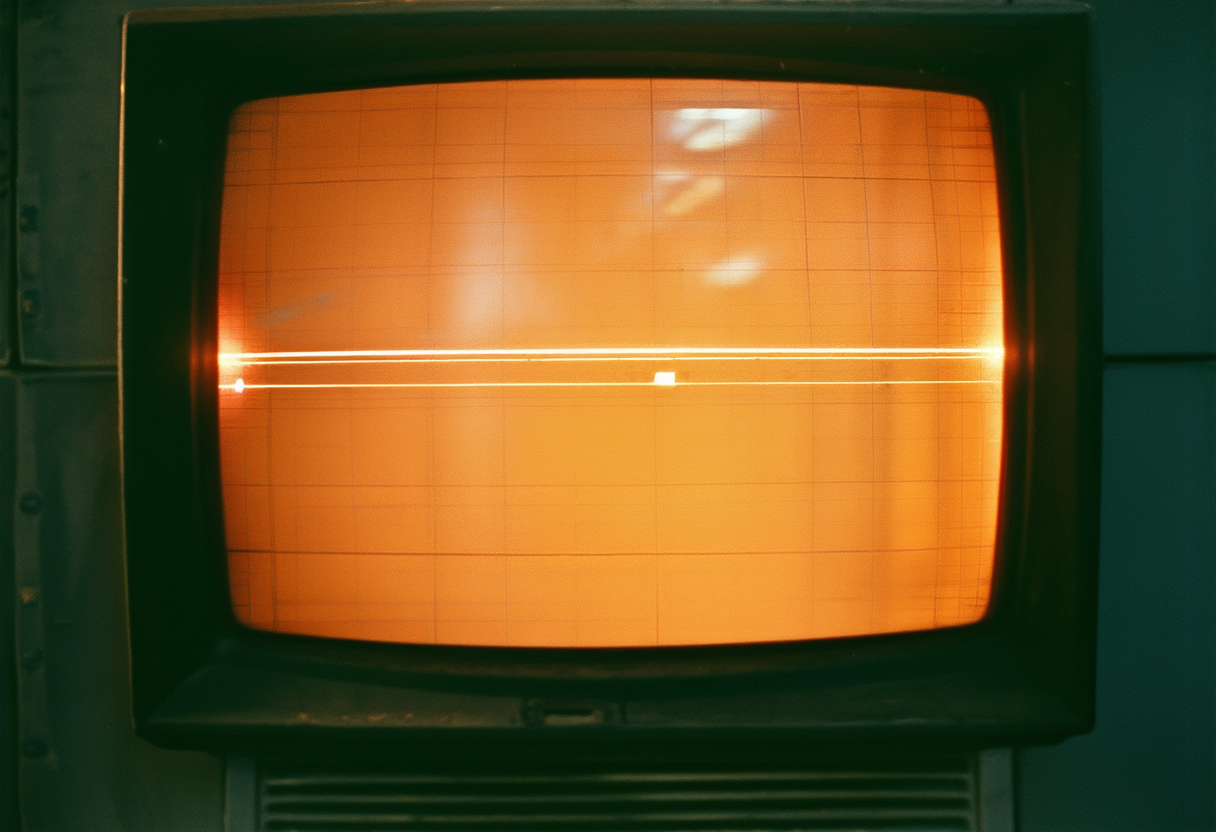
Figure 2. The navigation display during a carotid case, Elko, 2036. The curve is a model output, not an image. Nothing on this screen was produced by light passing through the patient.
The second job the radiation was doing
Fluoroscopy cost dose. It also produced something the field did not price, which is an account of the instrument's position that the navigation system had no part in generating.
X-ray is a dumb witness. It does not know the plan. It is not fitted to this patient. It cannot be self-consistent, because it is not a model of anything, it is photons through tissue. When the estimate and the picture disagreed, the picture won, and the operator went looking for why.
A field-based estimate cannot do that. It is produced by the thing it is checking. When the model is right, it is better than the picture and free. When the model is wrong, and a model fitted on a population will eventually meet an anatomy outside it, or a stent, or a sternal wire, or a hip, the system does not report doubt. It reports a pose. Confidently, smoothly, with the residuals inside tolerance, because the residuals are computed against the same model that is wrong.
The ETH microrobot work quietly acknowledged this. The particles were loaded with tantalum, a radiopaque metal, so the things could be tracked on X-ray while they swam. The most advanced magnetic navigation in the world put the second witness back in.
At 3:31 the line on Alma's screen is a centimeter past where she expects it and holding still.
She asks Denver for a run of fluoro. Denver says the tracking is nominal.
Alma asks again. She has the standing to ask and not the standing to insist, and the difference between those two things is the entire structure of this room. She is the only person here who can see the patient's face, and the face is the only instrument in the building that is not part of the system.
They run the fluoro. The wire is where Denver said. The case finishes at 4:02, and by six the man knows his wife's name.
Who pays
Not this patient, who got treated in Elko at three in the morning instead of somewhere else at eight.
Not the operators, whose lenses will be clear at sixty-five.
It falls on the patient whose interior does not match the fit, who will never know that this was the variable, and on the person standing in the room with no view of their own. Alma runs one short fluoroscopy burst at the end of every case and logs it as documentation for the chart. It is not protocol. Nobody has told her to stop.
The apron stays on its hook. She has not worn it in two years. She takes it down every few months, shakes the dust off the shoulders, and puts it back.
Author's Note: This is speculative journalism written from an imagined 2036. Alma Reyes, the Elko procedure room, the Denver console and the remote case described here are fictional composites, and no magnetically navigated remote thrombectomy has been performed on a human patient as of this writing. The underlying material is real and sourced below: the Stereotaxis Niobe history, the ETH Zurich electromagnetic navigation work and its commercialization, the in vitro renal artery timings and doses, the in vivo microrobot results and their tantalum radiopacity, the August 2025 transatlantic animal thrombectomy, the remote magnetic levitation control results including the uncontrollable dipole axis, and the documented radiation harms of fluoroscopy. The clinical deployment and the loss of an independent view are this magazine's speculative extension of those documented results.
Works Cited
- Singh, N., Zughaibi, J., von Arx, D., Nelson, B. J., and Muehlebach, M. "Remote Magnetic Levitation Using Reduced Attitude Control and Parametric Field Models." arXiv:2512.15207, December 2025, revised April 2026. https://arxiv.org/abs/2512.15207
- Zughaibi, J., Nelson, B. J., and Muehlebach, M. "Dynamic Electromagnetic Navigation." arXiv:2402.06012, February 2024. https://arxiv.org/abs/2402.06012
- "In vitro renal artery stenting using a steerable guide wire navigated by a mobile electromagnetic field." PMC12256320. https://pmc.ncbi.nlm.nih.gov/articles/PMC12256320/
- ETH Zurich. "Microrobots finding their way." 13 November 2025. https://ethz.ch/en/news-and-events/eth-news/news/2025/11/microrobots-finding-their-way.html
- Nanoflex Robotics. "Nanoflex Robotics Conducts First Transatlantic Remote Animal Thrombectomy Study." August 2025. https://nanoflexrobotics.com/nanoflex-robotics-conducts-first-transatlantic-remote-animal-thrombectomy-study/
- Medical Design and Outsourcing. "Why Nanoflex Robotics thinks it can win the stroke telesurgery race." https://www.medicaldesignandoutsourcing.com/nanoflex-robotics-stroke-telesurgery-robotic-system/
- "Radiation Physics and Safety in Fluoroscopy: A Clinician's Guide to Principles and Practice." PMC12317754. https://pmc.ncbi.nlm.nih.gov/articles/PMC12317754/
- Stereotaxis. "Genesis RMN robotic magnetic navigation system." https://www.stereotaxis.com/products/genesis/