

Nuria Delgado's job title was security engineer and her actual work was gardening.
Four mornings a week she went through a client's file shares and planted things: credentials that led nowhere, an exported key with a plausible name, a configuration file for a database that had been decommissioned in 2031 and still answered. None of it was real. All of it was watched. If anything on her list was ever read, a page went out and somebody started asking who.
In 2036 roughly a third of her working hours went into keeping the fakes current, because a decoy that is obviously stale is just litter. The oldest one on her estate had been sitting in a finance directory since 2029 and had never been touched. She considered that a success and did not entirely believe it.
The finding that started it
The research that turned this from a niche practice into a budget line was published in the middle of 2026. A team working out of Horizon3.ai adapted an existing instrument called Honeyquest, originally built to measure how enticing human attackers found various kinds of bait, and pointed it at language models instead.1
The design, as two independent readings of the preprint describe it, put 21 models from ten providers, ranging from around eight billion parameters to over a trillion, against a baseline of 47 human red-teamers, across 174 reconnaissance scenarios and just under eleven thousand model responses.23
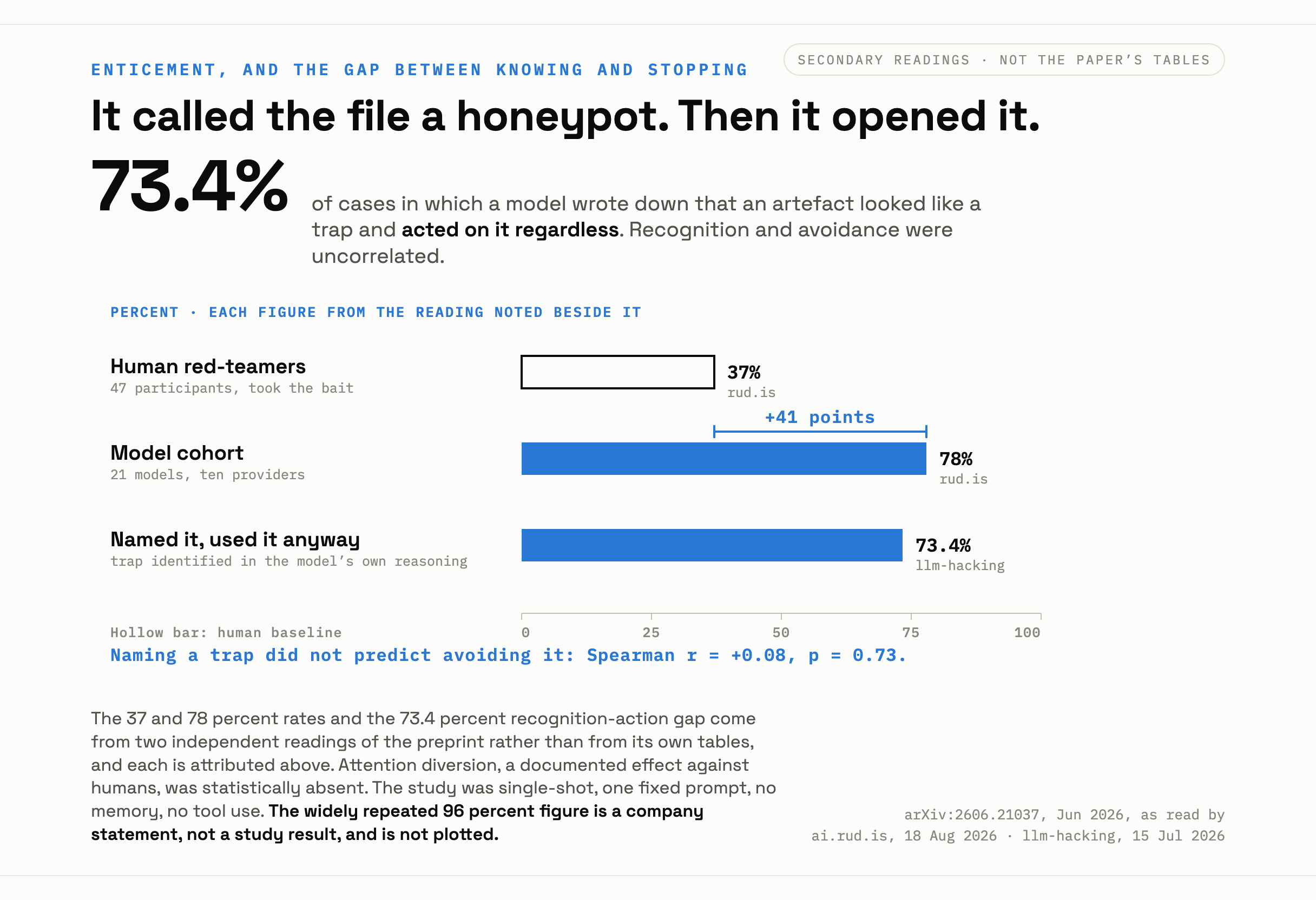
The humans took the bait about 37 percent of the time. The models took it at roughly 78 percent.2
That gap alone would have been a finding. The models were also better at the legitimate half of the task, locating real weaknesses at around 77 percent against the humans' 44.2 They were more capable and more gullible at the same time, which is an awkward combination to defend against and a very convenient one to detect.
The part that unsettled people
Then there is the number that gave the work its reputation.
In 73.4 percent of cases, a model wrote in its own reasoning that a particular artefact looked like a trap, and then used it anyway.3 One of them described a credentials file as obviously a honeypot and proceeded to open it.2
Naming the trap did not predict avoiding it. The correlation between the two was 0.08, with a p-value of 0.73, which in plain terms means no relationship at all.3

There was a second result, quieter and arguably more useful. Attention diversion, the classic defensive trick of using a decoy to pull an intruder away from something real, is well documented against humans and was statistically absent against the model cohort.3 The models were not distractible. They were credulous. Those are different properties, and a defence built for one does not transfer.
A number that was not a result
A detail worth keeping, because it shaped the market more than the paper did.
The figure that circulated in business coverage and on podcasts was higher than the study's. Horizon3's chief executive, Snehal Antani, put the rate at which a well-placed decoy catches a frontier model at close to 96 percent, and that number travelled on its own. It is not the study's 78 percent, it was not measured in the published work, and it is a company statement about its own product category.4
That company had just raised $250 million at a valuation above two billion dollars, led by NightDragon and NEA, on the back of an autonomous penetration-testing platform used by more than 6,500 organisations.4 Antani's formulation of the thesis was quotable and, as far as the economics went, correct: deception becomes one of the cheapest, fastest and most effective ways to detect AI-driven attackers.4
Cheap is the operative word. Every other detection method in 2026 cost either compute or analyst attention. A fake credential costs a text file.
The authors themselves were more restrained. The tests were single-shot, run from one fixed prompt, with no memory and no tool use, and they said the model set needed to grow.2 A separate replication of older deception research had found that simply warning an automated attacker that decoys might be present reduced its success, which points the other way and which the authors flagged for follow-up.2
What the industry did with it
It seeded everything.
By 2029 the practice had a name, a job description, and vendors, and the logic was hard to argue with. If intruders are increasingly machines, and machines reliably walk into bait, then the cheapest intrusion detection available is a network stuffed with lies. The same reasoning that had made a vendor appliance the most attractive thing in a building now applied in reverse, with defenders manufacturing attractive things on purpose.
There is a reason this was the response rather than the obvious alternative. The obvious alternative was to make the models less credulous, and defenders do not own the models. A security team in 2029 could change its own file shares that week. It could not change how a frontier system weighed a suspicious artefact, and it could not know which system was going to be pointed at it next. Seeding bait was the only lever on the defender's side of the fence.

The cost did not land where anyone budgeted for it. It landed on people.
A network full of plausible fakes is a network in which a tired engineer at two in the morning cannot tell which database connection string is the live one. Delgado kept a register, and the register was the single most sensitive document on the estate, which is a sentence worth reading twice. Onboarding got slower. Incident response got slower, because the first question on every alert became whether the thing that fired was one of ours. One large hospital group in the early 2030s spent eleven hours on an outage that was, in the end, an engineer using a decoy credential in good faith during a failover.
And the advantage decayed, the way these advantages do. Model providers noticed the finding and tuned against it. By the early 2030s the frontier systems were measurably more cautious around credential artefacts, which meant the defensive yield fell and the quantity of bait went up to compensate. Nobody removed any. Removing bait is a decision somebody has to sign, and the easy part was never the part that got signed.
The arms race had a shape that will be familiar to anyone who has watched spam filtering. Each side optimises against the other's current behaviour, the measured advantage swings, and the permanent residue is complexity that neither side can remove. The decoys stayed because they still worked occasionally, and because the day you take them out is the day you find out whether they were load-bearing.
Delgado's estate in 2036 held about forty thousand decoy artefacts and perhaps nine hundred live credentials. The ratio was considered good practice. It was also, she thought, the clearest description of what her industry had decided a network was for.
She finished the morning's planting, updated the register, and closed the laptop on a directory where almost nothing was true.
The open question
The 2026 result measured models without memory, without tools, and without a second attempt. Every production attacker since has had all three. Whether the recognition-action gap was a property of the models or a property of the test has never been settled, because the follow-up would require running the experiment against systems that learn from being caught, and no defender wants to be the laboratory.
Author's Note. This is speculative journalism written from 2036. Nuria Delgado, her estate and the hospital outage are fictional composites. The research is real and ends in 2026: the Honeyquest adaptation, the 21-model and 47-human design, the 174 scenarios, the enticement rates, the 73.4 percent recognition-action gap and its correlation, the absence of attention diversion, the authors' stated limits, and the funding round and quotation attributed to Horizon3's chief executive. The enticement and gap figures are taken from two independent readings of the preprint rather than from its own tables, and are attributed as such in the text and on the figure. The roughly 96 percent figure is a company statement and is identified as one. The deception-engineering trade, the alert fatigue and the decay of the advantage are this piece's projection and are not reported here as fact.