
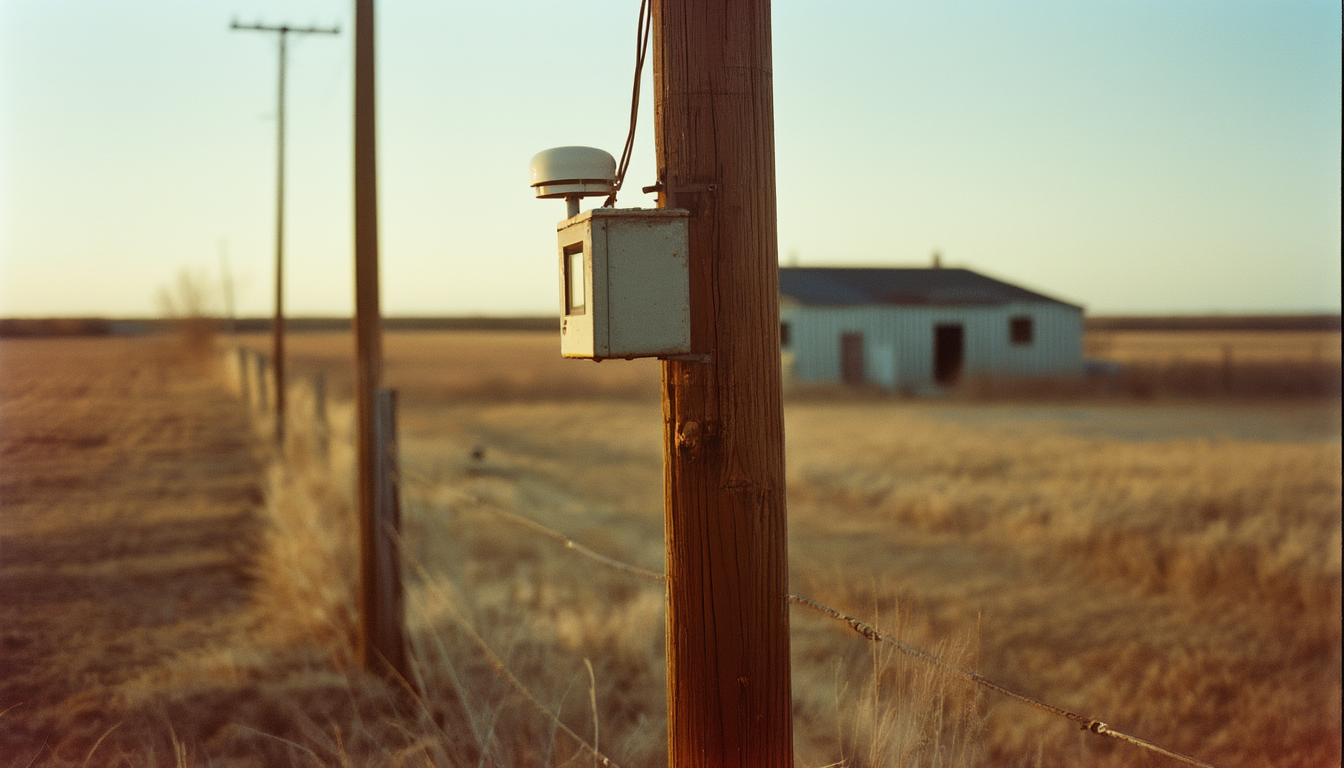
The pole is forty feet of weathered fir on the north fence line of a substation outside Moses Lake, and Hollis Pruitt has climbed it eleven times in two years. Sensor 7 stopped reporting at 03:12. By 04:40 she is up in the cold with a headlamp, unclipping a gray box the size of a paperback.
Inside there is nothing exotic. A phone-class board. Four microphone ports behind steel mesh. A solar cap, a cellular modem, a desiccant pack gone pink at the edges. The whole assembly costs less than the ladder rack on her truck. She swaps it, zip-ties the loom, scans the sticker on the replacement, and waits in the dark for the indicator to go green.
The work order on her handheld reads TIER 2. That line is the only part of this job that matters, and it is the part nobody on the fence line controls.
Tier 2 means the poles along this ring are licensed to recognize a defined set of airframe classes, and to receive the signature refresh that keeps that recognition current. Tier 1 is detection only, a sound in the dark and a phone call to somebody else. Tier 3 puts four interceptors on a rail inside the transformer yard and gives the utility's duty officer the authority to spend them. The hardware on the pole is identical at all three tiers. What differs is what the box is allowed to know.
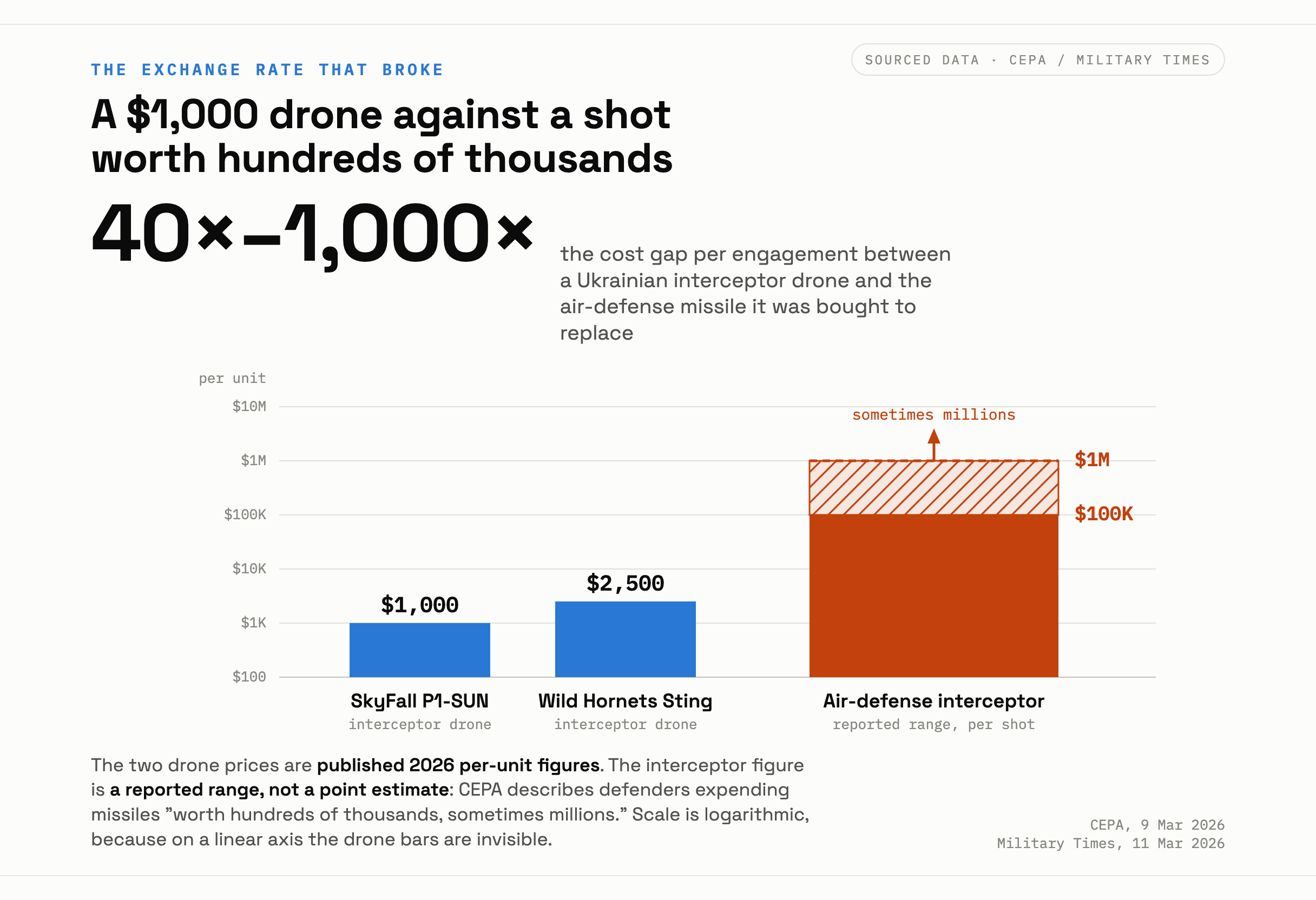
Figure 1. The exchange rate that broke, in the numbers that broke it. Prices are the published 2026 per-unit figures for two Ukrainian interceptor drones, set against the sourced cost range for the missiles they were bought to replace.
The arithmetic nobody could win
For about a decade the defense of a fixed site was an arithmetic problem with an obvious answer and no way to act on it.
The Center for European Policy Analysis put the shape of it plainly in March 2026. Attacking drones "often cost thousands of dollars but can overwhelm air defense systems and force defenders to expend interceptor missiles worth hundreds of thousands, sometimes millions."1 That is not a close trade. It is a trade the defender loses every single time, including on the nights the defender wins.
The Gulf fighting that spring made the bill visible. CEPA reported that roughly 800 Patriot-class interceptors were expended in three days, more than Ukraine had used across four years of war.1 Nobody ran out of courage. They ran out of inventory, and inventory of that kind is measured in years of production, not weeks.
The fix, when it came, was not a better missile. It was a cheaper one, plus a cheap way to know when to fire it.
By early 2026 Ukraine was fielding interceptor drones at prices that read like a typographical error. Wild Hornets' Sting: $2,500 a unit, AI-assisted terminal guidance, 3,900 drones downed since May 2025. SkyFall's P1-SUN: $1,000 a unit, fiber-optic guidance, a 3D-printed modular airframe, more than 1,500 Shaheds destroyed in four months. Ukrspecsystems' Octopus was licensed for manufacture in the United Kingdom and by five NATO countries. The Pentagon opened talks to buy.2
Underneath all of it sat the least glamorous component in the system. Sky Fortress is a network of acoustic sensors, microphones and smartphones on poles running machine learning against the sound a rotor makes. By 2026 there were more than ten thousand of them across Ukraine.1 It is the cheapest layer in modern air defense, and the layer that tells every layer above it where to look.
Awareness turned out to be the product
Two autumns earlier, Europe had already learned the softer version of the lesson.
On the evening of 22 September 2025, two or three large drones were sighted over Copenhagen Airport.3 Danish police declined to shoot them down over a populated field.4 The airport simply stopped for nearly four hours. Twelve days later Munich closed twice inside 24 hours: seventeen flights grounded and about 3,000 passengers stranded on the first night, roughly 6,500 on the second.5
Not one of those drones was intercepted. Not one needed to be. The cost was extracted entirely by uncertainty, and uncertainty is cheap to manufacture and expensive to hold.
Every airport director in Europe read the same conclusion off those two weeks. You do not need a kill. You need to not be surprised. And not being surprised is a condition, not an object. It has to be maintained, the way a certificate is maintained. Which is to say it is a service, and services are sold by the month.
The companies that won were not missile companies
The tell was in who bought whom.
In October 2024, Axon Enterprise completed its acquisition of Dedrone, the airspace-awareness firm. Axon is the body-camera company, and more precisely it is a company that learned to sell police departments a bundle: hardware, cloud, refresh, training, renewal. Its cloud services division accounted for 40 percent of 2024 revenue. It entered airspace security to sell a recurring line item, framing Dedrone's technology as the way customers stay "ahead of persistent and escalating threats."6 Persistent is the operative word. You cannot buy your way to the end of a persistent threat. You can only stay current with it.
Anduril had already built the same logic into its architecture. Lattice is the fusion layer, software that takes sensors of every make, including other vendors' sensors, and turns them into one picture. The hardware hangs off it. Roadrunner-M, the reusable interceptor, runs in the low hundreds of thousands of dollars, which sounds expensive until you price the alternative in Figure 1.7
When the Gulf states came shopping in 2026 they asked, at first, in units. The UAE inquired about 5,000 interceptor drones. Qatar asked about 2,000. Kuwait explored. Then somebody's procurement office ran the sustainment numbers and the question changed from how many to how much a year, and it has stayed that way ever since.1
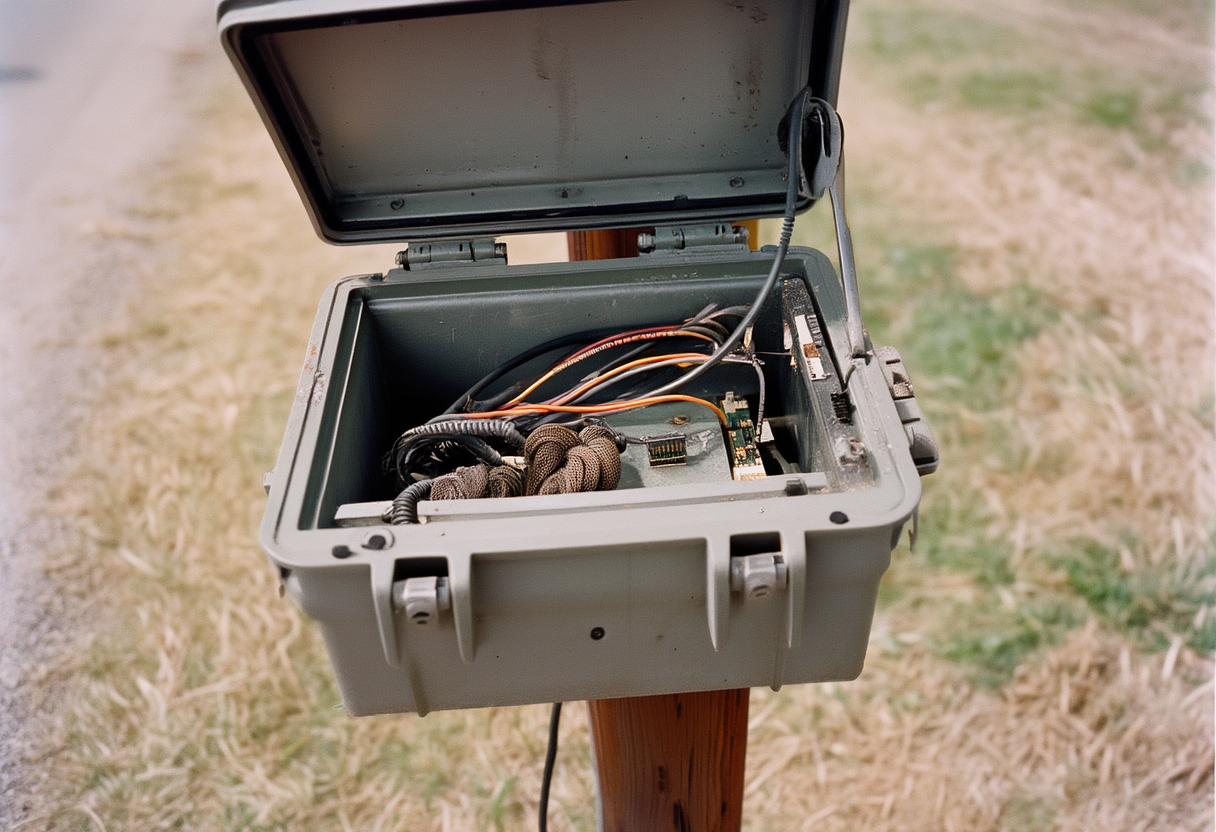
Figure 2. A Tier 0 site on the Quincy loop, 2036. The poles, the boxes and the wiring are all still there. The contract is not.
What a lapsed invoice looks like from forty feet up
Hollis's route includes four sites on what the dispatch system calls the Quincy loop. She services them on the same rotation as everything else, because the poles are company property and the boxes were paid for outright in 2031.
Nothing on them has listened since March.
A pump cooperative on the loop let its coverage lapse during a rate dispute. The equipment did not fail. It was not repossessed. It went quiet in the specific way that subscription hardware goes quiet, which is that the signature library stopped refreshing, then the classifier aged out, then the boxes kept sampling a sky they could no longer interpret. From the road it looks exactly like a defended site. That is the part Hollis finds hard to explain to the co-op's board, who point at the poles and ask what, precisely, they are being billed for.
The answer is the library, and the library is the weapon. A sensor is a microphone until somebody tells it what a threat sounds like this month. New airframes arrive constantly, cheap and 3D-printed and revised in the field, and a recognizer trained on last year's rotors is not a degraded recognizer. It is a deaf one.
There is a second edge on that, and it is the one the insurers ask about. A library that covers everyone covers everyone the same way. When a class of airframe is missing from it, every subscriber on that vendor's platform is blind in precisely the same direction, at the same moment, across an entire continent. The old sky was defended badly by thousands of uncoordinated operators who were each wrong differently. The new sky is defended well by a handful of platforms that are all wrong together.
And somewhere in a product meeting, a tier boundary gets drawn: this class is covered, that class is Tier 3, that one is an enterprise conversation. The drawing of that line is a policy decision about what counts as an attack. It is published as a price sheet.
04:58
The indicator goes green. Hollis logs the swap, and her handheld pulls the current signature package down to the new unit before she is off the pole, 31 megabytes, four seconds, a version string she does not read.
Below her the substation hums inside its fence. Coverage reads NOMINAL across the ring. In eleven weeks the utility's contract comes up, and she has heard the procurement people use the phrase "right-sizing our tiers," which she has learned means the same thing here that it meant at the co-op.
She comes down the pole. The sky over the Columbia Basin is doing what it has always done, which is nothing visible, and she has no way at all to tell by looking whether anything is listening to it.
Author's Note. This is speculative journalism written from 2036. Hollis Pruitt, the Moses Lake substation ring and the Quincy loop are fictional composites, as are the tier structure, the 2036 pricing behavior and the insurance framing. The counter-drone economics, the interceptor prices and combat records, the Sky Fortress sensor network, the Copenhagen and Munich airport closures, the Axon acquisition of Dedrone and the Gulf procurement inquiries are real, current and sourced below. Two claims circulating alongside this topic are not included here because no primary source for them would resolve at the time of writing: a widely repeated count of drone incursions over United States power sites, and a record annual venture funding total for defense technology.