
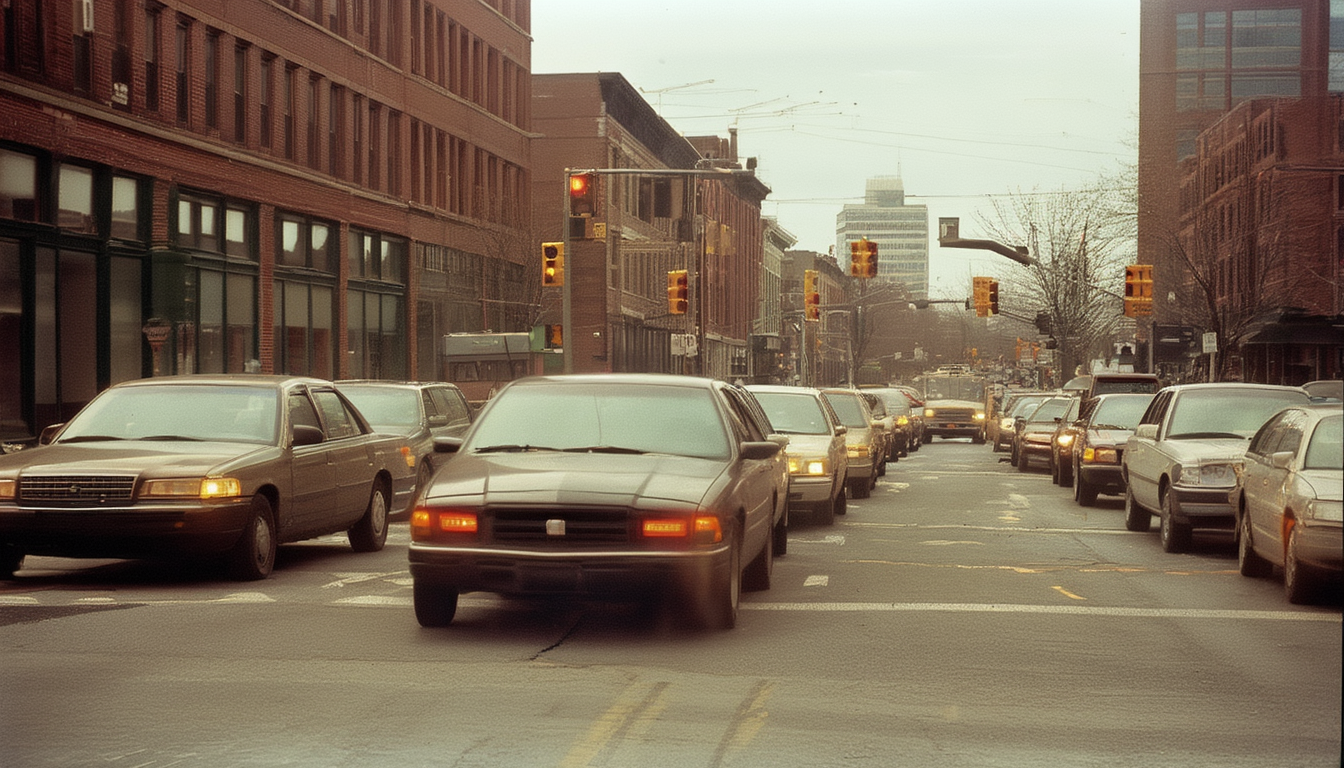
Sarah Chen's car had no steering wheel.
It is the morning of March 12, 2036, and she is sitting in the back-left seat of her 2033 Honda — the discount model, the one built on the assumption that the network would always be there, the way pavement is always there. The dashboard shows her usual route to Somerville in a calm green line. Somewhere under the floor, her car is talking to the city ten times a second, too fast for her to follow, settling a thousand tiny questions about who goes and who waits.
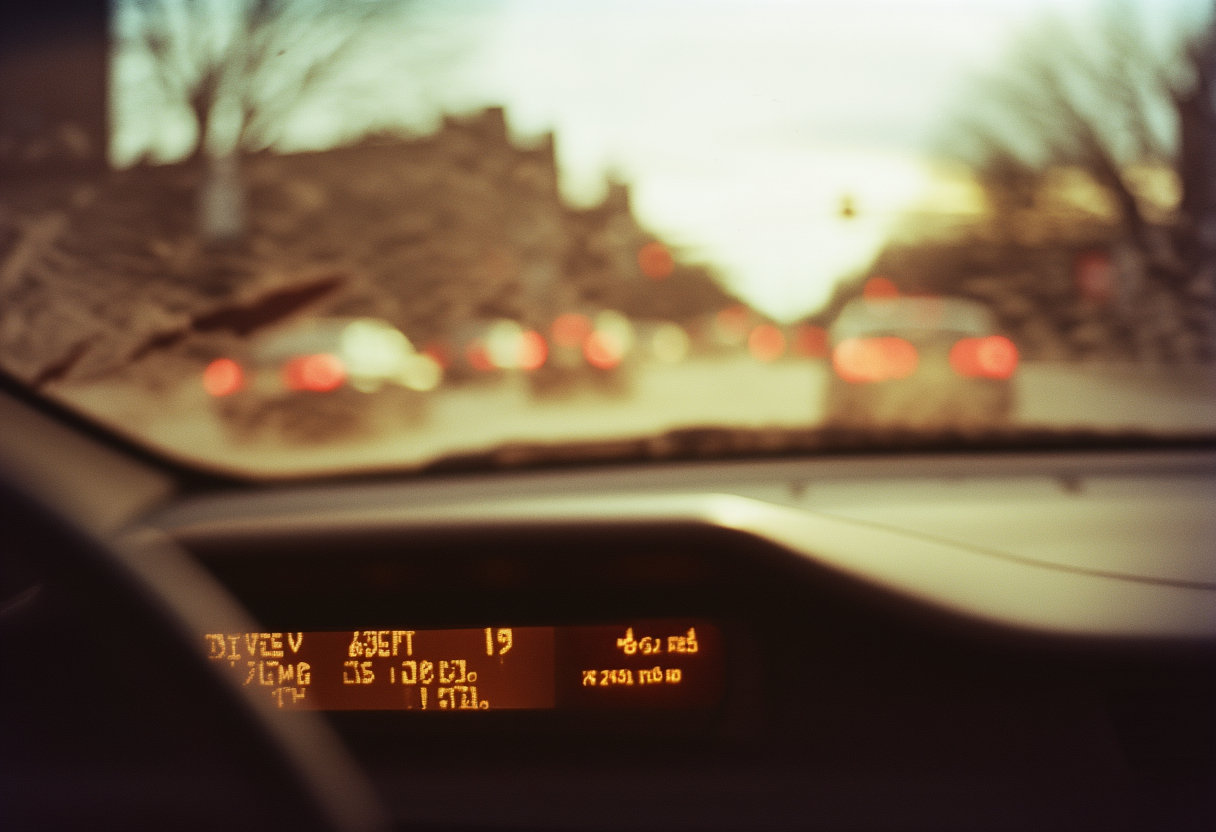
At 8:47, a soft yellow pulse crosses the display. Pedestrian crossing — high-speed approach. The car brakes, smooth and sure. Sarah barely registers it. These little corrections happen constantly; she stopped noticing them years ago.
Except there is no pedestrian.
Fifteen cars behind her brake at the same instant, in the same elegant unison that means the network is working perfectly. They are all responding, beautifully, to nothing. Within ninety seconds the phantom warning has rippled through dozens of intersections across Back Bay. By 8:53 the dashboards are screaming — collision imminent, red-light runner, ice on a dry road, an ambulance that isn't there. Sarah says it out loud to a car that was built for efficiency, not for panic: "Which one is real?"
The car doesn't know. So it does the only safe thing it can. It stops in the middle of Massachusetts Avenue, and so do eighty-seven others within sight.
To understand how a whole city of cars came to depend on a conversation they couldn't hear, you have to go back to the promise.
The promise had a name: V2X, vehicle-to-everything — the idea that cars, traffic signals, and roadside boxes could swap short safety messages many times a second and head off crashes before a human even saw the danger.1 By late 2024 U.S. regulators had even settled the radio fight, retiring the old short-range standard and handing the safety spectrum to a cellular one — a quiet sign of how serious the rollout had become.6 The pitch was almost irresistible. U.S. regulators estimated that connected-vehicle safety tools could prevent or soften up to 80 percent of crashes involving sober drivers, much of it at the intersections where roughly a third of American collisions happen.2 Pilots seemed to bear it out: on Wyoming's I-80, hundreds of trucks and snowplows were wired with the gear, and more than half of drivers who got a weather or work-zone warning changed what they were doing.3
Massachusetts went early and went public. In 2025 the state's Clean Energy Center launched a two-year demonstration with a hundred bidirectional chargers — about 1.5 megawatts of rolling battery — aimed deliberately at low-income neighborhoods, framed as safety, equity, and grid resilience in one box.4 Washington matched the ambition. In August 2024 the U.S. DOT published a national plan to put V2X in a quarter of the busiest cities' signalized intersections by 2028, and half by the early 2030s.5 The regulators called it Saving Lives with Connectivity. Nobody wrote a plan called What Happens When It Lies.
Here is what actually happened, mechanically, on that March morning.
The attackers — investigators would later trace them to a server farm overseas — never broke the encryption. They didn't need to. They exploited the seam: the few milliseconds between when a car asks "is this message real?" and when the answer comes back. Into that gap they fed forgeries that looked legitimate just long enough to enter the stream before anyone could check them. By the time the system flagged the fakes, thousands of cars had already braked for ghosts. There was no single throat to choke, either: by the mid-2020s more than 126,000 V2X patents had been filed worldwide, the lead held not by any one American firm but by filers in China, then the U.S. — Toyota, Ford, LG, Huawei, Baidu.7 The thing everyone leaned on, nobody fully owned. Dr. Jennifer Okonkwo, who runs MIT's transportation-systems lab in this telling, called it weaponized trust. The whole network had been built on a cooperative assumption — that every participant is honest, that every message means well. "We optimized for normal conditions," she tells a Senate panel in May 2036. "We never asked what happens when the system lies."
This is the turn the brochures never showed. The same coordination that made V2X so good at preventing small, isolated crashes is what let one corrupted signal cascade across an entire city. Independent risk had quietly become correlated risk. Marcus Webb, thirty-four years a trucker, learned to drive in 1992 — before GPS, before lane-keeping. When his rig flashed EMERGENCY STOP and then ACCELERATE in the same breath, his hands stayed steady. He looked at the actual road, saw it empty, and kept rolling. He still had the older instrument: his eyes.
Sarah didn't. She learned to drive inside the system, taught to trust it completely, and her discount car had no manual mode to fall back to. When the State Police ordered every vehicle to switch off V2X and return to manual, drivers like Marcus flipped a switch. Cars like Sarah's simply stopped — stationary obstacles scattered across the city's arteries, because they had been designed for a world where the network never failed.
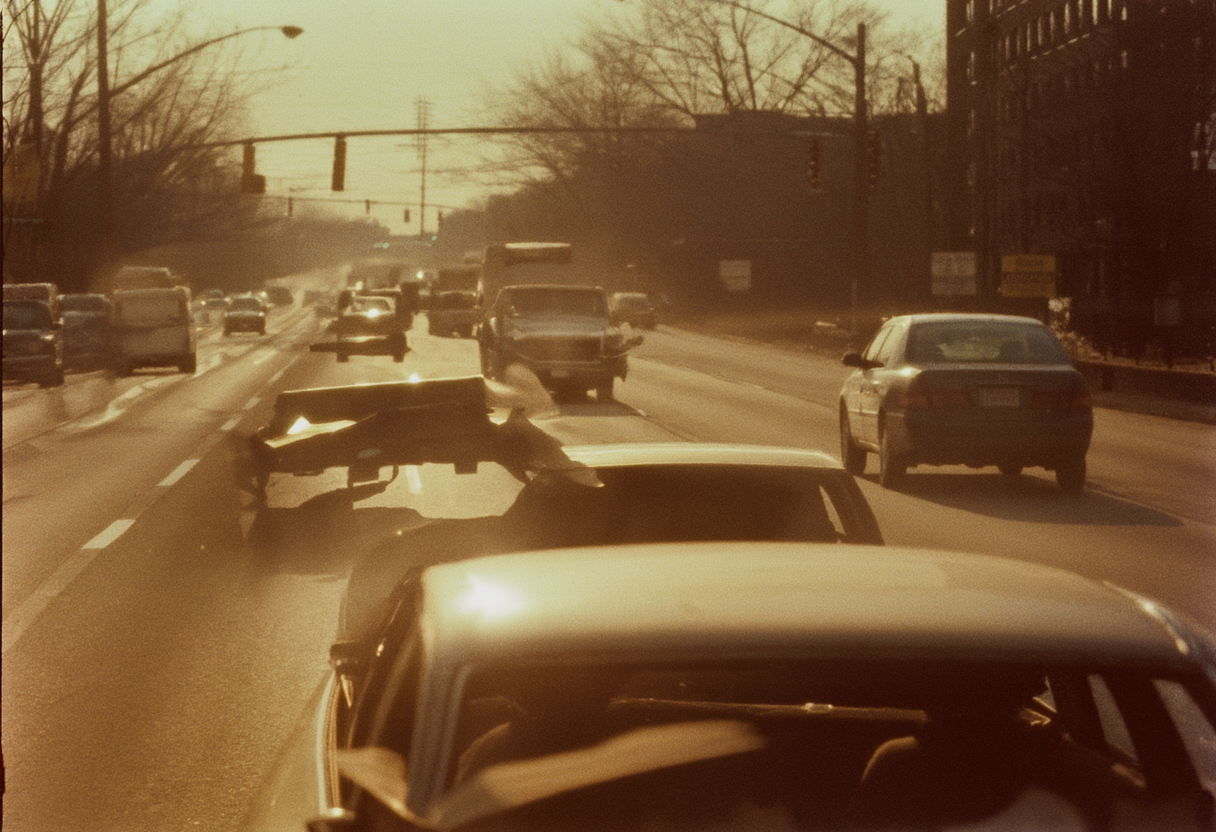
And then, in the wreckage, the oldest patterns came back. With the signals dark, people in some neighborhoods invented hand signals at intersections — reinventing the wordless right-of-way that traffic lights had made obsolete a century ago. Neighbors stepped into the road to wave cars through, retrieving the human traffic director the machines had retired. Those low-income blocks wired with bidirectional chargers in the 2025 pilot discovered their parked cars could power a corner of the grid when it wobbled.4 The very skills V2X was built to make unnecessary were the ones that worked when V2X didn't.
The most uncomfortable number arrived weeks later. Where the network stayed off, crashes went up — more fender benders, more confusion. But the deaths went down. The accidents were smaller, slower, local. When one human made a mistake, it hurt a dozen people, not a city. The messy, distributed system degraded gracefully. The optimized one had no middle setting between perfect and catastrophic.
Forty-three minutes after her car stopped, a National Guardsman reached Sarah's window. She was crying — not from any danger her sensors could see, but from the helplessness of depending on something she'd never understood. "I don't know how to drive without it," she told him. "I never learned."
That August, at forty-two, she enrolled in driving school. Marcus Webb sat in the passenger seat. The smart signals came back online by summer, a little less worshipped than before. The open question is the one Sarah is still living: not whether we build systems this good, but whether we'll keep the slower, redundant, gloriously inefficient human capacities that catch us when the good systems fail. We spent a decade calling those capacities obsolete. For one morning in March, they were the only thing holding the city together.
Author's Note
This is speculative journalism, set in 2036 and reported backward to the present. Sarah Chen, Marcus Webb, Dr. Jennifer Okonkwo, and the Boston "cascade event" are fictional composites — a scenario built to stress-test real vulnerabilities, not a prediction that it will happen this way. Everything about today's V2X landscape is sourced: the Massachusetts pilot, the U.S. DOT deployment plan, the FCC's C-V2X transition, the patent landscape, and the federal crash-reduction estimates are all documented below. The specific 2036 figures — the timing of the attack, the death toll, the dollar damages — are invented to dramatize a documented risk: that systems engineered for perfect coordination tend to have no graceful way to fail. Crucially, the much-cited "73% fatality reduction" from earlier drafts of this story has been removed; no real source supports it. The honest figure is a regulator's projection of what connected-vehicle safety tools could prevent, not a measured outcome — and the gap between the two is the whole point.