

The walking city was never an engineering problem. It was an accounting one.
That sentence would have sounded absurd in 2025, when the mechanical cities were still slides in venture decks and footnotes in adaptation white papers. By 2036 it is the only honest way to describe them. The hard part of moving two million people at three miles per hour was never the treads or the reactors. The hard part was deciding, in advance and on a spreadsheet, who rides up top and who rides in the hull. Every walking city answered that question the same way. That uniformity is the story.
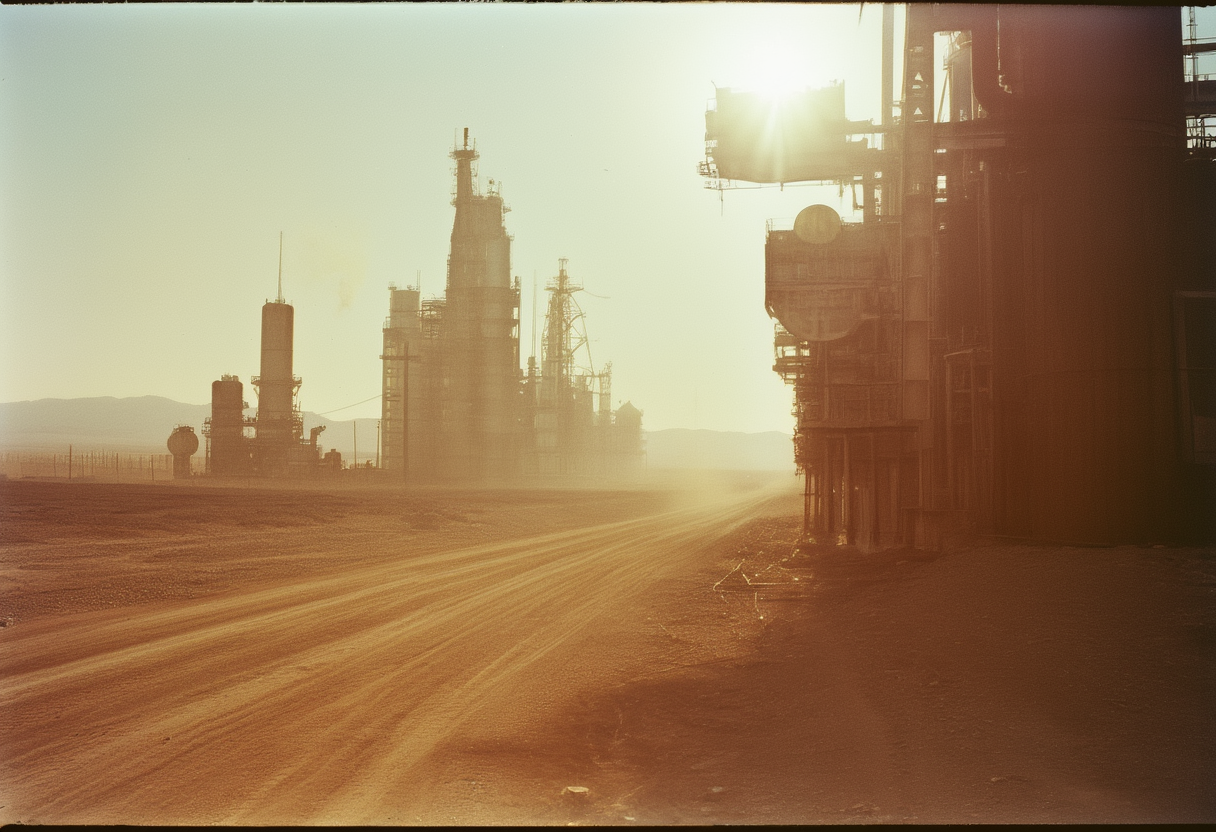
Start with what everyone got wrong. For most of the 2020s, climate migration was framed as a flow problem — people moving from hot places to cool ones, from coasts to higher ground, and the task was to manage the arrivals. The World Bank's Groundswell work put the projection at up to 216 million internal climate migrants across six world regions by 2050.1 The IPCC's Sixth Assessment was blunter and humbler: displacement will rise, but the evidence does not yet support a clean headcount.2 The conventional wisdom drew a logical conclusion. If people must move, build them somewhere to land.
The walking cities inverted that. They did not wait for the land to fail and then relocate the survivors. They put the relocation under the people permanently and never stopped. Mobility stopped being a one-time event and became a utility, like water or power — something a city consumed continuously to stay alive. That is the shift worth understanding, and the McLuhan tetrad is the cleanest tool for it: every powerful technology enhances something, obsolesces something, retrieves something older, and — pushed far enough — reverses into its opposite.
What they enhanced was speed of escape. A static city facing a Category 5 storm, a failed aquifer, or a fire front can only harden in place and hope. A mechanical city moves. When the threat is a vector — heat, drought, flood, fire — outrunning it at walking pace is enough, because the threat does not chase. This is the single capability that justified the cost, and the cost is the part to take seriously: not the trillion-dollar figures that circulate in the press, which are speculative, but the structural fact that continuous mobility is continuously expensive, and someone has to underwrite it forever.
What they obsolesced was the buyout. Through the 2010s and 2020s, American managed retreat ran on a quiet, voluntary mechanism: the government bought flood-prone homes, demolished them, and turned the lots into open space. The U.S. Government Accountability Office found that from 1989 to 2018, FEMA awarded about $4 billion to acquire roughly 46,000 properties this way.3 It was slow, piecemeal, and humane in intention. The walking city renders it quaint. Why buy a house out of a hazard zone one at a time when you can carry the whole settlement out of every hazard zone at once? Retreat stopped being a transaction and became a way of life — and the patient, local, consent-based version withered.
What they retrieved is the oldest idea in the file, dressed as the newest. A city that walks to follow resources and flee danger is not a 21st-century invention. It is the nomadic settlement, the migratory band, the moving camp — the human default for most of our history, abandoned only when agriculture nailed us to a spot. The mechanical city even retrieved its own blueprint. In 1964, the British collective Archigram drew the Walking City: vast pod-like structures on telescopic legs, striding across a ruined landscape, plugging into one another.4 It was meant as provocation. By 2036 it reads as a procurement document.
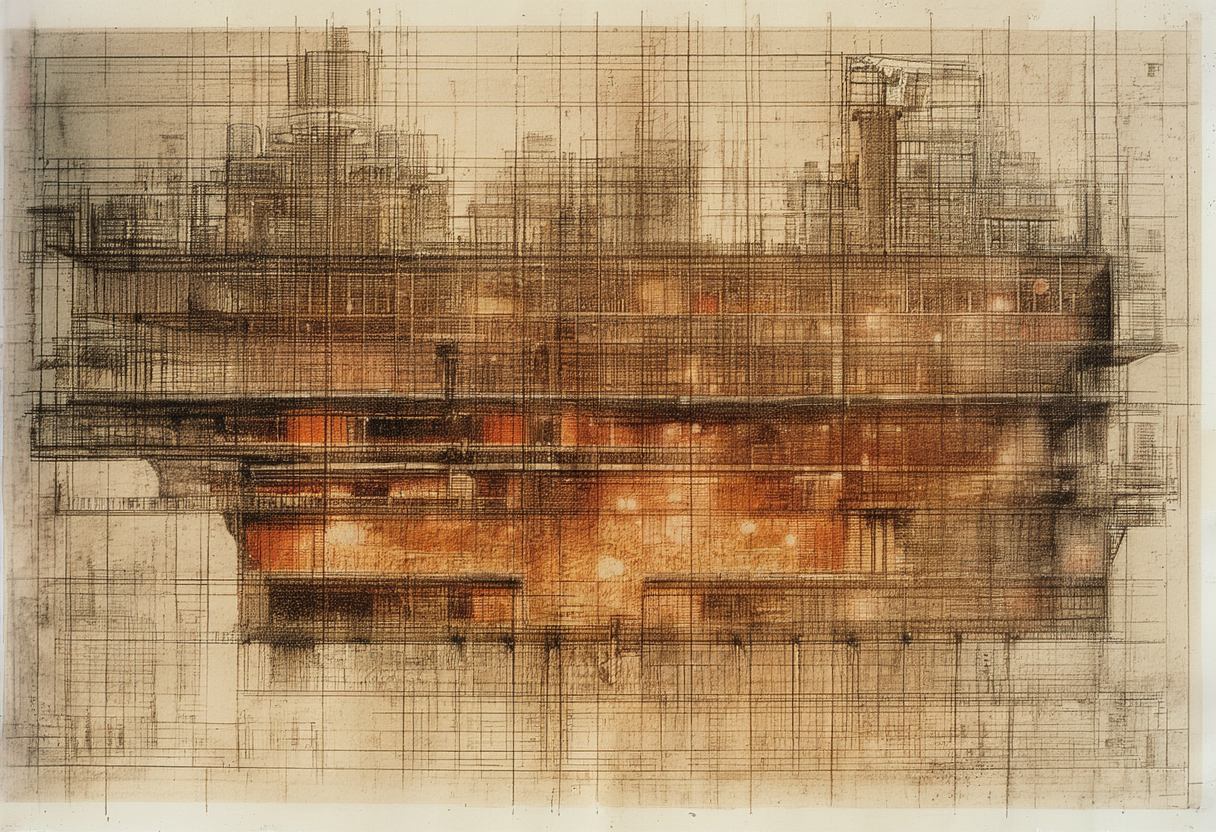
The power to run all this came from a technology that was genuinely emerging in the mid-2020s and is not science fiction: the nuclear microreactor. These are small fission units, generally in the one-to-twenty-megawatt range, designed to be transportable and to run for years without refueling. Idaho National Laboratory had test units and demonstration projects on the books well before 2030, and the peer-reviewed literature was already mapping their economics and regulatory path.5 Scaling that to power a moving city is the speculative leap. A power source you can pick up and carry is not.
Then comes the reversal, and it is the whole point.
The walking city was sold as the great equalizer of climate risk — a machine that would let a community survive together what would otherwise scatter it. Pushed to its limit, it became the most efficient inequality engine ever built, because it hard-coded the hierarchy into load-bearing steel. In a static city, the privilege gradient is contestable: zoning changes, neighborhoods gentrify and de-gentrify, a bad street can become a good one. In a mechanical city, the gradient is structural. The habitable upper sectors and the service hull are not a policy. They are the design. You cannot vote your way up twelve levels of a machine that was engineered to keep the mass low and the value high.
And the cruelty migrated outward, too. The destination towns that received the cities' overflow lived the same pattern that climate gentrification was already producing on dry land. Buffalo — long discussed as a Great Lakes "climate refuge" — watched the theory arrive as practice: capital and newcomers flowing into historically disinvested neighborhoods, prices climbing, and the people who made the place affordable priced out of it.67 Climate gentrification was a documented phenomenon before any city ever took a step.8 The walking machines did not invent it. They industrialized it, and gave it wheels.
So the ledger closes where it opened, on the accounting. A static city distributes its unfairness messily, over decades, in ways that can be fought and sometimes fixed. A walking city resolves the same unfairness once, cleanly, at the design review — and then carries the decision, unalterable, across three thousand miles of someone else's country.
That is the durable lesson, and it outlasts the specific machine. When you engineer survival, you engineer who survives well. A technology that promises to save everyone equally should be read most carefully precisely where it is most efficient — because efficiency, in a crisis, is just inequality that has stopped apologizing. The cities walk. The question of who walks below them was answered before the first tread ever turned, and the answer was poured into the frame.
Author's Note
This is speculative journalism written from a 2036 vantage. The mechanical "walking cities," their scale, sectors, and energy figures are fictional extrapolations and are presented as such. The present-day claims are real and sourced: the World Bank's Groundswell migration projection, the IPCC AR6 finding, FEMA's buyout program and the GAO's accounting of it, Archigram's 1964 Walking City concept, nuclear microreactor development, and the documented phenomenon of climate gentrification. No characters are depicted; the piece is structural by design. Where the line between sourced fact and 2036 projection matters, the text marks it.