
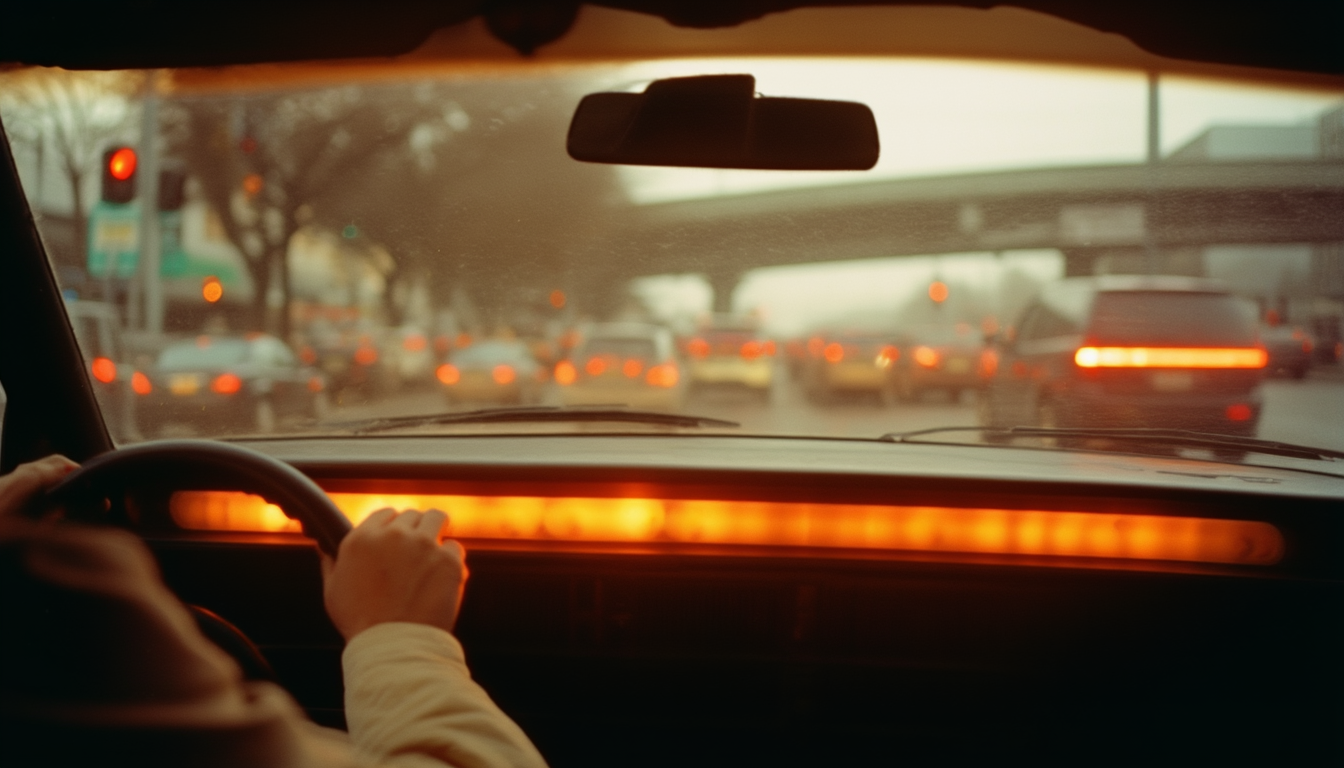
The amber light blinks on Maya's dashboard at 7:52 a.m., somewhere on the climb out of the Mission. It means the same thing it always means. She has been downgraded — Priority Tier 2 to Tier 3 — and the car already knows it, easing off the throttle, sliding her out of the express channel into the slow river of everyone else.
"Goddammit," she says to no one, and taps the notice.
The cabin voice is unbothered. "Your mobility score was adjusted based on recent travel patterns. Three visits to the Bayview last week reduced your route-diversity rating. An unscheduled trip at 2:13 a.m. Tuesday fell outside your predictability band. Would you like to file an appeal?"
She files it anyway, the way you'd swat a fly, and watches the dashboard add eighteen minutes to her arrival. It is 2036. Maya is thirty-four, good at her job, and a model of her own car has decided she is becoming unpredictable.
The promise was a mirror, not a cage
The thing that downgraded her began as something genuinely hopeful: a digital twin. A live virtual replica of the city's transportation network, fed by real-time data, used to simulate a thousand "what-if" scenarios before a single lane is closed or a single signal retimed.1 When Berkeley engineers described the technology in the mid-2020s, the pitch was a mirror — a way to understand a system too complex to hold in any one head, to test a bridge closure in software before it strands ten thousand commuters in traffic.
Nobody set out to build a caste system. They set out to reduce friction. The trouble is buried in the word optimization: to optimize a road at capacity, you have to decide whose trip matters more. Emergency vehicles first — everyone agreed. Then buses. Then carpools. Each step was sensible, and each step taught the system that some travelers could be moved ahead of others.
The mechanism: the city learned to charge for the front of the line
Then the city learned the line could be sold.
This part was visible from the 2020s, if you were looking. Congestion pricing — charging drivers to enter the busy core — was already the textbook tool for thinning traffic, and already the textbook fight over equity. Federal researchers warned that a flat fee thins the road by pricing out the people who can least afford it, handing the cleared lanes to those who can.2 Advocates pushed back with income-tiered designs: discounts and exemptions so a $10 toll didn't fall hardest on the household earning $25,000.3
By the early 2030s the toll had become a score, and the score had become a profile. Each resident's "mobility twin" tracked where they went, how predictably, in what kind of vehicle, toward what sort of destination. Stay legible and you floated up the tiers. Vary, wander, double back at 2 a.m., and you drifted down.
The cruel part is that even the fair versions didn't fix it. When Lawrence Berkeley modeled an income-aware cordon for San Francisco, the smarter pricing cut lower-income households' lost access by more than half against a flat fee — a real gain. But it could not erase the loss, because part of the harm came from the network reshaping itself around the toll, not from the toll itself.4 You can refund someone's fee. You cannot refund them the route that no longer exists.
The turn: a mirror that started giving orders
Here is where the technology flips into its opposite. A digital twin is supposed to describe you. By 2036 it prescribes you.
The mobility apps stopped reporting your score and started coaching it. Shop at this grocery, not that one. Take the children to the park on the east side; it reads as higher-value. Skip the 2 a.m. drive. The nudges were soft and constant — and people obeyed, because a downgrade was expensive and a tier was hard to climb back. None of this required inventing a new kind of cruelty. Algorithmic management had been steering gig drivers this way for a decade, surveilling them in real time and "nudging" them toward the platform's preferred behavior; the city simply pointed the same machinery at everyone.5
We had a working example of where that ends, too, and we mostly looked away from it. In China, court blacklists tied to the social-credit apparatus blocked "untrustworthy" people from buying plane and high-speed-rail tickets millions of times in a single year — restricting movement as a punishment, encoded in the booking system.6 San Francisco didn't copy the politics. It copied the architecture, then let the market run it.
The infrastructure hardened to match. Cities have always built their values into concrete: Robert Caro's account of Robert Moses has him setting Long Island's parkway bridges low to keep buses — and the poorer, often Black riders on them — away from Jones Beach. Historians still argue over how deliberate that was.7 What's no longer arguable is the principle. A network that decides whose trip counts will, given enough time, pour that decision into steel: the separate entrance, the elevated express lane, the concourse you're routed away from.
That is the reversal, and it lands hardest of all. A tool sold to give everyone frictionless movement became the most efficient machine ever built for deciding who gets to move at all. The mirror grew a will.

Back to Maya
Maya gets to work twenty minutes late. The appeal she filed from the Bayview climb is still "under review" — it will be for days — and she already knows the cheaper fix is to simply stop visiting her old neighborhood so often. Make herself legible again. Float back up.
She thinks about her grandfather, out by the water in a Tier 4 pocket the express lanes forgot, and how a few unscheduled trips to see him would cost her a tier she can't spare. The system isn't asking her to stop loving him. It's just quietly pricing it.
The open question is whether the twin can be rebuilt to do what it first promised — to understand the city without ranking it. A reflection that helps without commanding. Maya pulls into the lot, the amber light finally dark, and wonders, the way you wonder about weather, whether anyone will decide it's worth the cost of un-sorting what got sorted.
Author's Note
This is speculative journalism, written from an imagined 2036. Maya is a fictional composite, and the four-tier "mobility score" is an extrapolation, not a forecast — one possible trajectory among many. The technologies and evidence underneath it are real and current as of 2026: digital twins in transportation planning, the documented equity stakes of congestion pricing, algorithmic management's nudging of workers, China's use of blacklists to restrict travel, and the long history of infrastructure built to sort people. The point isn't that this future is coming. It's that every piece we'd need to build it already exists — and so does the choice not to.