
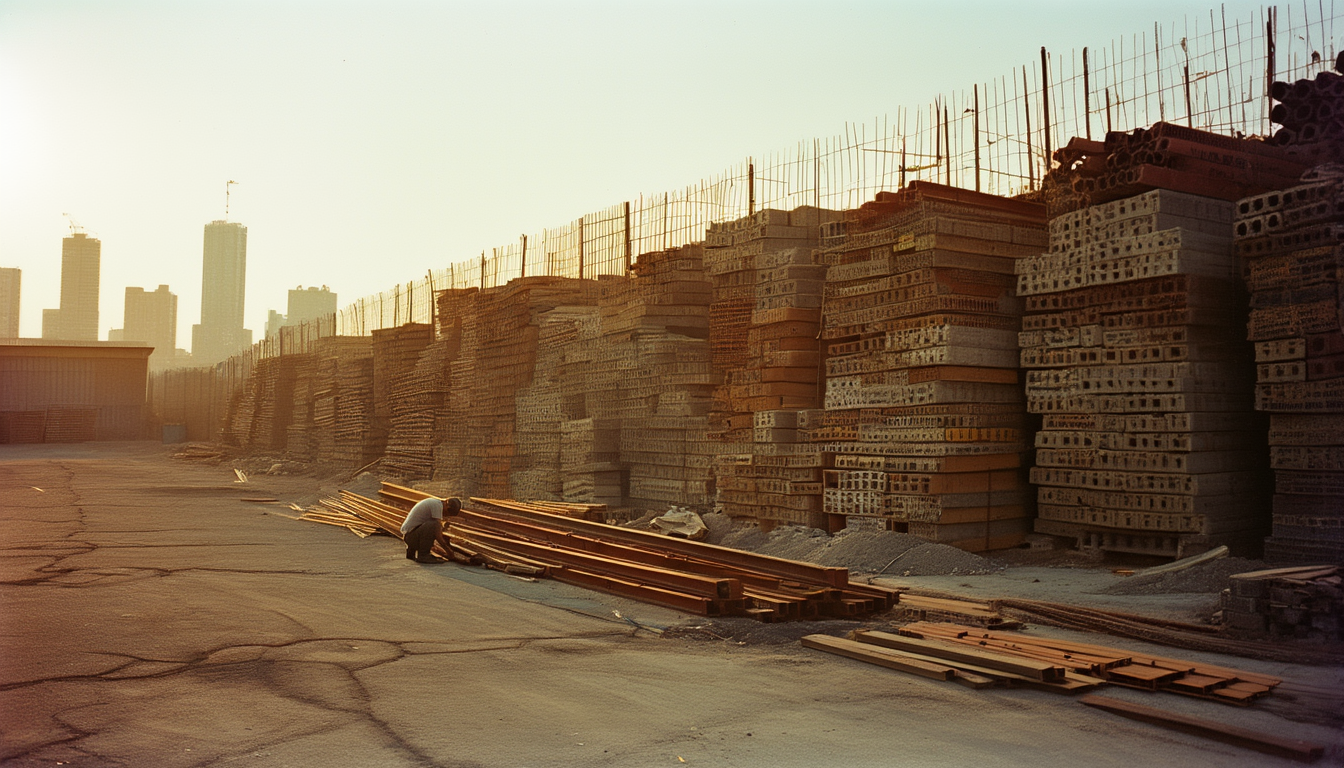
Mara Okafor keeps the beam in her front room, where other people keep a sofa.
It is a thirty-foot wide-flange steel girder, painted the rust-red of an old freight bridge, and it runs the length of the wall in her unit on Detroit's east side. It is a Tuesday in 2036. She is making tea, and when she sets the kettle down she touches the beam the way some people touch a doorframe on their way out — not thinking about it, just confirming it is still there. Stamped near one end is a small etched code. Scan it and a phone fills with the beam's whole life: which factory rolled it in 1974, the office tower it held up for fifty years, the demolition that freed it, the two buildings it has carried since. Her allotment from the neighborhood Material Commons. Hers to lend out. She has not lent it out in three years.
Mara is not a hoarder, exactly. She would tell you she is being careful. By 2036, in the districts that closed their material loops, careful is its own kind of trap.
The promise was simple
For most of the building century, a demolished structure was just trash with a permit. In the United States, construction and demolition debris ran to roughly 600 million tons in 2018 — more than twice the country's household garbage — and concrete and asphalt alone made up about 85 percent of it.1 Demolition, not construction, generated most of it. The standard move was to crush it, haul it, and bury it, then mine fresh gravel and pour fresh cement somewhere else.
Circular construction promised to close that loop. The idea, refined in the early 2020s at places like MIT, was to stop treating a building as a thing you throw away and start treating it as a temporary arrangement of parts you will need again.2 Each part would carry a material passport — a digital record of what it was made of, what it had endured, and what it was still good for. Design for disassembly. Catalog everything. Let one building's death feed the next building's birth.
Detroit believed it harder than most, because Detroit had buried more of itself than most. Mara's beam is what the promise looks like when it works: a fifty-year-old girder still standing, its biography legible, kept out of a landfill it would have reached three times over by now.
The mechanism, and the feeling it produced
The passports did what passports do. They made trust portable. A contractor in 2036 can know, before a beam ever leaves the yard, exactly how much fatigue it carries — and the knowing is what makes reuse pour into the gap that demolition used to fill.
But circular construction never quite escaped the chemistry. Concrete recycled once holds up well. Recycled twice, it holds up. The compressive strength of recycled-aggregate concrete drops to as low as 57 to 90 percent of fresh concrete by the third cycle, as old mortar accumulates and the crushing opens micro-cracks that never fully close.3 Steel is more forgiving than concrete, but nothing is infinitely forgiving. Every loop loses a little. The honest circular system is not a closed circle. It is a slow spiral that needs an occasional shot of virgin material to stay safe — a fact the early manifestos preferred not to dwell on.
So the people who ran these systems learned to feel for it. They became, in the trade slang, waste conductors — reading a neighborhood's building stock the way a farmer reads a field, tracking which structures were near the end and what they would shed. It is genuinely artisanal work, and it retrieves something old: the village habit of wasting nothing, the barn-raising logic of shared tools, now wearing a blockchain.4 That intimacy is the good part. It is also where the trouble starts.
The turn
Teach a community to never waste anything, and some of them will never let anything go.
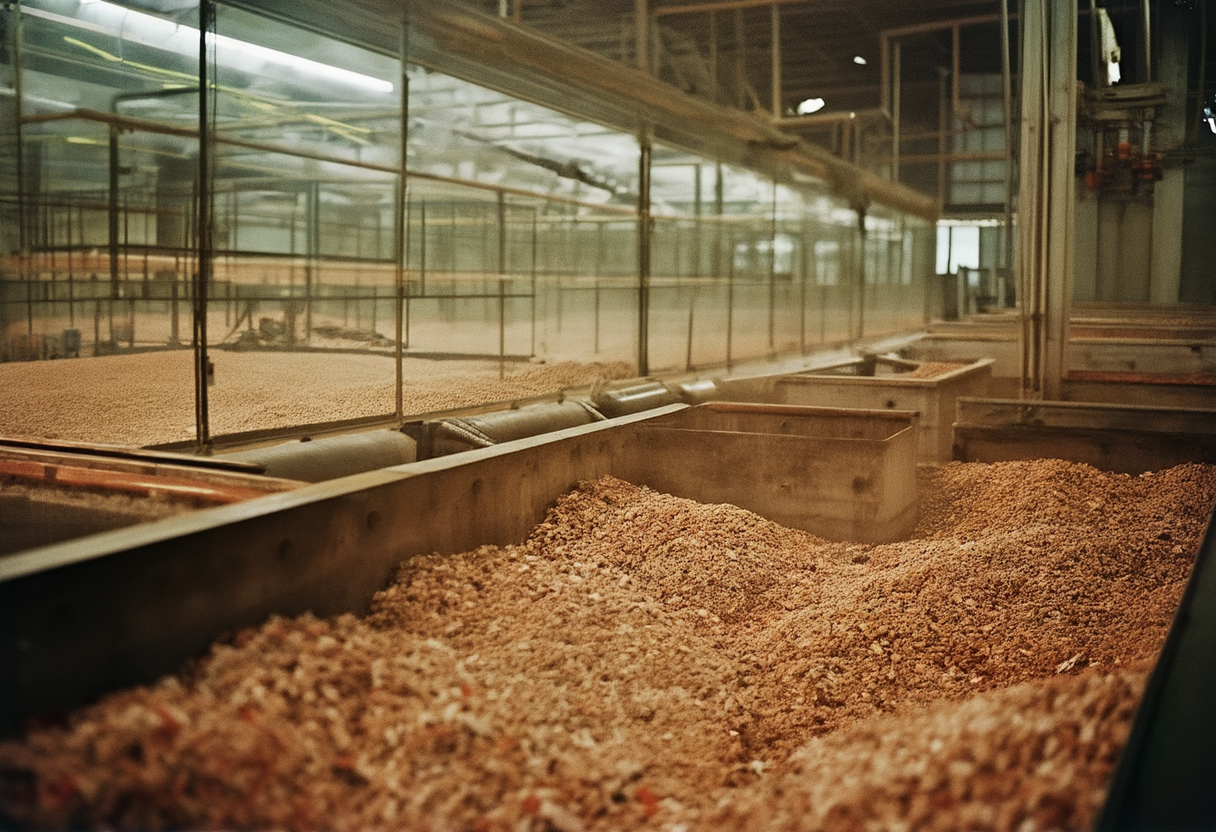
The reversal in circular construction is not scarcity of materials. It is the fear of scarcity, hardened into policy. The same hypervigilance that closed the loop keeps running after the loop is closed. Residents who learned to track every beam start stockpiling premium reclaimed steel "just in case," and the informal warehouses grow past any real plan to build. A neighborhood that hits high self-sufficiency starts treating material from the next district over as contamination — quality control quietly becoming a border. The networks that made circular construction work in the first place fray into a hundred little material kingdoms, each hoarding against the others.
Researchers had flagged this years earlier, in plainer language than the manifestos used. Push circular systems without attention to who owns the loop, one analysis warned, and they "enclose the value of discards and exacerbate inequality" — concentrating control of recovered material in the hands already holding it, and dispossessing the people who used to scavenge freely.5 The dream was democratized building stock. Pushed to its limit, it reverses into a market where your block's processing equipment decides your building's grade, and the passport that was supposed to guarantee quality instead certifies the hierarchy. A tool for sharing, perfected, becomes a tool for hoarding.
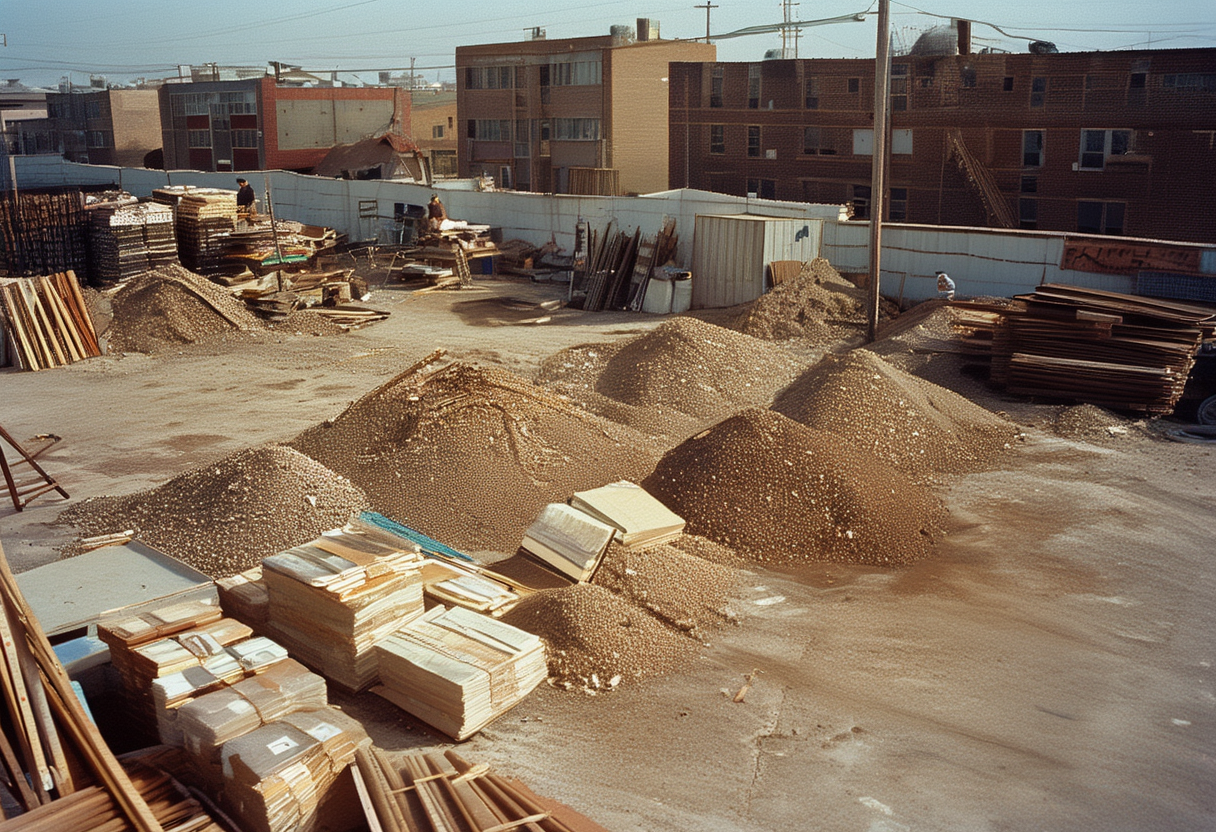
The environmental case never stopped being real. Vienna showed, in a careful study of its own building stock, that recycling its construction minerals could cut virgin-material demand by about 32 percent — roughly a million and a half tons of gravel never quarried.6 That is the prize, and it is worth keeping. The problem was never the chemistry of the loop. It was the psychology of the people guarding it.
Back to Mara
Mara's beam will outlast her. That was the point.
But three of her neighbors have beams just like it, scanned and logged and untouched, and the Commons across the street is short on exactly the steel sitting idle in their front rooms. The district's self-sufficiency number is the best in the city. Its build rate is the slowest. Everyone is being careful, and careful has quietly become the same thing as stuck.
She thinks about lending the beam out. She has thought about it for three years. The record says it is still good for one more building, maybe two. The chemistry agrees. What stops her is not the chemistry.
The open question for 2036 is not whether we can keep the materials moving. The passports proved we can. It is whether a community taught to hold on can ever be taught, again, how to give.
Author's Note. This is speculative journalism written from an imagined 2036. Mara Okafor, her beam, and the Detroit Material Commons are fictional composites; no real person or program is depicted. Everything outside the scenes is real and sourced: the U.S. construction-and-demolition waste figures, MIT's material-passport and design-for-disassembly work, the measured strength loss across recycling cycles, the equity critique of circular-economy "enclosure," and Vienna's virgin-material-reduction study are all drawn from the cited references. The hoarding, material nationalism, and "waste conductor" culture are plausible extrapolations, not reported facts.