
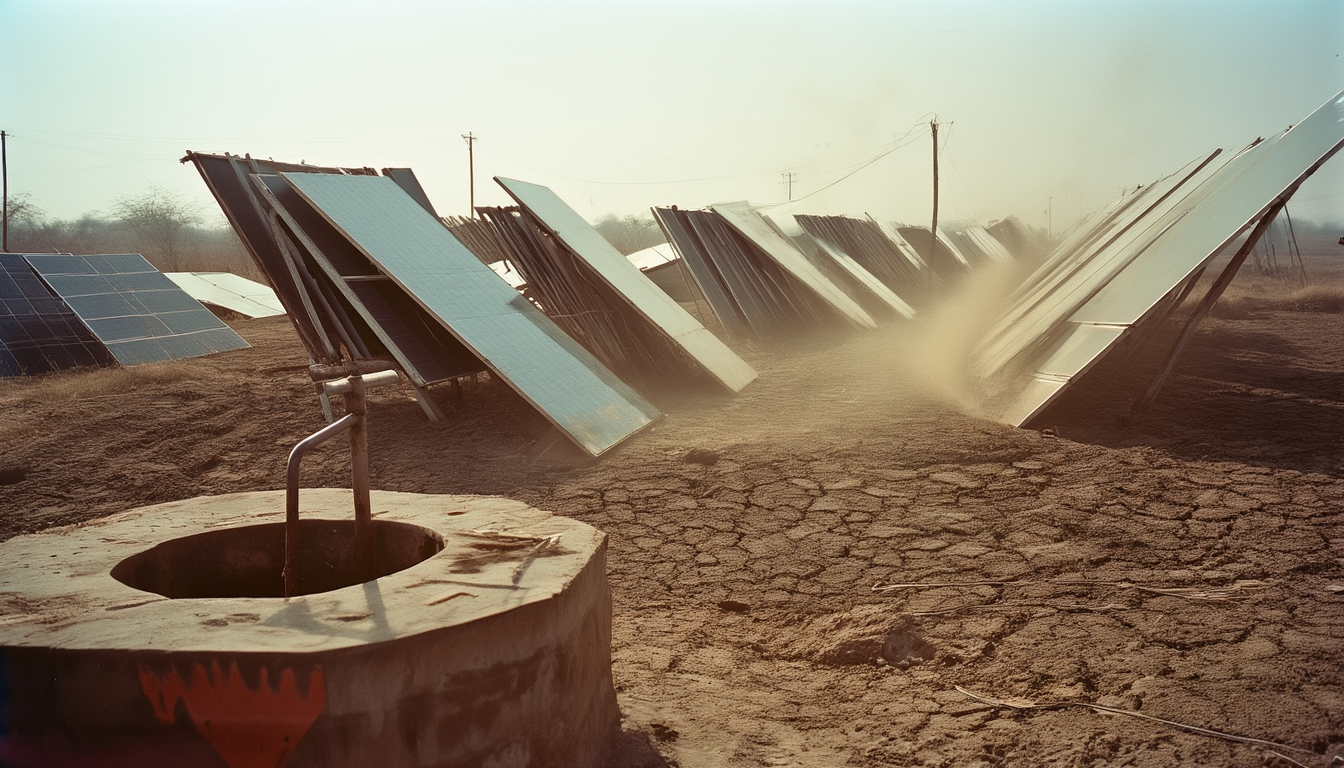
It is a Tuesday in 2036, and Meera Patel will not let her daughter near the well.
The water still looks clean. It still smells fine. But the pump in her courtyard, four kilometres from the edge of Jaipur, wears a band of red paint now, and the eight-year-old has learned to walk a wide arc around it the way other children learn to avoid a hot stove. Meera draws what the family drinks from a plastic jerrican trucked in twice a week. The well that watered three generations is just a thing in the yard that the warning sign points at.
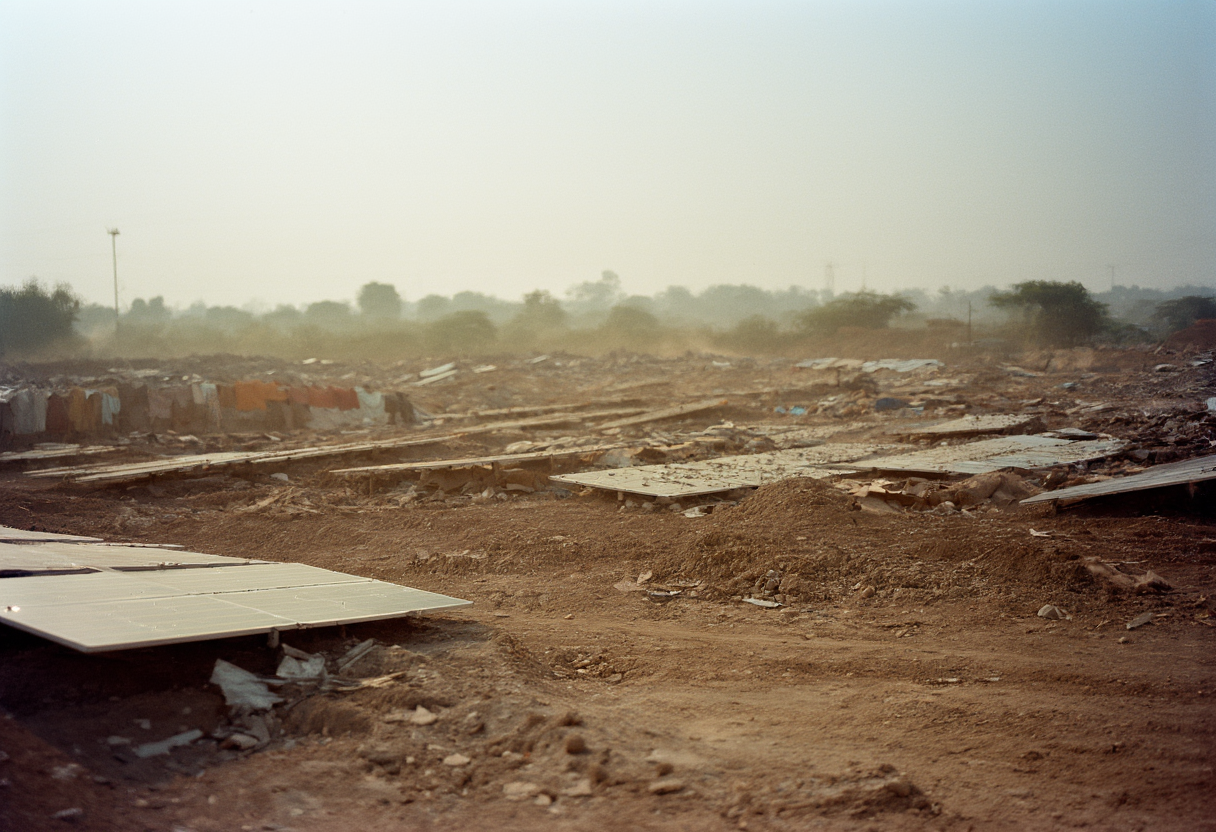
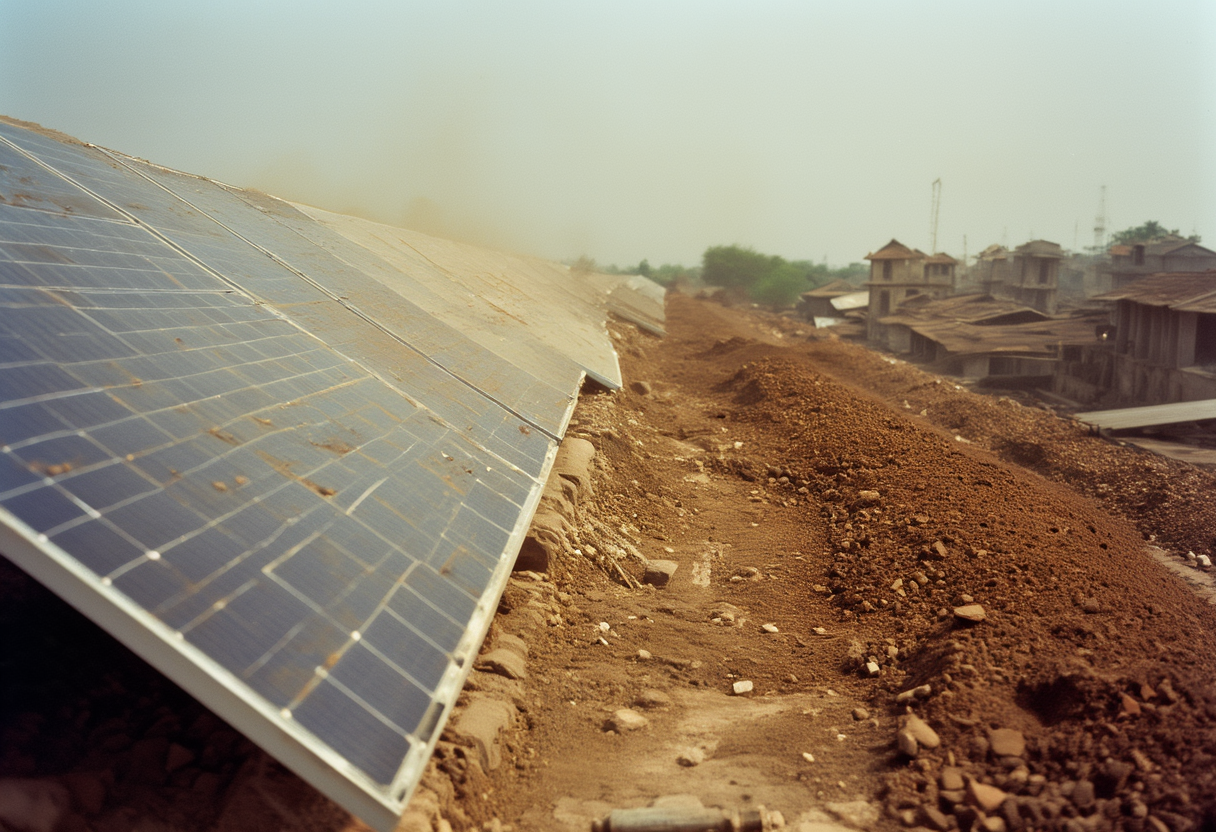
Out past the rooftops, the panels catch the afternoon light — thousands of them, stacked on their sides like dominoes, stretching toward a horizon that used to be wheat fields. Locals call it the Silicon Graveyard. The panels keep arriving and nobody recycles them, because here, in 2036, almost nobody anywhere does.
The promise
The thing that broke is worth remembering clearly, because the promise was real.
In 2024, solar was not just cheap — it was the cheapest electricity in human history, and a small circular-economy industry was racing to close the loop. A California recycler, SOLARCYCLE, recovered the silver, copper, aluminium and glass from more than 480,000 retired panels that year, keeping an estimated 13.8 million kilograms of CO₂-equivalent out of the air.1 Its process pulled better than 95 percent of the value out of a dead module. The engineering, the people inside it always insisted, was never the hard part.
The hard part was arithmetic, and the arithmetic was known. The first global accounting of solar waste, from the International Renewable Energy Agency, projected that retired panels would reach roughly 78 million tonnes worldwide by 2050 — mostly glass, but laced with metals you do not want in groundwater.2 India alone was on track for about 6.64 million tonnes by 2040.3 Researchers warned, plainly, that without rules and infrastructure that waste would be landfilled or burned "in a manner that may be detrimental to human health and the environment."3
Everyone read the memo. Almost no one built the plant.
The mechanism
Two real forces did the damage. The first was success.
Panels kept getting better. A module bought in 2024 was guaranteed for 25 to 30 years, but each new generation squeezed more watts from the same square metre. The economics turned cruel: why keep an old panel earning pennies when a new one earns more from the same roof? Replacement cycles compressed, and the waste IRENA had penciled in for the 2040s started arriving early — the "early-loss" scenario the India study had modeled.3
The second force was chemistry. A silicon panel carries several grams of lead in the solder that joins its cells.4 The thin-film panels carry cadmium — small per square metre, but it adds up across a hillside of them.5 Sealed inside glass on a German rooftop, none of that matters. Stacked in the open, cracked, rained on for years, it leaches. In 2036 the World Health Organization still sets its guideline for lead in drinking water at 10 micrograms per litre.6 Meera's well, when the testing finally reached her district, came back well above it.
That is the part that is not speculation. The metals are real, the waste tonnages are real, and the absence of anywhere to put them was, by 2024, already on the record.
The turn
Here is the reversal — the one that should have been seen and was not.
Solar was supposed to be the clean answer. It enhanced something genuine: it gave the world abundant power without a smokestack, and burning fossil fuels was killing on a scale solar never could. Air pollution from fossil fuels was linked to more than eight million deaths a year — close to one death in five worldwide.7 By every honest count, solar was the safer technology by orders of magnitude.
But pushed to its limit, without the back half of its lifecycle built, the clean solution acquired a dirty image — and the image was the weapon. The graveyards retrieved one of the oldest patterns in industrial history: the rich world keeping the benefit and exporting the harm, now wrapped in green. "Europe's clean energy comes to die here," people in Jaipur say, and the line travels.
So the thing that was meant to win the climate argument started losing it. Every photograph of a poisoned well became ammunition — not against fossil fuels, but against the alternative to them. A real, fixable waste problem got turned into a reason to slow down the one technology that was actually displacing coal. The solution reversed into a brake on itself.
Return to the well
Meera does not follow the politics. She follows her daughter.
The girl was born the year the panels started covering the wheat fields — energy her family never used, from modules they never installed, to solve a crisis their emissions did not cause. The blood tests are not abstract to Meera. She keeps the jerrican full. She repaints the red band on the pump when it fades, and walks the wide arc herself now, out of habit, even carrying nothing.
"They say it was a sacrifice for the planet," she says, in the quiet, worn-down register of someone whose anger ran out of new things to do years ago. "Maybe. I will never know what the other future would have cost her. I only know what this one did."
Out past the rooftops the panels go on catching the light, beautiful from a distance, like an art installation nobody meant to build. The technology that was supposed to secure her daughter's future is sitting in her line of sight, leaching into the ground, because the world built the factory and forgot the sewer.
The open question
The question the 2030s never answered is the one Meera lives inside: what do you owe the people who pay for a solution they did not choose?
Solar still works. It is still, by any sane accounting, better than the alternative. The waste is still an engineering problem with engineering answers — take-back rules, recycling built alongside deployment instead of a decade behind it. None of that changed since 2024. What changed is that a fixable problem became an unfixable story.
From 2036, that is the warning the graveyards send back. Not that clean energy was a lie. That a half-built solution is its own kind of pollutant — and the part it poisons first is trust.
The Tetrad
- Enhances: abundant, smokestack-free power at the lowest cost in history.
- Obsolesces: the fossil baseload — and the 25-to-30-year panel lifespan, undone by its own pace of improvement.
- Retrieves: the old colonial division of benefit and harm, now in green packaging.
- Reverses into: a climate solution turned into a weapon against climate action — the cleaner technology made to look like the dirtier one.
Author's Note
This is speculative journalism, written from an imagined 2036 looking back. Meera Patel and her daughter are fictional composites; the Silicon Graveyard scene is a projection, not a report. The foundations under it are real and cited: the 78-million-tonne global solar-waste projection by 2050, India's 6.64-million-tonne trajectory by 2040, the lead and cadmium content of panels, the WHO lead guideline, and the eight-million-a-year fossil-fuel air-pollution death toll. The 2036 specifics — the named graveyard, the contamination at this particular well, the political reversal — are extrapolation, a cautionary "what if," not a prediction. The point is the boundary: the danger here is real and documented; whether it plays out this way depends on choices being made now.