
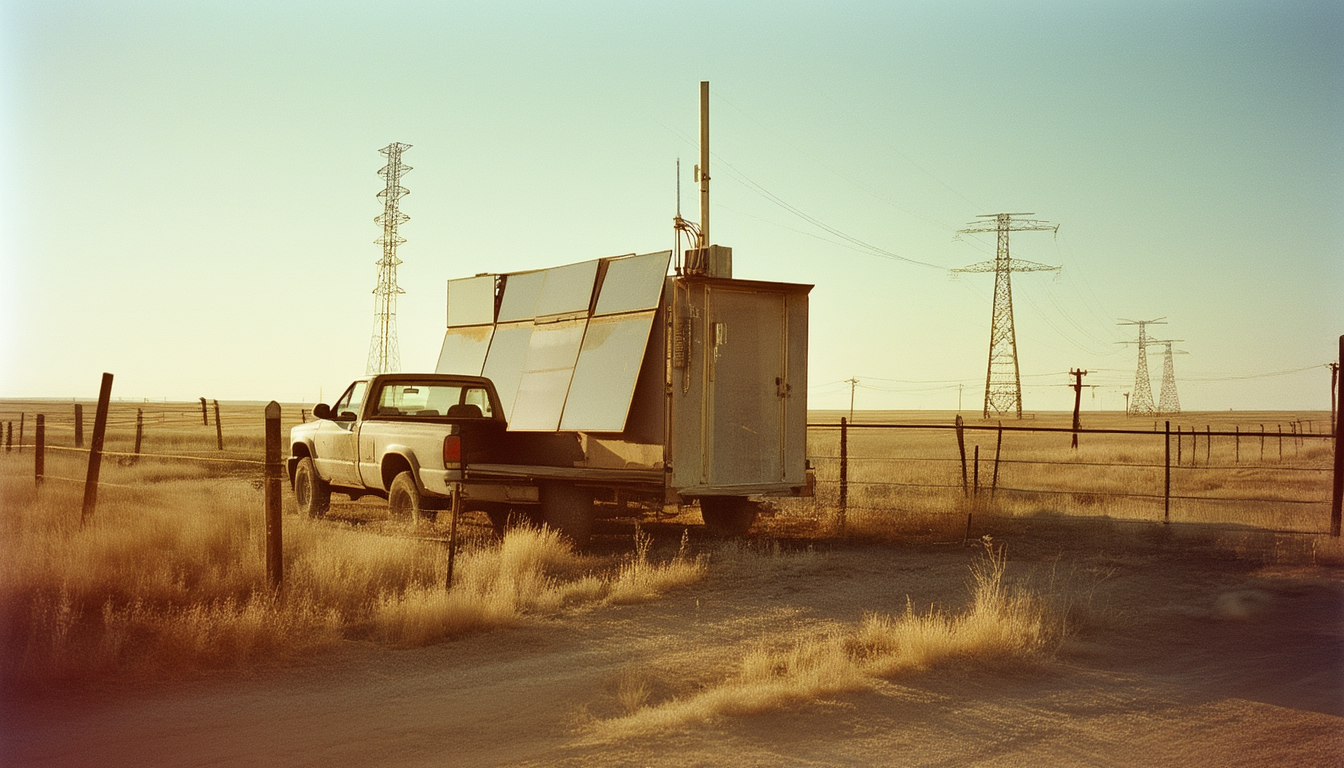
The lane opened at 5:40 in the morning, and Noor Haddad had eleven minutes of it.
She sat in the cab of a pickup on a service road east of Pueblo, window down, tablet on her knee, watching a coverage overlay redraw itself in pale amber. The transmitter trailer parked at the fence line belonged to the lane operator. The 230-kilovolt run she was under contract to inspect belonged to the utility. The drone in the truck bed was hers, and it was the cheapest thing in the arrangement.
Eleven minutes was not flight time. It was beam time: the window in which that ground array would hold a lock on her aircraft and keep its battery full while it worked.
With the beam, the drone could stay up for days. On its own cell, it had about forty minutes.
Her father had walked this same line in 2021 with a canvas bag of spare packs and a folding chair, swapping cells on the tailgate every half hour. He thought the bag was the problem. Nearly everyone did.
The half of the problem that got the money
Between 2024 and 2027, the storage side of the industry did almost everything it said it would.
Sodium-ion stopped being a slide. CATL's chief scientist, Wu Kai, told a Beijing forum on 30 May 2026 that the manufacturing bottlenecks had been resolved and that mass-produced sodium-ion products would ship that year, against a 60-gigawatt-hour supply contract described as the largest single sodium-ion order placed anywhere.7 Solid-state moved too, and moved carefully. CATL, BYD, Toyota and Samsung all named 2027 for first products, with CATL describing small-scale pilot output rather than mass production, at a peak energy density near 500 watt-hours per kilogram, roughly double a 2026 liquid-electrolyte pack. Its own reading of the industry's manufacturing maturity in 2024 was four on a nine-point scale.6
Gravity storage got out of the slide deck as well. Energy Vault's first commercial system, 25 megawatts and 100 megawatt-hours, went in at Rudong in China beside a wind farm, and Gravitricity raised 40 million pounds in January 2023 to drop weights down decommissioned mine shafts.10 Betavoltaics arrived, and arrived small: Beijing Betavolt's BV100 pairs a nickel-63 source with a diamond semiconductor to deliver 3 volts and 100 microwatts for up to fifty years with no charging at all.9 Quantum batteries, which hold energy as molecular excitations rather than as stored charge, had their first complete charge and discharge cycle published in March 2026, at room temperature, producing between 10 and 40 microwatts per square centimetre under LED light. The authors called the efficiency gain modest so far and the device a prototypical framework.8
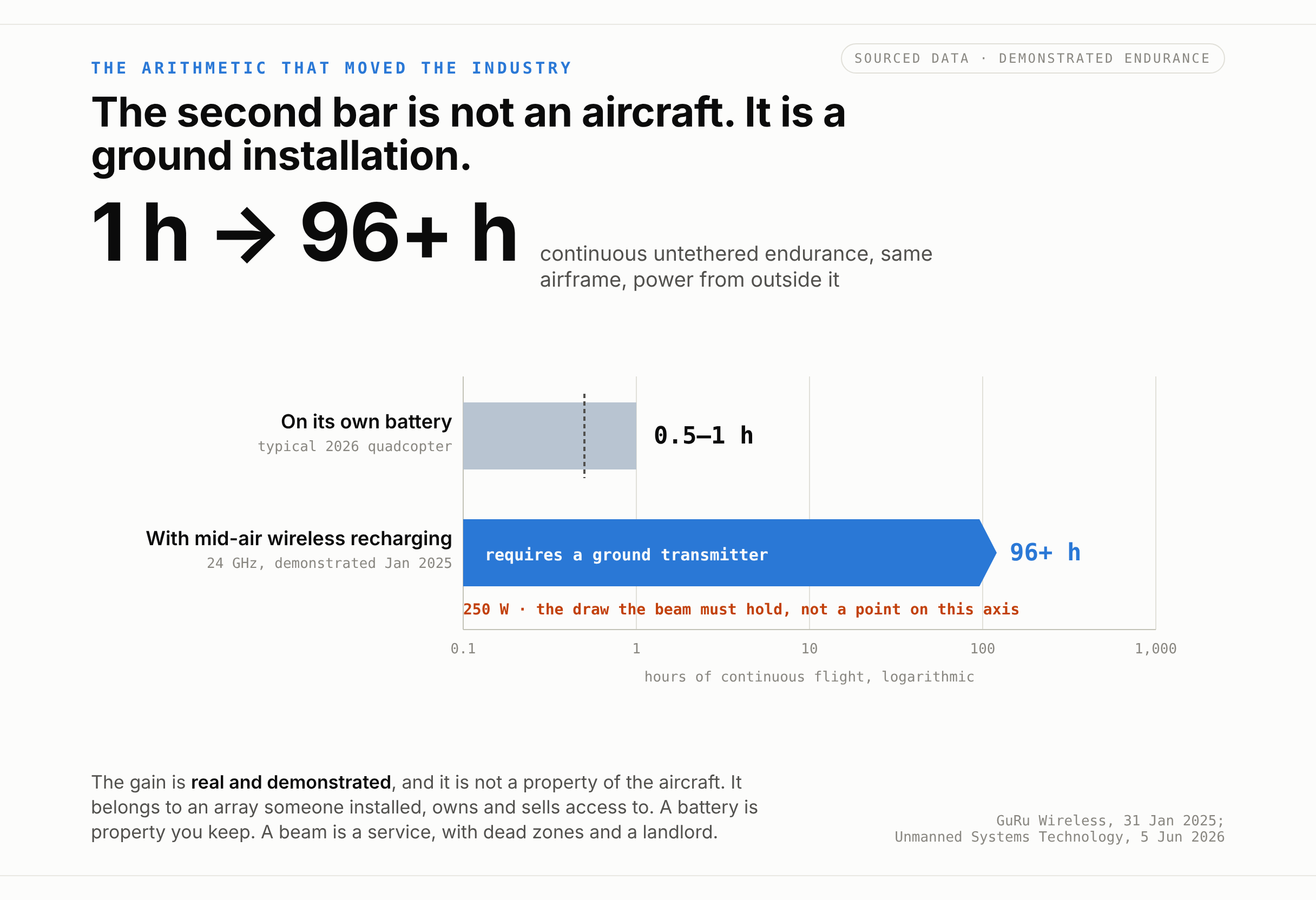
Now set those numbers beside the load. A small quadcopter in flight draws more than 250 watts.1 A hundred microwatts will run a sensor for half a century. It will not turn a rotor for one second. And in 2026 most quadcopters still flew thirty to sixty minutes before landing to swap or recharge.1
Fifteen years of chemistry, and the folding chair stayed in the truck.
The half almost nobody was funding
GuRu Wireless was founded in Pasadena in 2017 by Caltech electrical engineers and physicists, and raised a 15-million-dollar Series A in 2019.3 Its system beams power at 24 gigahertz from software-steered phased-array tiles, combining digital beamforming with a proprietary technique the company calls RF Lensing. Closed-loop tracking keeps the beam on a moving aircraft; sidelobe suppression keeps it off everything else. Light receivers on the airframe, which the company calls Recovery Units, turn the radio energy back into regulated direct current. One transmitter can serve several aircraft by multiplexing the beam and sharing it in time.2
The demonstrations escalated fast and stayed short in range. December 2024: an untethered drone powered from thirty feet away in a lab. September 2025: two drones aloft at once at a defence trade show in Taipei. Published distance by mid-2026: up to 200 feet.23 Then the figure that reframed the category, from January 2025. More than 96 hours of continuous untethered flight, the battery recharged in the air.1
Read that one carefully, because the version that travelled was wrong. The aircraft was not battery-free. It kept its cell. The beam kept the cell full. Endurance quietly stopped being a property of the thing that flies and became a property of the ground underneath it.
Defence work was further along than any of it. At the Army's High Energy Laser Systems Test Facility at White Sands Missile Range, DARPA's Persistent Optical Wireless Energy Relay program delivered more than 800 watts across 8.6 kilometres in a 30-second transmission, moved more than a megajoule over the test campaign, and measured better than 20 percent efficiency from laser output to receiver electrical output at the shorter ranges. "We absolutely obliterated all previously reported optical power beaming demonstrations," said the program manager, Paul Jaffe. The previous mark had been 230 watts at 1.7 kilometres.4
Civil power delivery ran on a different clock. Ossia's authorisation under Part 18 of the Federal Communications Commission's rules, announced in March 2022, was the first United States approval for radio-frequency power transfer with no distance limit, at roughly 5 watts. What it mainly did was lift a one-metre ceiling.5
Five watts for a living room. Eight hundred watts across five miles for a test range in New Mexico. That gap is what decided who built the lanes.
What you are actually buying
A battery is property. You buy it, carry it, charge it where you like, and when the vendor folds you still have it.
A beam is a service. It exists where someone installed an array, when that someone is selling, at a price set by whoever else wants the window. The phrase everyone reached for was WiFi for power, and the comparison held all the way down, including the parts nobody put on a slide: coverage maps, dead zones, congestion at peak, and a landlord.
Arrays went up first along military and critical-infrastructure corridors, because that is where the contracts were. Korea's route was typical. In February 2026 GuRu signed with Uniquest, a listed Korean electronics distributor, and the drone developer Arion, to fit small unmanned aircraft with 24-gigahertz receivers for persistent surveillance, phased from live demonstrations into pilots with military-related units. GuRu's chief executive, Narbeh Derhacobian, called it a meaningful step in advancing persistent ISR from concept to demonstrated, field-ready capability.3
He was right, and the sentence carries the whole shift inside it. Persistence became a capability that somebody grants.
The lane keeper
Noor's business was the gap in that sentence.
She owned three aircraft and no tiles. Tiles were the expensive half, and the lane operators had bought them with utility money and defence money and then sold the surplus by the minute to people like her. Eleven minutes at dawn, priced off what the gas pipeline inspectors two counties over were willing to pay for the same window.
So she worked the edges of the map, where it could not be. The uncovered spans paid worst and needed the most walking, and she subcontracted two of them to a pair of kids with battery bags, which is how she had started.
At 5:51 the lane closed on schedule, two spans short. She brought the drone down on the tailgate, put a warm cell in her jacket pocket and a cold one in the airframe, and finished the line the way her father had.
The oldest tool in the truck was still the bag.
The open question
Nothing in the decade was a swindle. The chemistry was real and the numbers were published. What the decade settled is narrower than the press made it sound: storage set the weight of an untethered machine, and delivery set what it was allowed to do.
What is still open is whether a beam can be made into a common carrier, the way a wire was, or whether it stays what it became by default, which is a lease. Nobody has written that rule yet. In the meantime the coverage map is the labour map, and it was drawn by the people who could afford tiles.
Author's Note
This article is speculative journalism written from 2036. Noor Haddad, her contracting business and the Pueblo lane operator are fictional composites. Every technical figure, demonstration, regulatory authorisation, funding round, corporate partnership and quotation cited below is real, published and sourced. Projections past October 2026, including the existence of commercial beam lanes and their pricing, are the author's.