
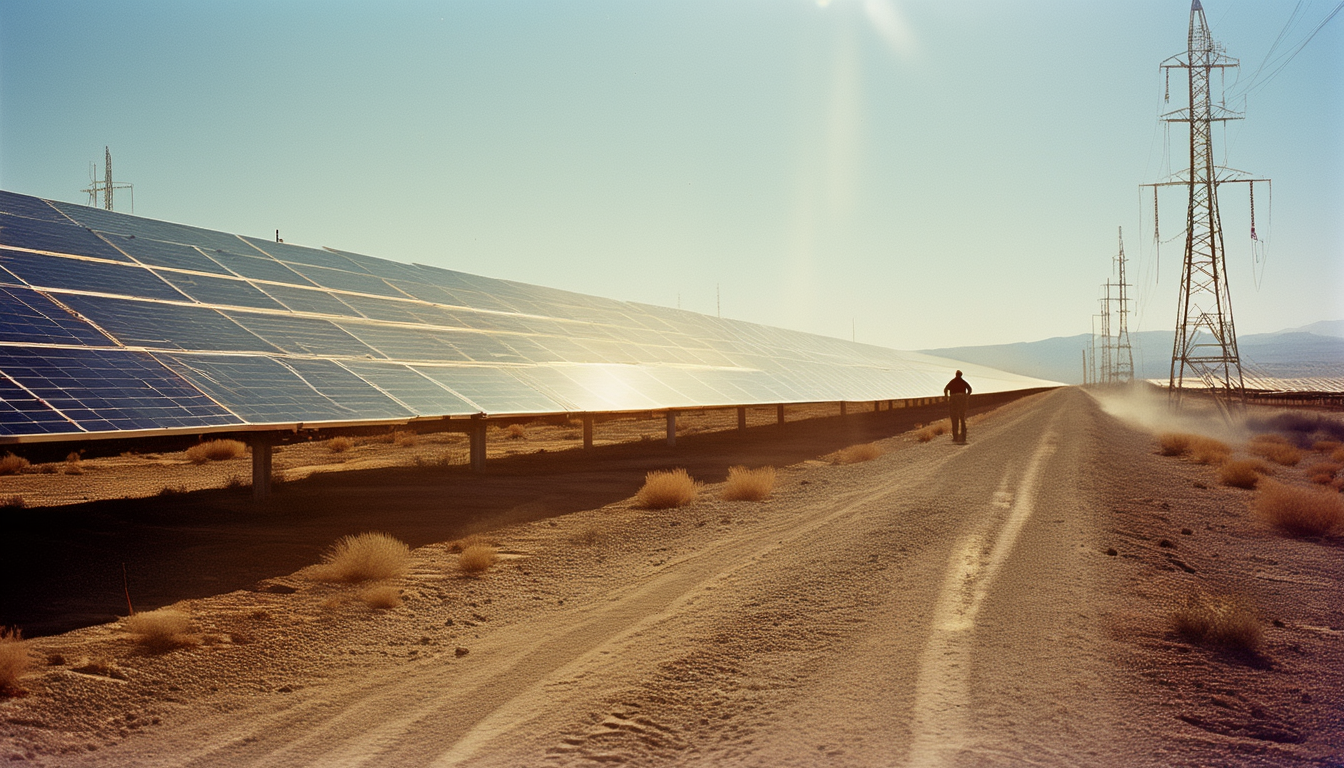
It is a Tuesday in March 2036, and Maria Castellanos is watching her solar farm lose money in real time.
She stands in a control room that smells of warm electronics and yesterday's coffee, one hand on a cracked tablet, the other tracing a price line on the wall display. The line dips below zero around ten in the morning and stays there, a long blue trough running clear through the middle of the day. Outside the window, a half-million panels tilt toward a cloudless desert sky, doing exactly what they were built to do.
"We're paying the grid to take our power," she says, not looking away from the screen. "Negative pricing, most sunny days now. The panels work perfectly. That's the problem."
The promise
The pitch was clean, in every sense.
Back in 2024, solar looked unstoppable, and the numbers earned the optimism. The global average cost of utility-scale solar had fallen to about $0.043 per kilowatt-hour — roughly 41% cheaper than the cheapest new fossil-fuel plant.1 Ninety-one percent of new utility-scale renewable projects that year came in below the cheapest new fossil option.2 Solar alone added a record 451.9 gigawatts of capacity in 2024, about 78% of all new renewable power on Earth.3 In a lab in Xi'an, a single tandem cell crossed 34.85% efficiency, edging past a physical limit engineers had assumed was a ceiling.4
Maria came up in those years. She remembers the language: energy independence, democratized power, the end of the oil weapon. You put panels on a roof or a field and you stopped being at the mercy of anyone. That was the deal.
She believed it. Most of us did.
The mechanism
Here is what the deal left out.
A technology, pushed far enough, tends to flip into its opposite. Make electricity abundant enough and you make it worthless — at least for a few hours a day, in the places that have the most of it. Engineers had a name for the early version of this: the duck curve, the daily shape of demand once solar floods the grid at noon and falls away at dusk.5 California's grid operator coined it years ago. By the mid-2030s the duck had deepened into something steeper.
The mechanics are unforgiving. When every panel in a region produces at once, supply overruns demand and the wholesale price collapses. Operators respond by curtailing — switching off perfectly good generation because the grid can't use it. In 2024, California already curtailed about 3.4 terawatt-hours of wind and solar, a 29% jump in a single year, with solar making up 93% of the waste.6 Germany ran 457 hours of negative wholesale prices that same year, most of them clustered in sunny midday windows.7 The pattern was visible early. It did not stay small.
Storage was supposed to fix this. And lithium batteries do smooth a few hours. But the deeper mismatch is seasonal — too much power in July, not enough in January — and a four-hour battery cannot bridge a season. So the surplus gets thrown away, day after day, in the sunniest, most "successful" markets on the planet.
The turn
This is where the promise eats itself, and it does so on four fronts at once.
Abundance becomes waste. The cheapest electricity in human history is also, at noon, the least wanted. A farm can be flawless and still bleed money every clear day.
Clean becomes toxic. Every panel eventually dies, and the world has built almost nowhere to send the bodies. In the United States, fewer than one in ten decommissioned panels is recycled; the rest go to landfill, because tossing a module costs a few dollars and recycling one costs far more.8 A single crystalline-silicon panel carries roughly 12 to 15 grams of lead in its soldering, plus traces of other heavy metals.9 Multiply that across the 78 million tonnes of panel waste the world is projected to generate by 2050 — more, by weight, than all the phones and computers ever discarded — and the scale of the coming graveyard comes into focus.10 India alone, on a business-as-usual path, could face up to 6.64 million tonnes of panel waste by 2040, with little domestic recycling to absorb it.11 The cleanup is real even where the recycling is not: one US recycler, SOLARCYCLE, processed 480,406 panels in 2024 — a genuine effort that still represents a rounding error against the global installed base.12
Independence becomes dependence. The revolution meant to free us from petro-states handed the keys to a different set of chokepoints. China's share of the solar manufacturing chain already exceeds 80%, and for wafers and polysilicon is heading past 95%.13 The minerals underneath are more concentrated still: by 2024 the top three countries refined about 86% of the world's key energy-transition minerals, and China alone refined roughly 91% of rare earths.14 15 The Democratic Republic of Congo supplies around 70% of the cobalt for the batteries that store all that sunshine, in output that includes artisanal mines where the US Labor Department estimates at least 25,000 children work.16 In the salt flats of Chile's Atacama, lithium extraction draws down water in one of the driest inhabited places on Earth.17
Democracy becomes division. Solar was sold as power for everyone. In practice, the households who can afford panels and batteries are quietly opting out of the shared grid, leaving fewer customers to carry its rising fixed costs — the people least able to leave.
Back in the control room
Maria pulls up the contract on her tablet. The farm was financed in the late 2020s on a thirty-year deal: imported panels, imported batteries, imported grid software. The terms were generous because the panels were cheap. Nobody in the room that day asked who would own the off-ramp.
"I thought I was building independence," she says. "I built a node in somebody else's network. The hardware, the software, the recycling I'm contractually required to use — none of it is mine to change."
She gestures at the battery racks beyond the glass. The silver in those panels is part of why they cost what they did; solar now consumes close to 200 million ounces of it a year, the single largest industrial source of silver demand, in a market that has run a supply deficit four years running.18 Every cell on her property is a small claim on a strained global ledger.
"We had the studies," she says. "The duck curve was obvious in 2022. The recycling gap, the supply chain — all of it was written down. We just decided the story was too good to interrupt."
The open question
None of this means solar failed. It worked, almost too well. The physics held; the costs fell; the deployment was real. The trouble was never the panel. It was everything we declined to build around it — the long-duration storage, the transmission, the recycling lines, the rules that might have kept one country from owning the whole chain.
So the question that hangs over the Mojave in 2036 is not whether the technology works. It plainly does. The question is whether a civilization can absorb a revolution this fast without the absorption itself becoming the disaster — whether abundance can be governed before it curdles.
Maria looks out at the array one more time before we leave. The panels catch the light and throw it back, flawless and useless in the same instant, generating power nobody at this hour wants.
"We could have done this right," she says. "The tools all existed. We chose speed."
Then she turns off the display, and the long blue trough goes dark.
Author's Note: This is speculative journalism written from a projected 2036. Maria Castellanos and her solar farm are fictional composites, built to carry a real systemic story; quotes attributed to her are invented. Everything outside the scene — the costs, the curtailment and negative-pricing data, the supply-chain and mineral concentrations, the waste projections, the labor findings — is drawn from real, present-day sources, cited below. The 2036 framing is a projection of where current trends could lead, not a forecast that they will. Where a number describes the future, it is offered as scenario, not fact.