
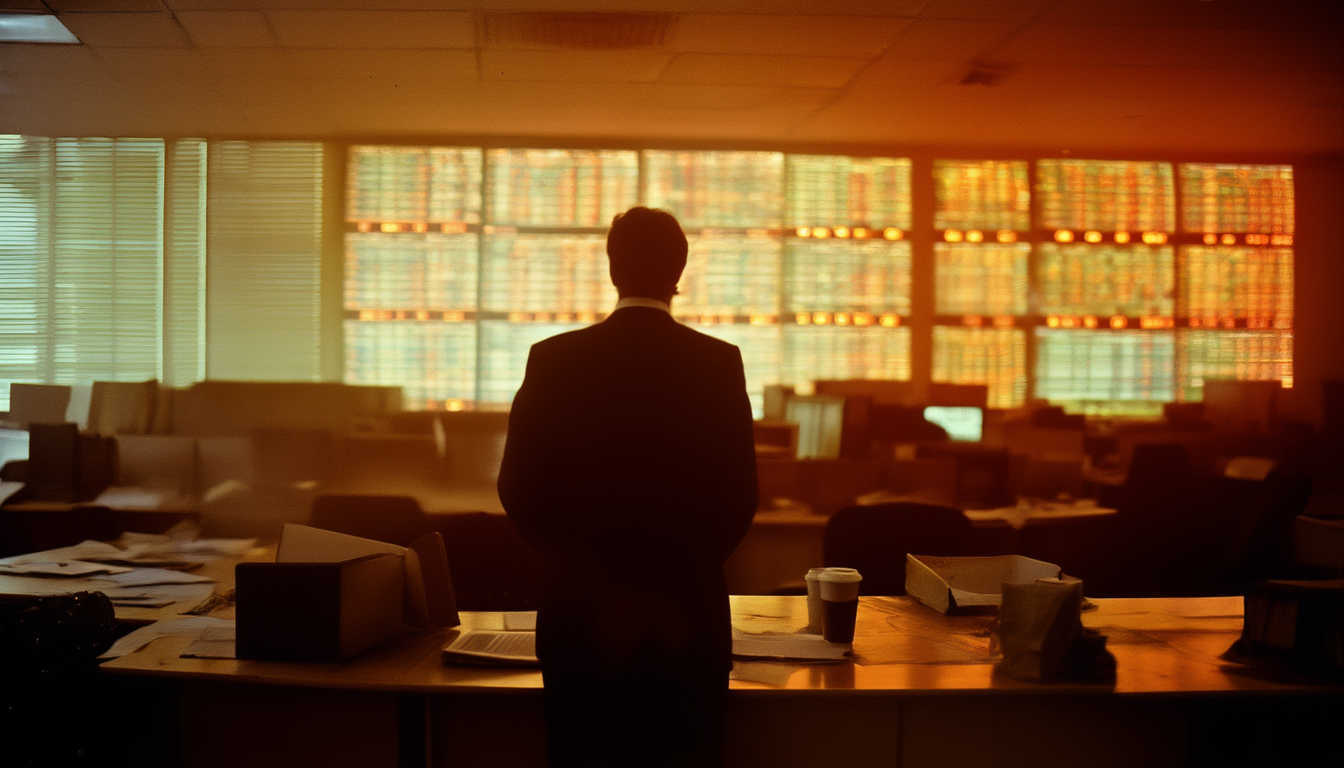
The classroom smells of cold coffee and radiator dust. It is a Tuesday in 2036, and Marcus Weber is setting up a slide for the twenty-two graduate students who file in expecting a lecture on derivatives. The slide is one number, blown up to fill the wall: a wholesale electricity price, somewhere in California, somewhere in the spring of 2032. It is negative eighty-five.
The students laugh, the way they always do. A negative price looks like a typo. Power that pays you to take it sounds like a joke about the future.
"I was on a desk when that printed," Weber says, and the laughing stops. He spent eleven years pricing solar projects for a Frankfurt finance house that no longer exists. He is fifty-one and teaches the thing that ended his career, two tram stops from the floor where he watched it happen.
He clicks to the second slide. The bankruptcies. The seized banks. The pension funds. The number stays on the wall the whole hour, because the number is the lecture: the day the cheapest energy in human history became worth less than nothing, and took its own industry down with it.
The promise everyone could read
You could not have built a more convincing case than the one solar made in the mid-2020s.
By 2024 the global average cost of new solar electricity had fallen to about four cents a kilowatt-hour, roughly forty-one percent cheaper than the cheapest new fossil option, according to the International Renewable Energy Agency.1 That year, IRENA found, ninety-one percent of new renewable projects worldwide undercut anything you could build on coal or gas.2 The world added a record amount of capacity, on the order of 452 gigawatts of solar in a single year.3 The International Energy Agency projected solar would supply almost eighty percent of the world's renewable growth through 2030.4
"The pitch wrote itself," Weber tells the class. "Cheapest power ever made. Falling every quarter. Governments paying you to build it. We were not selling a risk. We were selling an inevitability."
What the pitch did not price was the clock.
The mechanism: a duck, and a missing kitchen
Solar has one inconvenient honesty. It works when the sun is up, and stops when the sun goes down. And the sun does not consult the demand curve.
In California, grid operators had a name for the shape this made: the duck curve. Solar floods the system at midday, when offices are half-empty and nobody is cooking dinner. Demand peaks at dusk, exactly as the panels go dark. The U.S. Energy Information Administration tracked the duck getting deeper year after year, and tracked what operators did about the midday glut: they curtailed it, switching solar farms off because the grid could not absorb the power.5 On the worst days, the EIA documented California wholesale prices dropping below zero as solar surged.6 Germany logged the same disease on a national scale: its regulator counted 457 hours of negative power prices in 2024 alone, up from 301 the year before.7
Economists already had the diagnosis. When a market fills with identical solar that all arrives at the same hour, each new panel drives down the price of the hour it depends on. Researchers call it the cannibalization effect: solar eating its own value as it scales.8 The technology kept getting cheaper to build and less rewarding to own.
There was a fix, and everyone knew it: storage. Batteries to hold the noon flood and pour it out at dusk. The economics were arriving. Lithium-ion pack prices had collapsed to about $115 a kilowatt-hour by 2024, a record low.9
"The kitchen," Weber says. He pulls up a sketch a colleague drew in a meeting once: a restaurant, empty at breakfast, mobbed at lunch, dark by mid-afternoon, then asked to feed twice the lunch crowd at dinner with nothing prepped. "Storage was supposed to be the kitchen. Cook at noon, serve at night. In our models, somebody always built the kitchen."
The turn: when the kitchen never came
This is the part Weber slows down for, because it is the part nobody on his desk believed until it had already happened.
Nobody built the kitchen fast enough, because each utility waited for the next one to prove the returns, and each developer optimized its own project while assuming coordination was someone else's job. Panels (cheap, subsidized, easy to finance) went up far faster than the storage and transmission that would have made them pay.
So the value kept falling out of the middle of the day. In Weber's telling, the negative prices stopped being freak weather and became the spring. The thing that had made solar unbeatable (that once built, it generates at almost zero marginal cost, sunlight being free) became the thing that trapped it. There was no mine to idle, no well to cap. The panels generated whether the market wanted the power or not. Oversupply did not correct. It just sat there, at noon, every day.
That is what the whole hour builds toward, and Weber states it flat: abundance became the liability. The cheapest electricity ever produced turned unbankable precisely because it was too cheap, too abundant, at exactly the wrong hour. The value flowed to consumers and the climate while the people who financed it went broke. A tool built to make power abundant turned into a machine that destroyed the economics of producing it.
In the speculative history Weber teaches, the rest follows like dominoes nobody labeled as dominoes. Merchant solar projects modeled on prices that never materialized. Banks tightening, then seizing. A regional lender failing on a concentrated solar book. Pension funds that had bought "safe" infrastructure marking it down. By the time the press settled on the phrase "solar bubble," the damage was a generation of policy deep.
Back in the room
Weber lets the silence sit. Then he tells the students the part that still gets him, the part that is not in the slides.
"The technology never failed," he says. "The sun came up. The panels worked. The cost curve was real." He taps the negative number on the wall. "What failed was everything around it. We let the cheap part race ahead and assumed the rest would catch up because someone would make money making it catch up. We confused a thing being possible with a thing being arranged."
He has watched cycles turn before, which is the whole reason they let him teach. The lesson he leaves them with is not about solar at all. It is that a technology and the institutions meant to carry it can move at wildly different speeds, and the gap between them is where fortunes and decades disappear. Markets are very good at pricing scarcity. They had no idea what to do with abundance.
The open question
The panels are still out there in 2036, in the Central Valley and the Mojave and the German plains, generating power worth almost nothing at noon. The same researchers who diagnosed the cannibalization still publish the same fix: storage to shift the power in time, transmission to shift it in space, and market design that pays for reliability instead of just energy.8 None of it was ever impossible, and Germany, by some accounts, is wiring its kitchens now.
Weber closes the laptop. A student near the front asks the only question that matters: was the window real, that narrow stretch in the late 2020s when the crash could still have been arranged away?
He thinks about it longer than they expect.
"It was real," he says. "And the worst thing about windows is you only ever see them from this side."
Author's Note
This is speculative journalism, written from an imagined 2036. Marcus Weber and the specific crash he describes (the 2032 collapse, the named firms, the bankruptcy and bailout figures) are fictional composites built to dramatize a real risk, not predictions of record. Everything attributed to the present-day record is sourced below and true as of 2024 and 2025: solar's cost levels, the duck curve and curtailment, negative wholesale prices in California and Germany, the documented cannibalization effect, and the storage-cost trajectory. The argument the story carries, that abundance can outrun the systems meant to capture it, is the part to take seriously.