
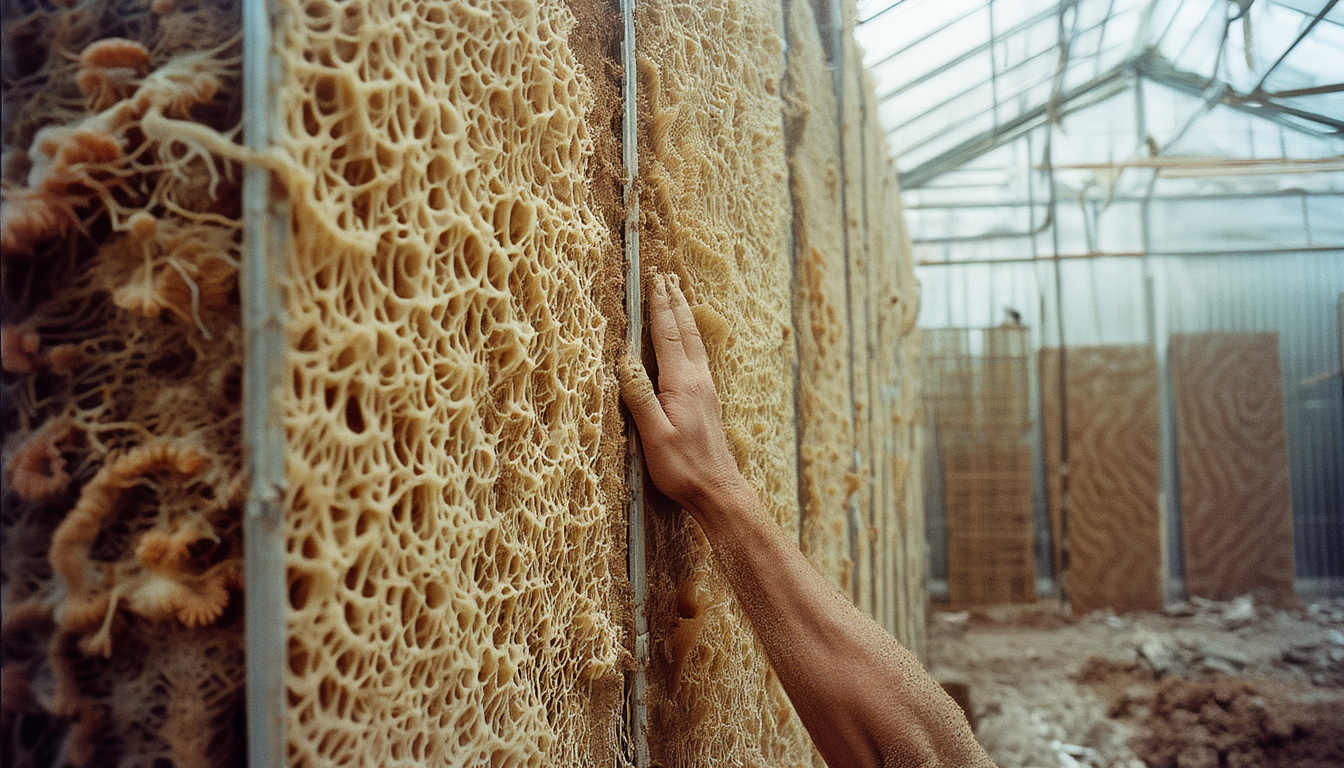
It is a wet Tuesday in March 2036, and Mara Voss is taking the temperature of a wall.
She presses a thin probe into a seam between two panels on the third floor of the Portland Living Campus and waits for the reading. The walls here are not poured or bolted. They were grown—fungal threads laced through hemp fiber, raised in a shed outside the city, trucked in while still alive. Mara is not a contractor. Her card says "structural steward," but everyone on site calls her a building farmer, and she does not correct them. The probe beeps. She frowns, makes a note, moves three meters down the corridor, and does it again.
Outside, the rain comes in off the Pacific. Inside the wall, in theory, something is responding to it—the living network firming up before the weather it can feel arriving. That is the pitch, anyway. Mara has learned to trust the probe more than the pitch.
A decade ago, a self-healing building was a lab curiosity. In 2025, engineers at Montana State University kept a fungus-and-bacteria material alive for over a month—long enough, they argued, that its cells might one day perform useful work like self-repair.1 They had not healed a standing wall. They had shown the cells could live long enough to try. By 2036, that "might one day" has hardened into Mara's job description.
The promise
The promise was beautiful, and most of it was even true.
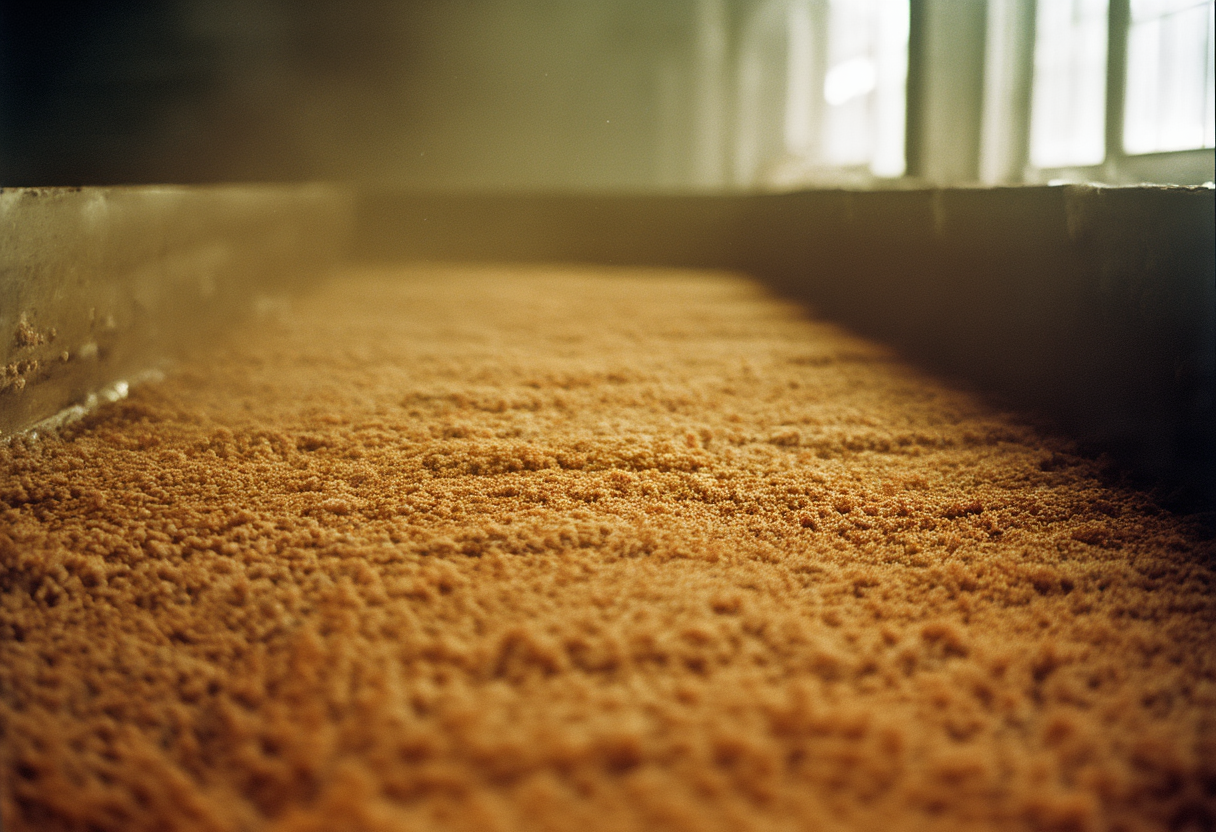
Buildings, in this telling, stop being extracted and start being grown. Instead of quarrying and smelting, you cultivate. Mycelium—the root-like web of a fungus—spreads through agricultural waste, binds it into panels, and is installed before it fully dries out.2 The market believed it. The mycelium bricks segment alone was worth about 1.7 billion dollars in 2024 and is forecast to roughly double, to 3.4 billion, by 2034.3
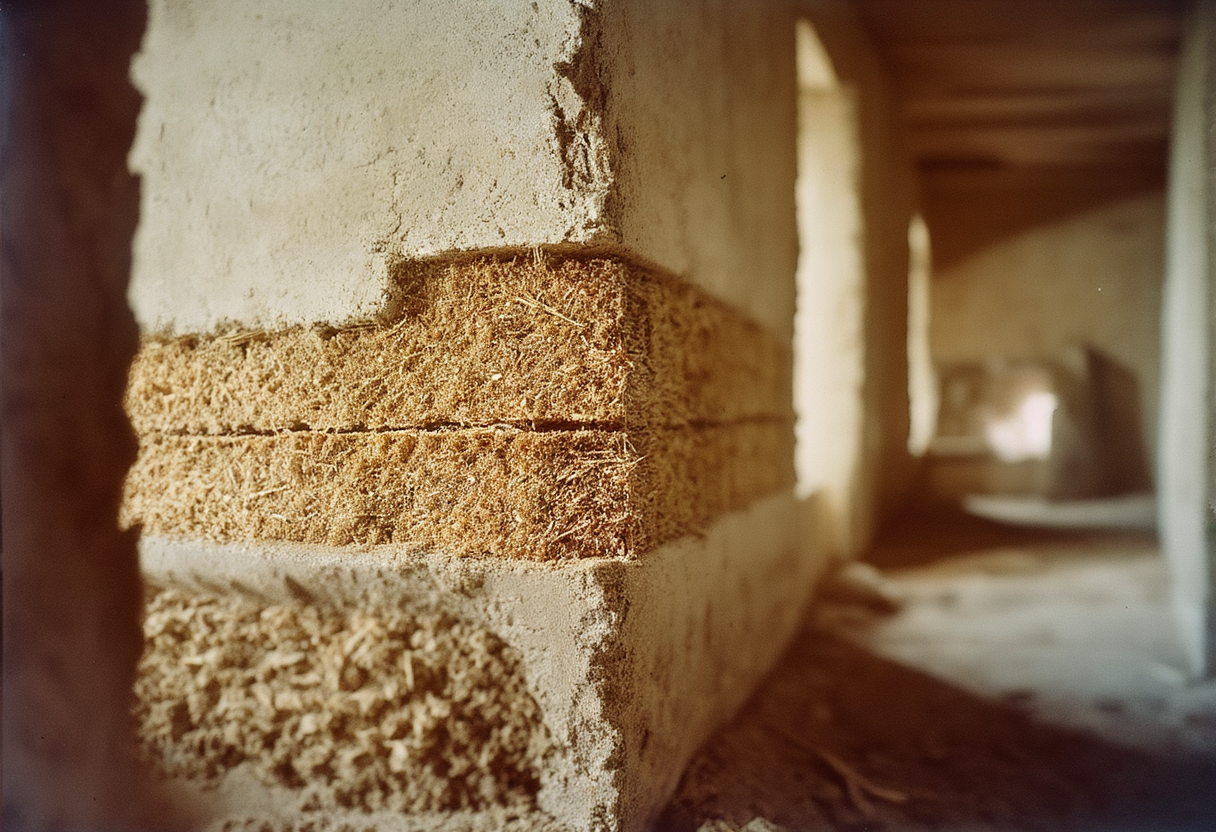
Then there is the carbon. Hempcrete—hemp stalk cores bound with lime—locks away carbon dioxide as it cures and over its life. Estimates vary with the recipe and the lifespan you assume, landing somewhere between 75 and 165 kilograms of CO₂ per cubic meter, with some studies claiming more.4 Multiply that across a city and the buildings stop being a carbon problem and start being, modestly, a carbon answer. Hempcrete's market is projected to reach about 34.6 billion dollars by 2030.5 In 2024 it was written into the model U.S. residential building code as Appendix BL, clearing a path for hemp-lime homes in the 48 states that base their codes on it—though each town still has to opt in.6
Mara likes this part of the story. It is the part she signed up for.
The mechanism
What nobody put on the brochure is that a grown building keeps the habits of the thing it was grown from.
It has a season. Mara's panels came from a harvest, and a harvest can fail. When traditional steel runs short, a mill adds a shift. When the hemp crop is thin, you wait a year. Construction schedules now bend around growing seasons the way her grandmother's vineyard bent around frost. A bad year for the crop is a bad year for the cranes. Even the engineered-wood cousins make the point: cross-laminated timber, the success story of grown construction, was on track to reach 4.1 billion dollars by 20327—proof biology can scale, and a reminder that everything in this supply chain still rots, burns, or gets eaten in ways steel never does.
It can also get sick. The same biology that lets a wall respond to humidity lets a contamination spread through it. A panel is less a manufactured product with fixed specs than a tray of seedlings—some thrive, some don't. The research that started all this is candid about the limits: these materials still aren't strong enough to replace concrete everywhere, and the self-repair that gives them their name was projected from cell viability, not shown in a finished structure.1 Mara's probe hunts the gap between the promise and the proof.
The turn
Here is where the beautiful idea curls back on itself.
A material that breathes is a material that can suffocate. The very adaptability sold as the headline feature is also the failure mode. Lean on one workhorse mycelium strain or one hemp variety across a whole building stock, and you have built a monoculture—and monocultures fall together. A blight that would have ruined a season's crop can, in this world, threaten a season's worth of buildings. The agricultural rule that biodiversity is what keeps you alive crosses over, quietly, into the safety code.
And the dependency runs deeper than blight. A steel beam, once installed, asks nothing of you. Mara's walls ask for her. Living buildings need continuous tending; without skilled care, they degrade in ways a steel frame never would. That care is expensive and scarce, which means the buildings that breathe best will be the ones in neighborhoods that can afford a steward on retainer. A technology pitched as planetary healing reverses, at its limit, into a new kind of inequality—and into the thing Mara least expected to be: not a builder but a nurse, on call to a structure that can die.
There is a land version of the same turn. Scale hempcrete far enough and the fields that feed people start competing with the fields that house them. Carbon pricing only sharpens the choice, making building-material crops more lucrative than food. The cleaner our walls, potentially, the tighter our pantry. And the knowledge itself is being fenced off: the technique of growing buildings is a thickening patent landscape, mapped study by study, with the United States, the EU, and China racing to own the methods.8 Ancestral ways of building with living material—bamboo, adobe, hemp—risk being repackaged as proprietary, the oldest craft turned into the newest license.
Back to the wall
Mara finishes the corridor a little before noon. The low reading on the third floor turns out to be a sensor seated wrong, not a sick wall—this time. She reseats it, watches the number climb back to where it should be, and exhales.
She thinks about her grandmother more than she expected to. The vineyard was beautiful and relentless; it did not care that you were tired, and one bad week could undo a year. Mara thought she'd escaped that life by going into construction. Instead she walks rows again, reading vitality off a tablet, hoping the weather holds. The building only knows it is alive, and that aliveness is both the gift and the bill.
The open question is not whether we can grow our cities. By 2036, plainly, we can. It is whether a civilization that builds with living things can keep tending them—every season, in every neighborhood, forever—or whether we have simply traded one fragility for another and called it progress.
Mara packs up the probe. Tomorrow there is another corridor, and the rain is not finished.
Author's Note: This is speculative journalism written from a vantage point in 2036. Mara Voss and the Portland Living Campus are fictional composites; no real person or building is depicted. Everything outside the scene—the materials science, the market figures, the carbon numbers, the building-code change—is real as of this writing and cited below. Where the 2036 details extend present research (self-healing walls in service, building monocultures, food-versus-shelter land pressure), they are clearly marked as projection, not fact.