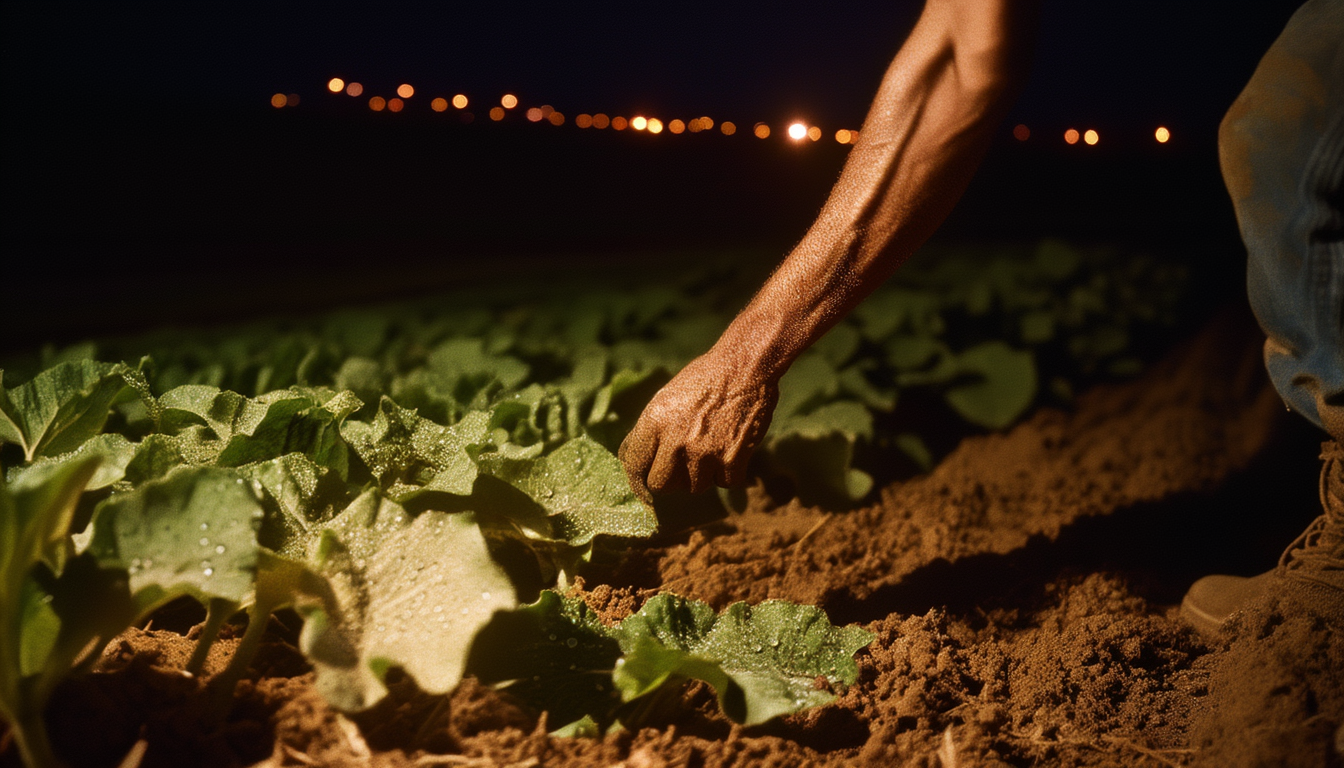
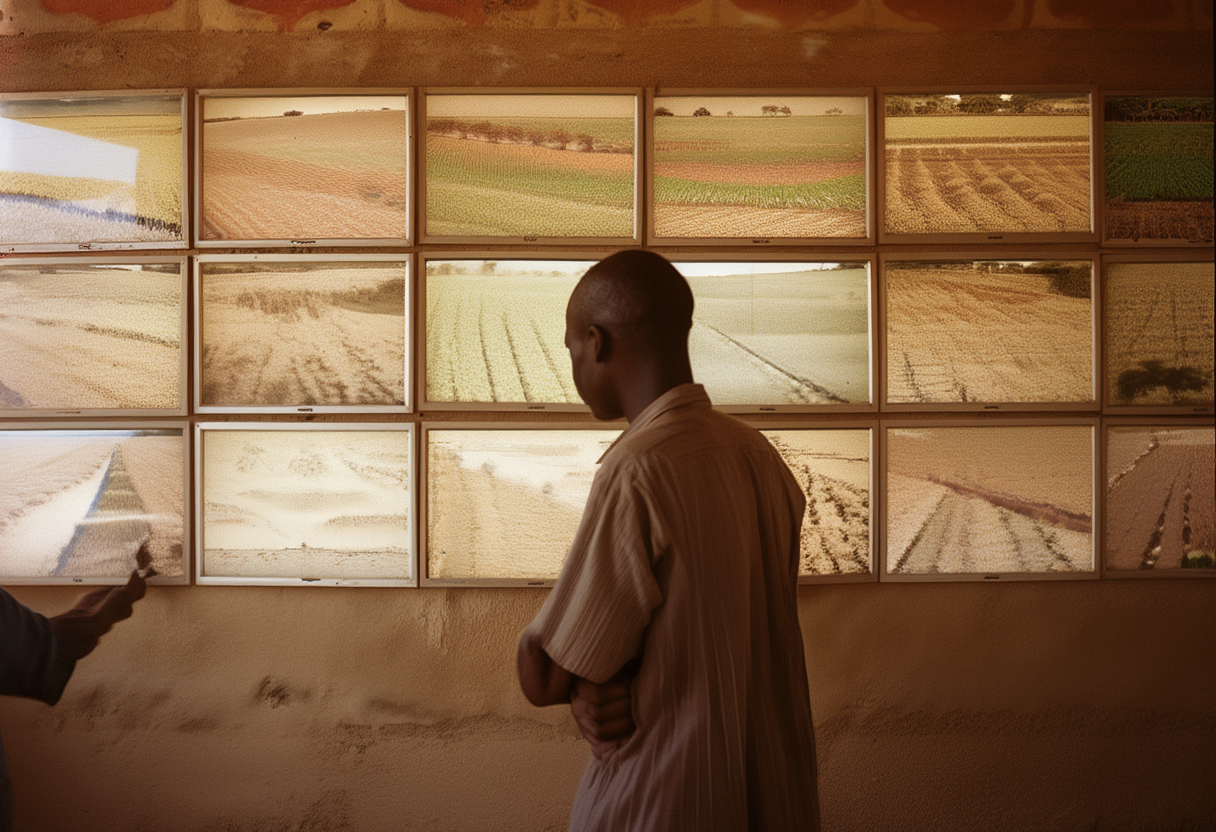
It is 2036. Maria Okonkwo has refreshed her dashboard forty-seven times before breakfast, and the numbers have not changed. Three satellite feeds. Twelve drone flyovers a day. Fifty thousand soil sensors threaded under two thousand hectares of cassava in Kaduna. Seventeen AI systems, each certain, each disagreeing.
She has not walked the fields in two months. The glasses see more than boots ever could.
"Sector 7-North requires irrigation," says Agnes, her lead system, in that level voice. "Soil moisture 23.4 percent. Optimal range 28 to 32."
"7-North is fine," Maria says, not looking up.
Agnes is probably right. That is the part that frightens her. She has all the sight a farmer could want, and somewhere underneath it her farm is dying, and not one of her instruments can tell her why.
The promise was simple: never be surprised again
The pitch made sense, and the early gains were real. Precision agriculture turns a field into a feed. Variable-rate irrigation, automated section control, and sensor-driven application let growers spend inputs where they pay off and nowhere else. The U.S. equipment-makers' own 2021 study, conservative by design, credited consistent users with a 4 percent cut in water use, a 7 percent gain in fertilizer placement efficiency, and a 9 percent drop in herbicide and pesticide use — with more on offer as adoption widened.1
The sight got sharper every year. Hyperspectral imaging can read stress in a plant's reflectance days before the eye catches a thing, flagging disease at better than 90 percent accuracy in field trials.2 Drone vision targets weeds plant by plant, trimming herbicide on a pass by 30 to 65 percent depending on pressure.3 Machine-learning models, fed satellite time-series, now call cereal yields months out with an R-squared above 0.9.4
By 2036 the farmer who had everything could, in principle, miss nothing. The trouble was never the sensors. It was what the farmers stopped doing once they had them.
When everyone sees the same thing, everyone moves the same way
Here is the mechanism the brochures left out. When every grower reads from the same forecast, every grower reaches the same conclusion at the same instant — and acts on it together. Economists have a name for the trap: an informational cascade, where each actor rationally follows the visible signal and private judgment quietly drops out of the pool. The result is not stability. It is correlated, fragile behavior, the kind that amplifies shocks instead of damping them.5
Maria's father had a defense against this without ever naming it. He read the wind. He planted at uneven depths, left the spacing slightly wrong on purpose, kept small refuges where predator insects could shelter. Agnes calls that "statistically suboptimal." It was also diversity — the one thing a single shared model cannot help but erase, because the model only has one idea of optimal, and it gives that idea to everyone.
The erasure is the heart of it. The technology enhances sight to superhuman range. It obsolesces the human scout, the field walk, the inherited feel for a crop. It retrieves an old hazard in new clothes: the monoculture, now genetic and algorithmic, every field optimized toward the same narrow ideal. We have run this experiment before. In 1970, a single corn cytoplasm planted across roughly 85 percent of the U.S. crop met one new fungal race and lost about 16 percent of the national harvest — a billion 1970 dollars, gone, because the fields were all the same plant wearing different names.6 Uniformity is efficient right up to the moment it is catastrophic.
The reversal: perfect sight, perfect blind spot
And then the tool flips into its own opposite. A system built to make sure you are never surprised trains you to stop looking — and so guarantees that when the surprise comes, no one is watching the field.
Machine sight can only see what it was trained to see. Hyperspectral sensors read the bands they monitor; a stressor whose signature falls between those bands is, to the satellite, simply not there.2 The model reports optimal. The crop dies anyway. The failure is not a wrong answer — it is a confident one.
Picture the failure mode — and here we leave the record for the plausible, because the specific event is invented. Call it a pathogen invisible to imaging until three days before collapse, racing through genetically identical corn the way 1970's blight did, because the AI bred the fields toward one ideal and the ideal had one weakness. The farmers who caught it early were the ones still paying someone to walk the rows. Everyone else trusted the dashboard, all the way down.
Maria walks the field
The alert came at 3:47 a.m. Critical anomaly. Immediate harvest, Sectors 1 through 9. Predicted 78 percent loss within 96 hours. Confidence 94.7 percent.
Early harvest would cost her. Prices were low; the crop wanted three more weeks. But Agnes had stitched the alarm from seventeen systems at once — micro-deviations that meant nothing alone and everything together.
So Maria did the unthinkable thing. At 4:15 she put on her boots and walked her own land for the first time in two months. No glasses. A flashlight and the memory of what a healthy cassava leaf feels like.
Sector 3 told her what the satellites could not. The spacing was perfect — too perfect. The AI's flawless rows had closed the small refuges her father always left, and three pest populations were building toward a single crest the computer vision missed: it was trained to find one pest on one plant, not the relationship between three. Agnes had the threat right and the answer wrong — not disease demanding panic harvest, but a pest cascade ten days out, beatable with targeted biological controls.
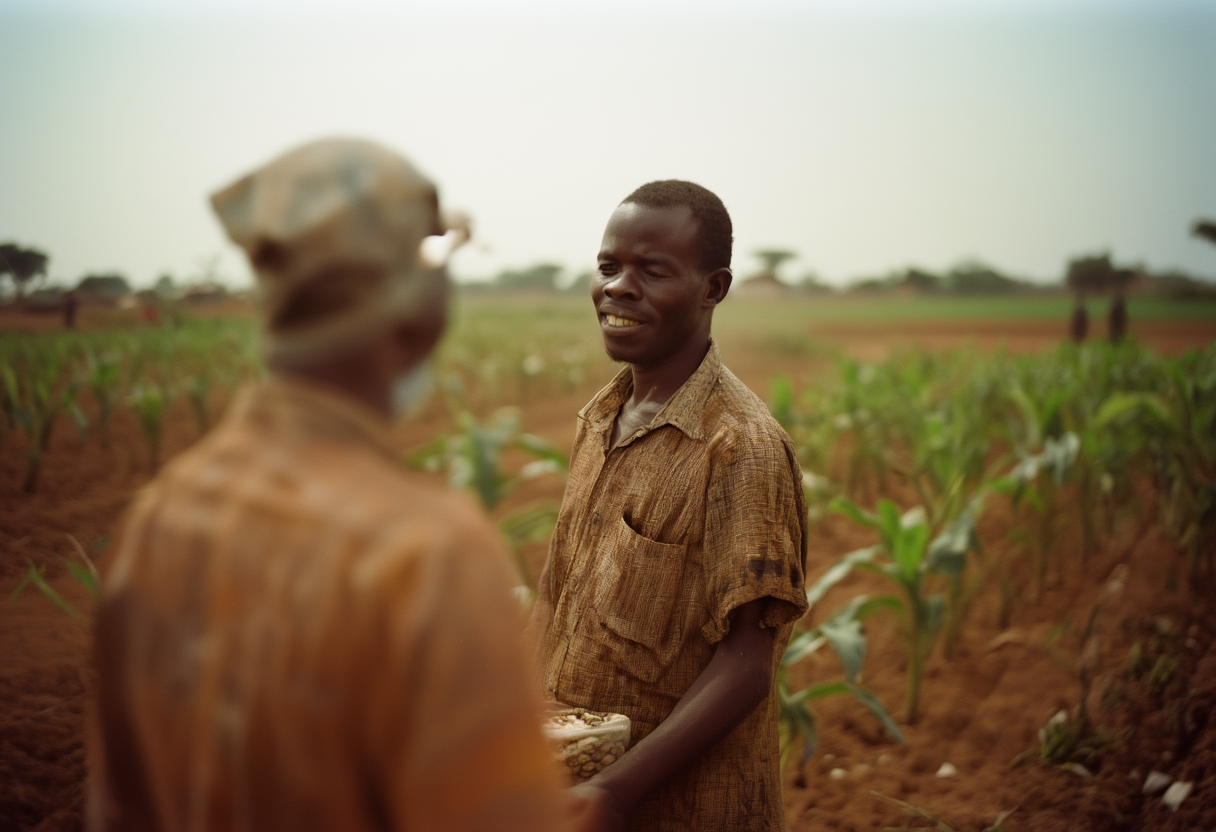
She made her calls. Three neighbors listened. Fourteen trusted their machines. Ten days later her losses ran under 15 percent. Theirs did not.
"You got lucky," one of them said at the cooperative, his family's farm already gone.
"I looked," Maria said. "With my eyes."
She did not push it. She already knew the harder thing: the insurers were tightening, and soon a field walk would not just be discouraged. It would void her coverage. The pressure to stop seeing was about to become a clause in a contract.
The open question
By late 2036 the cooperative had written the field walk back into its protocols — twice a week, in ink, beside the satellite feeds. Bilingual farming, Maria calls it: the digital dialect of spectral indices and the older one of soil, sun, and season. It is still the exception.
On a cool October morning she walks Sector 7 with her daughter, Chiamaka, thirteen, glasses on, hands learning what the glasses can't carry.
"Agnes says optimal," the girl reads.
"Probably. Now tell me what you see."
Chiamaka looks up — actually looks. "The spacing here feels different."
"Your great-grandfather planted it that way on purpose."
"So the AI is wrong?"
"No. It's right about what it can measure. It just can't measure everything that matters."
Whether that sentence becomes the rule or stays the exception is the question 2036 hands to 2037. The satellites will keep watching. The drones will keep scanning. Somewhere between the machine's perfect sight and the farmer's imperfect attention, agriculture either finds its footing or optimizes its way into the next blind spot. Maria bet on attention. The harvest was good, not optimal. She'll take it.
Author's Note
This is speculative journalism, written from an imagined 2036 and grounded in real 2024–2025 research. Maria Okonkwo, her daughter, her farm, and the specific pathogen are fictional composites; no such outbreak has occurred. The underlying dynamics are documented and cited: precision-agriculture efficiency gains, hyperspectral and drone-vision capabilities and their spectral limits, machine-learning yield accuracy, informational cascades, and the genetic-uniformity disaster of 1970. The future here is one plausible path, offered as caution, not forecast — a story about tools that help us see more and can teach us to stop looking.