
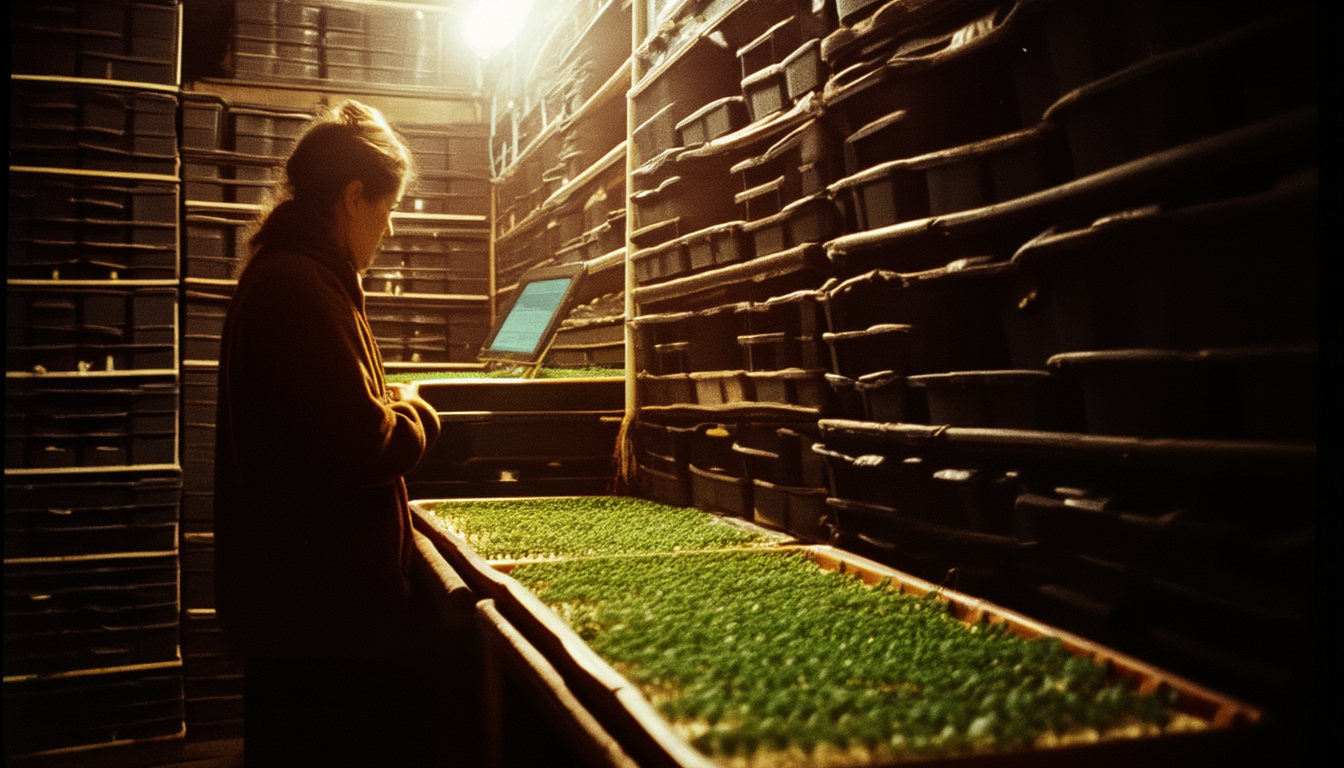
The bin rises out of the grid at 6:12 in the morning, and Rosa Tapia knows it is wrong before the screen does.
It is a black polymer tote, roughly two feet square, cold enough that the rim beads with water in the Phoenix summer. It arrives at the Port, the single opening in the whole structure where anything goes in or out. Above her, in the dark, machines run on rails across the top of the stack, pulling bins the way you pull one card from the middle of a deck.
The screen at her elbow gives the tray's life in eleven characters and four numbers. Day 13 of 15. Canopy uniformity, 0.94. Nutrient conductivity, in range. Status: PASS.
Rosa leans in. Along one edge of the tray, the micro-basil is standing about half a centimetre too tall, and the green has gone the colour of weak tea. That is etiolation, the stretch a plant makes when the light falls short of what it expected. The cameras score the canopy from directly above. A tray that grows upward looks, from above, like a tray that is doing fine.
She taps REJECT. The bin drops back into the dark.
"That one would have shipped," she says. "It would have been fine. It just wouldn't have been good."
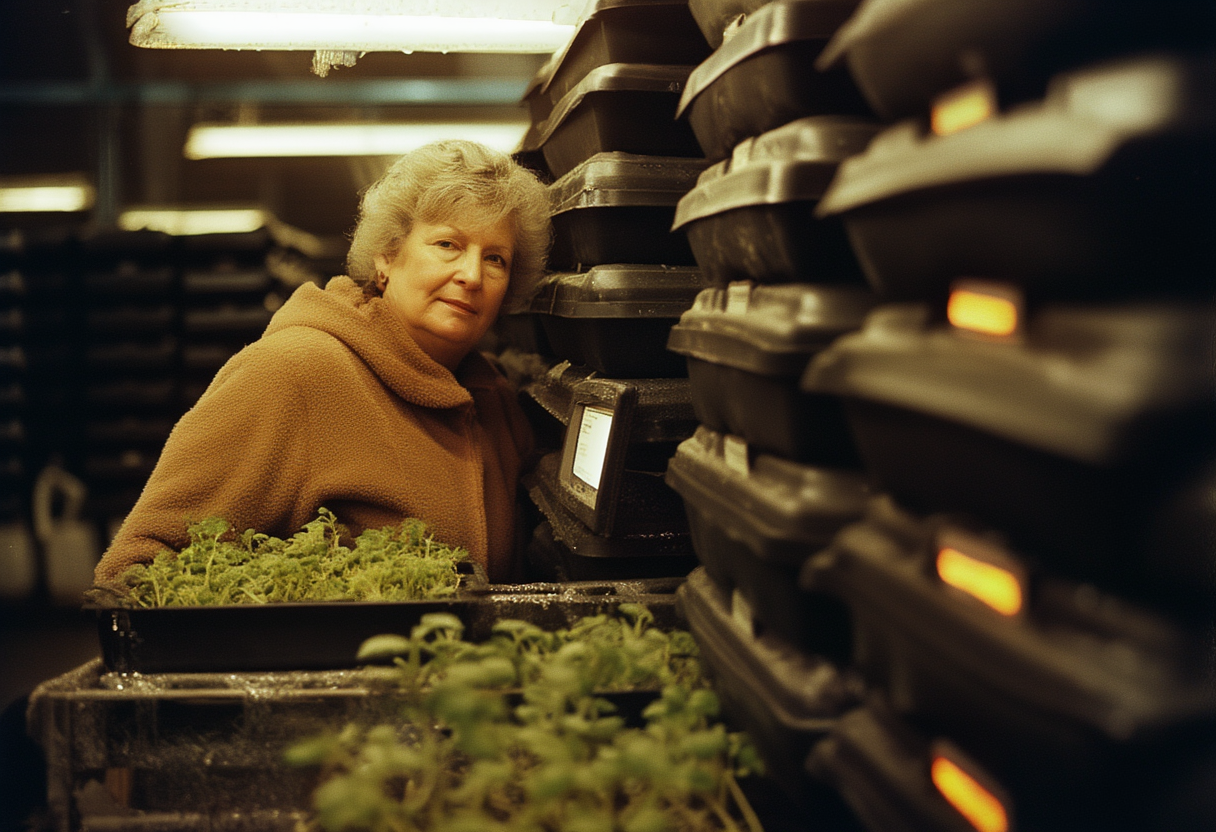
Rosa is forty-eight. For twenty winters she cut lettuce in the fields outside Yuma, Arizona. She is not sentimental about it. Ten hours bent at the waist, a knife, a band, a box, then the season ended and so did the money. Her lower back still argues with cold mornings.
So when she says the building she works in now is better, she means it. And when she says it is not really a farm, she means that too.
The measurement that made it look inevitable
The idea Rosa works inside was demonstrated publicly in May 2025. AutoStore, the Norwegian warehouse-automation company, put its cube grid inside a growing facility run by OnePointOne of Avondale, Arizona. The site was called Opollo Farm, the retail brand Willo, and it supplied select Phoenix-area Whole Foods Market stores. The installation was about 1,000 square feet and held roughly 1,000 bins, with robots working the top surface.12 AutoStore and OnePointOne said the system could take greens from seed to harvest in 15 days, use up to 95% less water, and cut production costs by 60% for microgreens, 40% for basil and 20% for packaged salads.13
The water number was not marketing invention. In 2015, researchers modelling greenhouse hydroponic lettuce in Yuma, Arizona found it used 20 litres of water per kilogram against 250 litres for conventional field growing, and yielded about 11 times more per square metre.4
The same study, in the same table, found the hydroponic system used 82 times more energy.4
That sentence is the whole decade. The water figure went on the pitch deck. The energy figure went in the appendix.
Why automation did not save anyone
By 2020 much of the money had settled on labour as the missing piece. Growing indoors cost too much because people had to walk the aisles, so the answer was robots. It was a clean story, and it was wrong.
A 2018 Wageningen study put it plainly. A plant factory burned 247 kilowatt-hours of electricity per kilogram of lettuce measured as dry weight, meaning the plant with its water removed. A Dutch greenhouse using daylight needed 70.5
Then the failures arrived, and the pattern was unkind. Fifth Season, a startup whose whole identity was robotics, shut down in October 2022.6 Kalera filed for Chapter 11 bankruptcy in April 2023,7 AeroFarms in June,8 AppHarvest in July, converting later to liquidation.9 Bowery Farming, which had raised more than $700 million at a $2.3 billion valuation, simply ceased operations in early November 2024 and laid off 187 workers.10 Plenty filed Chapter 11 in March 2025.11
Britain told the same story with better irony. Ocado, the online grocer that built its business on warehouse robotics, owned about 70% of Jones Food Company, the country's largest vertical farm. Jones Food entered administration, the UK insolvency process, in April 2025, with 61 redundancies.12 Vertical Future, a firm that sold the automation itself, went into administration that August after turnover collapsed from £6.7 million in 2023 to £691,000 in 2024.1314 GrowUp Farms entered administration in December 2025, its group owing creditors roughly £120 million.15 Investment in the category that held vertical farming fell 53% in 2024 against the year before.16
Automation saved nobody. The operators that spent hardest on robotics spent it on a constraint that was never binding, and none of that capital touched the electricity bill.
The floor nobody could engineer under
In 2025, researchers at the Weizmann Institute worked the problem from energy first principles and found a floor. Growing plant matter indoors cannot get below roughly $10 per kilogram of dry matter, before any building, machine or wage is counted. Farm-gate cereals and pulses sell for under $1 per kilogram, sometimes as little as $0.10.17 That is a gap of two orders of magnitude, and no robot closes it. Indoor wheat, modelled in 2020, could yield extraordinary amounts per hectare and still lose money at real prices.18
The land argument inverted too. A 2025 review of 116 studies across 40 countries found that US controlled-environment agriculture, meaning growing under managed light and climate, supplied under 1% of the country's food crops while using more energy than all open-field cultivation combined. Solar-powering it would need about three times more land than farming outdoors.19
The technology was never bad at growing. In a 2018 contest at Wageningen, an AI-run greenhouse compartment outgrew expert Dutch growers on cucumbers.20 It was just being asked to grow the wrong things.
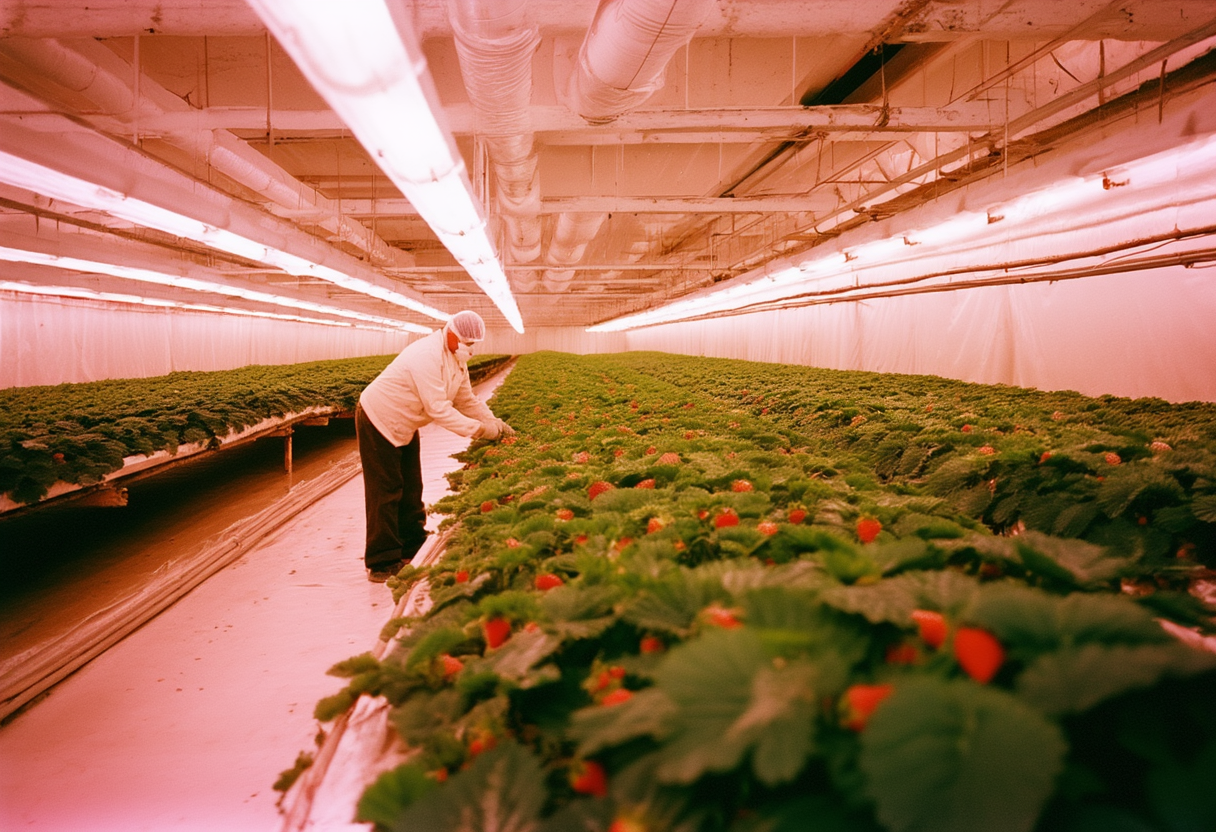
What lived through it sorted by price per kilo. Oishii, selling premium Japanese-variety strawberries, closed the first tranche of a $150 million Series C in May 2026.21 Plenty came out of restructuring in May 2025 as a strawberry company growing for Driscoll's.11 In Japan, Spread's Techno Farm Keihanna has produced around 30,000 heads of lettuce a day since opening in 2018.22
None of this was new information. US controlled-environment operations roughly doubled between 2009 and 2019, and in both years 60 to 70% of the crop was tomatoes, lettuce and cucumbers.23 The concentration was visible for a decade before anyone called it a lesson.
The last unautomated thing
Rosa's shift ends at two. In eight hours she has rejected nine trays and released about four hundred. The building promises freshness measured in hours, and it keeps that promise. The greens go into a truck already inside the same distribution centre. Nothing about that is fake.
What is strange is what she is growing. Micro-basil. Sorrel. Purple radish tops that go on a $19 salad. Garnish with excellent logistics. In Yuma she cut a thing people ate to be full. Here she inspects a thing people eat to feel a certain way about dinner.
She knows what the machine is good at, which is nearly everything, all the time, without complaining. And she knows what it cannot do, which is see a tray from the side.
Her badge says Quality Associate. There is no line item anywhere in the building for twenty years of reading a leaf. When she retires, the seeing goes with her, and nobody has written down how to replace it.
I asked whether she would teach someone. She thought about it a while.
"Ask me what they'd pay," she said.
Author's Note
Rosalva "Rosa" Tapia is a fictional composite. So is the 2036 grocery distribution centre she works in, and the unnamed operator that employs her. The idea that cube-grid growing modules would be installed at scale inside distribution centres is speculation, extrapolated from a single real 2025 installation. No 2036 outcome is asserted for any real company named in this piece.
Everything else is real and sourced: the AutoStore and OnePointOne installation and its stated claims, the Yuma lettuce study, the Wageningen energy comparison, the bankruptcies and administrations, the funding decline, the survivors, and the USDA crop figures. Where a company made a claim rather than a researcher publishing a finding, the text says so. The 2034 scene in Figure 2 is imagined, as is Figure 1.