
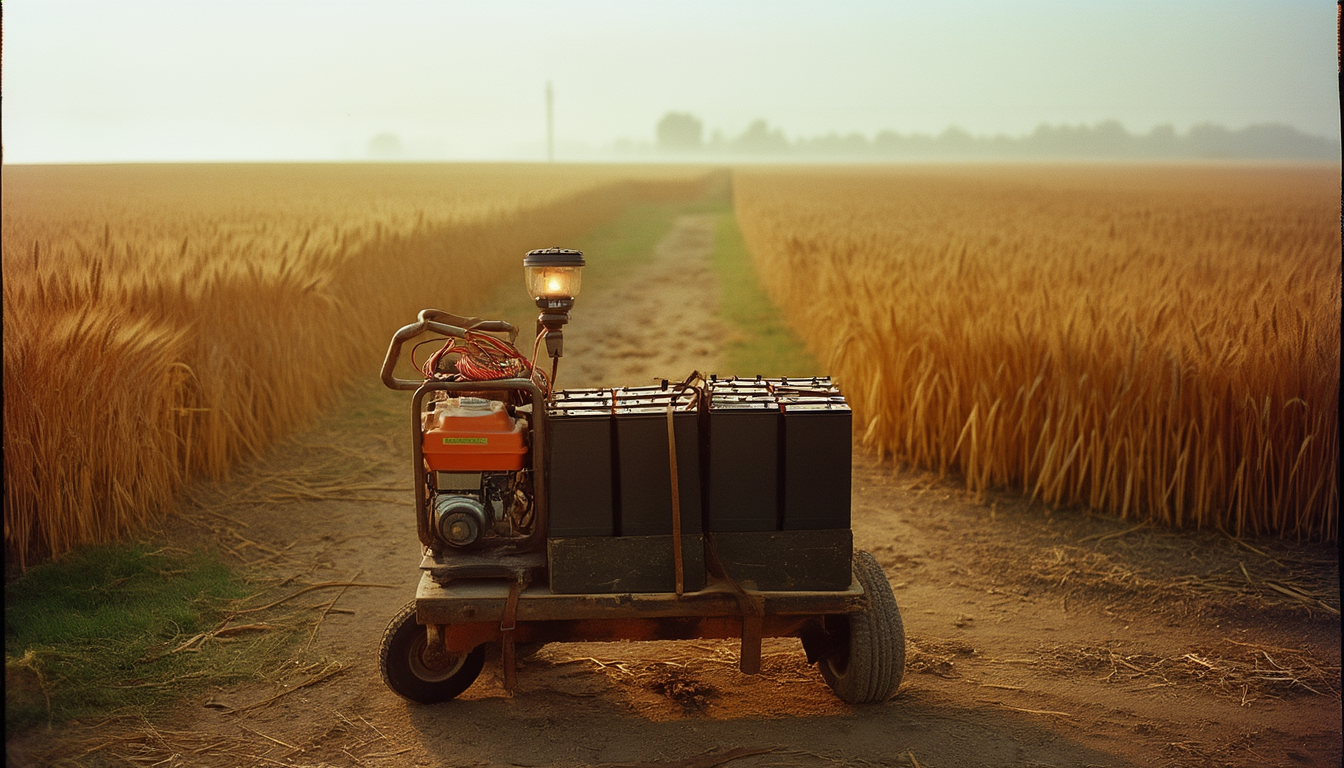
The trolley goes out before the light does. Thirty-eight battery packs in two rows, a small generator strapped at the base, a charging harness coiled over the handle, and the whole thing pushed along the field margin by a man named Ding Haoran, who is forty-four and has been flying other people's fields since he was twenty-five. The packs are the job. A two hundred mu block takes thirty to forty changes, one every five to eight minutes, and the rhythm of the work is not flying but swapping, walking, swapping, until the sun is up and the wind comes and the spraying window closes.1 He works from a phone. Calls and messages, no platform, the same way it was done in 2024.
What he is paid for a mu is the number that tells the story. When he started, spraying contracts cleared more than ten yuan a mu. Then five and a half. Then four and a half. By the middle of the 2020s the floor in his part of Jiangsu was three and a half yuan, and on jobs that needed travel and a night's lodging it stopped covering itself.1 A good year still grosses well over three hundred thousand yuan. The machine is replaced almost every year, because constant flying burns the motors out, and the first one he bought in the late 2010s, with its generator and spare packs and insurance, cost a little over ten thousand yuan.1
The promise made to him was national, and it was explicit. At the Central Rural Work Conference in December 2022 the general secretary said the red line of 120 million hectares of arable land must be kept, that special attention must be paid to farmland and seeds, that major varieties must be kept firmly in the country's own hands, and that agricultural development consolidated the foundation of national security.2 A year later that language acquired teeth. The Food Security Law, adopted on 29 December 2023 and in force from 1 June 2024, requires that grain be basically self-sufficient and staple grain absolutely secure, makes provincial governments answerable for cultivated land protection in their jurisdictions, and provides that officials who fall short can be summoned to a responsibility interview. Article 66 is the one that reaches the field: plant something non-compliant on protected farmland and the grain production subsidy can be withdrawn.3
It worked, by the measure it set itself. The National Bureau of Statistics recorded 706.50 million tonnes of grain in 2024 and 714.88 million in 2025, a third consecutive record. The machinery arrived with it. By 2026 somewhere between 2.7 and 3.5 million agricultural machines were running BeiDou satellite guidance, depending on which ministry you asked, off more than five thousand ground augmentation stations that deliver a centimetre-grade fix in two minutes in the northeast and five minutes elsewhere, holding better than 2.5 centimetres on a straight line and between rows.4 More than three hundred thousand spray drones were in service, covering over 460 million mu a year. The comprehensive crop mechanisation rate reached 76.7 percent and improved-variety coverage passed 96 percent.5
Ding never saw the policy. He saw the consequence of it, which was that the fields got bigger and the people in them got older and fewer. The average age of the agricultural labour force was forty-six, with two thirds of it between forty and sixty and only 4.8 percent born in the 1980s.6 By 2025 there were 301.15 million migrant workers, and the rural resident population had fallen to 451.09 million, under a third of the country.7 Nearly 98 percent of Chinese farmers worked holdings smaller than two hectares.8 A household that size cannot buy a guided tractor. What it buys instead is somebody's machine time. By the early 2020s there were roughly seventy-four thousand mechanisation cooperatives, two hundred thousand hire-service organisations and 4.24 million specialised service providers, together earning 473 billion yuan a year.6 In one Jiangsu survey of 1,839 households, 1,583 of them bought at least one such service, and the average head of household was sixty-one.9
That is the quiet part of the transformation. Modernisation did not arrive as a tractor. It arrived as a contractor, and Ding was the contractor. He owned the machine and not the land, and the land owned the subsidy. The 2026 policy document said the optimal machines should receive the optimal subsidies, which is a sentence that reads very differently to a man replacing a burnt-out airframe every spring than it does to an operator with forty units and a service contract.10
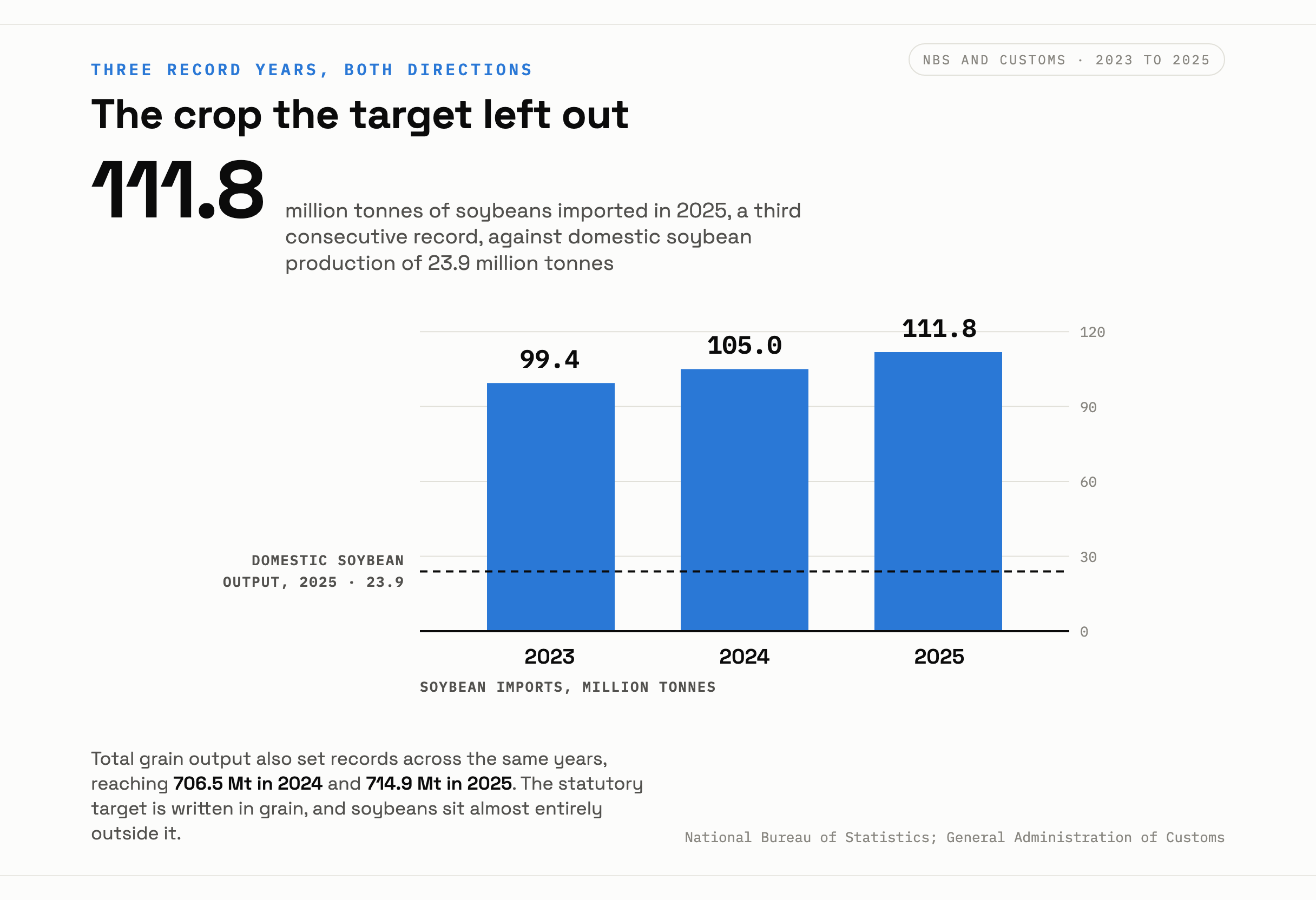
That one chart is the whole argument. Grain output set records in 2023, 2024 and 2025. Soybean imports set records in the same three years, 99.4 million tonnes, then 105.0, then 111.8, with Brazil supplying something close to nine tenths of the 2025 total against domestic soybean production of 23.93 million tonnes.11 Basically self-sufficient was a definition, and the definition excluded the crop the country depended on most. Nobody was lying. The statute set the target in grain, and grain is what was delivered.
What the technology did on Ding's own terms is also narrower than the announcements. Official figures credited drone spraying with cutting pesticide use by twenty to forty percent. A prefecture-level study across 2018 to 2023, published in 2026, put the real reduction at 1.11 kilograms a hectare, which was 7.6 percent of the mean, and found that denser drone coverage came with measurable gains in biological abundance and species richness.12 A genuine benefit, a fifth the size of the claim. Meanwhile the price of the harvest fell out from under everybody. In late August 2024 procurement prices had corn down 18 percent year on year at 2,306 yuan a tonne and wheat down 14 percent, with analysts expecting corn to trade below the cost of growing it.13 The year the machinery story was at its most triumphant was the year the margin went.
The last thing to arrive was the record of it. A 2026 action plan from the cyberspace office, the agriculture ministry and the industry ministry set out digital archives of cultivated land, a trusted agricultural data space, and a certification system for smart farms, against a baseline in which actual digitalisation of primary production stood at 10.78 percent and one researcher found that ninety-nine percent of the data she collected across fifteen sites in 2024 was unusable.14 The apparatus that proves a plot is still growing grain is the same apparatus that proves a province held its red line. It is a satellite view of a field, and it does not show Ding at all.
He is still licensed, which puts him in a minority. As of June 2024 the country had 1.875 million registered unmanned aircraft and around 225,000 people certified to fly them, and the aviation and agriculture ministries only issued joint rules on training agricultural operators in January 2025.15 Most of the machines in those fields were flown by somebody without the paper. Ding has the certificate, the aviation regulations and the meteorology, and the certificate is now worth roughly what the spraying is, which is three and a half yuan a mu.
The open question in 2036 is not whether the rice bowl is held in Chinese hands. It is. The question is whose hands those are. The land is contracted to households that mostly do not farm it, worked by contractors who mostly do not own it, guided by satellites nobody at the field margin controls, and audited by a data layer that counts hectares rather than people. Ding pushes the trolley out before the light because thirty-eight packs is what the block takes, and because the window closes when the wind comes up, and because the fee is the fee. The food security is real. So is the trolley.
Author's Note
This piece is speculative journalism written from the vantage of 2036. Ding Haoran is a fictional composite; the working conditions attributed to him, including the per mu fee range, the battery change interval, the annual machine replacement and the cost of a first drone, are drawn from reported accounts of Chinese agricultural drone contractors and are sourced below. The statutes, policy documents, official statistics, procurement prices and peer-reviewed findings are real and sourced. Where official and independent figures disagree, both are given. The 2036 framing of the open question is the author's, not a sourced projection.