
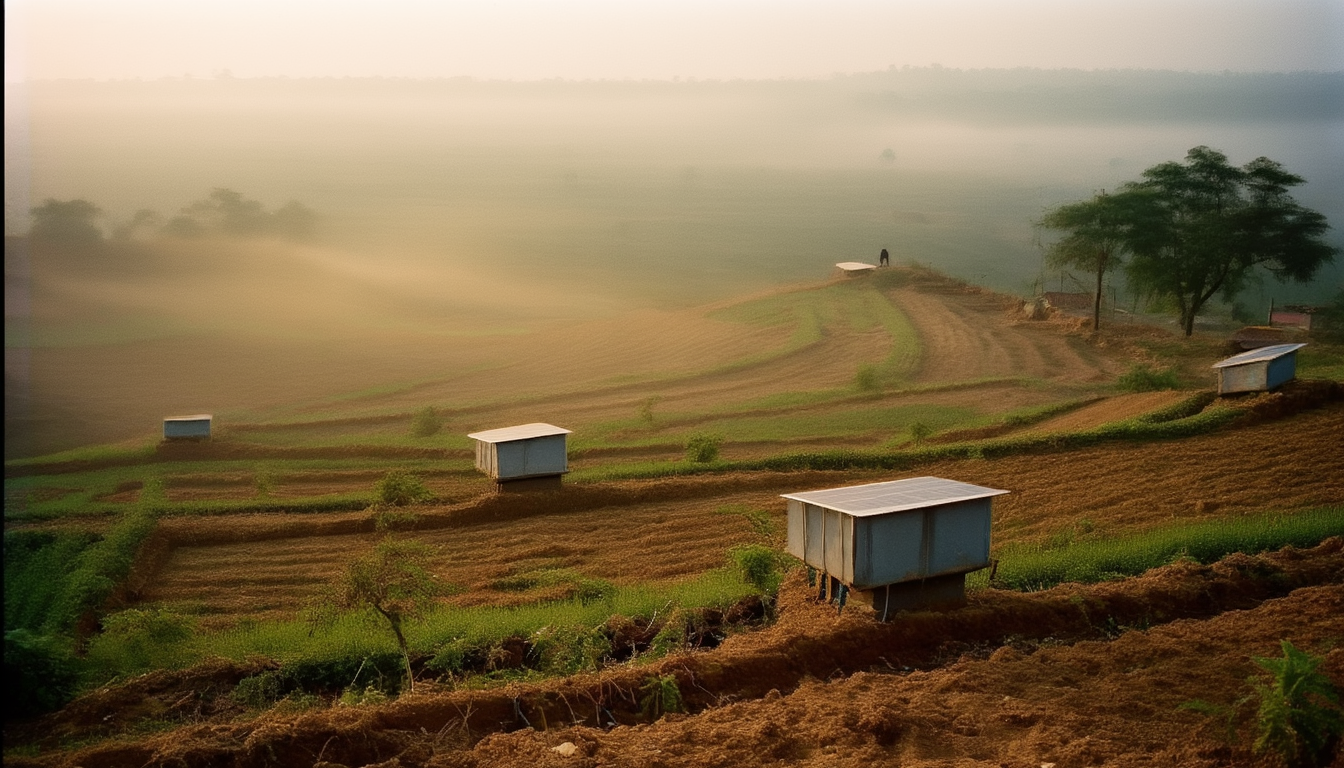
Lakshmi Baraker stopped trusting the box the morning it agreed with every other box in the valley.
It was a gray brick the size of a paperback, bolted to the head of her irrigation line, a small solar panel angled at the sky above it. Inside was a camera, a cheap chip, and a model that had never once phoned home. For four seasons it had watched her two hectares outside Belagavi and made small decisions no human had time to make: open this valve now, hold that one, the leaf curl on the third row reads like early blight, spray at dawn. It did all of this without a signal bar. That was the point. That was why she had bought it.
By 2036 the box was ordinary. You could find one on nearly any small farm in northern Karnataka, and on farms like it across the places where most of the world's food actually comes from. Small family farms grow roughly a third of it on around twelve percent of the land.1 For a long time the tools meant to help those farms assumed a thing those farms did not have, which was a reliable connection. Only a quarter to a third of farms under one hectare had usable 3G or 4G coverage, against three-quarters of the largest operations.2 The advice, the analytics, the subscription dashboards all lived in a data center a farmer could not reach.
The chip that could see
What changed was that the seeing moved onto the farm.
The models got small enough to run on hardware that cost less than a good pair of boots. Researchers had been shrinking crop-vision networks for years, fitting disease classifiers onto microcontrollers with a few hundred kilobytes of memory and getting real answers back in a fraction of a second.3 Lightweight vision transformers, tuned to run at postage-stamp resolutions, learned to tell a healthy canopy from a sick one and a spray day from a wet one on the device itself.45 No round trip. No monthly fee. The camera looked, the chip decided, the valve moved.
Around that core grew the rest of it. The box talked to a soil probe, a weather sensor on a post, and, on the bigger plots, a spray drone that lifted off on its own schedule. The industry had a tidy name for the whole arrangement, Agriculture 4.0, and a tidy promise: sensors and smart devices closing the loop from watching to acting without a person in the middle.7 The drones alone became a market analysts expected to pass seventy billion dollars within the decade.6 For Lakshmi the pitch was simpler and truer than most pitches. The box gave her back something the dashboards had quietly taken, which was the ability to run her own field without asking permission from a server she would never see.
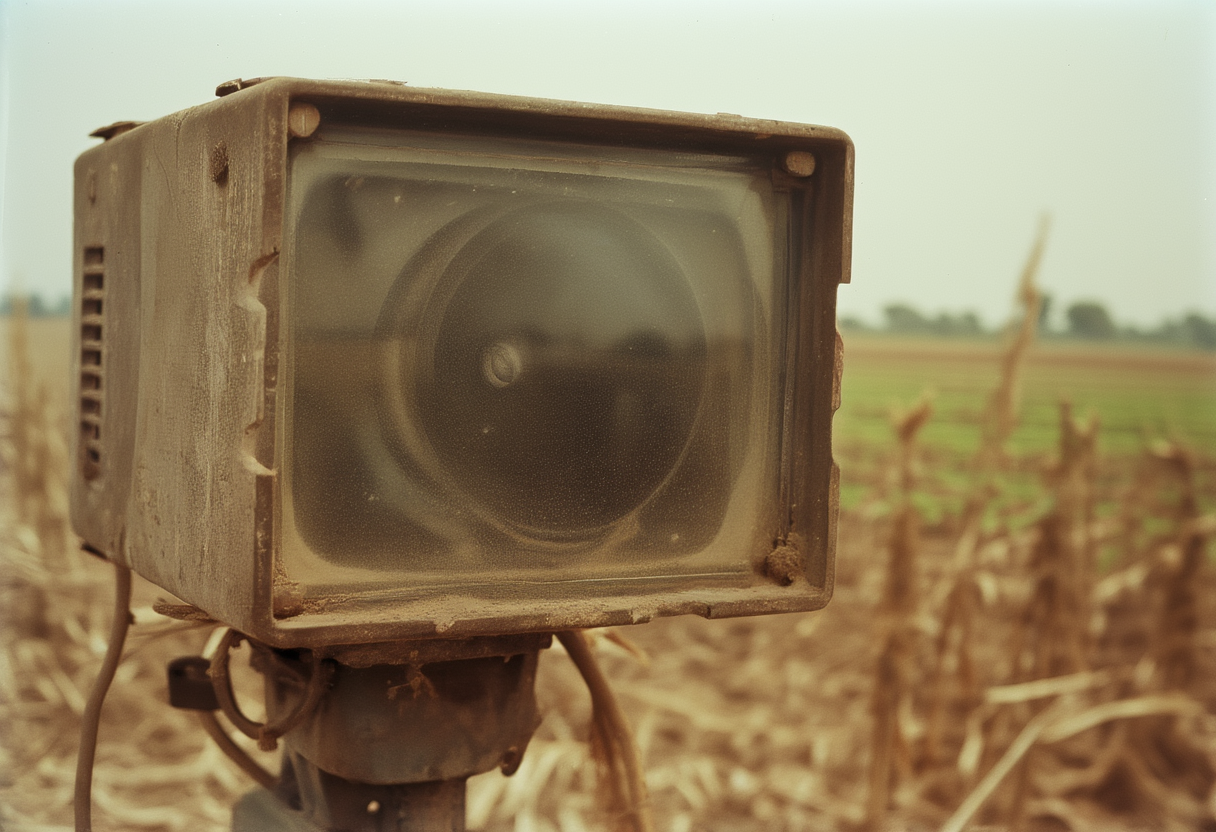
Figure 1. A first-generation on-valve inference unit, Belagavi district, March 2033. The camera classified crop and sky locally; the model weights shipped preloaded and were rarely updated. Photograph, What If? field archive.
What it gave back, and to whom
For three years it felt like independence.
The box did the tedious watching that used to eat a morning. It caught a fungal outbreak on a neighbor's chilies days before the neighbor did. It read the sky and held water on a day that looked dry and turned out not to be. It obsolesced the subscription dashboard, the once-a-season visit from an agronomist whose fee was half a harvest, the guesswork of a farmer squinting at a leaf. In doing that it handed back something older, the close daily attention to a single plot that industrial farming had spent a century training out of people. Only now the attention lived in a chip, and the chip was very sure of itself.
That certainty was the part nobody read the fine print on. The box was confident because the model was good, and the model was good because it had been trained once, carefully, on a large shared dataset, and then copied. Every box in the district ran the same weights. That is what made them cheap. It is also what made them, without anyone deciding it, a single mind wearing ten thousand bodies.
The morning they all agreed
A pest arrived in the valley that the training data had never seen. Not a dramatic one, a small sucking insect that mottled leaves in a pattern that looked, to a model tuned on older blights, like ordinary heat stress. The correct response to heat stress is water. The correct response to this pest was not water; water spread it.
So on a warm morning in the fifth season, the boxes did what they were built to do. They looked, they classified, they acted. And because they were all the same model reading the same unfamiliar thing, they did not make ten thousand small independent errors that would average out across the valley. They made one error, together, at the same hour. Valves opened across the district on the same wrong reading. The failures were not scattered noise. They were synchronized.
This is the trap that researchers of algorithmic systems had named well before it reached the fields: when everyone relies on the same model to make the same call, the individual gains in accuracy can leave the whole system more fragile, because a single blind spot is now everyone's blind spot at once.8 Digital agriculture had been warned, gently, that scale and sameness were not the same thing as resilience.9 The warning did not travel as fast as the hardware.
Lakshmi's box opened her valve too. She was standing in the row when it did, close enough to see the mottling the model could not name, and she reached down and shut the water off by hand. Across the valley, most of the boxes ran unattended, exactly as sold. The plots that did best that season belonged to the farmers who had never fully stopped walking their own fields, the ones who treated the box as a second opinion instead of the only one.
The device that promised to give a farmer her judgment back worked best, in the end, for the farmers who had kept theirs.
Author's Note. Lakshmi Baraker is a composite, and the fifth-season pest outbreak is a scenario, not a reported event. They stand in for a real and documented tension: the same edge-AI systems that make on-farm intelligence cheap and offline also push every farm toward the same model, and shared models fail in shared ways. The technical capabilities described (on-device crop and weather classification, sub-second inference on microcontroller-class hardware, autonomous irrigation and spray loops), the smallholder and connectivity figures, the market trajectory, and the algorithmic-monoculture risk are all drawn from the sourced work below and reflect the state of the field in 2024 through 2026. The valley of 2036 is where those lines, extended, appear to point.