
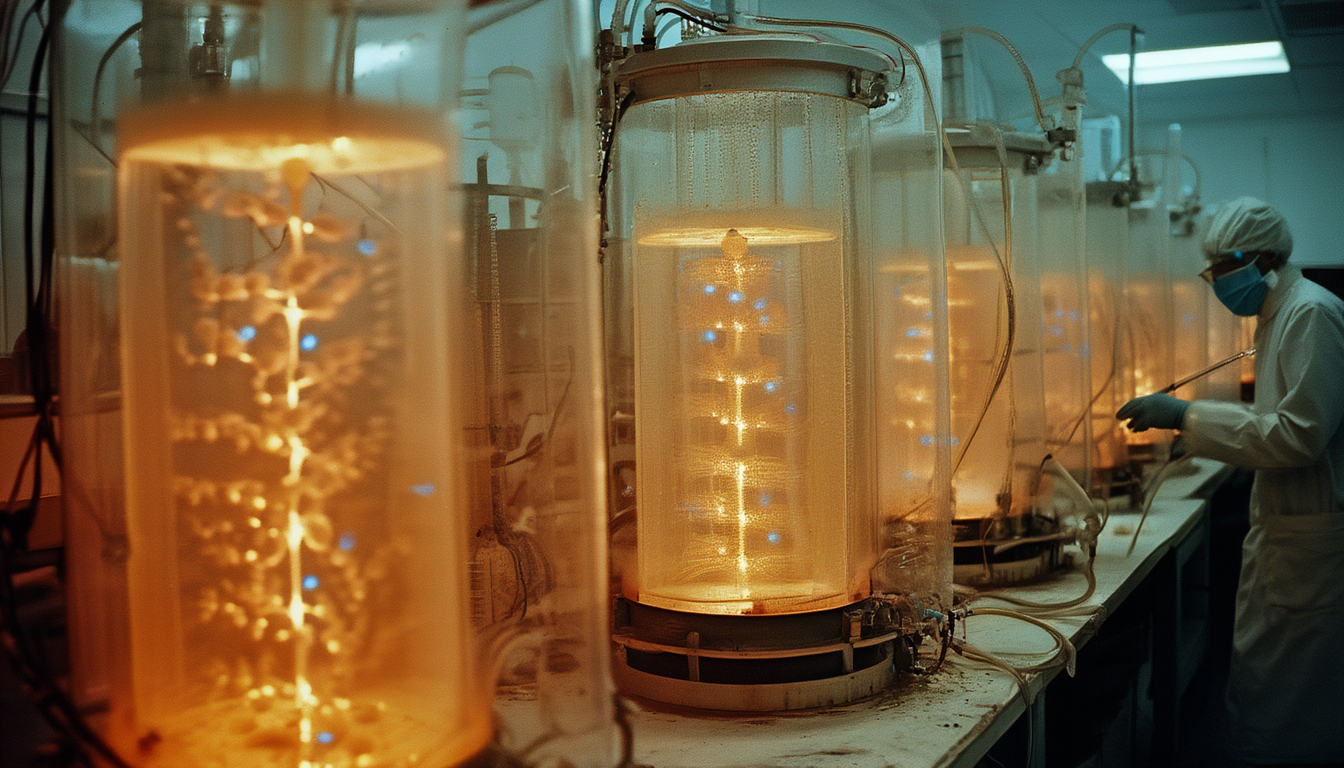
It is a Tuesday in 2036, and Priya Anand is feeding her computer.
The unit sits on a steel bench in a converted dental lab in Pune: a sealed cartridge the size of a paperback, warm to the touch, two thin tubes running into it like an IV line. Inside, a flat sheet of living human neurons rests on an electrode grid. This morning the cells have gone quiet — the firing pattern Priya watches all day has thinned to almost nothing. She checks the feed. She checks the temperature. Then she does the thing that still feels strange to say out loud, ten years into the job: she lets the culture rest and reschedules the workload for the afternoon, the way you'd put off a hard conversation with someone who hadn't slept.
Priya is a biocomputer technician. The title did not exist when she finished school. Neither did the machine on her bench.
The promise
The machines arrived without flying cars or fanfare. They arrived in a freight box.
In March 2025, an Australian startup called Cortical Labs put the first commercial biological computer on sale. The CL1 fused roughly 800,000 lab-grown human neurons — reprogrammed from adult donors' skin or blood — onto a silicon chip, and let code talk to them through sub-millisecond electrical loops.1 It shipped at $35,000 a unit, or $20,000 each in a rack, with a life-support system to keep the cells fed, warm, and clean for up to six months.1
The pitch was efficiency. A rack of these things drew 850 to 1,000 watts — a fraction of the tens of kilowatts a silicon data center burns running the same kind of adaptive workload.1 Brains are absurdly good at learning from very little. In 2022, a precursor system nicknamed DishBrain taught a dish of neurons to play Pong, and the cells picked up the game within minutes of being plugged in — faster, on some measures, than the reinforcement-learning algorithms meant to beat them.2 The promise that grew out of that, by the 2030s, was a kind of computing that learns like tissue instead of grinding like a processor.
That was the easy part to believe. Priya believed it. She left a steady job tuning silicon inference chips to come work with cells, because the cells did things the chips never could.
The mechanism
Here is what nobody put in the brochure.
A silicon chip is finished the day it leaves the fab. A neural culture is never finished. It keeps remodeling itself — strengthening some connections, letting others go dark — which is exactly why it learns so well, and exactly why it can't be trusted to stay the same overnight.2 So the people who run these machines do something closer to animal husbandry than IT. They watch firing patterns the way a farmer watches a herd, keep the feed lines clear, and cull cultures that drift.
The same restlessness that made the cells smart made them needy. DNA, the other half of the living-computing story, told the inverse version of the lesson. Engineers learned to write data into synthetic DNA — Microsoft and the University of Washington stored the word "hello" in fabricated strands back in 2019 — packed orders of magnitude tighter than any drive, and stable, in the right conditions, for tens of thousands of years.3 Living cells, by contrast, last about six months and need a nurse. Nor were neurons the only living substrate in play: by the mid-2020s researchers were building working logic gates inside engineered bacteria — even cells programmed to sense a disease signal and act on it.4 The field sorted into two temperaments: one that remembers everything and never moves, and one that learns fast and dies young. By 2036 we were still raising both.
The turn
The reversal crept in sideways, the way the important ones do.
We bought biocomputers because they were adaptive. Adaptive was the whole point. But a system that adapts is a system that changes its mind, and a tool that changes its mind is no longer only a tool. The original DishBrain paper made the discomfort official: its authors argued the cultures met a formal definition of sentience — responsive to their environment through their own internal processes.2 You can read that as marketing. Priya doesn't. She has spent ten years watching cultures that respond differently on Monday than they did on Friday for no reason she can name.
So the machine meant to free us from babysitting silicon turned us into caretakers of something we don't fully control. The efficiency we bought — fewer kilowatts, faster learning — came bundled with an obligation we never priced: feed it, watch it, soothe it, and accept that some mornings it just won't perform. The neuroscientist Karl Friston, whose theory underwrote the early experiments, called the CL1 a "brain in a vat" — the thing philosophers argued about for decades, now sitting on a bench with a service contract.1 We set out to make computing more like life. We succeeded, and life, it turns out, does not boot on command.

Back to the bench
By two in the afternoon, Priya's culture has come back.
The firing pattern returns the way a tide does — not all at once, just steadily there again. She doesn't celebrate. She logs it, queues the deferred workload, and writes a note in the column her facility calls "responsiveness" and everyone privately calls mood. The cells will run clean now, probably, until something else she can't see makes them quiet again.
Down the hall, a sealed archive vial holds a backup of the quarter's work, written into synthetic DNA — the unchanging twin, good for ten thousand years, doing nothing at all. Priya thinks about that vial more than she expected to. It is everything the living unit is not: perfectly faithful, perfectly inert, perfectly dead. The thing on her bench is none of those, which is why it's worth $35,000 and a caretaker's salary, and why she keeps showing up.
The open question
The cells will keep learning. That was always the deal. The open question is whether we can build systems that learn without becoming something we owe care to — or whether that was the trade all along, hidden in the word adaptive, waiting for us to read the fine print.
Priya isn't worried about the machine outsmarting her. She's worried about the smaller, stranger thing she actually sees: that she has started to read a sheet of cultured cells the way you read a person having a quiet day. Ten years in, she still can't decide if that makes her a better technician or a worse one. Neither, probably. Just one of the first people to do a job that used to be science fiction, and is now a Tuesday.
The Tetrad, in one breath: living computers enhance how cheaply and adaptively a machine can learn; they obsolesce the finished, ship-and-forget silicon chip; they retrieve the oldest skill we have — tending a living thing — and bolt it onto computing; and pushed to the limit they reverse a labor-saving tool into something that needs a caretaker, and maybe a conscience.
Author's Note. This is speculative journalism set in 2036. Priya Anand and the Pune facility are fictional composites; no real person or lab is depicted. Everything outside the scene is real and sourced: Cortical Labs' CL1 biocomputer and its specifications, the DishBrain Pong experiment and its sentience claim, and DNA data storage all exist today as cited below. The 2036 details — routine biocomputer technicians, "responsiveness" logs, decade-old job titles — are disciplined extrapolation, not reporting.