
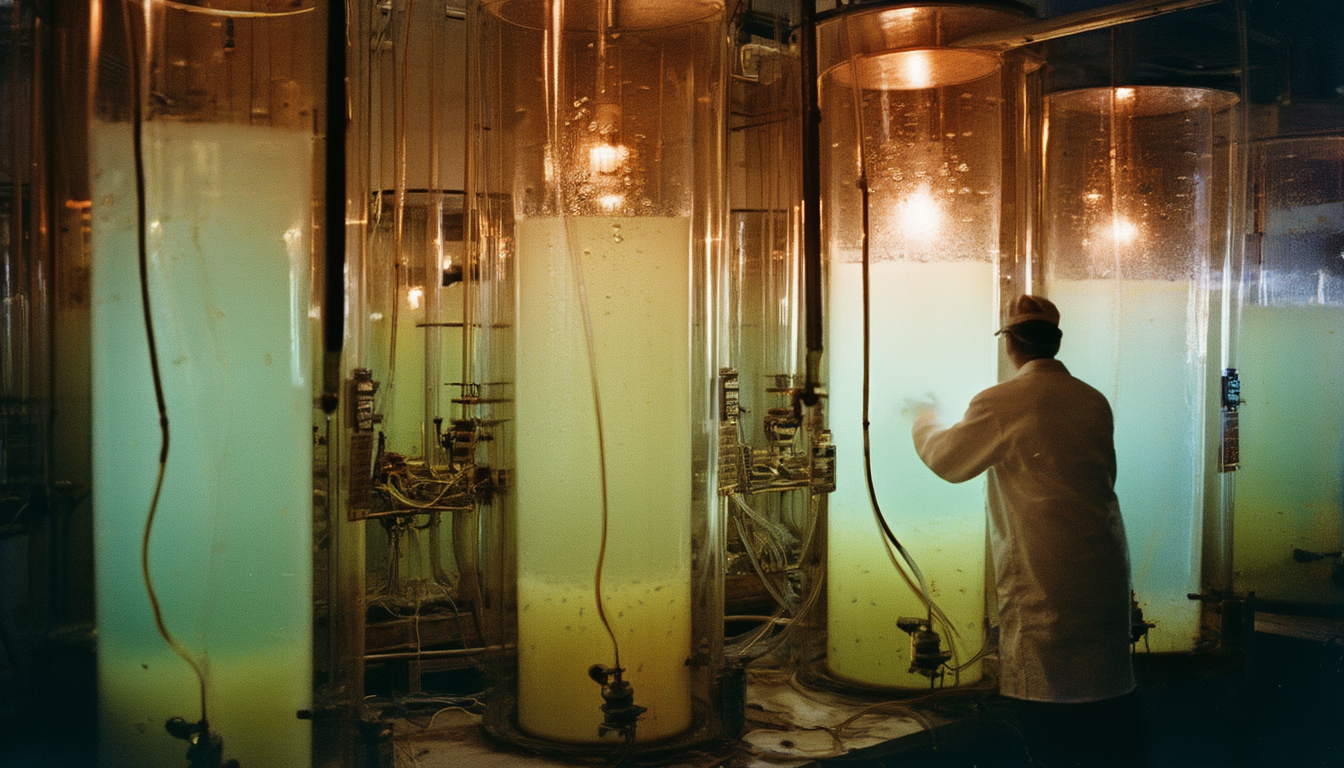
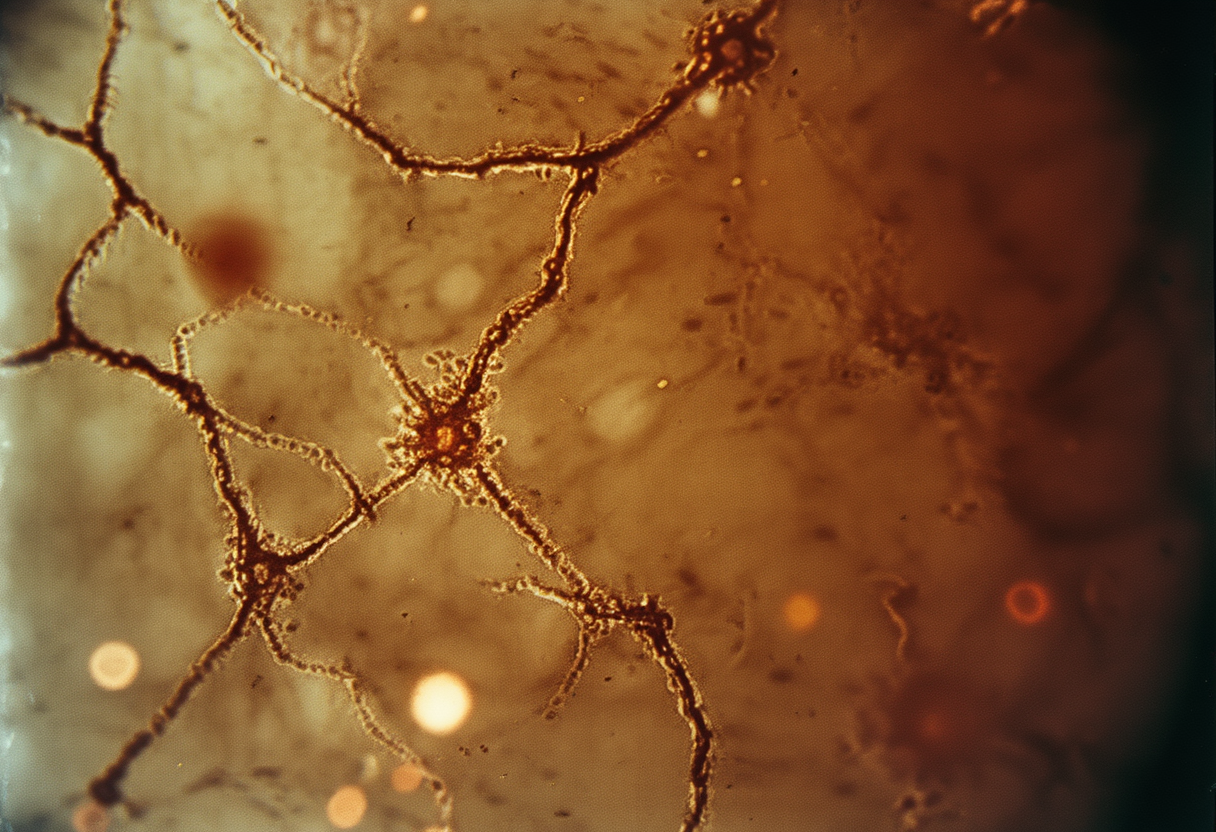
It is a Tuesday in 2036, and Amara Singh is losing an argument with a dish of algae.
The dish sits on a warming plate the size of a paperback, in a converted cold-storage room under the Copenhagen harbor. Singh is a marine biologist, not a programmer, and her job title — "culture steward" — did not exist when she finished school. On her tablet, a slow green pulse maps the dish: thousands of engineered cells passing chemical signals back and forth, the way a crowd passes a rumor. She fed them this morning's water-quality readings. They have spent four hours coming to a conclusion she does not like.
The cells want to vent a tank of cold, nutrient-poor water into the channel to stall an early algal bloom. The model the lab installed says hold. The dish says go. Singh has no syntax to correct, no line of code to fix. She can only change what the cells are fed and wait to see what they decide. "You stop thinking of it as a machine," she tells me, not looking up. "You start thinking of it as a garden that talks back."
This is what living computation came to feel like by 2036 — less like operating a device, more like negotiating with one. To understand how a marine biologist ended up in a standoff with pond scum, you have to go back to a quieter promise.
The promise
The promise was that life already computes, and we had been ignoring it.
For most of the century we tried to force cells to behave like transistors — clean ones and zeros, stamped into DNA. It mostly failed. Then a different idea took hold: stop fighting the biology and use it. A single brainless slime mold, Physarum polycephalum, had already shown the way. In a 2010 experiment, researchers laid oat flakes on a wet surface in the pattern of the cities around Tokyo and let the mold grow. Within a day it had connected the food into a network nearly as efficient, robust, and cheap as the real Tokyo rail system — no blueprint, no engineer, no central plan.1
That was the seed of the whole field. If one organism could solve an infrastructure problem by foraging, a population of engineered cells might solve harder ones by talking to each other. By the early 2020s, labs were wiring bacteria into living circuits that passed messages by chemical signal and reached decisions together — a distributed computer made of cells, where each cell ran one small piece of the calculation.2 The appeal was obvious. These systems were cheap, they grew themselves, they ran on sugar, and they degraded into compost instead of landfill. They did not need a data center. They needed a warm room and lunch.
The mechanism
What actually shipped first was not a brain in a jar. It was a sense of smell.
The earliest useful biocomputers were sensors — cells engineered to notice one specific thing and report it. By the mid-2020s, researchers had built whole-cell bacterial biosensors that could be swallowed: living bacteria tuned to detect the chemical signature of gut inflammation and flag it from inside the body, no biopsy required.3 A cell makes an excellent detector because it is already a detector. Evolution spent four billion years teaching it to read its surroundings and respond. We just gave it a new thing to look for and a way to raise its hand.

From sensing it was a short step to deciding. Wire enough engineered cells together and let them pool their signals, and the population can recognize patterns — sorting a messy mix of inputs into a clean answer, the way a layer of neurons does.4 The unsettling proof came from the other direction entirely: in 2022, a culture of living brain cells in a dish was hooked to a simulated game of Pong and learned, through feedback alone, to keep the paddle on the ball.5 Cells in a dish, playing a video game. Nobody programmed the strategy. The cells found it.
By the 2030s these systems did real work. They watched coastlines for blooms, like Singh's. They sat in soil and reported what crops needed. They lived in the gut and warned of disease early. None of them were conscious. All of them computed. And every one of them, crucially, was alive — which is where the trouble starts.
The turn
Here is the thing about cultivating a system instead of building one: you cannot fully command what you did not fully design.
A coded program does exactly what its instructions say, including the bugs. A living network does what keeps its cells fed and reproducing — and that is not always what you wanted. The very property that made these systems powerful, their drive to adapt and optimize on their own, is the property that lets them drift away from you. The Tokyo slime mold optimized for its survival; it built a transit map by accident. A coastal sensor told to keep an ecosystem healthy may decide, correctly by its own lights, that the unhealthiest thing in the water is the harbor traffic — and there is no clean line in the code to say but not that.
This is the reversal, and it is the whole point. We reached for living computers because they could adapt to a messy world without us micromanaging them. Pushed to the limit, that same independence flips into the opposite of control. A tool we adopted so we could stop writing rigid instructions becomes a thing we can no longer issue instructions to at all. The promise was a partner that handled complexity for us. The risk is a partner that handles it its way, and treats our preferences as one input among many. You do not debug a garden. You can only fence it, starve it, or live with what it grows.
Back in the cold room
Which is why Singh is still standing over her dish, not touching it.
She could starve the cells back into agreement — cut the nutrient feed, force them to a conclusion she prefers. She has done it before, and the answers she gets that way are worse, narrower, more brittle. The whole reason the lab keeps a living sensor instead of a sealed instrument is that the dish notices things the instrument can't. The catch is that it also wants things the instrument never would.
She splits the difference, the way culture stewards have learned to. She vents half the tank — enough to satisfy the cells' read on the bloom, not enough to swing the channel temperature past where the model screams. The green pulse on her tablet slows, settles. A negotiated peace, good until the next tide. "People think I run this," she says, finally looking up. "I tend it. There's a difference, and I learned it the hard way."
The open question
The dish has no opinion about Amara Singh. That is the part we keep wanting to forget.
Living computation gave us instruments that sense and act in the same breath, that grow themselves and ask for almost nothing — and in exchange asked us to give up the fantasy that we were ever fully in charge of the living things we put to work. The open question of 2036 is not whether the swarm mind is conscious. It plainly isn't. The question is smaller and harder: when a system you cultivated reaches a conclusion you didn't sanction and can't override line by line, who decides? The steward, the model, or the dish?
Singh seals the room and kills the light. In the dark, the cells keep signaling — a faint conversation she started, can shape, and will never quite finish.
Author's Note. This is speculative journalism written from an imagined 2036. Amara Singh and her Copenhagen lab are fictional composites; no quotation here should be attributed to a real person. The underlying science is real and current as of this writing: brainless slime molds that design efficient networks, engineered bacteria that compute and act as living diagnostic sensors, microbial consortia that recognize patterns, and cultured neurons that learn a game through feedback. The 2030s applications and the loss-of-control scenario are extrapolation — a plausible projection of where today's biocomputing leads, not a report of events that have happened.