
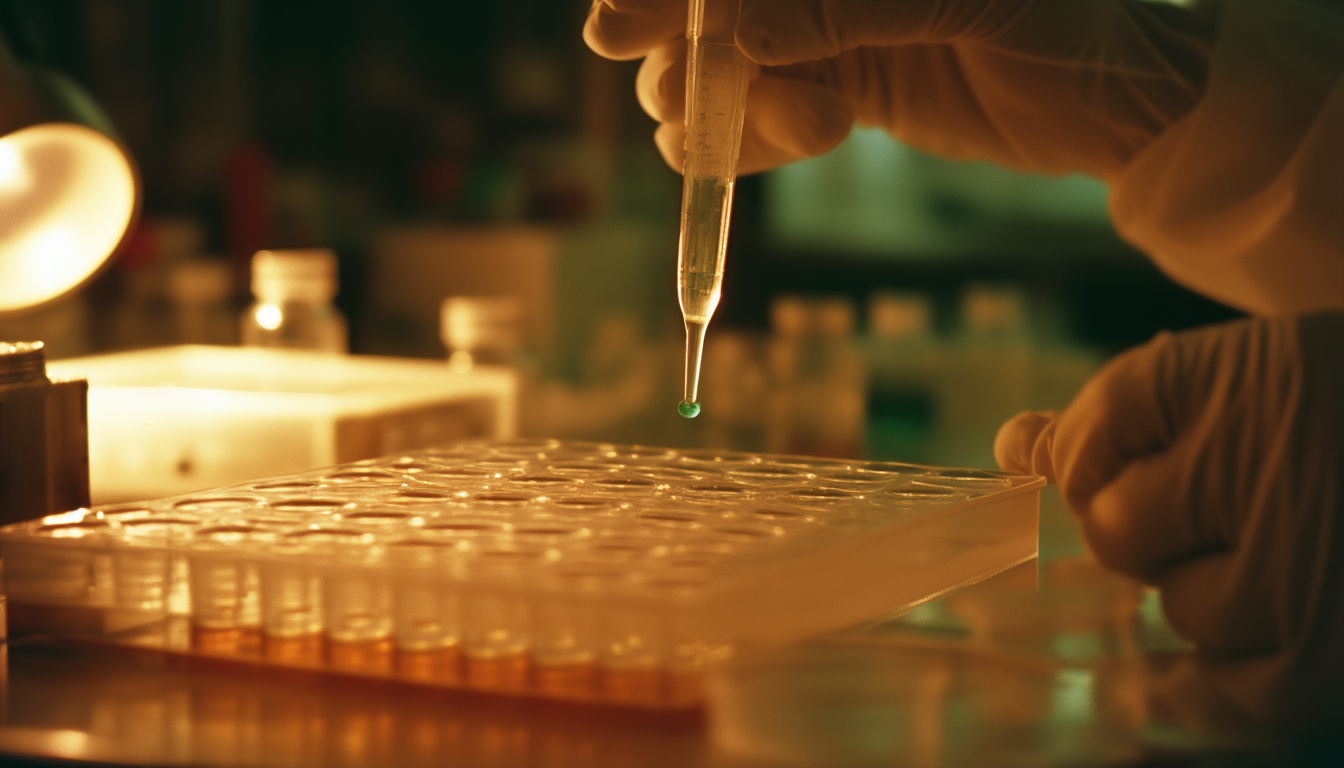
It is 2036, and Kenji Nakamura is watching a teaspoon of liquid make a decision.
The dish on his bench holds no chip, no wire, no line of code. Just water, salt, and a few engineered proteins he designed last spring. He adds a drop of a patient's blood. For ninety seconds nothing happens. Then one corner of the well glows faint green, and the proteins — folding, binding, cleaving each other in a sequence no one programmed step by step — return their verdict. This sample carries the marker. That one doesn't. The molecules sorted it themselves.
Nakamura has done this thousands of times. It still unsettles him. He keeps thinking the word understand, then making himself cross it out.
The promise
For most of the computer age, "thinking" meant electrons moving through silicon. The dream that started this lab was simpler and stranger: what if the computer could be the medicine? Not a machine that decides what drug to give you, but a molecule that does the deciding inside your body, at the only scale that matters — the cell.
That dream stopped being science fiction around the middle of the 2020s. In October 2024, the Nobel Prize in Chemistry went to David Baker for computational protein design and to Demis Hassabis and John Jumper for predicting protein structure — the two halves of the same key.1 Jumper and Hassabis's AlphaFold had cracked a fifty-year problem: given a protein's sequence, predict the origami it folds into. Baker's lab ran the problem backwards — design a brand-new protein, from scratch, to fold and act however you want.2
By 2024 you could draw a function and let software hand you a molecule that performed it. That is the whole story, compressed.
The mechanism
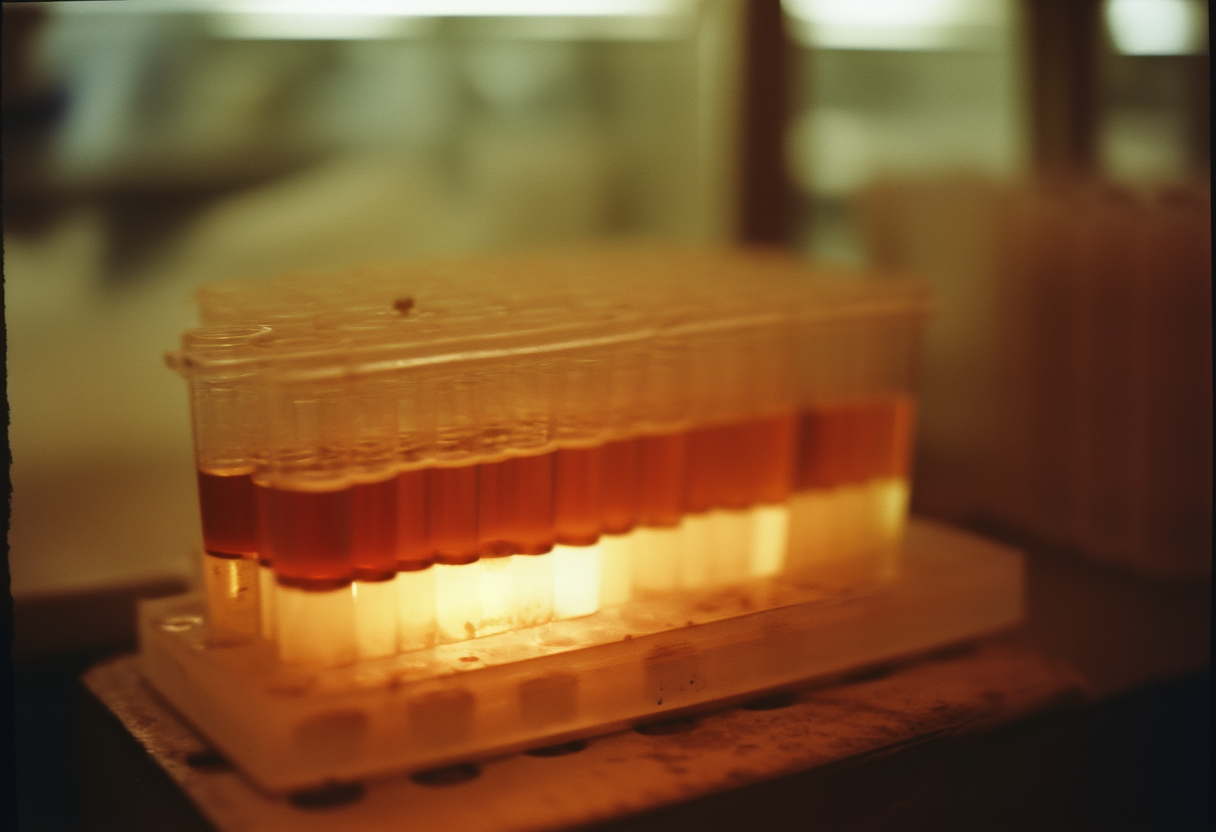
The leap from "designed protein" to "thinking molecule" came from a quieter line of work: building circuits out of proteins the way engineers build them out of transistors. Synthetic biologists had shown that proteins could be wired into logic gates, cascades, and feedback loops inside living cells — many different circuits from a handful of molecular parts.3
Then, in December 2024, a team at Caltech and Westlake University did the thing that made Nakamura change fields. They built an actual neural network out of proteins. Their system — they called it "perceptein" — used designed protein pairs and protein-cutting enzymes to weigh inputs, add them up, and classify a signal into one of several outputs, all inside mammalian cells. It could even be tuned to trigger cell death only when the inputs crossed a learned boundary.4 A network that classifies, made of molecules, running with no processor in sight.
The other half arrived in test tubes. By 2025, researchers had shown that DNA molecules could not just compute but learn — carry out supervised learning in vitro, training on molecular examples until they could classify new patterns they'd never seen.5 Heat alone could recharge the circuits for another round.6 Nakamura's assay is the medical descendant of that work: a molecular classifier you can hold in a pipette.
What made any of this designable was the prediction stack underneath. AlphaFold 3, released in May 2024, could model not just a protein but how it binds DNA, RNA, drugs, and other proteins — the interactions that are the computation — and it beat the best physics-based tools at the task.7 You could now design the parts and simulate the wiring before touching a bench.
The turn
Here is where the dream curdles, the way every powerful tool eventually does.
A protein circuit is not a program you read line by line. It is a population of molecules finding an equilibrium. The early systems were small and legible — you could trace every binding event. But the useful ones got big, and the most useful ones got trained rather than designed. A molecular network that learns its decision boundary doesn't store that boundary anywhere you can open and inspect. It's distributed across millions of fold states, the same way a deep neural net hides its reasoning in a wash of weights.
So the thing that made molecular computing a miracle for medicine — that it optimizes itself, in place, to its target — is exactly the thing that made it opaque. The early protein assays were auditable and dumb. The current ones are accurate and unreadable. We did not build a molecule that "wonders." We built one whose work we can no longer fully check, and then we put it inside people because it worked.
That is the reversal. Designed-from-scratch transparency reverses into engineered-and-trained opacity. The promise was control at the scale of a single cell. The cost is that, at that scale, we increasingly take the molecule's word for it.
Back to the bench
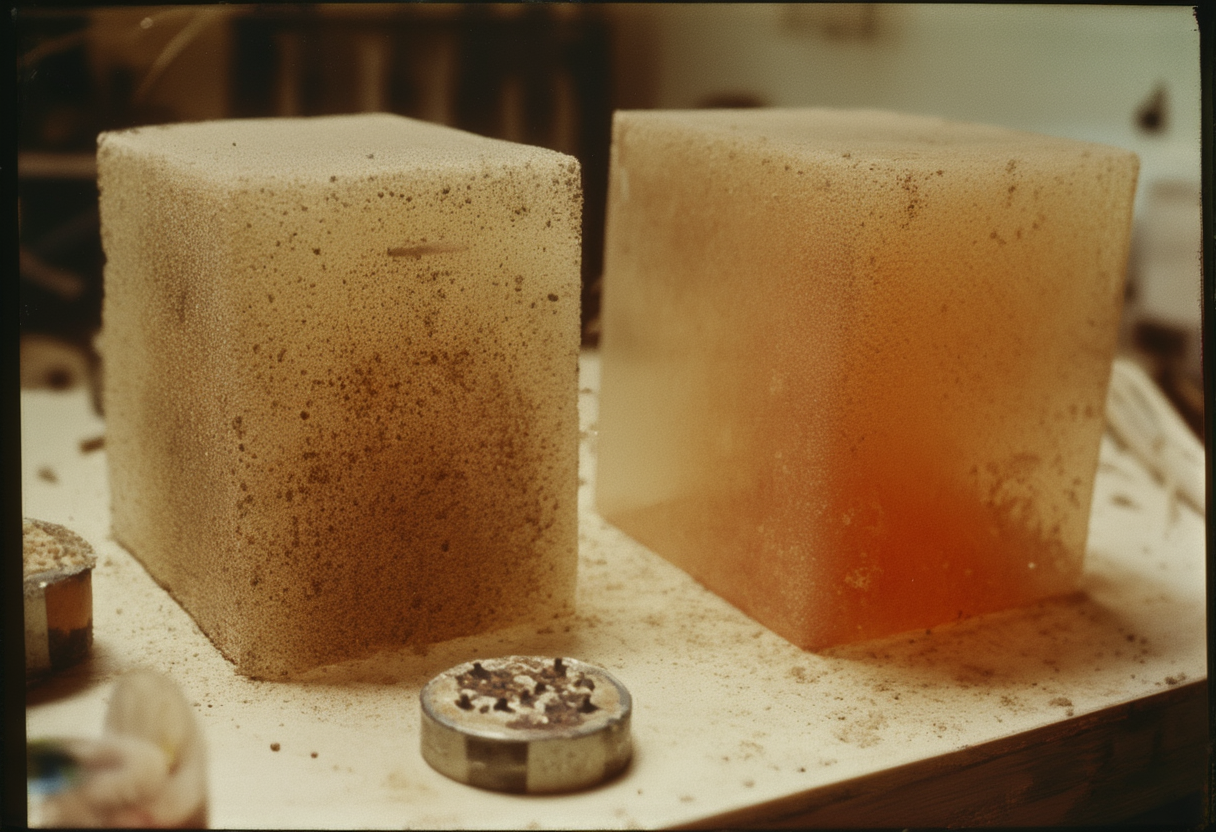
Nakamura's green well is a triumph and a warning at once. It catches the marker faster and cheaper than any lab analyzer — that's why three hospitals already use his design. It also can't tell him why it was wrong the eleven times it was wrong last quarter. There is no log file. There is only the dish, and a statistical confidence he has learned to trust the way an older doctor trusted a stethoscope.
His field invented new jobs to live with this. Molecular validation isn't programming anymore; it's closer to clinical trials for a chemistry. You don't audit the circuit. You characterize its behavior across thousands of runs and bound its failure rate, the way you'd vet a drug.8 The old alchemists, it turns out, had it backwards. We didn't learn to make matter obey. We learned to make matter capable, and then to negotiate with the results.
The open question
The molecules aren't conscious. That's the easy part to say. What's hard is that they don't need to be conscious to take decisions out of human hands. A classifier that runs inside a cell, optimizes itself toward a target we set, and produces an answer we can't fully trace has already crossed the line that matters — not the line between machine and mind, but the line between a tool we audit and a tool we trust.
Nakamura adds another drop. The corner glows. He believes it. He is mostly right to. The question the next decade has to answer isn't whether molecules can think. It's how much of our medicine, our manufacturing, and our judgment we're willing to hand to a kind of intelligence whose work we can only check from the outside.
The molecules are doing the math now. We're still deciding how much to look away.
Author's Note
This is speculative journalism written from an imagined 2036. Kenji Nakamura and his bench scene are fictional composites; no claim is made that any specific lab, assay, or "incident" exists. Everything outside the narrative frame is real and sourced: the 2024 Nobel Prize in Chemistry, AlphaFold, de novo protein design, protein-based logic and the "perceptein" neural network, and DNA circuits that learn are all documented in the citations below. The projection — that trained molecular systems become powerful but hard to audit, and that this trade-off, not machine consciousness, is the real frontier — is an extrapolation from those facts, not a reported event. Claims in the original draft about molecular "emotions," "loneliness," alchemical or shamanic insight, room-temperature quantum minds, and a 2035 "Tokyo Incident" had no support and were cut.
Works Cited