
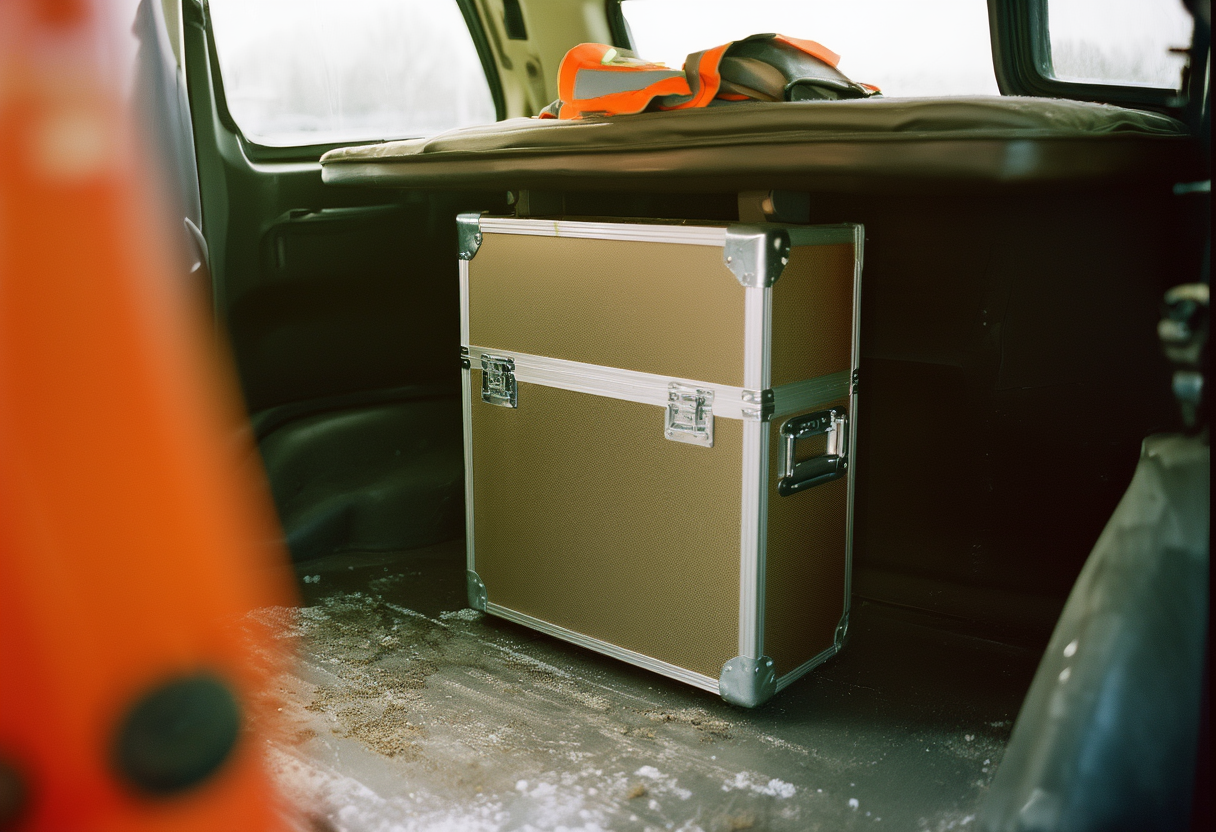
The safe rides in the footwell with a strip of gaffer tape over the keypad light. Teo Varga parks behind the Cumberland Valley Credit Union at 6:40 on a Tuesday morning in March 2036, an hour before the branch opens, because the ceremony takes ninety minutes and the lobby cannot be part of it.
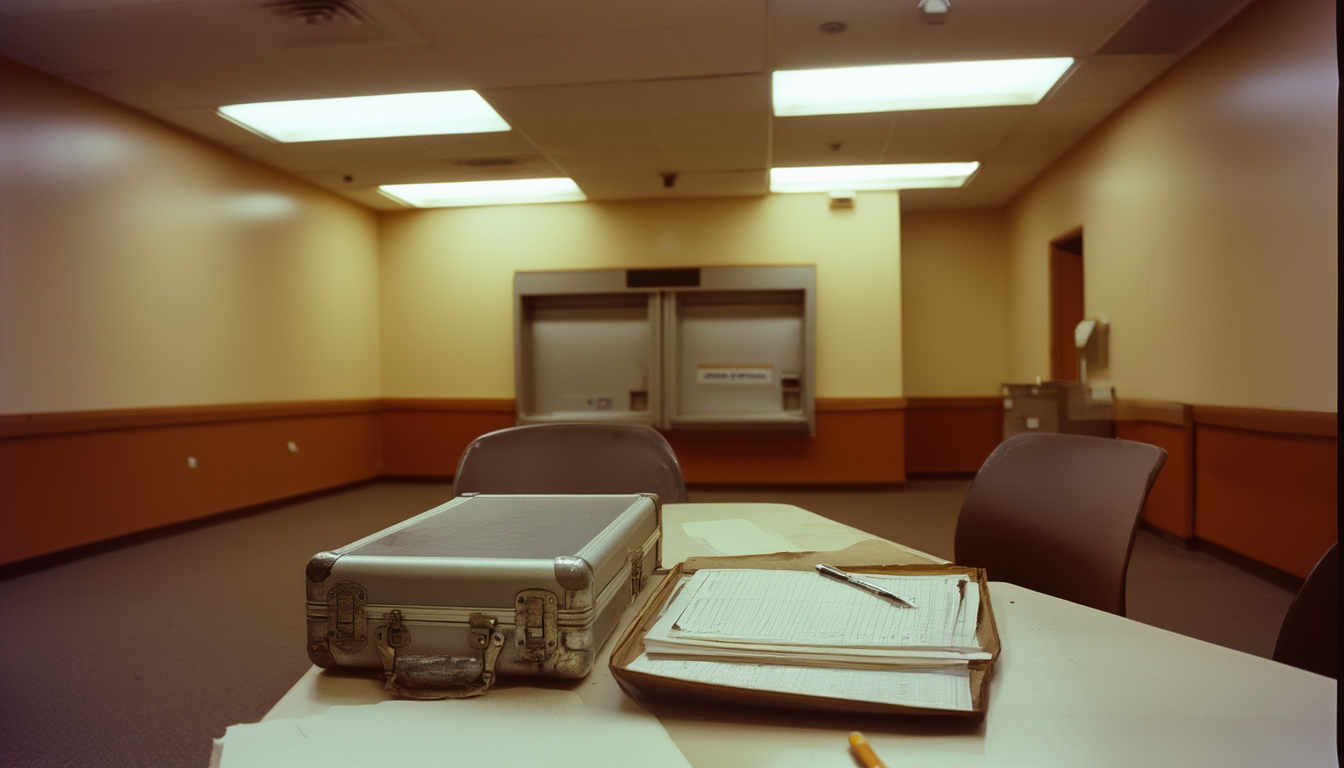
Inside: a card table. A laptop that has never touched a network. Two witnesses from the branch, a teller and the operations manager, both holding pens. A printed log with numbered lines, because the log has to be paper and the signatures have to be wet. Varga opens the case and the room goes quiet in the way rooms do at a notary's office.
The work is unglamorous. The branch's cash-machine controller and its two back-office signing appliances were built in 2024 and 2025. Their root keys are RSA, which the machines cannot change by themselves, and which the standards bodies stopped allowing last year. Varga re-signs the firmware with a key the hardware will still accept, logs the serial numbers, and drives on. Four days a week, a route through credit unions, rural water districts, two hospital boards and a community college. He is booked into 2037.
"People assume I'm here because something broke," he says, filling line eleven. "Nothing broke. A date passed."
What the autumn of 2026 believed
Ten years ago a story moved through group chats and brokerage notes faster than anyone could check it. A machine had found a shortcut through a problem that was supposed to have none. The Exponential Time Hypothesis was dead. That was why software flaws were suddenly being found everywhere at once, and it was why security and biotech were the trade for the coming year.
It was a good-shaped explanation. One cause, many effects, a clean line from a result in theory to a line in a budget. It had the further advantage of being hard to argue with in a group chat, because almost nobody in the chat could say what the hypothesis claimed.
What the hypothesis actually says
Russell Impagliazzo and Ramamohan Paturi named it in the late 1990s, working on k-SAT, the problem of deciding whether a logical formula can be satisfied. For each k they defined a number, the smallest exponent for which a solver running in roughly two-to-the-power-of-that-exponent-times-n exists. Their hypothesis was that this number is above zero once k reaches three. In their own gloss: "for k ≥ 3, k-SAT does not have a subexponential-time algorithm."1
They were careful about its standing. The underlying question was "a celebrated open question," and the hypothesis rested on what they called intuitive evidence.1 It was an assumption, held because nothing had contradicted it, and useful because a great deal could be built on top of it. Assume it, and you can show that many familiar algorithms are already close to the best anyone will do.
Here is the part the chats skipped. The hypothesis is stronger than the famous open problem it touches, not weaker. Writing about its strong form, Virginia Vassilevska Williams calls it "a much stronger assumption than P≠NP," and notes that it sits comfortably with everything then known.2 Implications run one way. Knocking it down would remove a sufficient condition for the separation. It would not supply the reverse, and it would not hand anyone a method.
It also was not the thing standing between an attacker and a bank. Public-key cryptography rests on particular problems assumed to be hard: factoring large numbers, discrete logarithms, finding short vectors in lattices. A fast solver for one logic problem does not produce a fast solver for any of those, and nobody in 2026 claimed it did. The claim was added later, by people repeating the story.
The quieter embarrassment is that practitioners had been living on the far side of the worst case for thirty years. Writing in the early 2000s, Henry Kautz and Bart Selman recorded solvers in routine use on hardware verification problems with about a million variables, and a method that handled random instances of similar size in roughly two hours of processor time.3 The worst case stayed exponential the whole time. The instances in front of people did not.
What actually got cheaper
The flood of found flaws was real. Its cause was mundane.
In October 2024, an experimental agent at Google found a stack buffer underflow in SQLite, in a corner of the code that handles generated number series. It was reported and fixed the same day, before it reached a release.4 The team published it as a milestone and then undercut their own headline with unusual honesty: the work was "highly experimental," and "it's likely that a target-specific fuzzer would be at least as effective." A conventional fuzzer had run 150 processor-hours on the same code without finding it.4
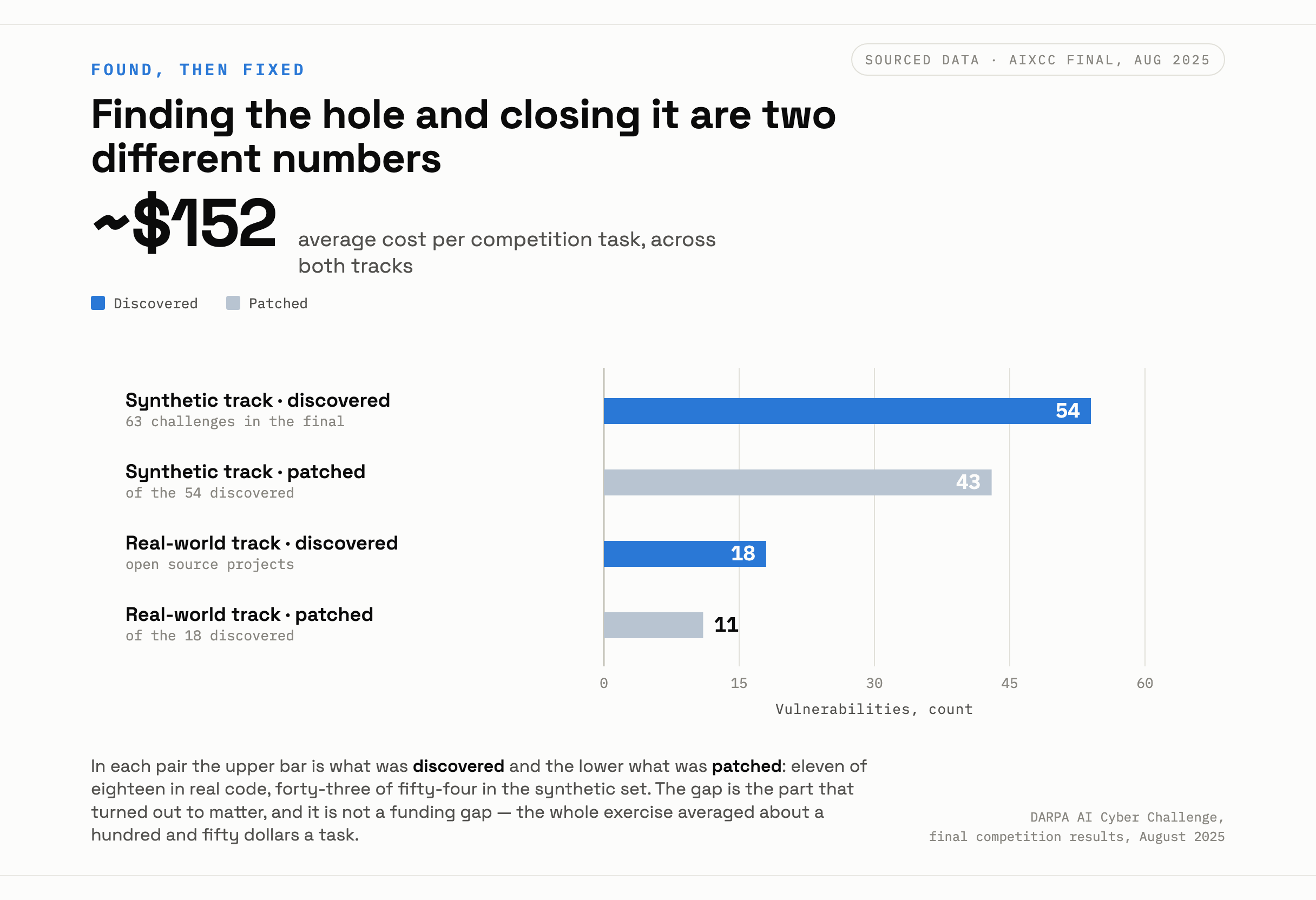
The following August, DARPA finished a two-year competition built to answer the scaling question. In the final round, teams running autonomous systems against 63 challenge problems found 54 unique planted flaws, or 86 percent, and produced patches for 43 of them. Turned loose on real open-source code, the same systems surfaced 18 genuine vulnerabilities, six in C and twelve in Java, and supplied 11 patches.5 The organisers reported an average cost of about 152 dollars per task.5
That figure is the whole story. Not a new mathematics. A collapse in the price of looking.
The sorting
Cheap search does not stay a gift for long, because somebody has to read the output.
By the spring of 2026 maintainers were saying so plainly. Linus Torvalds described the Linux security list as "almost entirely unmanageable" under duplicate reports. Daniel Stenberg, who leads curl, put it as a forecast: "This avalanche is going to make maintainer overload even worse."6 The honest footnote is that the tools worked. After curl tightened what it would accept, its rate of confirmed vulnerabilities rose above the level it had seen before any of this started.6 The finding was never the bottleneck. The attention was.
So the sorting began, and it did not follow the theory at all. Projects with staff to triage came out of the decade safer than they went in. Projects with one volunteer and a full inbox got a queue.
Institutions were sorted by something even less dramatic: a calendar. NIST had finalised its first three post-quantum standards in August 2024 and told administrators, in plain words, to "start integrating them into their systems immediately, because full integration will take time."7 Most did not. Then on 27 October 2026, the same week the shortcut story was going round, the agency published the schedule with the years in it. Quantum-vulnerable signatures and key exchange, RSA and the elliptic-curve family included, "deprecated after 2030" and "disallowed after 2035."8
Nothing in that document was a discovery. It was a deadline, and it did more to decide which institutions were defensible in 2036 than any result in complexity theory.
The route
Varga's customers are the residue of that schedule. The ones who read the date in 2024 rotated their keys on their own time, in daylight, using their own staff. The ones who waited found out in 2035 that a signing appliance bought in 2024 cannot replace its own root key, that the vendor is gone, and that the only remaining path is a man with a case, a witness, and a numbered sheet of paper.
He finishes at 8:05. The operations manager signs, the teller signs, Varga photographs the log and puts the original in a sleeve. Outside it is still cold enough to see his breath.
What nobody can tell him is whether the next one arrives the same way. The story people were ready for in 2026 was a theorem, a breakthrough, something with a name attached. What actually reshaped their decade was a price falling and a date being set, and neither of those announced itself.
Author's Note
This piece is speculative journalism written from an imagined 2036. Teo Varga, the Cumberland Valley Credit Union and the route are fictional composites. The Exponential Time Hypothesis and what it does and does not imply, the Big Sleep and AI Cyber Challenge results, the maintainer-overload reporting and the NIST standards and transition dates are real, documented and sourced below. No claim is made that the hypothesis was refuted in 2026 or since; it remains, as it began, an open assumption.