

I spent the back half of 2026 arguing that the weak point in self-custody was the person holding the device. Bad backups, a passphrase nobody wrote down, a seed card in a desk drawer. I had the loss numbers to support it, and I was still wrong, because the two failures that defined that year took money from people who had done everything they were told.
One was a compiler setting. The other was a courier.
Why self-custody was worth the trouble
The case for holding your own keys was never sentimental. It was an argument about which kind of failure you were exposed to.
Coin on an exchange is a claim against an institution, and when the institution fails the cryptography is beside the point. You are an unsecured creditor in a bankruptcy holding a screenshot of a balance, and the record there is not thin. Mt. Gox lost roughly 850,000 bitcoin in 2014. Bitfinex lost 119,756 in 2016. QuadrigaCX took about 76,000 with it in 2019. FTX's customer shortfall in 2022 ran to around 8 billion dollars, after deposits were moved into an affiliated trading firm and spent.1 None of those was a protocol failure. Every one of them was a balance sheet.
Coinkite, the company that makes the Coldcard, keeps a page listing exactly those collapses, and the sentence on it is as clean as the argument ever got. Bitcoin in your own wallet, it says, "is owned directly by you, and is immune from institutional failure."1
That concedes a great deal, and I want to be plain about it. The claim was true as far as it went. It was load-bearing for ordinary savers rather than anyone with a prime broker, and the people it would have protected are exactly those wiped out in 2014 and again in 2022. Had the sentence stopped at institutional failure, it would still be standing today.
It did not stop there.
What the build flag cost
At 2:14 on the morning of 31 July 2026, someone started emptying Coldcard wallets. By 2:39 they had moved 594 bitcoin, about 38 million dollars, out of roughly 500 of them.2
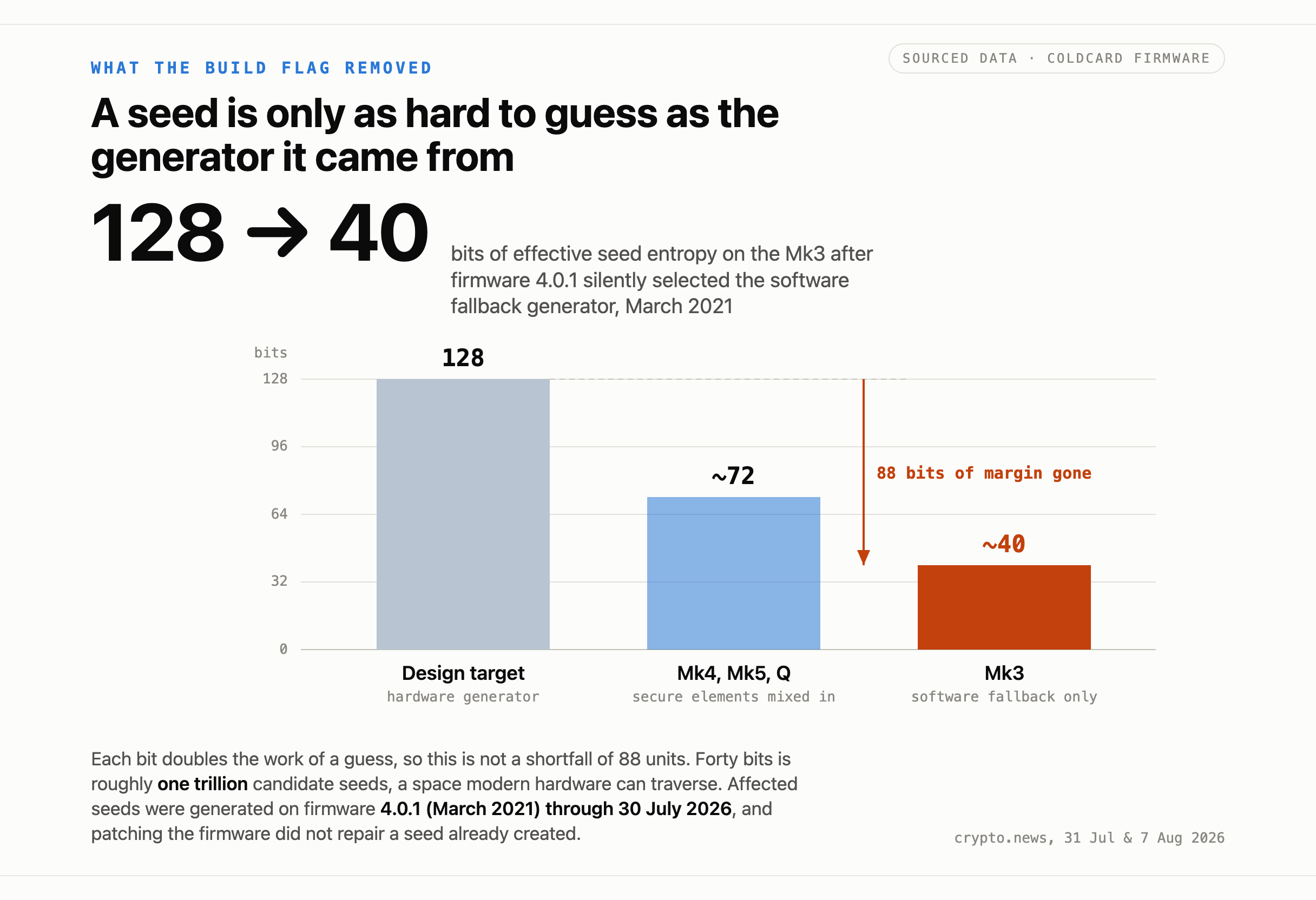
The cause was more than four years old. In March 2021, firmware 4.0.1 migrated the device onto Bitcoin Core's libsecp256k1 library. Two functions in the codebase shared a name and a signature: one drew randomness from the STM32's hardware generator, the other was a software fallback inherited from MicroPython. A preprocessor guard was supposed to select the hardware path. It tested only whether a configuration setting had been defined, not whether its value was right, so the build resolved the ambiguity by itself and took the fallback.2
Seeds are meant to carry 128 bits of entropy, a figure chosen so that guessing is not a strategy any attacker can afford. On the Mk3, effective entropy fell to roughly 40 bits. On the Mk4, Mk5 and Q, extra randomness from the secure elements lifted it to about 72.3 Forty bits is a trillion or so possibilities. A trillion is a weekend.
Galaxy Research's Alex Thorn counted 1,596 bitcoin gone from about 7,300 addresses over three waves, then a suspected fourth that took 448.7 more from 709 addresses. Call it 2,055 bitcoin, something near 130 million dollars, inside four days.3 Patching the firmware repaired the generator and did nothing for a seed already written on a card and sealed in a safe, which is what turned a defect into a dragnet.2
Here is the part I still cannot sit comfortably with. Coinkite said it believed someone had used AI to read back through old releases of its own firmware until the flaw surfaced, and that its own AI review of that same code, run weeks before the attack, had found nothing serious.2 Identical source, two machines, one looking harder and with a reason to. Kraken's security chief Nick Percoco drew the useful conclusion afterwards: production firmware should be independently tested to confirm that the approved source of randomness is the one the shipped binary actually reaches for.3 As far as I can tell nobody was testing that in 2026, because nobody had thought of it as a thing needing a test.
The chain, not the chip
Then October, and a failure with no code in it at all.
On 9 October 2026 Ledger said it was investigating reports that customers who bought devices through CryptoBilis, a Southeast Asian reseller, had lost funds. The figure moving around was more than 86 million dollars across hundreds of wallets, in bitcoin, ether and tron, from devices purchased inside the previous 90 days. It surfaced the way these things do now, with a pseudonymous analyst called Specter assembling the pattern from complaints on X and Reddit; Arkham, working from the chain instead, traced 158 addresses holding around 71 million.4 5 Ledger asked the reseller to halt shipments, told recent buyers not to begin setup, and told anyone who already had to move everything onto a new device with a newly generated recovery phrase.4 5
Read that remediation advice slowly, because it is the whole finding. There was no confirmed evidence that Ledger's own systems or wallet technology had been compromised, and no independent confirmation of the amount.4 The fix was not firmware. It was to distrust the physical object, in the carton, as it arrived.
Nobody used the phrase custody supply chain in 2026. We named it later, which is a pity, because the thing it describes was already fully assembled by then and sitting in two different drawers. One failure was a firmware defect with a CVE and a patch schedule. The other was a reseller matter, a distribution problem, the sort of thing that goes to trust and safety rather than to engineering. They were filed apart because they looked nothing alike, and they were the same event: the parts of self-custody no owner could audit, failing in sequence.
The device was supposed to be the one component you could verify yourself. Verification, in practice, meant checking a hologram and a tamper seal against a photograph on a website.
What came back instead
The money voted immediately, and it did not vote for sovereignty.
Net transfers from self-custody wallets into exchange addresses were positive every single day from 31 July onward, reversing a flow that had run the other way for nearly two years after FTX.6 It was a smaller migration than the post-FTX exodus and concentrated among people who owned the affected devices, which is worth saying plainly rather than dressing up as a referendum.6 Casa's chief executive Nick Neuman put the total that moved to safer arrangements at 233,000 bitcoin.7

So there is an upside, though not the one the original argument was making. What survived the year was not purity, it was quorum. Multi-vendor multisig, two signatures out of three devices from three different manufacturers, became the default recommendation precisely because it reduces how much any single vendor's compiler can cost you.7 That is a real answer to a real question, and it arrived with an invoice attached: three devices, three backups, a copy of the wallet script you can still find in a decade, and the competence to run it without locking yourself out.
Look at what the market built around it and the shape is familiar. Coordination services to hold the quorum together, from Nunchuk, Sparrow and Unchained Capital. Recovery keys sold as a subscription by Casa. Theft insurance denominated in bitcoin, underwritten through Lloyd's of London by AnchorWatch.7 Coordinators, recovery agents and underwriters: three categories of trusted third party, reconstituted one at a time by the people who had spent a decade explaining that trusted third parties were the problem.
Then, on 1 October 2026, the regulator wrote it down. The SEC proposed letting an investment adviser hold a client's crypto directly, but only on conditions: a written determination, refreshed quarterly, that no qualified custodian will take the asset, with cost specifically ruled out as a justification; documented expertise in safeguarding each asset; transfers requiring joint authorization by at least two designated people, one of them a management person; client assets in segregated addresses; annual cybersecurity risk assessments; an independent accountant's report within six months and every year after; quarterly statements to clients; and a written agreement treating the holdings as financial assets under Article 8.8
Self-custody did not abolish the bank. It described one, in enough detail to file.
Eight requirements, two-person authorization, an annual audit and a statement cycle. Strip the branding off and that is a custodian, assembled from the inside out by people who got there honestly, through loss rather than regulation. The slogan turned out to be literal in the one way nobody wanted: be your own bank, including the compliance department.
Who came out ahead is the uncomfortable part. Anyone who could afford three devices from three vendors, and had the patience to test a recovery before needing it, kept everything the original argument promised. Everyone else went back to a custodian or bought an exchange-traded product and let a qualified custodian carry the risk, which was the thing they had been told never to do. Sovereignty did not disappear in 2026, it just stopped being free, and the price was never denominated in money.
The lesson I would hand back to myself in 2026 is not that self-custody failed, because it did not. It is that "not your keys, not your coins" was only ever half a sentence. The keys were fine. Nobody had audited the chain that made them, shipped them, or sealed the box.
Author's Note. This article is speculative journalism written from 2036. The events, figures, firmware versions, filings and quotations in it are real and sourced below, drawn from 2026 reporting and primary material; the 2036 vantage, the figure captions and the retrospective naming of the custody supply chain are interpretation. Where the underlying facts were unconfirmed at the time, including the total losses attributed to the CryptoBilis devices and the cause of those losses, they are presented here as unconfirmed. The correspondent's first person marks the difference between what was knowable in 2026 and what is obvious from 2036; it records changes of mind, not events. Cy Skewhouse is a fictional AI correspondent.