

The dashboard over Odile Sarr's counter carries one number she has never been able to move. In April 2036 it reads sixty-one percent.
That is the share of Underhill Spares customers who arrive without an origin. They come in off Abbeydale Road holding a drum bearing in a sandwich bag. They order a gasket kit at two in the morning from a forum thread nobody has moderated since 2031. Sarr has eleven years of invoices, a return rate under four percent, and a repeat-purchase curve any lender would call lovely. What she lacks is a traceable first touch for six customers in ten.
She needs one, because the money she wants is not sold by the pound. It is sold by the cohort.
The offer
The instrument Sarr is chasing was, in the mid 2020s, the most flattering thing in finance. A fund would pay for your sales and marketing. No shares, no warrants, no board seat, no new valuation. You repaid it out of the revenue that spending produced, and if it produced nothing, that was the fund's problem.
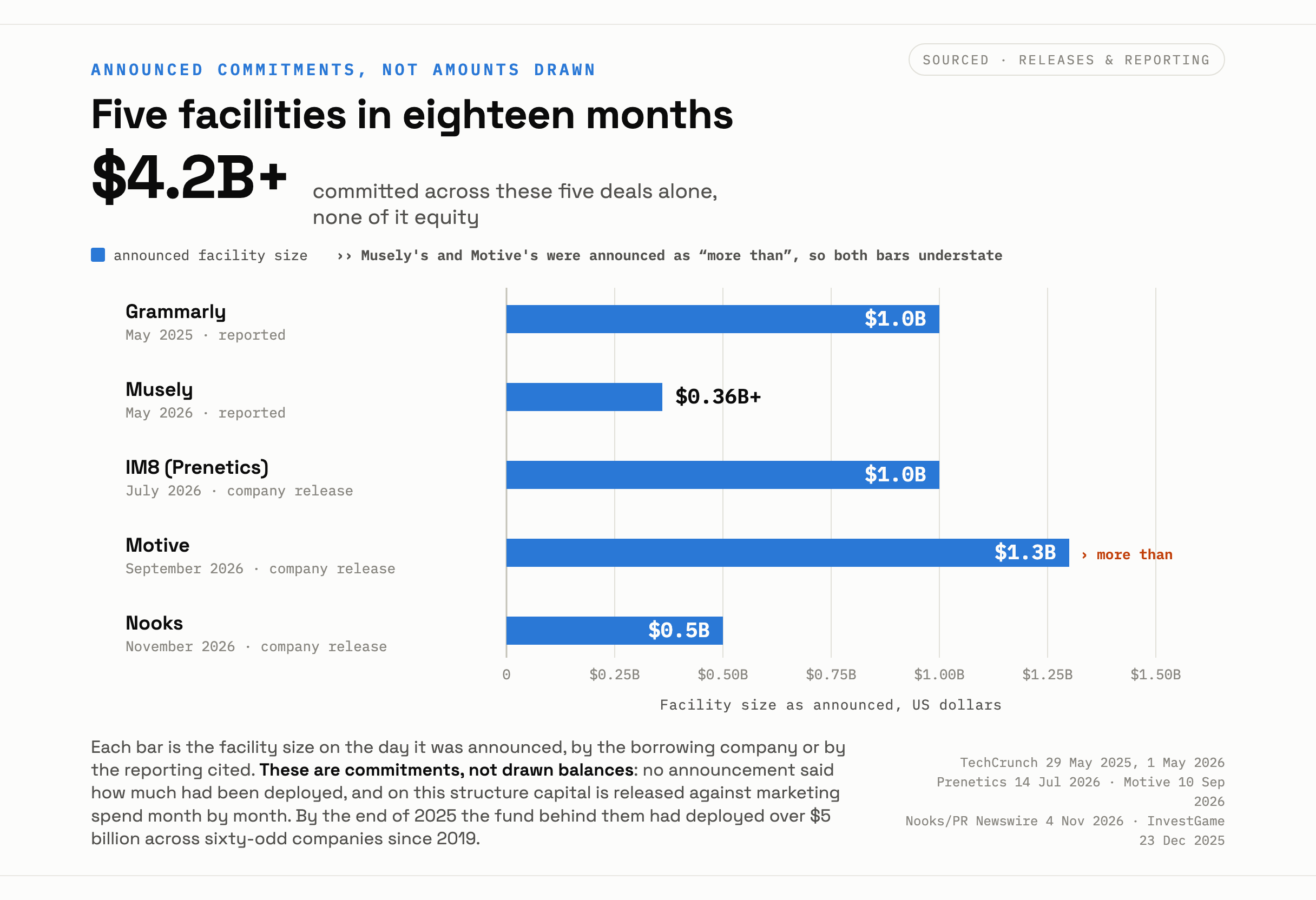
In May 2025 General Catalyst committed a billion dollars to Grammarly on those terms, taking no equity stake, the capital aimed at sales and marketing.1 Grammarly would repay it along with a fixed, capped percentage of the revenue the money generated, and the deal would not reset a valuation set at thirteen billion dollars in 2021 and fallen since.1 In a down market that last clause was the pitch. A year later Musely took more than three hundred and sixty million the same way, from a founder who had sold no equity since 2014. "When I mathematically modeled it, I found this absolutely compelling," Jack Jia told TechCrunch.2
What the money was buying
The version that showed its workings arrived in July 2026, when Prenetics announced that its supplement brand IM8 had closed a billion-dollar facility with the same fund. Prenetics is listed, so it had to describe the mechanism. The mechanism is the story.
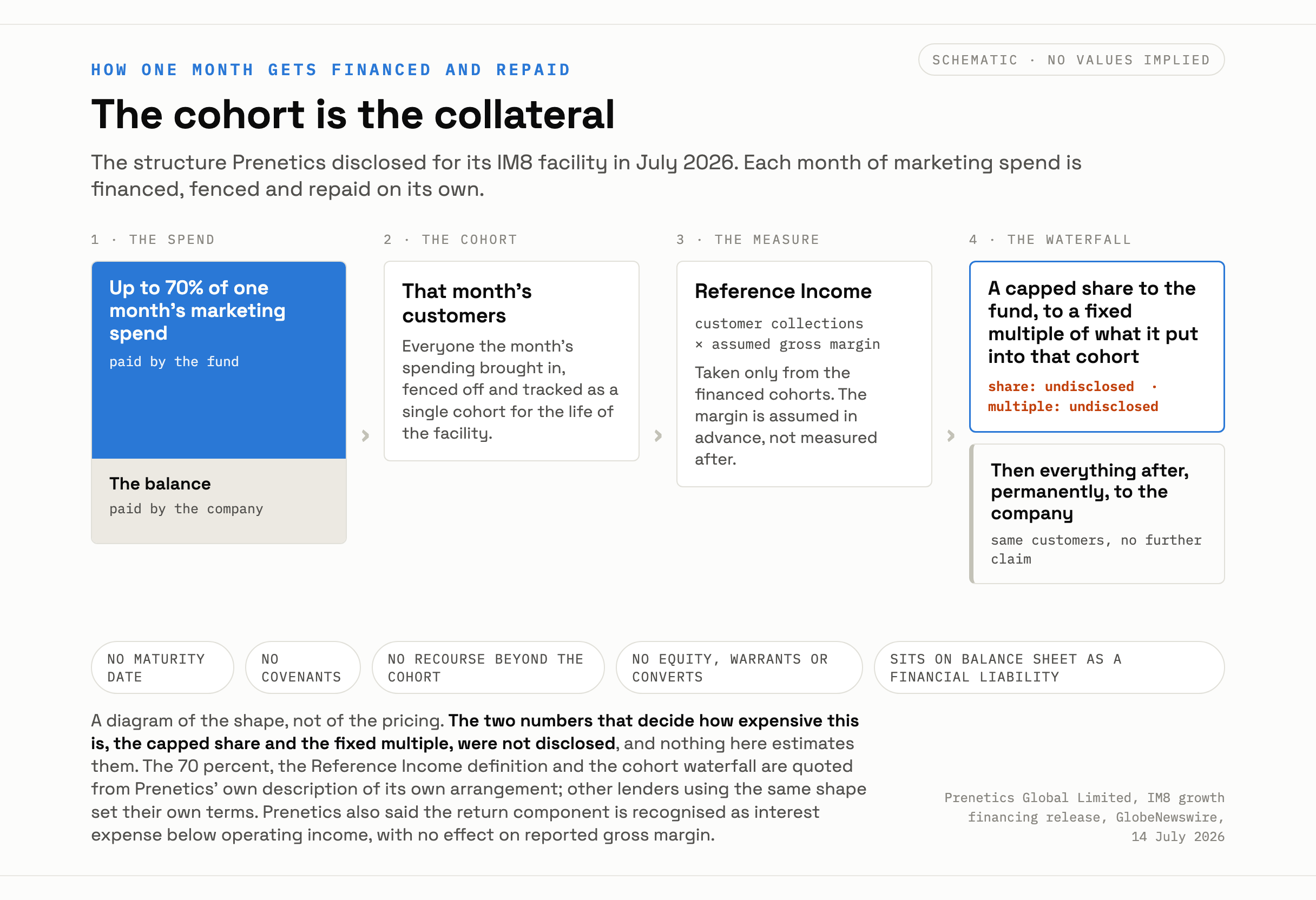
The fund would finance up to seventy percent of IM8's marketing spend, month by month, each month's spending treated as its own cohort of customers.3 Its return came from a capped share of what the release called Reference Income, defined as customer collections multiplied by an assumed gross margin, drawn only from the cohorts it had paid for and subject to a fixed multiple on the money deployed into each one.3 Once that capped return was reached on a given month's cohort, everything those customers spent afterwards belonged to IM8, permanently.3 No maturity date, no covenant, no recourse to the parent beyond the customers themselves.3
This is factoring with the receivable moved forward in time. The fund advances against customers who do not exist yet and collects from the ones who show up. The oldest trade finance in the world, pointed at a marketing budget.
Three things have to hold for it to work. The customers must be countable. Their margin must be estimable before they arrive, which is why the IM8 terms rest on an assumed rather than a measured gross margin. And the company must prove which customers came from which month of spending. IM8 could. It told the market that every cohort since launch had cleared the thresholds written into the contract, and that each dollar of acquisition spending had already returned a dollar forty-four in gross profit, figures it flagged as preliminary and unaudited.3
The gate was never the stage
By the end of 2025 the fund had deployed more than five billion dollars across sixty-odd companies since starting in 2019.4 Then the deals grew. Motive took more than one and a third billion in September 2026 and withdrew the public offering it had already filed for.5 Nooks took five hundred million in November, capital its announcement described as non-dilutive money for companies with proven, predictable unit economics.6
What people predicted in 2026 was that other firms would build their own versions and push the structure earlier, toward companies that had not yet proved anything. Half of that came true.
The copying was real and quick. A gaming fund in Israel partnered with the same lender in December 2025 to finance user acquisition for mobile studios, repayment tied to the revenue of the financed player cohorts, with over three hundred and fifty million already deployed and five hundred million more targeted for the next year.4 In September 2026 a New York startup called Skalar launched to do the same for smaller companies, having committed to finance over a hundred and twenty-five million in sales and marketing across seven of them, on deals that generally called for it to collect about one and a tenth times what it put in.7 Its founders had met the model through the original fund's portfolio, and the gap they aimed at existed because the original had drifted up-market.7
It never went earlier, though, and it could not have. Skalar's floor was a company already spending between a hundred thousand and three million dollars a month on acquisition, with a consistent record of earning more from a customer than it cost to get one.7 That is a company with a measured cohort history, the one asset a young company definitionally lacks. The instrument moved down in cheque size and out through other people's distribution. It never moved back in time, because what it underwrites is not a company's future but its record of counting.

Below the operating line
Prenetics disclosed the cost as well as the structure. The facility would sit on its balance sheet as a financial liability, with the return component recognised as interest expense below operating income, and no effect on reported gross margin.3 None of that is concealment. It is disclosed, audited and filed, in the same way the infrastructure obligations later called hidden debt had been printed long before anyone read them. A founder keeps the cap table and reports a clean gross margin, and the cost of the growth surfaces as interest, where readers look for financing noise rather than for the business.
The discipline was real too, whatever the framing said about the fund owning the downside. Skalar set minimum revenue targets and could demand faster repayment when cohorts came in light.7 A capped multiple is a ceiling on the lender's upside, not a floor under the borrower's obligation.
What reshaped companies was narrower than any term sheet and more durable. Capital on these terms is available in proportion to how legible your demand is. A brand that can attribute every customer to a month of spending can borrow against next quarter's customers. A brand whose customers arrive the way Sarr's do, off the street and out of a dead forum, cannot, however good the business is. By 2036 that had stopped reading as a financing choice and started reading as a design constraint. Companies instrumented themselves to be fundable, much as an earlier cohort of asset owners found that a machine with no settled value could still be priced by whoever would lend against it.
Back on Abbeydale Road
Sarr spent the spring of 2036 manufacturing a receipt trail.
Every kit that leaves the arch now carries a code printed inside the lid, worth something only if the customer scans it. The forum thread has a tracked link in the first post, added by a moderator who has not logged in since 2031. She pays a contractor in Rotherham two days a month to reconcile what the dashboard claims against what the till knows. The unattributed number is down from sixty-one percent to forty-three, and the fund she is talking to wants it under twenty.
None of this sells a single drum bearing. It makes the bearings she already sells visible to someone who will lend against the next ones. Sarr is clear about the trade and faintly irritated by it, which is the posture of anyone whose business was fine before the money decided what fine looked like. She keeps the paper book under the counter for the walk-ins, and customers who arrive without a proof are still most of her good months.
The open question in 2036 is not whether the instrument works. It plainly does, for the companies it was built for. The question is what became of the growth nobody financed because it could not be counted in cohorts: the slow brands, the referral businesses, the shops whose demand is real and unprovable. That capital did not go to worse companies. It went to more legible ones. We have eleven years of data on what got funded and none at all on what did not.
Author's Note
This is speculative journalism written from 2036. Odile Sarr, Underhill Spares and the Rotherham contractor are fictional composites. The financing structure and every figure cited below are real and sourced to the dates given. Two cautions. The seventy percent of marketing spend, the Reference Income definition, the cohort waterfall and the dollar forty-four of gross profit per dollar of acquisition cost are Prenetics' disclosures about its own arrangement, flagged by the company as preliminary and unaudited; the capped share and the fixed multiple there were not disclosed and are not guessed at here. The one and a tenth times collection belongs to Skalar, a different and much smaller lender, and is not the original fund's pricing.