

Among the things a visitor could do at the New York Stock Exchange in October 2026 was look into a sphere. Its maker said Orbs were available there for anyone who wanted to claim a Proof of Human, a credential stating that its holder was one real, unique person.1 The device examined the eye, the visitor left with a proof that lived on a phone, and the sphere, having been consulted once, had no further interest in anybody.
From 2036 the object is easy to misread. It looked like a camera, and most of the 2020s argument about it was an argument about cameras: what they captured, where the images went, who could delete them. What it came to resemble, once the decade had run its course, was something considerably older, which had once stood inside every bank.
The pitch in Las Vegas
On 18 October 2026, at the Money20/20 conference in Las Vegas, World co-founder Alex Blania unveiled World ID for banking and finance.1 It was the company's first product designed for a single industry, although in substance it bundled three existing tools.2 The World ID app issued the proofs. World ID for Zoom placed a "Human Badge" on a caller's video tile after a live selfie matched them to their Orb visit. AgentKit let a verified person delegate their proof to an AI agent, so that a bank could confirm a human stood behind the software applying for a mortgage. World said Zoom received no personal data.3
The agent tool, in beta since March, was less built by Coinbase than attached to its work: an extension to x402, a protocol Coinbase had developed with Cloudflare so that software could pay small sums for access. "Payments are the 'how' of agentic commerce, but identity is the 'who,'" said Erik Reppel, who led engineering at Coinbase's developer platform.4
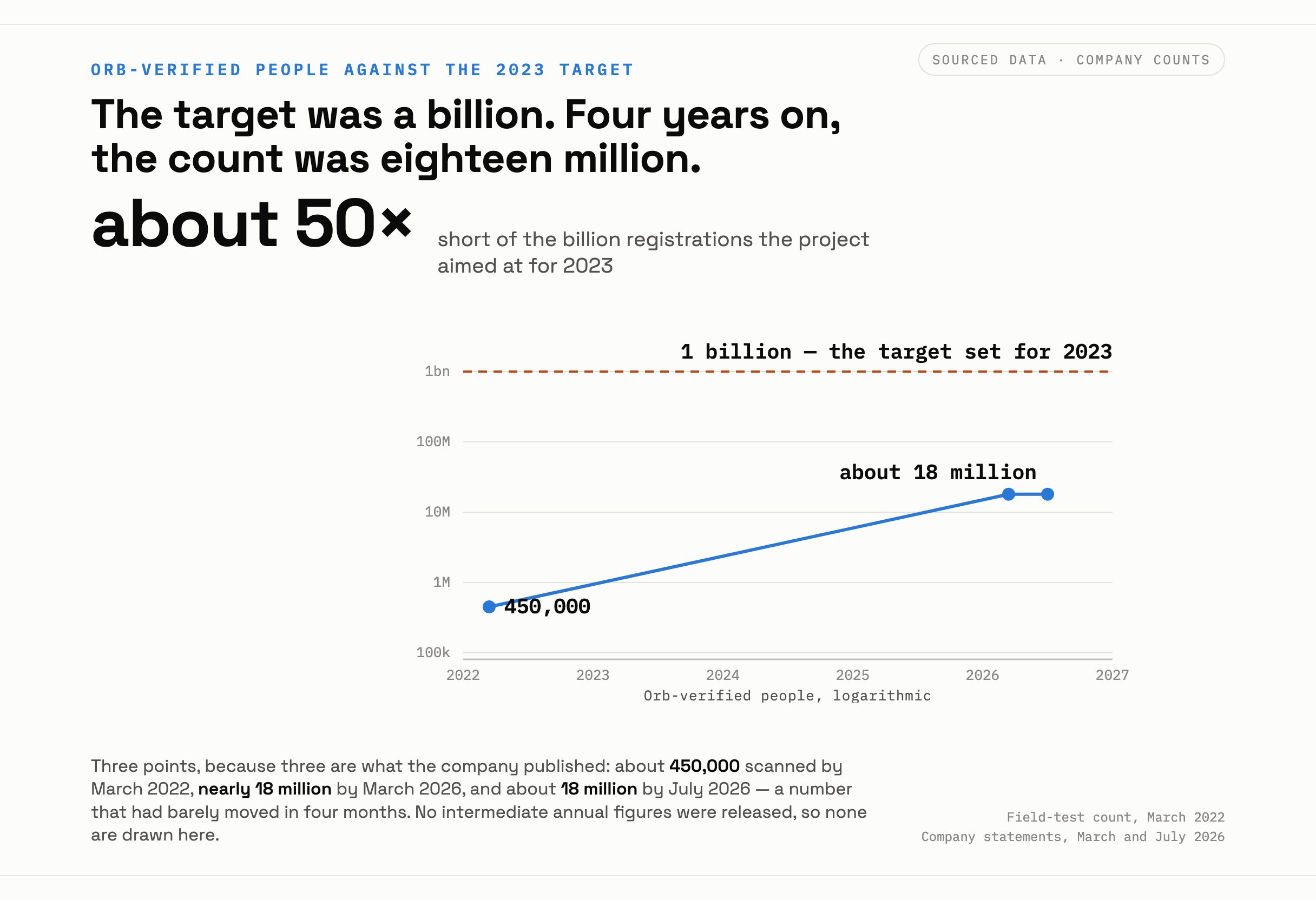
The company said more than 18 million people held a Proof of Human.1 Its design partners were Bain Capital, OpenExchange, Outtake, Pantera Capital and VanEck Funds.1 No bank appeared among them and no price was announced.23 Two of the five were hardly strangers: in July, Pantera had led a 52.5 million dollar sale of World's token, and Bain Capital's crypto affiliate had participated.35
Early, and right about the problem
None of this made the pitch foolish. Deloitte had estimated in 2024 that generative AI could help push fraud losses in the United States from 12.3 billion dollars in 2023 to 40 billion by 2027.6 Early that year a finance employee in the Hong Kong office of the engineering firm Arup made 15 transfers worth about 25.6 million dollars after a video call in which the chief financial officer and several colleagues were all fabrications. Later accounts often omit that the email requesting a secret transaction had first made him suspicious. The call was what settled his doubt.7
Tools for Humanity, the company behind World, was founded in 2019,8 although the public did not hear of an Orb until the project emerged from stealth in 2021. By March 2022 its field tests had scanned about 450,000 people, and it was aiming for a billion registrations by 2023.9 The premise that software would soon pass for people, and that someone would need to certify the difference, sounded like a novelist's conceit in 2021 and like an ordinary fraud report by 2026. On the question it had set itself, the company was early and correct.
Being right about a problem is not the same as being its natural custodian, however, and the growth curve illustrated the distinction. By July 2026, 39 million people had joined its network but only about 18 million had visited an Orb, a number that had barely moved since March, when the company described it as nearly 18 million.45
The record the pitch left out
How the first half million were enrolled was documented in 2022: cash, earbuds, payments to local officials, and operators paid per scan, some with little training to answer questions about privacy.9 Then the regulators arrived, one jurisdiction at a time. Spain's data protection agency ordered a halt in March 2024 after complaints that minors had been scanned and that consent could not be withdrawn.10 Hong Kong's privacy commissioner found the face and iris images taken from 8,302 people "unnecessary and excessive."11 Bavaria's regulator ordered a deletion procedure that satisfied European law.12 Kenya's High Court ordered local biometric data deleted within seven days in May 2025,13 and Thailand ordered 1.2 million iris scans erased that November.14
At the time this resembled friction, national bureaucracies grinding against a global product. Considered together, the rulings performed a single function. Each insisted that the person scanned retained a claim on the scan, including the right to withdraw it, and that right sits awkwardly with what a bank wants from a proof of human, which is something stable, portable and difficult to leave.

A registry that worked
The cautious interpretation has a formidable rival in India. Aadhaar, the state's biometric identity system, attracted many of the same objections, all the way to the country's highest court. By 2024 the government's annual economic survey reported that digital public infrastructure, Aadhaar included, had reduced the cost of verifying a customer electronically from about 12 dollars to 6 cents.15 A registry of irises and fingerprints had become the plumbing of Indian finance, which is approximately what World proposed to become for the internet.
India also demonstrates where the limits originated. In 2018 the Supreme Court upheld Aadhaar by four votes to one, then struck down the provision letting private companies demand it, so banks could no longer require it for an account. The dissenting judge warned of "a risk of surveillance."16 The registry worked, and an institution with authority over its issuer drew the boundary. Europe chose a comparable route: its 2024 identity regulation required every member state to offer citizens a digital identity wallet by December 2026, and banks to accept it for strong customer authentication by December 2027.17 The public alternative was approaching the banks on a statutory timetable during the same season World arrived in Las Vegas.
What the badge moved
The banks eventually came, gradually and mostly for the difficult cases: approval of large wires, account recovery, and above all the agents, since an agent without a delegated proof came to be treated much as an unsigned cheque once was, acceptable in principle and questioned in practice.
What shifted was the burden. In 2026 a bank had to establish that a customer was who they claimed to be, and when it was wrong, the loss was the bank's to explain. A decade later, wherever a proof was requested, the customer had to demonstrate they were human at all, using a credential the bank had not issued, could not revoke, and did not govern. The most valuable list in retail finance became a list of people held outside any bank. Those without a proof were not excluded. They were directed to the slow queue, the callback and the branch, together with many residents of the countries whose courts had ordered their scans erased, and the friction that had once belonged to the institution settled on whoever lacked the badge.
The older checks had been expensive partly because they bundled verification with responsibility. The Arup employee's suspicion was the last remnant of that arrangement, and a video call overruled it. A badge on a tile is designed to overrule doubt as well, and usually it was right to.

The sphere at the exchange was never really a camera. It was a counter, the place where a person had to appear in the flesh so that someone could vouch they had been there, which was precisely the errand online banking had been built to spare people. In 2026 the counter returned, on Wall Street of all places, operated by a company that was not a bank. The decade settled that people would still have to turn up in person. It left open who stands on the other side of the glass.
Author's Note
This is speculative journalism written from 2036. The archived Orb, the branch counter and everything after 2026, including how banks adopted the proofs and who came to carry the burden, are projections and composites. The launch, products, partners, user counts (the company's own claims), fraud figures, court and regulatory rulings and European deadlines are real and sourced below.