

The laminated card on Noor Abadi's desk read ATTESTATION PACKETS, FLAT FEE, and it had been propped against the same filing cabinet for seven years.
Her office was one room above a dry cleaner on International Boulevard in Oakland. A flatbed scanner bought used. A filing cabinet she actually opened. A kettle on the windowsill, and a blind kept half shut against the afternoon.
The man in the folding chair was twenty-seven and needed to prove one year of his life to a hospital system's hiring portal. In 2027 he had been one of about fifty people in the founding class of a venture funded school in San Francisco. He had a portfolio. Eleven projects, two of them good. The portal wanted a transcript, and there had never been one.
Nobody had lied to him. The school had published the relevant fact on its own website before he applied. It just had not been the fact anyone read in 2026.
What was on the poster
Palantir had gone first. In April 2025 the company launched what it called the Meritocracy Fellowship, open to recent high school graduates who were not enrolled in college. The first cohort ran four months. Fellows read great works, visited institutions, and worked alongside full time employees on real problems. More than 500 people applied and 22 were taken. The program was advertised as a way to "get the Palantir degree," under the slogan "Skip the debt. Skip the indoctrination."1
The company was explicit about what it meant to replace. Its posting said that "opaque admissions standards at many American universities have displaced meritocracy and excellence." Chief executive Alex Karp told an earnings call it was "by far the best credential in tech."1
By the fall 2027 cycle the shape had hardened into something closer to a job. Five weeks of seminar style sessions in New York, then placement on a development or forward deployed engineering team, Palantir's term for engineers who sit inside a customer's operation rather than at headquarters. Estimated pay was 5,400 dollars a month. The eligibility list was the part worth reading twice: a high school certificate, no undergraduate degree, not enrolled at an accredited United States university, and not taking university classes during the term.2
On 22 September 2026, Andreessen Horowitz announced the Horowitz Andreessen Academy: San Francisco, for profit, 42 million dollars raised, run by Gagan Biyani, who had co-founded Udemy and Maven. The Founding Class Fellowship would start in September 2027: one year, tuition free, about fifty students, admission decided on proof of work, meaning what an applicant had built, shipped, or earned. No grades, no tests, no homework. Short courses of two days to four weeks taught by founders and operators, co-ops at partner companies including Stripe and Google, and fifty thousand dollars of compute credits plus a 5,000 dollar travel budget per student.3
The ten founding corporate partners were Anduril, Anthropic, Coinbase, Google, Meta, Nvidia, OpenAI, Palantir, Replit and Stripe, and they were not passive donors: they supplied hardware, helped write the curriculum, and offered the co-op places.3 Ben Horowitz put the case plainly: "The training that worked for the Industrial Revolution isn't going to map perfectly onto the AI revolution."4
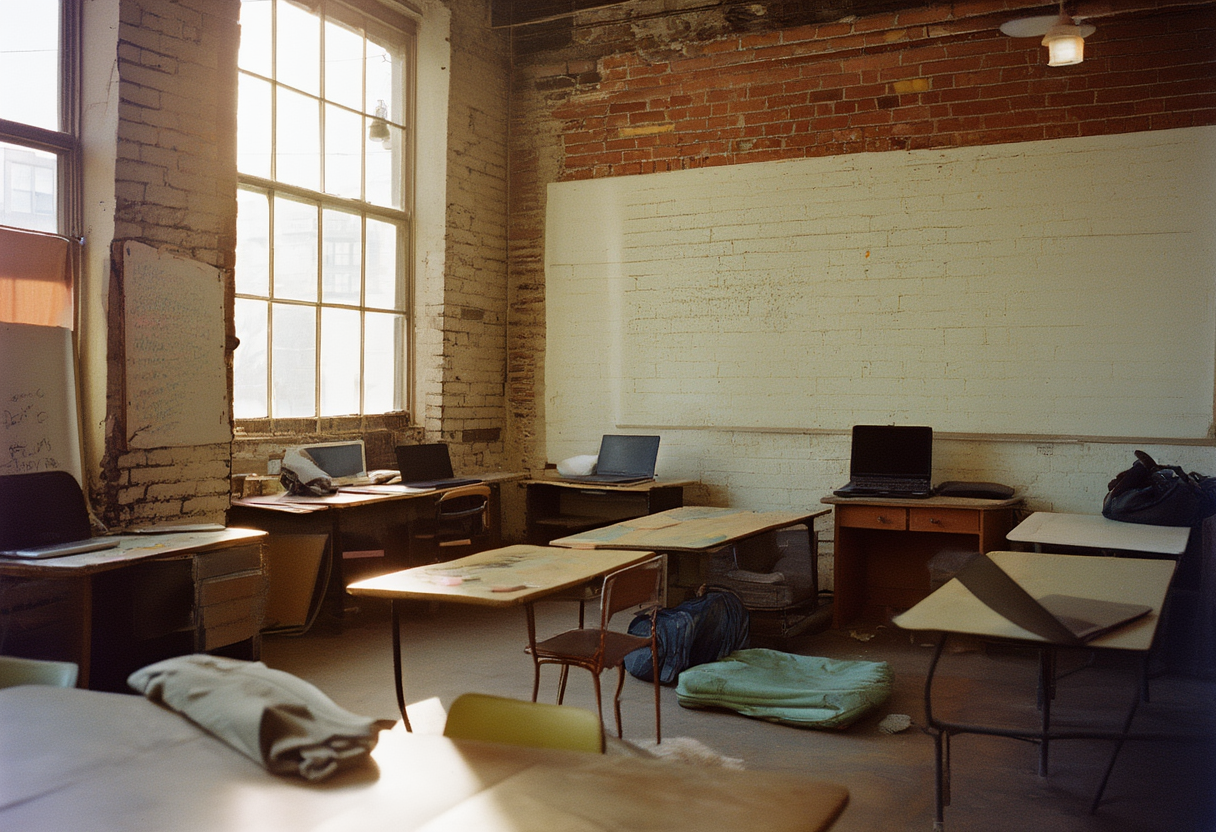
Figure 1. A shared study room in San Francisco, 2036. Three of the six desks belong to people repeating a year they already did.
What was in the small type
The Academy answered the central question in its own 2026 admissions material, in four words: "The Academy is not accredited." No degree. No certificate. Students would leave with a portfolio. It took no part in federal or state financial aid, and families could not spend 529 college savings on it tax free. Tuition free did not mean free either: students arranged their own housing, and the dorm options the school had identified in San Francisco ran about 1,600 to 1,800 dollars a month shared and 2,300 to 2,600 single. It did not guarantee a co-op placement or a job, and could not guarantee that every co-op would be paid.5
So the year cost between nineteen and thirty one thousand dollars in living expenses, with no loans, no aid and no tax advantaged savings to draw against. Nothing was owed at the end. Nothing was owned either.
Why it was the better trade anyway
Here is the part the unkind retrospectives leave out. The arithmetic was real.
The Federal Reserve Bank of New York had run the numbers in April 2025, and they favoured college. The wage premium was over 32,000 dollars a year, about 68 percent. Median wages were roughly 80,000 dollars with a bachelor's degree and 47,000 with a high school diploma. The return on the degree was 12.5 percent in 2024 and had sat between 12 and 13 percent for three decades.6
But look at how that cost was built. Four years came to about 180,000 dollars, and only 30,000 was the net price of attendance. The other 150,000 was wages not earned while enrolled.6 Five sixths of the price of a degree was time.
A program that paid 5,400 dollars a month did not discount tuition. It deleted the opportunity cost and reversed its sign. And the Fed's own figure carried a caveat that mattered more than the headline: half of graduates earned a return below the median. For an eighteen year old with reason to think they were in that half, the paid year was not recklessness. It was arithmetic, done correctly, on the numbers available.
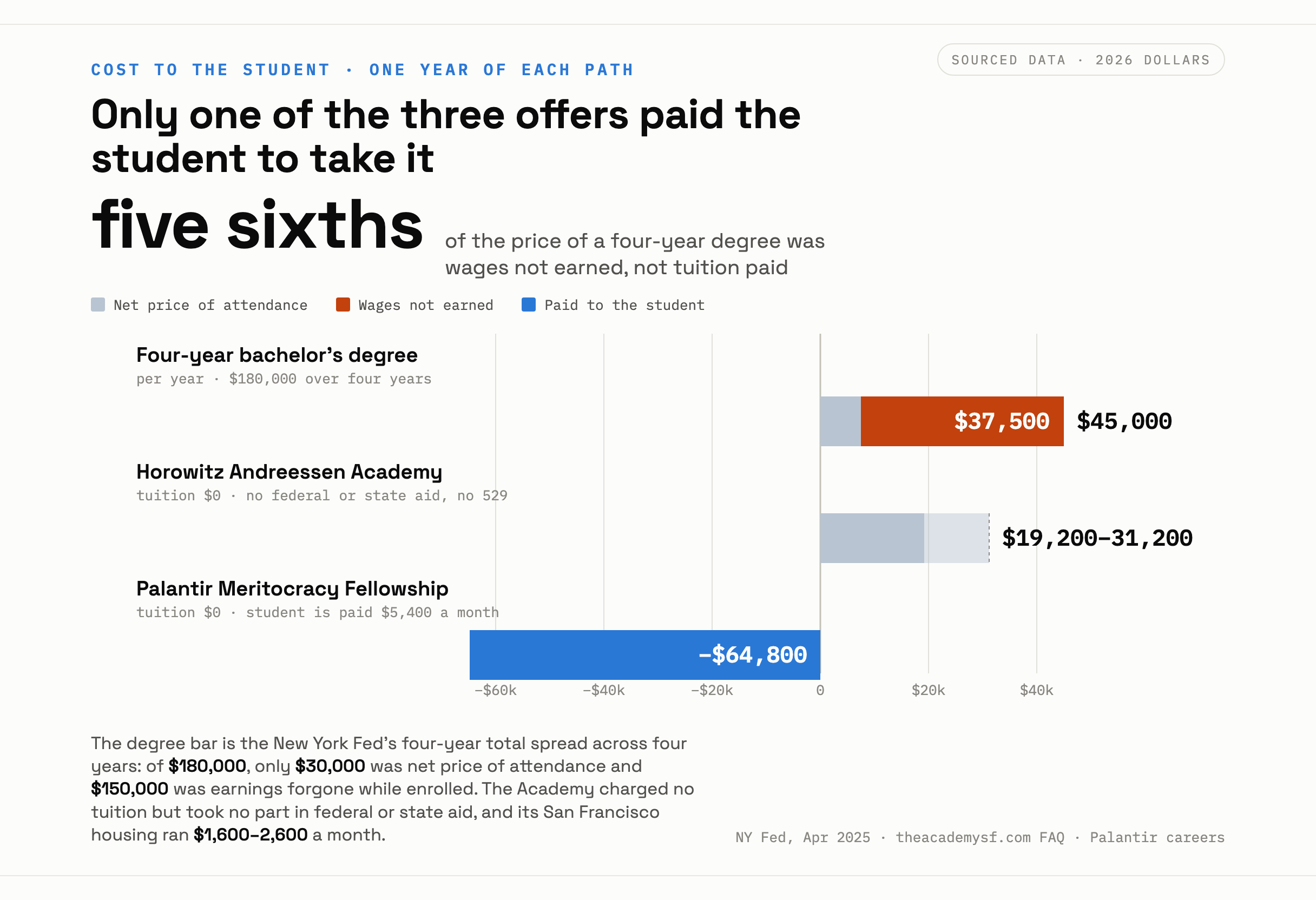
Figure 2. The three offers on the table in 2026, read back from 2036. Only one of them paid.
What the transcript had been for
What both brought back was older than either of them, and older than the university.
An apprenticeship bound a young person to a master for a term of years, and what it produced was not a document. It was a person who could vouch for you, and the vouching stayed inside the relationship. The modern transcript solved that quietly, by moving the voucher outside the employer. A transcript was a claim on the entire labour market, honoured by an institution that had no stake in whether you stayed anywhere.
The 2027 programs removed the debt. They removed the transferability in the same motion, and only one of those appeared on the poster.
Palantir's eligibility rule said it most clearly. You could not be enrolled at an accredited university while you were a fellow.2 The Academy's version was gentler and shaped the same way: a deferrable year that produced no credit to carry into the second year of anything.5 Both were honest. Neither was reversible by the student.
While the company was still there and still pleased with you, this cost nothing. A title at a firm everyone had heard of did the vouching, the way a founder's own name became the asset in the same decade. The cost arrived later, and only for some people.
The middle of the class
Noor had started in 2029, assembling a packet for a cousin, and had not meant it to become a business.
A packet was a thin paper folder, because portals trusted paper scans more than live links. Inside: archived project pages with timestamps, a commit history printed and dated, a screenshot of a cohort roster from a site that no longer resolved, and letters from two people who had since left the company and were careful to say they no longer spoke for it.

Figure 3. An attestation packet assembled in Oakland, 2036. Eleven days of work to replace what a registrar would have mailed in an afternoon.
Her clients were not the experiment's casualties. "The ones who did badly went back to school in 2029 and nobody asks them about it," she said. "The ones who did well never climb my stairs. They have a job title that answers the question." The people who came up were the middle. Competent, unlucky about timing, holding a year of genuine work that no institution had ever been asked to witness. The same middle that paid when the operator's notes turned out to be the valuable part and the operator did not own them.
The man in the folding chair got his packet in eleven days. The portal accepted it. He paid in two instalments, which Noor allowed and no longer mentioned.
What is still open
The two year program was always the real plan. The Academy said in 2026 that it intended to seek regulatory approval for it, and expected to charge roughly what an elite private university charges.3 7
Accreditation is the machinery by which a credential stops belonging to whoever issued it. Almost nobody in 2026 argued it should be denied, and through the 2030s the Academy pursued it. The harder question is still being argued in 2036, and it is narrower than the shouting match about college: whether a school seeded by the ten companies that hire from it can issue a credential those companies do not control, and what the paper is worth if it cannot. The answer decides whether the class of 2027 was the first of something, or the last cohort to pay for a lesson in who ends up owning the record of your work.
Noor keeps the card propped up because clients ask what the fee covers. The answer is that it covers finding someone with nothing to gain who signs.
Author's Note
This article is speculative journalism written from 2036. Noor Abadi, her Oakland office, her client and the attestation packets are fictional composites. The programs, companies, eligibility rules, prices, quotations and wage data are real, documented and sourced below. The forward projection from 2026, including the Academy's pursuit of accreditation and the market that grew around unwitnessed training, is the speculative layer.