

I spent 2026 convinced the trading agents would make ordinary investors poorer. I was right about the outcome and wrong about the mechanism, which is the most expensive way to be right.
The story everyone told, including me, was overtrading. A hundred trades where one would have done. Short-term gains taxed as ordinary income. Fees, spreads, churn, the slow bleed of a portfolio being handled too much.
All of that is true. All of it is documented. None of it is where the money went.
Why the agents looked like progress
The case for handing your portfolio to software was not stupid. It rested on the best-evidenced finding in retail finance.
Brad Barber and Terrance Odean went through 66,465 households at a large discount broker across 1991 to 1996. The households that traded most earned 11.4 percent a year while the market returned 17.9. The average household turned over 75 percent of its portfolio annually and still finished at 16.4 percent, under the index it could simply have bought and left alone. Their explanation was overconfidence, and their title did the rest of the work: trading is hazardous to your wealth.1
So the logic followed cleanly. If the damage comes from a human acting on conviction at the wrong moment, take the human out of that moment. Give the decision to something with no ego in the position, no story about why it bought in March, no need to be seen doing something on a bad Tuesday. By July 2026 Coinbase, eToro and Robinhood had all launched agents that could construct a portfolio and execute inside limits you set once, calmly, in advance. Interactive Brokers went the other way in June and kept a human approving every trade, which its people called keeping a human in the middle.2
That concedes a great deal and I want to be plain about it. The penalty Barber and Odean measured was real. It fell on ordinary households rather than on anyone sophisticated. An agent that simply declined to churn would have fixed it, and some of them did exactly that.
What the gap actually measured
Here is the number I should have been looking at the entire time.
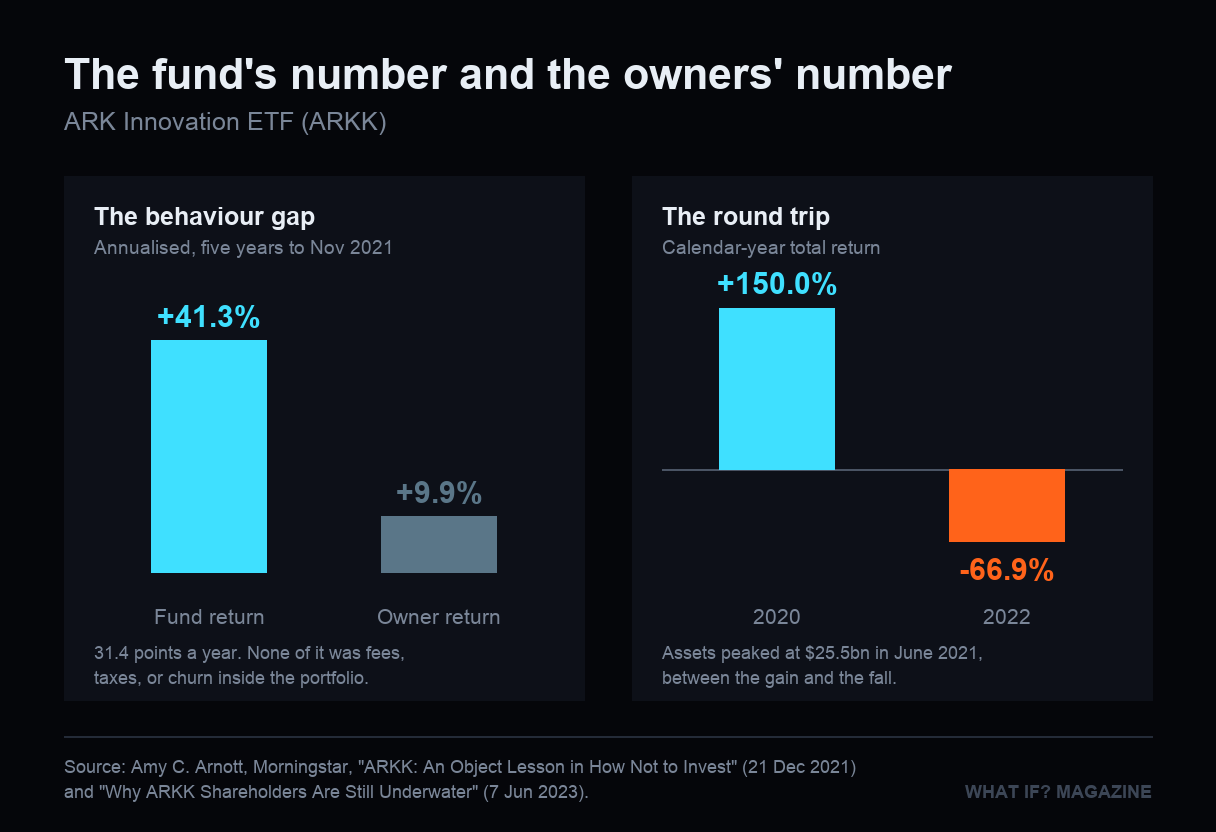
In December 2021 Amy Arnott at Morningstar published an analysis of ARK Innovation that has aged into something close to a founding document. Over the five years to that point the fund reported an annualized total return of 41.3 percent. Its investors earned about 9.9 percent.3
Read that twice, because the first reading is always wrong. The fund did not lose money. The fund was one of the best performing vehicles of its era. The people who owned it took home less than a quarter of what it made, and the difference was not fees, was not taxes, and was not churn inside the portfolio. The difference was when the money showed up.
Roughly 90 percent of every dollar the fund ever took in arrived across 2020 and 2021, after the returns that made it famous. Assets peaked at 25.5 billion dollars in June 2021. The spectacular years were earned by a small amount of money. The crowd bought the track record those years produced.

The shape of it is what everybody remembers, and the shape is not the problem. ARK Innovation returned 150 percent in 2020. In 2022 it lost 66.9 percent.7 Put those end to end and a dollar that sat through both comes out at about 83 cents: the vertical climb, then the long slide back to where the boring money had been sitting all along.
But a round trip is only a round trip if you were there for the whole circuit, and almost nobody was. Arnott went back to it in 2023 and found the fund had returned 9.59 percent annualized since its 2014 inception, while its dollar-weighted return, the one that accounts for when the money arrived, was sharply negative.7 The fund went up and came back. Its owners just went down.
This is the part with no villain in it, which is exactly why nobody could sell it as a story. There is no churn to point at, no obvious greed, nobody to be angry with. Many of the people who lost the most were not day traders at all. They bought once and held, precisely as instructed, and still lost, because holding from the wrong starting point is not a virtue. It is arithmetic with a bad initial condition.
The tax argument sat on top of all this like a coat of paint. Short-term gains really are taxed as ordinary income at graduated rates instead of the 0, 15 or 20 percent long-term schedule, and an agent trading inside a twelve-month window really does convert the favorable treatment into the unfavorable one.4 That is a genuine cost and worth avoiding. Set it against thirty-one points a year and it is a rounding error.
The trading was the visible mistake. The timing was the expensive one.
The frictions that were doing work
So what did the agents actually change?
Not when conviction arrives. Conviction arrives the way it always has, after a run, from a chart in a group chat, from twelve months of headlines about a fund returning 41.3 percent. What changed was everything sitting between the conviction and the transfer.
Consider what used to occupy that space. Funding an account. Reading a page of a prospectus you did not follow. Choosing an allocation while faintly embarrassed by the number. A weekend in the middle. None of that was designed as protection. Nobody built a brokerage onboarding flow as a cooling-off period. But functionally that is what it was, a delay between the feeling and the money, and delay is the only thing that has ever reliably improved retail timing.
An agent collapses the whole span into a sentence you say out loud. You describe what you want, in the moment you want it, and the position exists before the feeling has finished.
Notice that this is a genuine improvement by every metric the industry had agreed to measure. Fewer abandoned signups, less time from intent to execution, lower cost per trade. The friction they removed had never been a feature. It was an accident of paperwork that happened to be load-bearing.
The early figures were not small. Robinhood reported more than 50,000 agentic accounts opened within the first few weeks, generating daily volumes worth millions. eToro said its agent had executed over 500,000 trades in its first year. Coinbase reported more than 4 million dollars in revenue across about 40,000 agents.2
Every one of those is a real number. Not one of them measures whether a single customer ended up better off. Revenue per agent is legible on day one. Dollar-weighted investor return takes five years to read. You can guess which of the two shaped the product.
When every agent reads alike
Now the part I did not see coming, which I file alongside everything else I did not see coming.
Go back to those 66,465 households and notice what the paper never needed to say out loud. They were wrong in 66,465 different ways. One was overconfident about semiconductors, one about a brother-in-law's tip, one about a company whose products they happened to enjoy. That is not a consolation prize. That is a market. Uncorrelated errors net against each other and get absorbed, and the loss stays private.
The agents did not inherit that property. They were built on a handful of foundation models, reached through one standardized interface, the Model Context Protocol, the same plumbing that lets a general-purpose model talk to a brokerage at all.2 The paper that named the real problem was not about retail investing in the slightest. Hui Gong's framework, posted in March 2026, argued that the systemic implications of AI in finance "depend less on model intelligence alone than on how agent architectures are distributed, coupled, and governed," and put heterogeneity in the list of design parameters, sitting next to autonomy and execution coupling.5

Four drawers, four different filing systems: a behavioral finance paper from 2000, a protocol specification from 2025, a systems preprint almost nobody in retail read, and FINRA restating without drama that its rules "are intended to be technology neutral" and apply whatever the software happens to be.6 Put them on one table and the shape stops being subtle.
The agent did not stop the investor from being wrong at the wrong moment. It made sure that everyone would be wrong at the same moment.
That is the trade that actually got made. Tens of thousands of households holding tens of thousands of private errors became a much smaller number of correlated positions, arrived at faster, funded at the same point in the cycle, because the conviction came from the same headlines and the reasoning came from the same weights. The behavior gap did not close. It stopped being idiosyncratic.
Who won is easy: the platforms, and the model vendors underneath them. Who paid is the person whose agent was sold as a personal strategy and was running the consensus of a training distribution with a first name attached, plus everyone afterward who had to price a market where a shared mistake no longer nets out against anything.
The durable lesson, and I would like it carved somewhere permanent: automation moves a decision, it does not delete it. The agents took the hundred trades. They never touched the one decision that was costing the money, which was when you decided to believe.
Author's Note. This piece is written from 2036 and looks back at 2000 to 2026. The correspondent's first person marks the difference between what was knowable in 2026 and what is obvious from 2036; it records changes of mind, not events. The Barber and Odean findings, the Morningstar dollar-weighted return analysis, the US capital gains treatment, the 2026 agentic brokerage launches and their reported figures, the Gong framework and the FINRA position are all real and sourced below. Three boundaries. Figure 2 is a chart, not an illustration, and both of its panels are drawn only from the two Morningstar analyses cited; the annualized and calendar-year measures are shown side by side but are deliberately not combined, because they are not the same thing. The correlated-error outcome described in the final section is an extrapolation from the design parameters Gong identifies, not a documented market event as of 2026. And no claim is made here that any specific fund or platform named caused a specific investor's loss; the ARK figures are cited because they are the clearest published measurement of the gap between a fund's return and its owners' returns, not as an accusation.