

There is a photograph, taken on a stage in 2019, that still turns up in business-school lectures. A stainless-steel pickup truck sits under hard light, its designer standing beside it with a sledgehammer, having just proven the body could take a swing without a dent. Then someone throws a small metal ball at the window, and the glass shatters on live television.1 For years afterward, the moment got told as an embarrassment. It is more useful as a diagnosis. The truck was never really a truck. It was a claim that everything a pickup had accumulated over a century, aerodynamics, repairability, the shape people expected at a hardware-store curb, was mostly evidence of timidity. What if you started over?
That question ran under most of Silicon Valley's defining projects for three decades. It animated electric vehicles and rockets, then social media, cloud computing, cryptocurrency, artificial intelligence, and eventually the machinery of government itself. Sometimes it produced extraordinary results. Sometimes it produced the shattered window. What mattered was that "start over" stopped being an engineering tactic and became a worldview, and the worldview needed a face.
That face was the founder: impatient with institutions, fluent in technology, convinced that everyone still working inside the old system had simply stopped noticing its walls. Steve Jobs supplied the prototype. Jeff Bezos, Mark Zuckerberg, and later Elon Musk and Sam Altman extended it into new registers. Apple became Jobs. Tesla became Musk. Facebook became Zuckerberg. A sprawling semiconductor supply chain is hard to narrate. A person onstage is easy. The founder became the interface the public used to understand technological change, because the alternative was trying to explain the whole system at once.
The premium
The strange thing about the founder era is that it ran on the most collectively produced technology economy in history: public research, universities, global logistics, telecommunications infrastructure, and enormous pools of specialized labor that never got a byline. Culturally, none of that shrank the story so much as the story shrank around one name in it. Jobs did not invent the smartphone alone, but the iPhone became his biography. Bezos did not invent logistics, but Amazon's rise became a parable about his willingness to sacrifice a quarter's profit for a decade's infrastructure.
None of that was false. It was incomplete, and the incompleteness compounded. A founder who had been right about one improbable thing accumulated what amounted to credit, spendable in domains that had nothing to do with the original bet. Bezos's success at logistics made his opinions about media and spaceflight sound heavier than they had any structural reason to be. The mechanism got a name in 2024. An essay by the investor Paul Graham argued that founders who kept direct, hands-on control of their companies outperformed the ones who delegated into a conventional management structure. It became the most argued-about piece of writing in the industry within a week.2 Whatever its merits as management advice, "founder mode" gave the era's oldest instinct a citation: conviction itself, not the specific judgment behind it, was being treated as the competitive advantage.
Elizabeth Holmes ran the same grammar without the underlying company. The dropped-out visionary, the mission too large for a normal biography, the impatience with people who wanted to see the data before believing the claim: she performed it well enough that investors and board members mistook the performance for evidence, until a jury took a different view and a federal judge gave her eleven years.3 Adam Neumann's WeWork lost forty billion dollars of paper valuation in six weeks once outside underwriters, rather than believers, were finally asked to price it.4 The founder premium worked only as long as the audience doing the pricing had a reason to keep extending credit.

Figure 1. A coworking floor, emptied out, somewhere in 2036. The furniture of the founder era outlasted most of its mythology.
Where the boundary sat
Musk's career is the clearest record of where that credit was earned and where it was merely spent, because he kept crossing the line between the two. SpaceX is the strongest case for the model: rocket engineering eventually submits to physical reality, an engine produces the required thrust or it does not, and a leader unusually willing to challenge inherited assumptions can turn that brutal feedback into real progress.
X was a different environment. Twitter had genuine problems when Musk bought it. But it had never been only a software product. It was also a reputation system, an advertising market, and an identity layer, and changes to one piece moved the others. Verification had answered a specific question since 2009: was this account really who it claimed to be. Selling the badge for eight dollars a month solved a revenue problem while quietly changing what the badge meant.5 A rocket that fails gives you an unambiguous signal. A social platform that destabilizes gives you an argument instead, distributed across millions of people with no agreed referee. The founder's own conduct becomes part of the product in a way no engine ever does.
Mark Zuckerberg supplied a subtler version. Facebook's growth had rewarded a rare alignment between what the metrics showed and what the company needed. More engagement was more revenue, cleanly. Meta's metaverse bet assumed the next transition would reward the same instinct. It did not. Reality Labs lost 13.7 billion dollars in 2022. By 2024 the figure had climbed past 17 billion, and the unit still shed more than four billion dollars in a single quarter of 2026, against a product line that earns roughly one percent of the company's revenue.6 The instinct that correctly read mobile did not automatically transfer to a headset. Past success changes the burden of proof. It does not change the terrain.
The government experiment
Nothing tested the founder's export value like the attempt to run it through Washington. The Department of Government Efficiency treated federal bureaucracy the way a startup treats legacy code: full of redundant approvals, overlapping programs, and procedures nobody could justify on request. Some of that diagnosis was fair. Every large institution needs someone willing to ask why a process takes four signatures.
The trouble was assuming that a requirement with no obvious justification had no purpose at all. DOGE's headline claim was roughly 110 billion dollars in federal savings, built in part from 13,476 contracts it said it had terminated. By August 2026, the Government Accountability Office had reviewed the number and found much of it inflated or simply unverifiable. Some of the credit came from building leases that were already being terminated before DOGE's involvement began. Nearly 2,000 of the claimed contract terminations, on inspection, had not actually happened.78 Redundancy in government is not always waste. Sometimes it is the thing that keeps a failure in one office from becoming a failure everywhere at once. A metric that fits on a dashboard, contracts closed, headcount cut, dollars claimed, will always look more real than the resilience it was quietly funding.
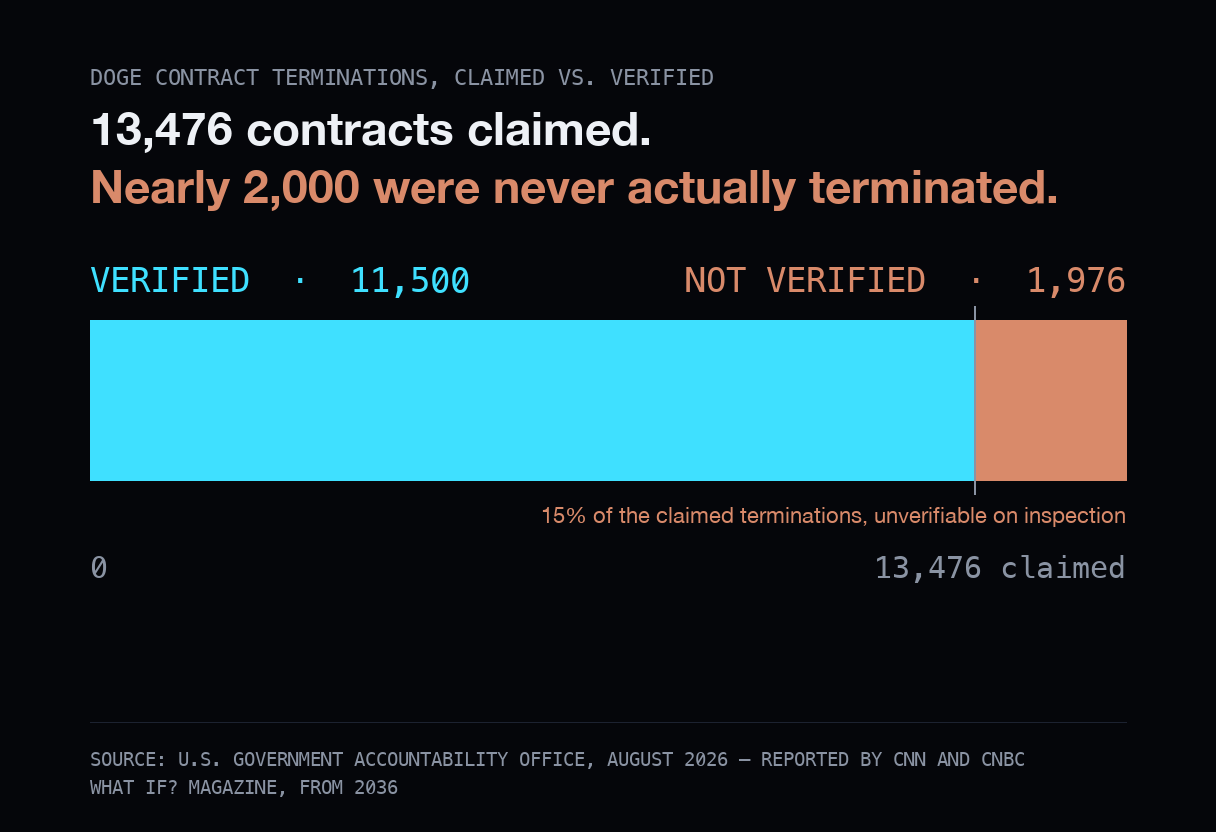
Figure 2. DOGE's claimed contract terminations against the Government Accountability Office's mid-2026 count of the ones it could actually verify. Source: GAO, reported by CNN and CNBC, August 2026.
The founder gets cheap
For a while, artificial intelligence looked set to intensify all of this rather than end it. If one exceptional person with enough compute could substitute for an entire company, the founder was approaching a final, purified form. Sam Altman himself predicted the industry would see a ten-person billion-dollar company, then a one-person one.9
Then abundance did what abundance generally does to a signal: it flooded it. By the early 2030s, starting a plausible company had become almost frictionless, and the founder title stopped indicating rarity the way a photograph stopped indicating a decisive moment once every phone could take one. What became scarce instead was the thing AI could not manufacture on demand: a track record of still answering the phone five years later. Institutions that survived long enough to be boring started trading at a premium that "vision" alone no longer commanded.
What they were right about
None of this is an argument that the founders were simply wrong, and treating it as one would be its own kind of laziness. Institutions really do accumulate assumptions nobody has re-examined. Jobs was right that consumer electronics could be simpler than the industry believed. Bezos was right that the internet could support retail infrastructure nobody else was willing to build first. The mistake was never asking why something existed. It was assuming that standing outside one system meant standing outside every system, when the outsider was always standing inside a system of his own: venture capital, engineering culture, and the feedback loop of his own previous success.
The truck is still driving around in 2036. So is X. So is Amazon's logistics network. None of that changed. What changed is the assumption underneath it. The founder taught an industry to ask why a constraint had to exist. The institutions that came after him were less charismatic and harder to put on a magazine cover. They learned to ask a second question before tearing anything down: what was the constraint doing that nobody could see from the stage.
Author's Note: This is speculative journalism written from an imagined 2036, looking back at a present that runs through late 2026. The people, companies, court outcomes, and figures named here (the Cybertruck unveiling, the Theranos and WeWork outcomes, the Twitter/X verification change, Meta's Reality Labs losses, the "Founder Mode" essay, Sam Altman's one-person-company remarks, and the GAO's findings on DOGE) are real and sourced below. The framing of 2036 as a settled verdict on any of them, and the characterization of what the 2030s institutional landscape looked like, is this magazine's speculative projection, not a reported fact.