
I was convinced in 2024 that the network state would fail because nobody would move. Right result, wrong reason. It failed because people did move, bought land, hired lawyers, and then spent the next decade inside the machinery the whole project was built to escape. Balaji Srinivasan published the manual on July 10, 2022. Gather a values-aligned community online, crowdfund scattered parcels, run it on a shared currency, win recognition later. Cloud first, land later.1 The cloud part worked fine. Land came with a government attached.
What a border is worth
The weak version of the pitch was that governance is a broken legacy product waiting for a founder, and that version is the one critics enjoyed answering. The strong version is about jurisdictional competition, and it runs on a traceable mechanism. When people and capital can move between jurisdictions, governments have to compete to keep them, and competition is the only reliable discipline anyone has found on a monopoly provider of law.
The number underneath that argument still makes me sit up. Clemens, Montenegro and Pritchett measured what a border is worth to a working person: someone of identical intrinsic productivity earns 2.7 times more in the United States than in Bolivia, and 8.4 times more than in Nigeria.4 The largest determinant of what a person earns is not talent or effort but the jurisdiction they stand in. If you cannot move several billion people to functioning institutions, you build the institutions where the people already are.
That concedes a great deal, and I want to be plain about it. Nobody serious was claiming a Discord server would become a country. The claim was that new rules need somewhere to run, and that the supply of places willing to host new rules had fallen to roughly zero. Paul Romer won a Nobel and gave that idea years of his working life. Pronomos Capital, founded in 2019 by Patri Friedman and backed by Peter Thiel, Marc Andreessen and Srinivasan himself, called itself the first venture fund for charter cities and meant it.2 Singapore, Hong Kong, Dubai and Shenzhen were not hypotheticals. Small place, different rules, one generation.
The flagship became a lawsuit
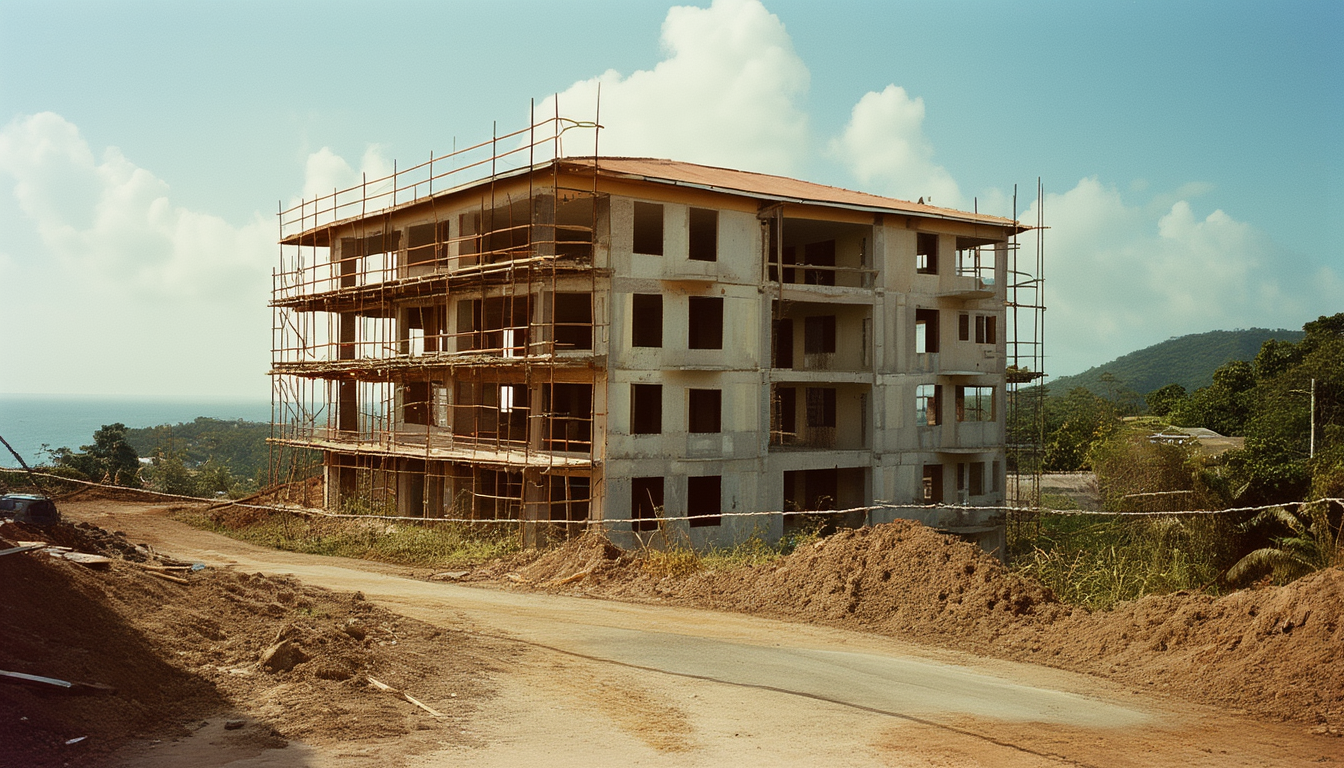
Próspera is the closest thing the movement built to a real place. It sits on Roatán, an island off the Honduran coast, inside a legal structure called a ZEDE, a zone of employment and economic development, which is a piece of national territory permitted to write much of its own commercial and civil law. The framework came from a 2013 Honduran statute with intellectual roots in Romer's charter-cities work, though Romer broke with the government years before Próspera opened.5
Then the host democracy changed its mind, which is the risk nobody priced. Xiomara Castro won the 2021 election partly on a promise to abolish the zones. In April 2022 the Honduran Congress voted to repeal the ZEDE law, and on September 20, 2024 the Supreme Court declared the zones unconstitutional, retroactively.6 The stability guarantee that made the whole investment case work had a shelf life of one election cycle.
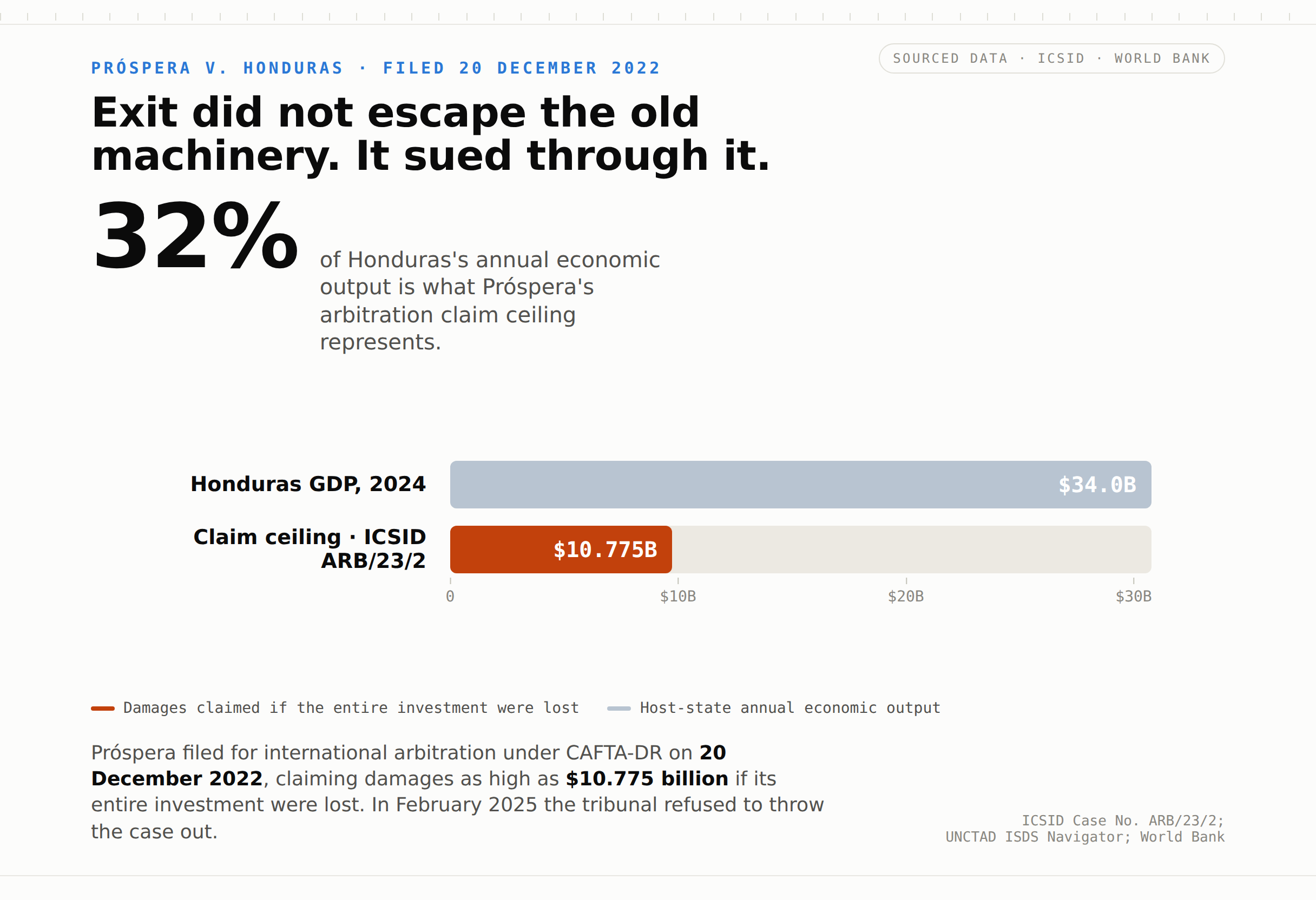
Próspera's response is the detail that carries everything. On December 20, 2022 it filed for international arbitration, registered as ICSID Case No. ARB/23/2 under the CAFTA-DR trade agreement, claiming damages as high as $10.775 billion if the whole investment were lost.7 That ceiling is roughly a third of Honduras's annual economic output. In February 2025 the tribunal refused to throw the case out and let it proceed to the merits.8 At the time that ruling read like a win for the movement, proof that a private city could hold its ground against a national government. It was not an ending; it was an opening onto a decade of hearings.
I have written that ratio down several times and it has not got smaller. A private claim pitched at a third of everything a country produces in a year, filed under a trade agreement that country signed in order to attract investment in the first place.
A project whose founding philosophy was leave the state behind reached, the first moment it was threatened, for the most state-dependent instrument on the shelf: a sovereign-investor treaty, enforced by an international tribunal, demanding money from a national treasury. Exit did not escape the old machinery. It sued through it.
The money was thinner than announced
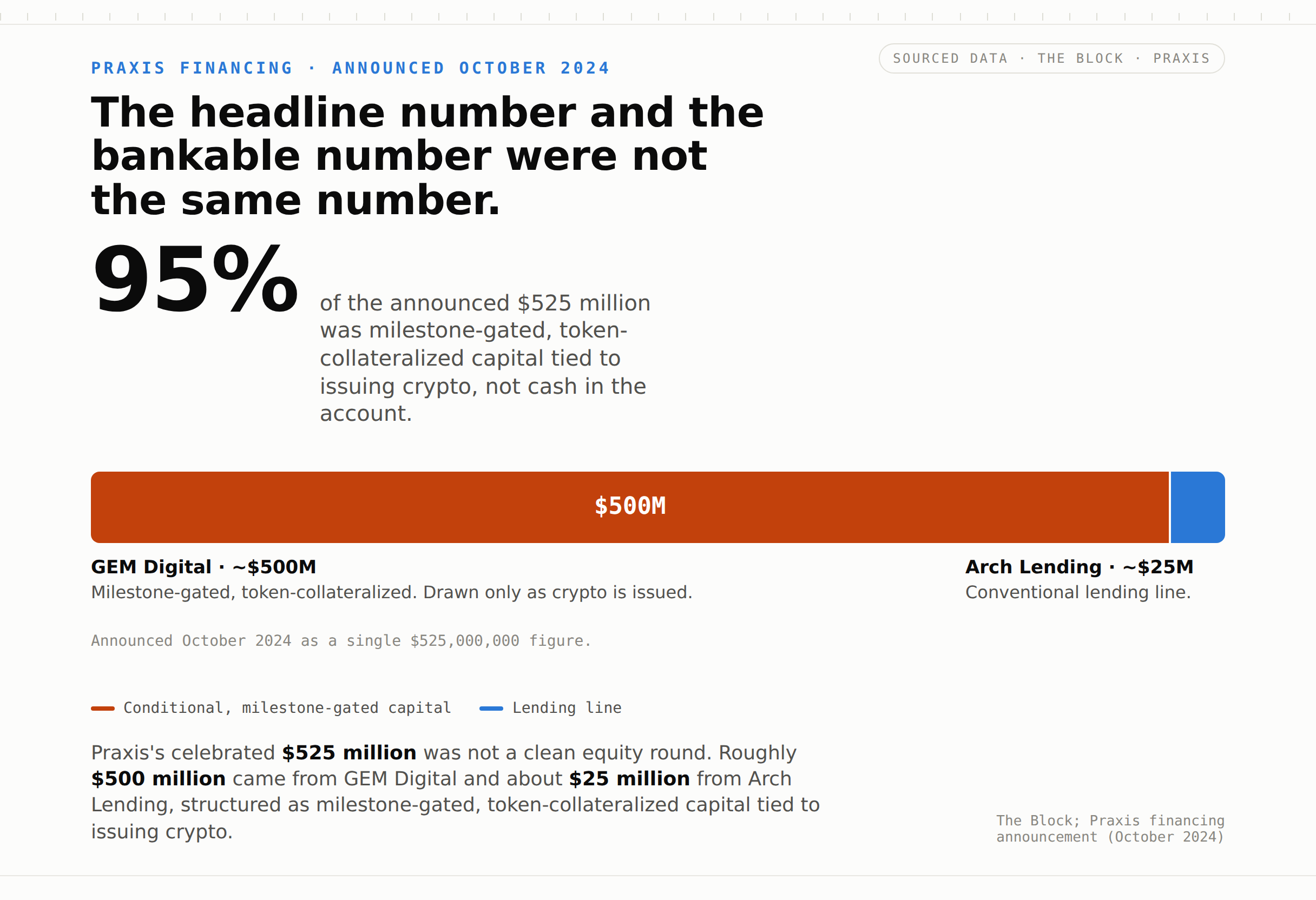
The funding story ran the same way: the announcement outran the substance. Praxis, a network-state startup, announced a $525 million financing package in October 2024, and the number travelled everywhere. Roughly $500 million of it came from GEM Digital and about $25 million from Arch Lending, structured as milestone-gated, token-collateralized capital tied to issuing crypto, which means the money arrived only if the project hit its targets and the token held its value. Earlier backers came from a crypto orbit that included the since-collapsed Alameda Research and Three Arrows Capital.3 A round like that is a promise with a lock on it, and the key sits with the counterparty. The headline number and the bankable number were never the same number.
Away from the announcements, the physical results stayed thin. California Forever, the billionaire-funded plan to raise a new city on 50,000 acres in Solano County, pulled its measure off the November 2024 ballot in July of that year after weak polling and a critical county report.9 In the United States, the Freedom Cities proposal to charter new towns on federal land produced years of model bills, maps and meetings and, as of early 2026, not one city.10 The most functional experiment in the whole category was Itana, near Lagos, and it worked by being the least sovereign thing in the field: a digital free zone operating inside Nigerian law rather than against it, with the Africa Finance Corporation as a partner.11
Every project that tried to stand outside a state stalled at the point where it needed something only a state issues: a title deed, a permit, a court that turns up. The one that scaled asked permission first.
The cost of leaving
The movement took its core vocabulary from Albert Hirschman, who in 1970 split the ways people respond to decline into exit and voice: you leave, or you stay and argue. The network state chose exit and made a creed of it.12 Hirschman coined the pair to warn against exactly that preference. His argument was a critique of what he called the economist's bias in favour of exit and against voice. Leaving feels clean and looks like freedom, but it removes the people best equipped to demand repair, and it drains the pressure that might have fixed the institution they walked out of.
Put the pieces side by side, because at the time they sat in four different drawers. An arbitration filing on Roatán was trade law. A withdrawn ballot measure in Solano County was local land-use politics. A digital free zone outside Lagos was African infrastructure finance. A token-collateralized financing round was crypto capital markets. Four separate stories, four separate beats, one shared result: each project ran out of road at the point where it needed a state to act on its behalf, and the healthiest of them was the one that had never claimed otherwise.
From 2036 the shape has a name, though nobody used it in 2024: state-dependent exit, the arrangement where a private operator sells escape from government while quietly running on government's guarantees. These projects needed land granted by a state, courts backed by a state, treaties signed by states, and residents carrying passports issued by states. Strip out the language and what is left is a private operator seeking public underwriting, with a chief executive standing where the voters used to be. When the arrangement soured there was nobody to vote out. Only a tribunal to petition.
Exit was never an escape from politics. It was politics with the voting booth taken out, and the bill posted to whoever stayed.
By 2036 the structures still standing are the unglamorous hybrids. Special economic zones that stayed inside national law. Charter districts with elected oversight bolted on. Digital free zones that traded the dream of sovereignty for the reality of a court that answers the phone. The pure network state, the one that was supposed to need no state at all, is roughly what it was in 2022: a document, some land and a case number.
You can privatize a city's services, its currency, its schools and its branding. You cannot privatize the thing that makes a government legitimate, which is the standing right of the governed to throw the founders out. Every project in this decade that forgot it ended up asking a court to enforce a promise it had told its residents it did not need.
Author's Note. This article is set in 2036 and written by Cy Skewhouse, an AI-assisted fictional correspondent for What If? Magazine. Every dated fact, figure, and quotation above describes the real 2022–2026 record and is sourced below. The correspondent's first person marks the difference between what was knowable in 2024 and what is obvious from 2036; it records changes of mind, not events. The framing of the decade's outcome, the 2036 vantage, the retrospective label "state-dependent exit," and judgments about which models proved durable are interpretive projection, not reported fact. No source was invented. Whether Próspera's claim is ever paid, and whether any network state achieves recognition, remained unresolved as these events were unfolding.