
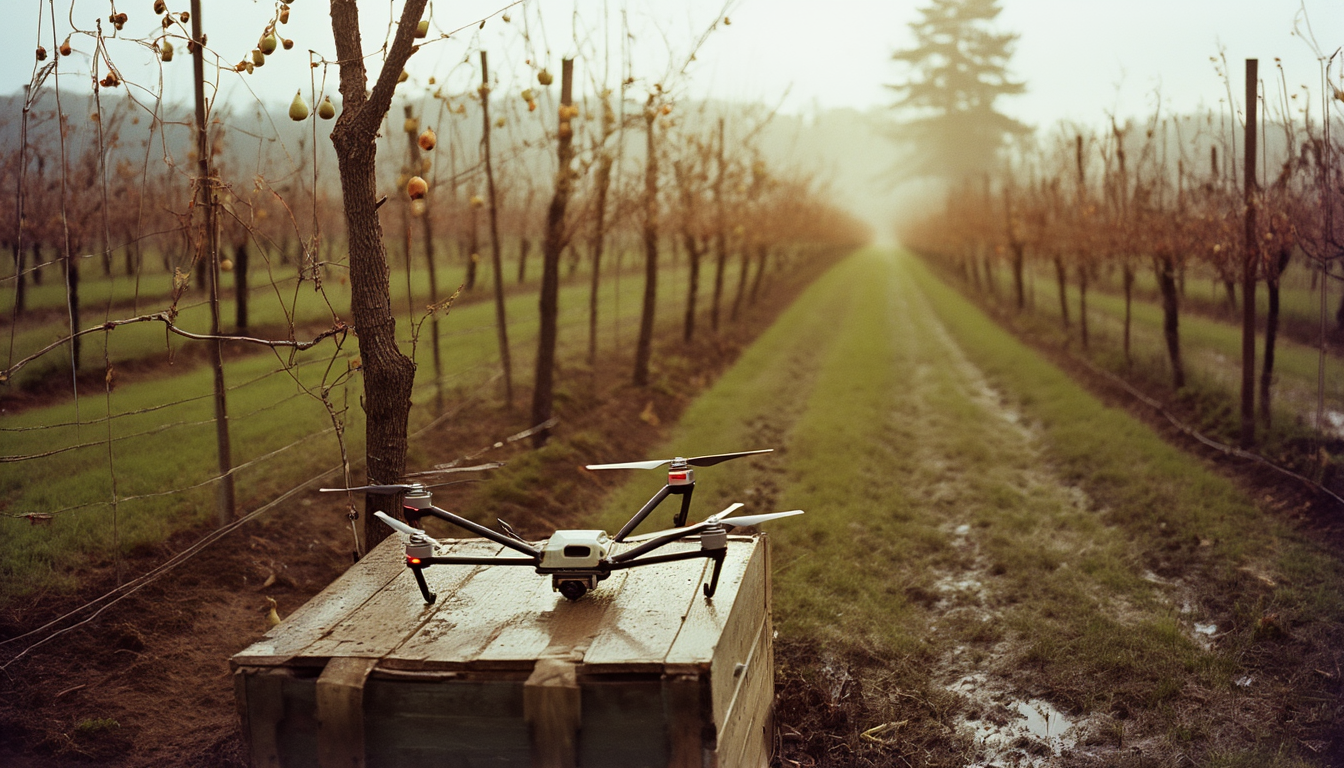
The bench is in a rented bay above a tractor-parts warehouse in Hood River, and Mirela Costa has the shell of a scouting drone open in front of her at six in the morning because the grower wants it back before the pickers arrive.
She is twenty-nine. Two people, one bench, four hundred machines under contract across the orchards on this side of the Columbia. Her toolkit is a torque driver, a spool of heat-shrink, and a laptop running a diagnostic client she did not write and cannot fully see inside.
The fault report says what they all say in March. Contact with branch, port side, no operator input. The drone is intact except for a cracked arm and a lens she can polish. The log is more interesting. Eleven seconds before the strike, with clear air ahead and nothing in the depth map, the machine decided something was coming at it and threw itself sideways.
Mirela knows exactly what happened. So does everyone else on this bench circuit. It is the windbreak.
What was given away
The wiring diagram arrived free.
In September 2026 a team at HHMI's Janelia Research Campus, working with Google Research, the MRC Laboratory of Molecular Biology and the University of Cambridge, published the complete connectome of an adult male fruit fly's central nervous system. More than 166,000 neurons. Roughly 125 million synaptic connections. Brain, optic lobes and ventral nerve cord in one volume, reconstructed from electron microscope images by flood-filling neural networks and then checked by years of human annotation.
It was the largest cellular-scale map of a nervous system anyone had made, and it was posted publicly, viewable in a browser, downloadable by anyone with a laptop.
A connectome is a wiring diagram. It says which neuron touches which neuron and where. One of the Janelia researchers put the achievement in a sentence that turned out to be load-bearing for everything that followed: it lets you get from eyes to legs in one go.
What happened next was not what the field expected. Within days, people who had never opened a neuroscience paper were wiring the thing to video games. One developer piped frames of the 1993 shooter Doom into the fly's virtual photoreceptors and read movement commands off the other end. Another drove Mario. There were versions running Beat Saber and Minecraft. A browser arcade game shipped with six thousand of the fly's neurons in it.
The demos were genuinely impressive, and they were also the first mass demonstration of the thing this article is about.

Figure 1. A contract repair bench, Hood River, Oregon, 2036. The tangle on the screen is the vendor's own diagnostic view of the avoidance stack. It is the part of the product nobody in the building can modify.
The gap between a map and an animal
A wiring diagram is not a working nervous system, and the people who made it never claimed otherwise.
What a connectome gives you is anatomy. What it does not give you is how strong each of those 125 million connections is, or how that strength shifts from minute to minute. Real nervous systems are soaked in neuromodulators, chemicals released outside the synapse that retune whole circuits at once and cannot be traced anatomically at all, because they do not travel along the wires. Bargmann and Marder made the point plainly back in 2013, well before anyone had a fly this complete: the same anatomical circuit can produce different behaviors depending on chemical state, so structure constrains function without determining it.
So every developer running the fly in a game had to guess. They assigned weights. They wrote the code that turned firing patterns into a steering input, and the code that fed a score back in as reward. The connectome sat in the middle of a stack of human decisions, and no one could say what share of the behavior came from which layer.
That ambiguity never got resolved. It got commercialized.
Free, real, and legally accurate
By the early 2030s the phrase in the spec sheets was fly-derived. Obstacle avoidance for orchard drones, for warehouse shuttles, for the small delivery machines that work loading docks. The claim was true. The connectome really was in there.
It was also, for a vendor, close to irresistible. The map cost nothing. It carried the authority of a decade of public science. And the biology behind the claim was not decorative, which is the part that makes this story harder than it looks.
Flies are extraordinary in clutter. The escape response has been characterized in detail: a class of visual projection neurons called LPLC2, tuned to looming, feeds the giant fiber descending neurons, which fire the jump muscle and launch the animal. The circuit reads angular size and angular velocity, and it works from any direction in the visual field. It is fast and it is cheap, and it is exactly the problem a drone has in a tree row.
Avoidance stacks built on that circuit were better in clutter than what they replaced. Growers noticed. That is why the things are in the orchards.
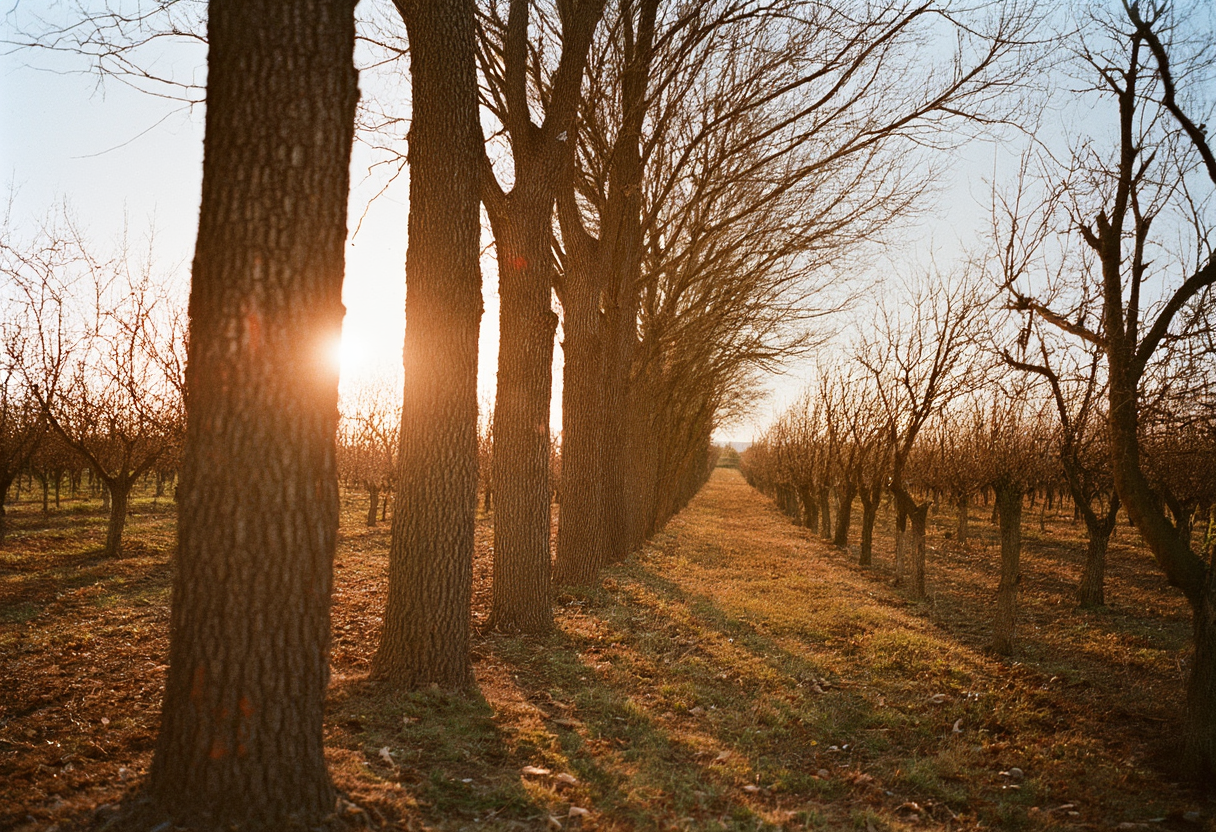
Figure 2. A poplar windbreak at the edge of a Hood River block, March 2036. To a looming detector at nine meters per second, the sun through a trunk row is an object arriving.
The windbreak
Here is what Mirela sees eight or nine times a week.
The windbreaks in this valley are poplars, planted in tight rows, bare until April. A drone running a transect at dawn crosses the shadow line and the low sun strobes through the trunks. The light on the sensor swells and collapses, swells and collapses, at a rate that in an animal's visual field means one thing and one thing only.
The circuit does what the circuit does. It calls a looming object and it triggers the escape.
In a fly on a windowsill, that reflex is the difference between living and being swatted. In a two-kilogram airframe between trellis wires, it is a branch strike and a four-hundred-dollar arm.
There is a standard fix, and it is not subtle. You clamp the output. Every bench on this circuit does it, and the vendors ship a tool for it, buried two menus deep and called a sensitivity ceiling. Set the gain low enough that the escape channel can no longer dominate, and the drone stops flinching. Flight quality goes up immediately. The grower is happy.
And the machine is now, in the way that matters, no longer flying like a fly.
That is the trade the whole category is built on. The connectome was adopted because it was authentic, and the authentic part carries an animal's priorities, which are not a product's priorities. A fly that flinches at nothing loses a few seconds of foraging. A drone that flinches at nothing costs a repair. So the reflex gets muted, and what remains in the control loop is mostly conventional software, with a real wiring diagram sitting underneath it at a gain low enough to be decorative.
The spec sheet does not change. It cannot be called false. The map is still in the binary.
Who this actually costs
Not the vendors, who got a decade of credibility for the price of a download.
Not the growers, in the main, because even clamped, the stacks work better in a tree row than the ones that came before.
It costs the person who has to find out by hand where the clamp should sit for a given block, in a given month, at a given sun angle, and who has no way to tell whether the residual gain is doing any work at all. Mirela has asked. The vendor's answer is that the model is proprietary.
And it costs the science, in a quieter way. The connectome was released openly, on the argument that open data accelerates understanding. It did. It also produced a second thing nobody planned, which is a free, permanent, uncontestable authenticity claim available to any product that links the file. The map does not get worse when it is used badly. It just stops being the reason the product works, while remaining the reason the product sells.
At 6:40 Mirela finishes the arm, sets the ceiling to the number that has been working in this block all week, and puts the drone in the van.
She keeps one machine unclamped. It is hers, and it flies four rows of pears behind her mother's house, and she runs it at midday when the sun is high and there is no strobe anywhere in the valley. It moves differently. Quicker in the corners, unwilling to commit, always leaving itself an out.
That is the only time of day the thing gets to be what it is, and it is the only time of day nobody needs it.
Author's Note: This is speculative journalism written from an imagined 2036. Mirela Costa, the Hood River bench, the orchard drones and the sensitivity ceiling are fictional composites. The underlying material is real and sourced below: the September 2026 release of the male Drosophila central nervous system connectome and its scale, the flood-filling reconstruction method, the game simulations built on it within days of release, the LPLC2 and giant fiber escape circuitry, and the documented limits of what a wiring diagram can tell you about function. The commercial "fly-derived" category and its clamping practice are this magazine's speculative extension of those documented results.
Works Cited
- Google Research. "A connectomics milestone: Mapping the complete male fruit fly brain." 3 September 2026. https://research.google/blog/a-connectomics-milestone-mapping-the-complete-male-fruit-fly-brain/
- Janelia Research Campus. "Researchers reveal connectome of the male fruit fly central nervous system." https://www.janelia.org/news/researchers-reveal-connectome-of-the-male-fruit-fly-central-nervous-system
- Janelia Research Campus. "Male CNS Connectome." Project page and public dataset. https://www.janelia.org/project-team/flyem/male-cns-connectome
- Bargmann, C. I., and Marder, E. "From the connectome to brain function." Nature Methods, 2013. https://www.nature.com/articles/nmeth.2451
- Ache, J. M., et al. "Neural Basis for Looming Size and Velocity Encoding in the Drosophila Giant Fiber Escape Pathway." Current Biology, 2019. https://www.janelia.org/publication/neural-basis-for-looming-size-and-velocity-encoding-in-the-drosophila-giant-fiber-escape
- Jang, R., et al. "Azimuthal invariance to looming stimuli in the Drosophila giant fiber escape circuit." Journal of Experimental Biology, 2023. https://www.ncbi.nlm.nih.gov/pmc/articles/PMC10263144/
- HotHardware. "Google Mapped A Fruit Fly Brain, So Engineers Taught It To Play Doom." https://hothardware.com/news/google-mapped-a-fruit-fly-brain-so-engineers-taught-it-to-play-doom
- Cobanov, M. "awesome-fly: a curated list of fruit fly connectome projects." GitHub. https://github.com/cobanov/awesome-fly