
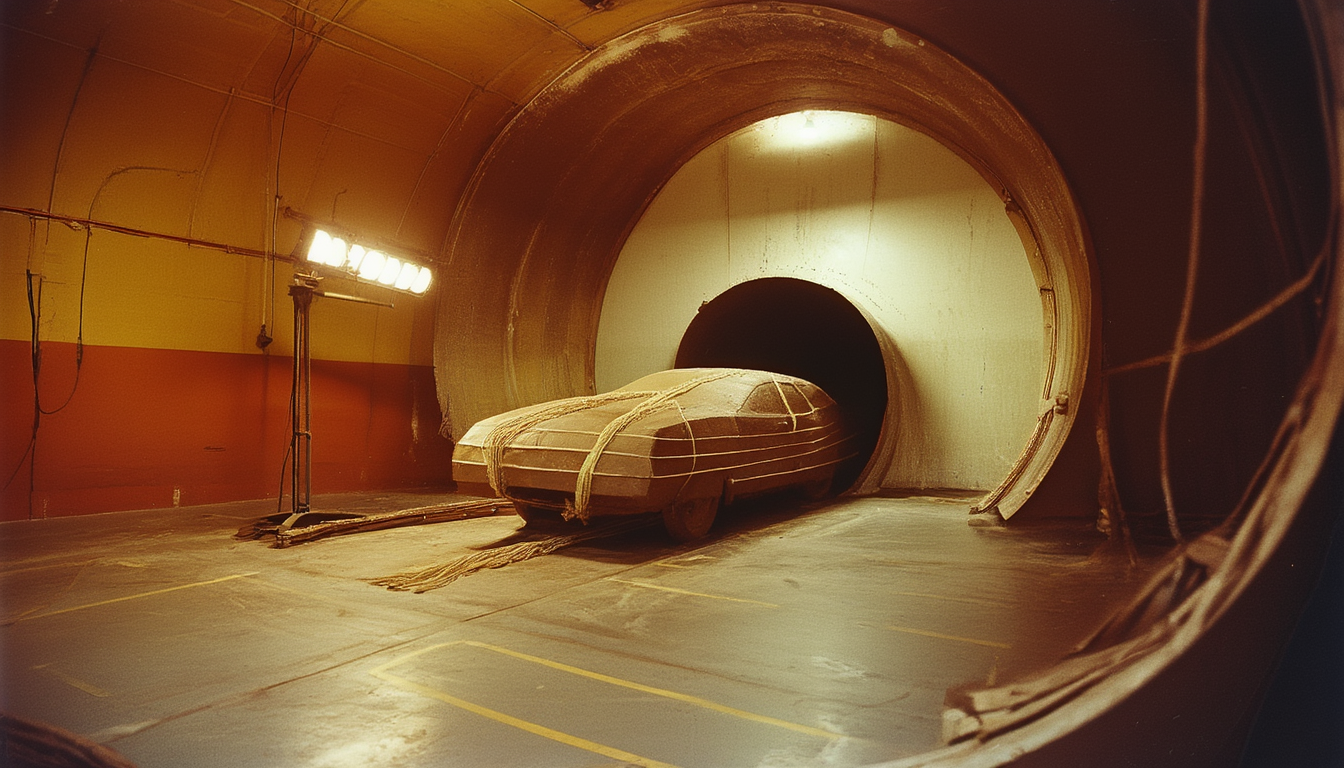
The fan house at Willow Run begins its climb at 4:12 in the morning, and Neve Okada feels it through the floor before she hears it. She is thirty-four, a contract validation engineer, six years into a career spent inside rented wind tunnels in southeast Michigan. Buildings the car industry walked away from and never quite managed to sell.
Tonight it is a battery cooling duct for a mid-market delivery van. The client's report is already on her tablet. A large physics model looked at the duct geometry and returned a pressure-drop figure in under four seconds. The number is clean. Three decimal places, no error bar.
The tunnel takes forty minutes to produce its own number. The two disagree by eleven percent.
Neve writes down both. The eleven percent is why she has a job.
The decade of the fast answer
Nobody in 2036 argues about whether these models work. They work. The argument is about what they know.
A large physics model is an AI system trained on the output of physics simulations rather than on text. Feed it a shape and it predicts how air will move across it, where the metal will crack, how heat will pool, without solving the underlying equations at all. It recognizes. It does not compute.
The first ones arrived in the middle of the 2020s and moved quickly. PhysicsX released LGM-Aero on 4 December 2024, a large geometry model for aerospace, trained on more than 25 million meshes and 10 billion vertices drawn from tens of thousands of computational fluid dynamics and structural simulation runs supplied by Siemens Digital Industries. It returned geometry and performance figures in under a second, against the several hours a conventional solver needed.
NVIDIA opened the field a year later. At the SC25 conference on 17 November 2025 it announced Apollo, a family of open physics models spanning fluid dynamics, structural mechanics, electromagnetics, semiconductors and weather. Applied Materials reported acceleration of up to 35 times inside its own software. Synopsys reported up to 500. Cadence, Siemens, Luminary Cloud and Northrop Grumman were named at launch.
Then the money. PhysicsX closed a $300 million round on 8 June 2026 at a $2.4 billion valuation, led by Temasek, with NVIDIA and Siemens investing. Its chief executive, Jacomo Corbo, put the speedups at "ten thousand to close to a million times faster depending on the type of physics being simulated." General Motors had already folded the models into vehicle design and cut an aerodynamics analysis from roughly two weeks to minutes.
Weeks to minutes. That was the headline of the decade, and it was true.
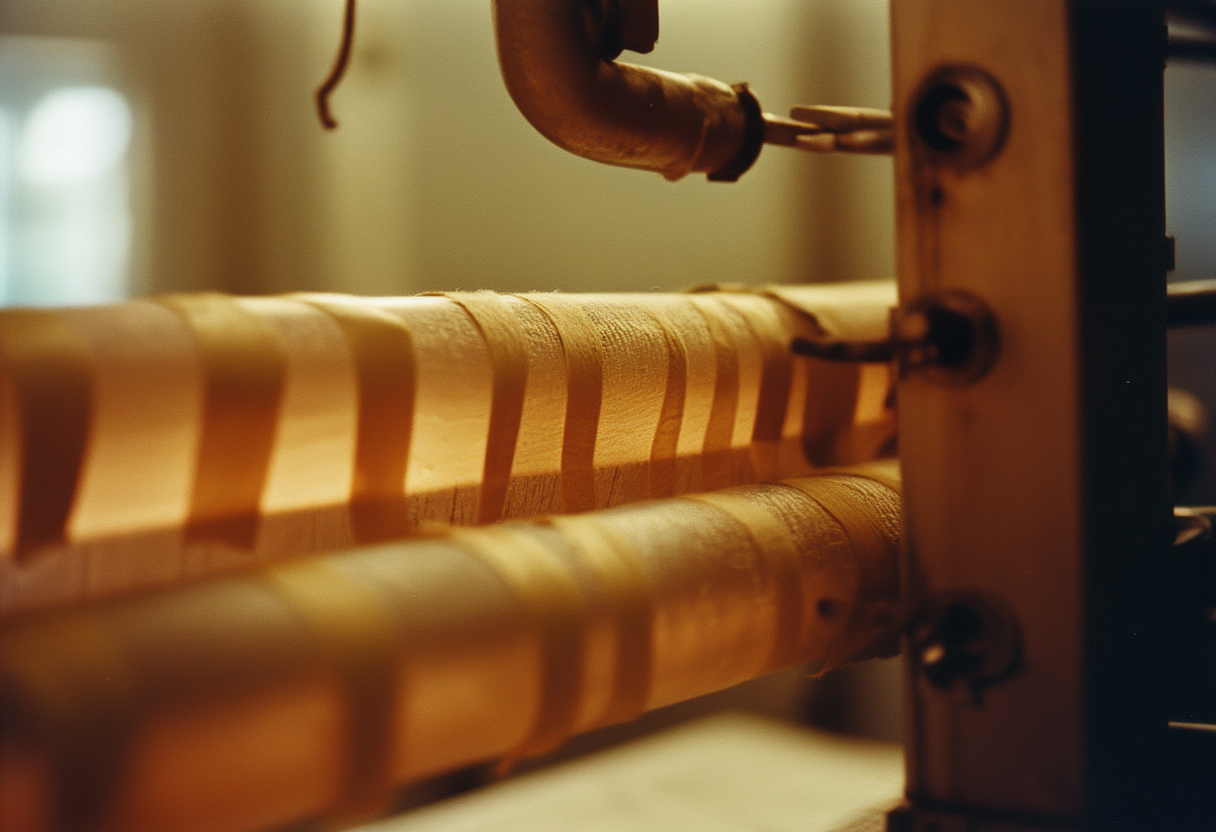
Figure 1. A cooling duct under tuft test at a third-party validation tunnel, southeast Michigan, 2036. Yarn and a pressure tap: the cheapest instruments in the building, and the only ones with no training data behind them.
What was actually in the archive
Here is the part that took longer to become common knowledge.
A conventional solver is slow because it is ignorant. It knows the governing equations and the shape in front of it and nothing else. It holds no opinion about whether the shape is sensible, and it gives the same patient answer for a wing nobody has ever built as for a wing already in production.
A large physics model is fast because it is not ignorant. It has read the archive. What it holds is a statistical map of simulations that were already run, and it answers a new question by resemblance to old ones.
That distinction sounded academic until people asked what was in the archive. LGM-Aero's corpus came from tens of thousands of runs performed by an industrial software company for industrial customers. That was never a random sample of possible shapes. It was the set somebody had paid to analyze: refinements of parts already in production, variations inside a platform a company had committed to, the immediate neighborhood of what was already built.
So the model is most confident exactly where engineering has already been. Training-data density and past commercial interest turn out to be the same map, drawn twice.
The number that looked right
The research community said so early, and plainly.
A benchmark called SIMSHIFT, published by Setinek and colleagues in 2026, tested neural surrogate models on four industrial tasks: hot rolling, sheet metal forming, electric motor design and heatsink design. On hot rolling, one model scored a normalized error of 0.020 inside the parameter range it had trained on, and 0.199 just outside it. Ten times worse. The physics had not changed. Only the dimensions had. Adaptation techniques recovered a quarter to a third of that gap and left the rest standing.
A second benchmark was harder to shrug off. REALM, published on 2 February 2026 by Mao, Zhang, Bai and more than twenty co-authors, ran neural surrogates against realistic multiphysics flows and found a persistent gap between nominal accuracy and physically trustworthy behavior. Models posting high correlation scores were still missing transient structures and integral quantities. On three-dimensional irregular meshes, most surrogates reached almost total relative error within a handful of steps, losing precisely the fine combustion structure the simulation had been built to find.
Read that twice. The metric said the model was right. The physics said it had missed the only thing anyone was looking for.
That is the failure that survives review. A wrong answer that looks wrong gets caught in the first meeting. One carrying a good score gets built.
The filter nobody voted for
None of this slowed adoption, and it should not have. Early ideation is exactly where a fast, approximate answer earns its keep, and every serious operator said so. GM's director of virtual integration engineering told reporters in 2026 that the models were for early design exploration, and that "when it really starts to matter is when we're getting close to launching a vehicle." That was the moment the wind tunnel came back into the room.
But something moved underneath that nobody actually decided.
When an answer costs four seconds, you ask for ten thousand of them. When it costs eleven hours, you ask for six. Teams did not spend the new speed reaching further from the archive. They spent it searching more finely inside it. The fast model stopped being an oracle and became a gate, and the gate chose which candidate designs ever earned a slow, honest solve.
A design the model scored badly did not get a second look. And the model scored badly on unfamiliar shapes for reasons that had nothing to do with whether those shapes worked. The tool sold as a way to explore more of the design space became, in practice, the most efficient machine ever built for staying inside the part of it that was already mapped.
Regulators held a line against this, in slower language. EASA's guidance for machine learning applications, published on 6 March 2024, was built around learning assurance and the boundaries of an operational domain: you have to show what your system learned from, and where it is entitled to be believed. On the certified side of engineering, resemblance was never evidence. Somebody still has to run the real test.
Which is why buildings like Willow Run are still standing.

Figure 2. Six years of paired readings in a contract engineer's logbook, model prediction beside measured result, southeast Michigan, 2036. The right-hand column is the product.
The delta
Neve keeps that logbook. Not the client reports, which belong to the clients. The other thing: six years of differences between what the model said and what the tunnel said, sorted by geometry family.
For the first few years it was a private habit. Around 2033 people started asking to buy it. Not the validation work, which is a commodity now and priced like one. The delta. A map of where the models are wrong is worth far more than any single measurement, because it says which parts of the design space are underpriced. If everyone's model is pessimistic about a shape, and the shape is fine, the shape is cheap.
She sells some of it. She is careful about who to, and she does not write down why.
At 5:40 the fan house winds down and the building goes quiet in stages. Neve pulls the tufts off the duct one at a time, and the yarn goes into a bag she will empty and reuse tomorrow. The eleven percent goes into the logbook. In the morning the client will read it, and someone there will decide whether the model needs retraining or the duct needs redesigning, and the honest answer is that nobody in that loop can reliably tell those two questions apart.
What nobody has instrumented is the archive itself. The corpus training the next generation of these models is being filled, right now, with shapes the last generation approved. Every year the map gets denser in the middle and no wider at the edges. Measuring what that costs would take a slow, expensive, physical test nobody has a commercial reason to run.
The tunnel would do it. The tunnel is expensive.
Author's Note: This is speculative journalism written from an imagined 2036. Neve Okada, her clients and the Willow Run validation work are fictional composites. The underlying material is real and sourced below: LGM-Aero and its training corpus, NVIDIA's Apollo family and its partner speedup claims, PhysicsX's June 2026 round and General Motors deployment, the SIMSHIFT and REALM benchmark findings, and EASA's machine learning guidance. The market in validation deltas, and the narrowing design space described here, are this magazine's speculative extension of those documented results.
Works Cited
- PhysicsX. "Introducing LGM-Aero." 4 December 2024. https://www.physicsx.ai/newsroom/introducing-lgm-aero-genai-for-aero-engineering-and-airplane-showcase-application-for-aerostructures
- NVIDIA. "NVIDIA Apollo: Open Model Family for Scientific Simulation." 17 November 2025. https://blogs.nvidia.com/blog/apollo-open-models
- Tech Times. "PhysicsX Raises $300M." 17 June 2026. https://www.techtimes.com/articles/318582/20260617/physics-ai-slashes-engineering-simulation-days-seconds-physicsx-raises-300m.htm
- Setinek, P., et al. "SIMSHIFT: A Benchmark for Adapting Neural Surrogates to Distribution Shifts." arXiv:2506.12007. https://arxiv.org/abs/2506.12007
- Mao, R., Zhang, R., Bai, X., et al. "Benchmarking neural surrogates on realistic spatiotemporal multiphysics flows." arXiv:2512.18595, 2 February 2026. https://arxiv.org/abs/2512.18595
- EASA. "Artificial Intelligence Concept Paper Issue 2." 6 March 2024. https://www.easa.europa.eu/en/newsroom-and-events/news/easa-publishes-artificial-intelligence-concept-paper-issue-2-guidance