
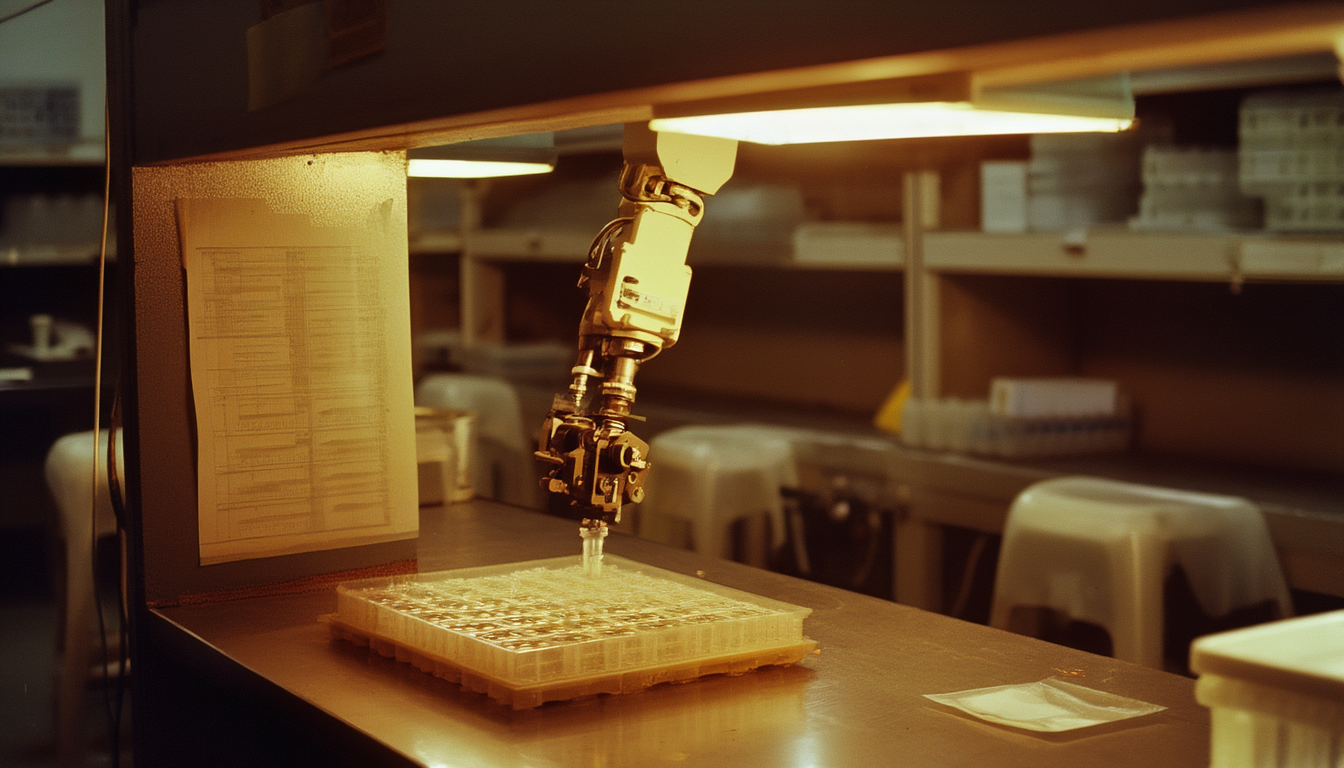
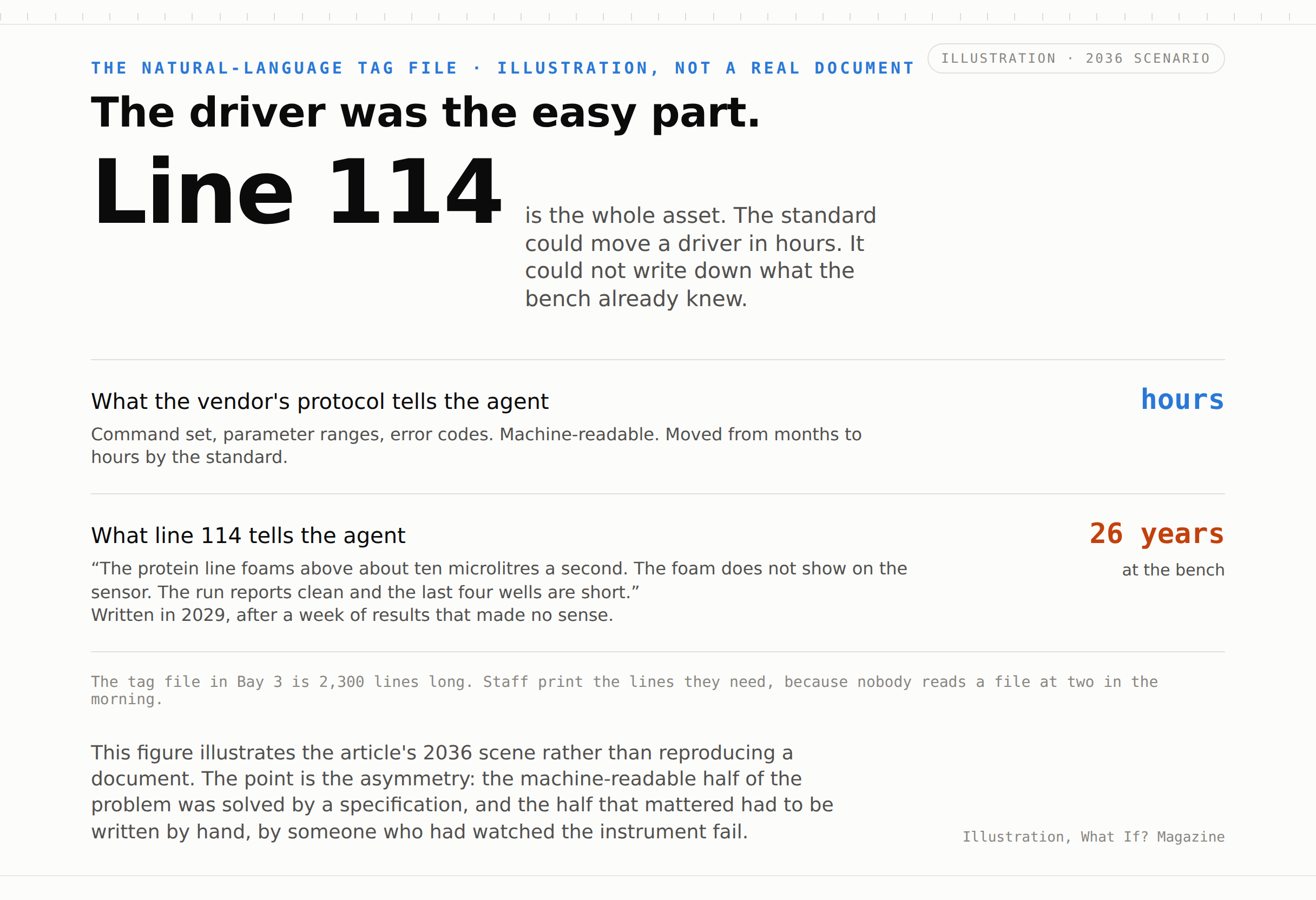
The liquid handler in Bay 3 has a laminated sheet taped to its housing, and Bea Ferraro did not put it there. Someone printed it out of the tag file and taped it up because the file is 2,300 lines long now and nobody reads a file at two in the morning.
Line 114 is hers. It says the protein line foams if the aspirate rate goes above about ten microliters a second, that the foam does not show on the sensor, and that the run will report clean while the last four wells are short. She wrote it in 2029 after a week of results that made no sense. The agent driving the machine tonight has never seen foam. It has read line 114, and so it slows down, and the plate comes out right.
Bea is fifty-two. She has worked benches for twenty-six years. Her hands have not touched this instrument in four.
Twenty-three years of not talking
To understand what changed in 2026, you have to appreciate how badly the previous attempts went.
Laboratory instruments have never spoken a common language. AnIML, an effort to standardize analytical instrument data, began in 2003 and was still a version 0.90 draft twenty-three years later. SiLA 2, the successor to a lab-automation standard first drafted in the 2000s, shipped version 1.0 in 2019, and by the middle of 2026 only a handful of instruments from a couple of manufacturers supported it. OPC UA LADS, the newest entrant, released version 1.0 in December 2023 and had gathered roughly two dozen companies willing to integrate it.1
None of these failed because the specifications were bad. They failed because the people who make the machines had no reason to adopt them. Interoperability was not a missing feature in the instrument business. It was a threat to it. Closed systems sell software licenses, service contracts, and eventually the next instrument from the same catalog. A lab that could swap a microscope for a competitor's without rewriting anything is a lab that stops being a captive customer.1
So labs did what labs do. They glued instruments together with vendor middleware, custom scripts, and open-source drivers that volunteers had reverse-engineered because the manufacturer would not document its own protocol. Wiring one instrument into an automated workflow took specialist contractors and, commonly, several weeks. That cost, repeated per device, is the real reason physical automation lagged the software layer for two decades. Not intelligence. Integration.
The part that went from months to hours
Anthropic previewed the Model Hardware Standard on 27 August 2026.2
The design is unglamorous, which is the point. MHS gives devices a standard way to announce themselves on a network, a pair of primitives that amount to read and write, and standardized drivers that translate between an operating system and a specific piece of hardware. Devices can be driven through the Model Context Protocol, through a command line, or through ordinary code. A shared-memory state dictionary lets several programs read the same device at once. Alongside all of that sits the piece that matters most for this story: natural-language tags, where a human writes down what the device is actually like.2
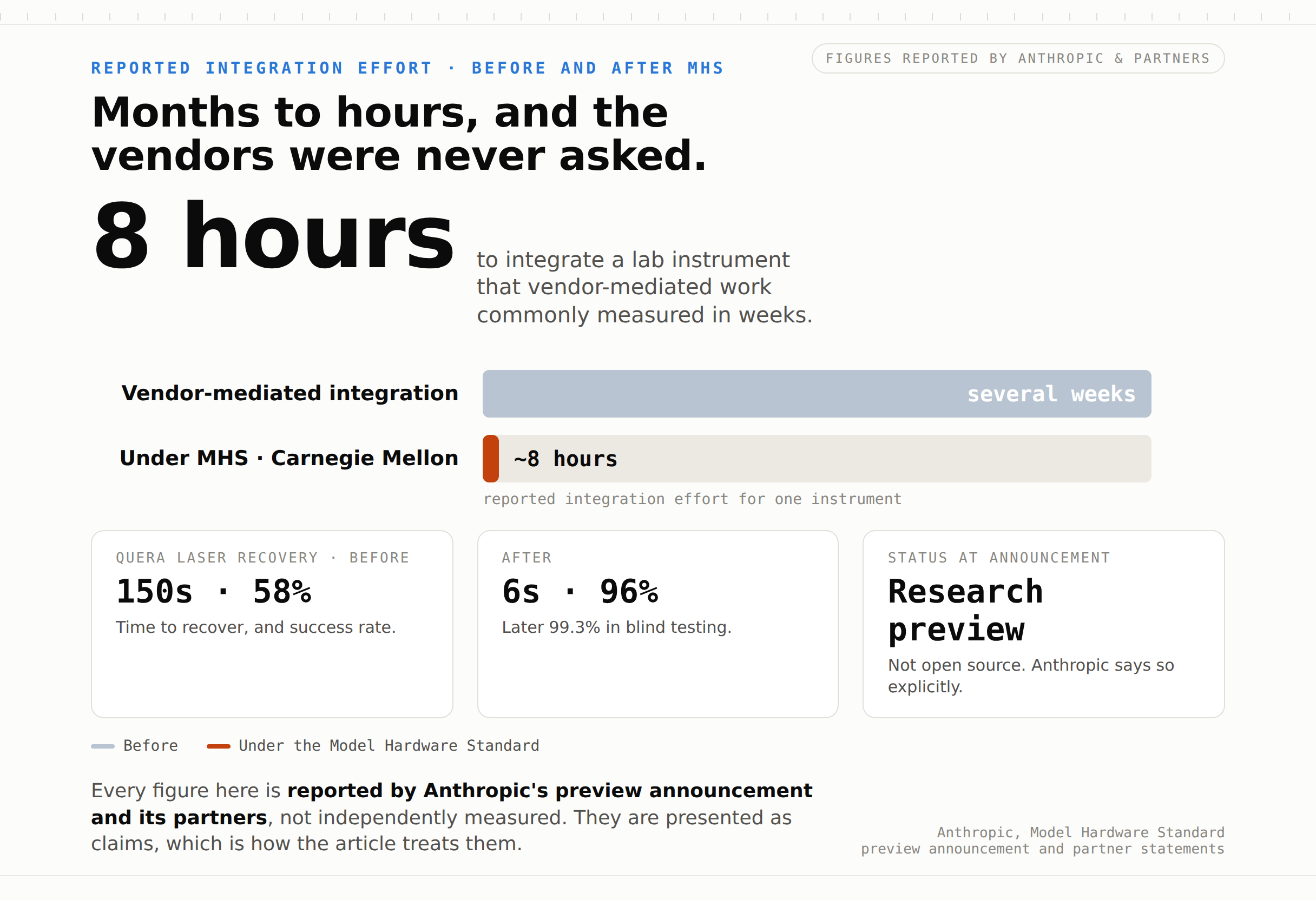
The launch numbers were real and they were good. Carnegie Mellon reported integrating hardware in about eight hours where vendor setups had taken several weeks. QuEra, working on laser recovery in a quantum computing stack, went from roughly 150 seconds per attempt at 58 percent success to about six seconds at 96 percent, and later measured 99.3 percent in blind testing. Genentech reported a model hitting target flow rates on a liquid handler, with low error on water and noticeably worse error on viscous protein. Named collaborators ran from HHMI Janelia and Genentech through Danaher, Tecan, QIAGEN, Universal Robots, AWS, Raspberry Pi, and Hugging Face.2
It was a research preview, not an open standard. Anthropic said plainly that more work was needed before open-sourcing it, that safety evaluations were still being built with launch partners, and that Claude struggles with physical, chemical, and biological constraints that require real-world intuition.2
Look at what MHS did that SiLA never managed. It did not ask instrument vendors to open up. It wrapped them. If the driver can be written by anyone, and the description of the device can be written by the lab, then the vendor's refusal to document its protocol stops being a veto. Twenty-three years of standards politics were routed around rather than won.
That is the same shape as the Model Context Protocol, which Anthropic released in 2024, watched become an industry default, and then donated to the Linux Foundation's Agentic AI Foundation in December 2025 alongside OpenAI and Block.3 Make the connection free, and every machine becomes a place where a token can land.
The part nobody standardized
Here is where the story turns, and it turns on a sentence in Anthropic's own release.
The company noted that its model had trouble troubleshooting foam formation in viscous liquids without guidance. That is not a small caveat. It is the whole job. Anyone who has run a bench knows that operating an instrument is mostly knowing what it lies about: which sensor reads late, which reagent behaves badly when the room is cold, which error code means nothing and which one means stop.
MHS made every machine reachable. It did not make any machine understood. And so the bottleneck moved, cleanly and predictably, to the only remaining scarce input, which was the accumulated intuition of the people who had been running the machines all along.
The standard had a place to put that intuition. It was called the tag file, and writing it was framed as documentation, which is to say it was framed as unpaid.
By the early 2030s the tag file was the operational asset of a working lab. Instruments were commodities, swappable in an afternoon. Agents were rented by the hour from whoever was cheapest that quarter. The thing you could not buy off a shelf was two thousand lines describing how this building's particular machines misbehave. Labs began treating tag files as trade secrets. Vendors, having lost the lock-in fight at the driver layer, started shipping pre-written tags with new instruments, which is how the lock-in came back through a different door.
Who won, and who paid
Anthropic's incentive was never hidden. The constraint on a company that sells tokens is not intelligence. It is reach. Making the connection free is how reach gets built, and the vertical products follow the volume. That worked.2
Science won too, and it is worth saying so clearly. Instruments that sat idle because nobody could afford to integrate them ran. Small labs got automation that had been priced for large ones. Failures got caught by systems that watch every run, rather than by whoever happened to be on shift.
The bill landed on the people in Bea's chair. Their leverage had always been that the machine did not work without them. MHS did not take that away. It asked them, politely and in plain language, to write it down. They did, because writing it down made the night runs come out right, and because nobody frames a documentation task as a negotiation.
Bea's hands have not touched Bay 3 in four years. Line 114 runs it every night. She was never paid for line 114, and the tag file does not carry her name.
Author's Note. Bea Ferraro, Bay 3, the 2,300-line tag file, and every scene set in 2029 or later are invented. They are this magazine's projection of where a documented present-day trend leads, not reported events. Everything set in or before August 2026 is sourced and linked below: the Model Hardware Standard preview and its partner figures are from Anthropic's own announcement of 27 August 2026, the standards-adoption history is from contemporaneous trade reporting, and the MCP donation is from the Linux Foundation. The claim that tacit operator knowledge becomes a traded asset is an argument, not a finding.