
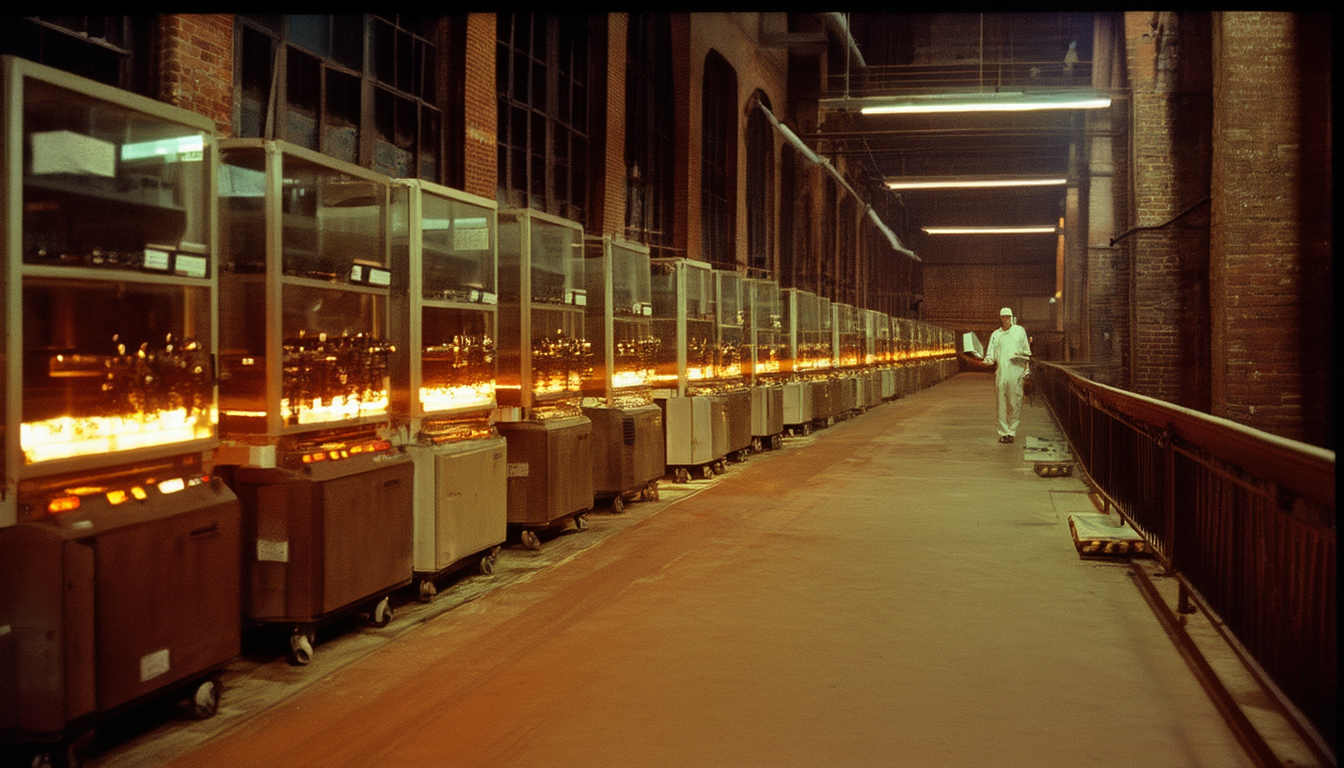
The cart reaches her bay at 02:40, riding its rail with a magnetic sigh Mira Delic stopped hearing in her first month.
She is a reagent steward on the night floor of a cloud lab in Ghent, three storeys of a converted textile mill where the looms used to be. Her badge says Steward II. The floor runs about seventy instruments, and on a normal shift she will touch none of them. Her job is upstream and downstream of the machines: thaw what needs thawing, seat the vials, load the tray, take the finished plates off at the other end, log the handoff.
The work that happens between those two moments is not hers. It arrives from somewhere else, as language.
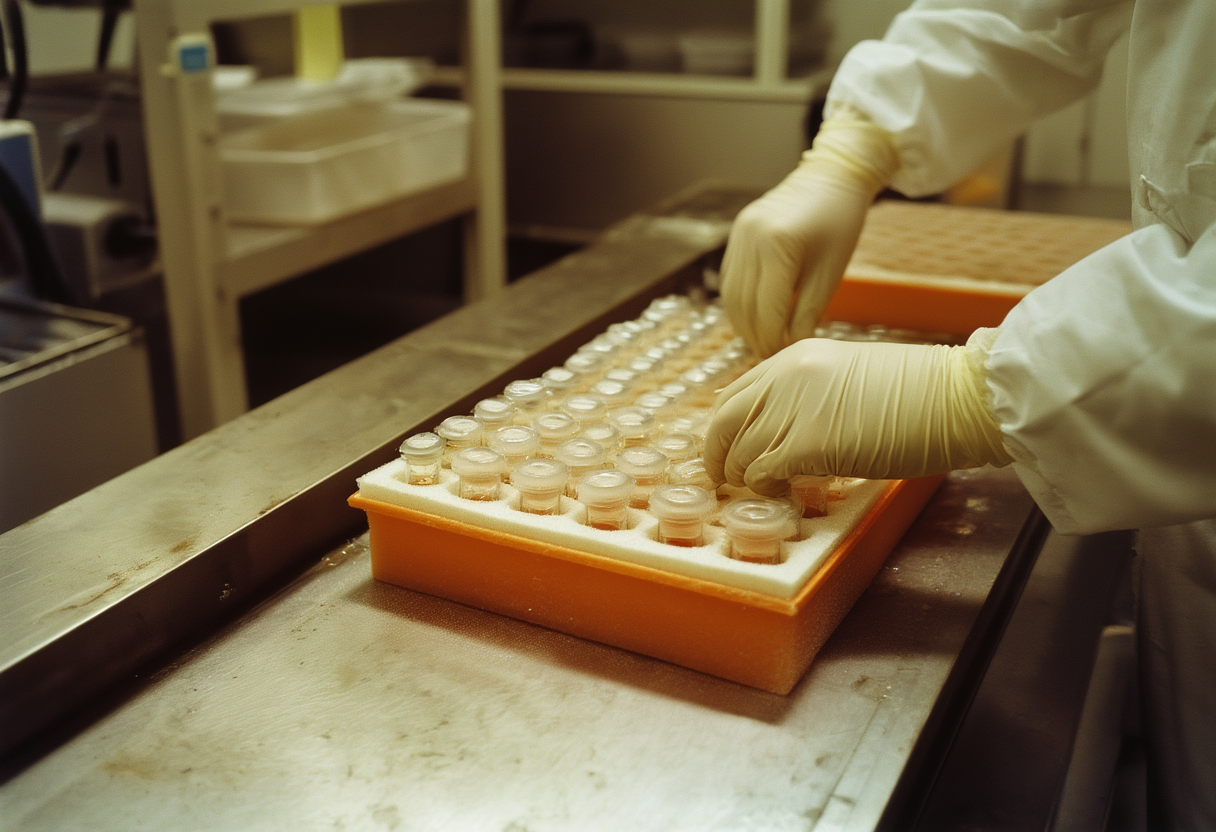
Figure 1. A reagent bay on the night floor, Ghent, March 2036. The steward's hands are the first and last human contact a run gets, and neither moment is a review.
How it stopped being a place
The shift happened faster than the people inside it noticed, because each step was reasonable.
In February 2026, Ginkgo Bioworks and OpenAI published a run that made the shape of it obvious. A GPT-5 system was given internet access, a computer with analysis tools, the metadata from previous rounds, and a preprint describing the current best result. Then it was allowed to behave like a scientist. Over six months and six iterative cycles it designed about 36,000 reaction compositions, worked through more than 580 plates, and generated close to 150,000 data points. It was optimising something modest and real: the cost of making a protein without cells. The prior published best was 698 dollars per gram. The run finished at 422.1
A forty per cent improvement, which is a good quarter for anyone. The part that mattered more sat in the same announcement, stated without embarrassment. Humans were still needed for reagent preparation, for loading and unloading, and for system oversight.
Three jobs. Mira does two of them. The third has no shift pattern.
A month later, in March 2026, Ginkgo opened the same infrastructure to anyone with a protocol and a card. Submit through a web interface, and an agent priced your experiment and told you whether the floor could run it. You did not need a building. You did not need a bench. You needed a description.2
By 2036 that is how a great deal of biology is done, and the arrangement has a property nobody wrote down at the time. The person who designs the experiment and the person physically present when it runs are two different people, in two different countries, with no reason ever to speak.
What the bench had been doing
There is an old paper the automation people quote and the biology people did not read until late. Lisanne Bainbridge noticed in 1983 that the more you automate a process, the more the leftover human role becomes monitoring, the single task humans are worst at, and that the operator's skill decays precisely because the system rarely needs it.
Avigail Ferdman gave that argument its 2036 shape in a 2025 paper on deskilling, and her framing is the one that stuck. She argued the problem is structural, not personal. Skills need environments that afford practice. Take away the routine occasions for judgment and you do not get a person who judges less often. You get a person who no longer has the capacity to, in a building designed so that the question does not come up.3
The pitch for automating the bench was reproducibility. Biology had a real and humiliating problem with results that would not repeat, and machines do the same thing every time. That argument was true. It was also incomplete, in the specific way that expensive mistakes usually are.
The bench had a second function that nobody had priced, because nobody had ever had to buy it separately. A technician who has run four hundred plates does not only execute a protocol. She notices. She sees a reagent list that is strange for the stated purpose. She sees a run that is the right technique pointed at the wrong thing. That noticing was never in anyone's job description, was never a line item, and was free.
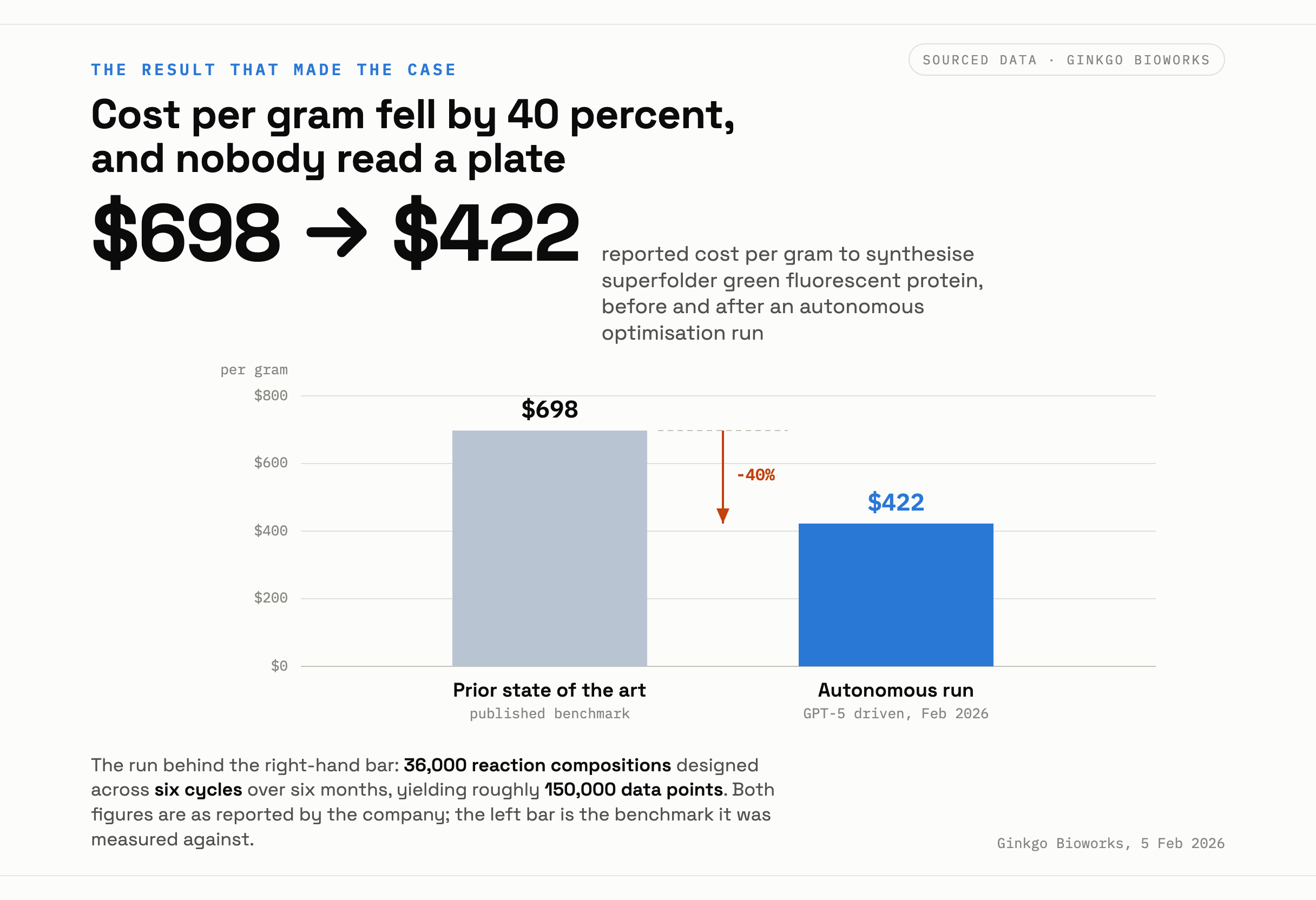
Figure 2. The 2026 result that made the case. Cost fell, throughput rose, and the number that did not appear anywhere on the chart was how many human beings had looked at any individual plate.
The wrong alarm
The safeguards that did get built were built against the loudest fear.
In October 2025, a team led by Microsoft's Eric Horvitz published in Science the result of a two-year confidential project. They had used open-source protein design tools to generate roughly 76,000 redesigned versions of 72 proteins of concern, including ricin and botulinum neurotoxin. Then they ran those sequences past the biosecurity screening software that DNA synthesis companies use to catch dangerous orders.4
The screens caught the originals. Many of the AI-redesigned versions went straight through.5
The response was, by the standards of the field, exemplary. Ten months of patching with partners across sectors before publication, and a tiered-access arrangement with the International Biosecurity and Biosafety Initiative for Science so the method could be verified without being handed out. Nicole Wheeler, one of the authors, said what everyone was thinking: people were going to try this, and the worry was that they would publish before anything could be fixed.
After the patches, about three per cent still evaded detection.
Three per cent is a good number. It is also a perimeter, and a perimeter is only as meaningful as what stands behind it. IBBIS's own mapping of the industry says the plain thing: screening remains voluntary, inconsistent and globally fragmented, and it is not hard to find a company or an intermediary that does not screen at all.6
Nik Hynek had written the year before about why that gap had stayed survivable for so long. The Biological Weapons Convention governs tangible pathogens and toxins, not intangible design data, and the reason this had not yet been catastrophic was mundane: wet-bench expertise and tacit knowledge were still a real barrier. Somebody had to actually be able to do the work, in a room, with their hands.7
That was the backstop. Not the treaty. The difficulty.
Cloud labs dissolve exactly that difficulty, and they dissolve it as a service, with a price quote. The tacit knowledge barrier came down in the same decade that screening software became the only remaining gate, and the two facts were discussed by different committees.
04:15
The plate comes back to Mira at a quarter past four and she does not look at it, because there is nothing to look at and no procedure that would tell her what to do if there were.
Atoosa Kasirzadeh drew the distinction that the 2030s ended up needing. Most of the argument about catastrophic AI risk had been about a decisive event: one system, one moment, extinction. She pointed at the other road. Accumulative risk, she called it, an incremental series of smaller interconnected disruptions crossing thresholds over time, where the small ethical failures are not a separate category from the existential ones but the mechanism by which you arrive at them.8
Nothing on Mira's floor is a decisive event. Every individual thing about it is defensible. The screening runs. The patches were applied. Protocols are validated automatically against plate layout, controls, replication and reagent availability before anything moves, which catches real errors.
What is gone is the other kind of check, the one that never had a name. Not is this run correctly specified, but is this run strange.
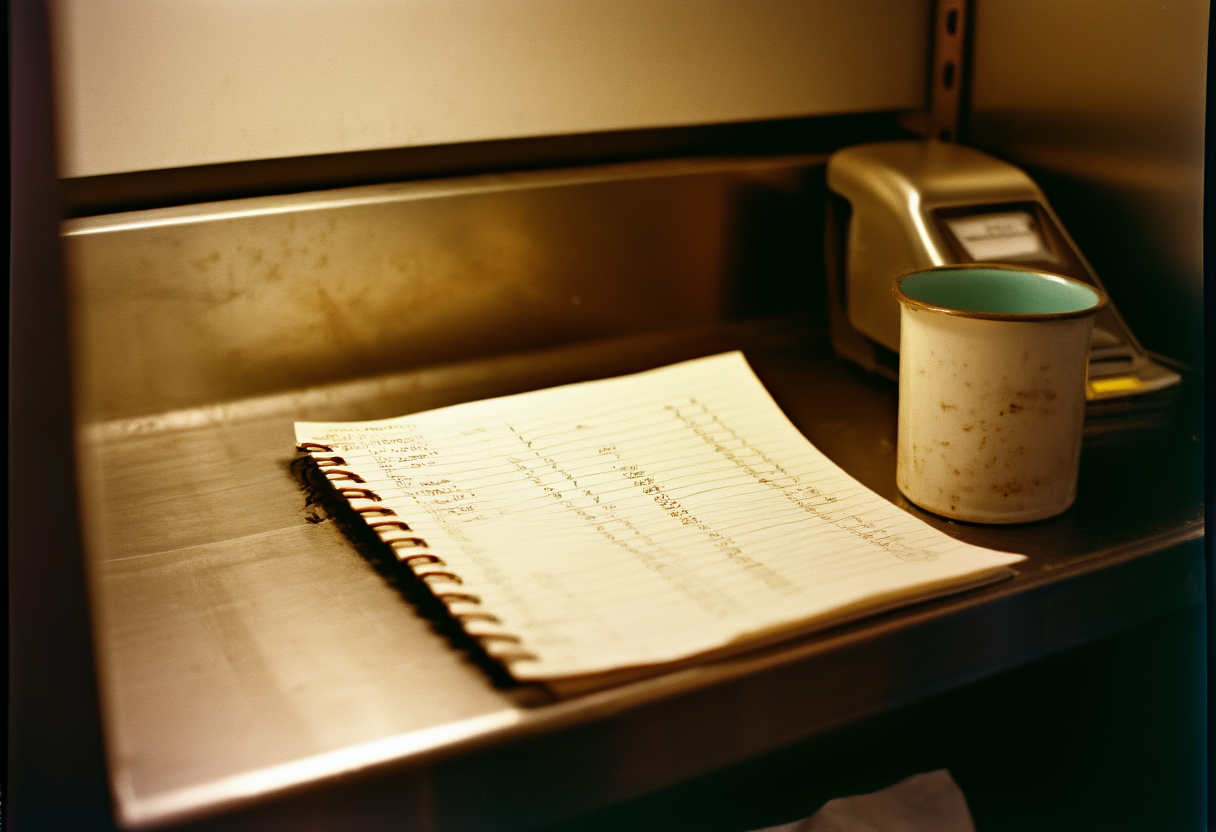
Figure 3. The unofficial log on the Ghent night floor, kept by three stewards across four years. It has no field in any system and no standing in any audit.
Mira keeps a paper notebook on the shelf by the badge reader. So did the steward before her. It is not sanctioned and not forbidden. In it are times, cart numbers, and short flat notes in three different hands. Reagent set odd for stated assay. Client would not clarify. Ran anyway, nothing came of it.
Nothing came of it is the usual ending. She has no way to know whether that is because nothing was there, or because she is the wrong person to ask, or because the part of her that would have known the difference was never given four hundred plates to learn on.
At 06:00 she signs off, walks down through the old mill under high black windows, and the carts behind her keep going. They are extremely good at what they do. What they do not do, and were never asked to do, and could not be billed for, is doubt.
Author's Note. This is speculative journalism written from 2036. Mira Delic, the Ghent night floor, the steward grade, the paper notebook and the events of the shift are fictional composites. The research is real and sourced below. Two boundaries. The Ginkgo Bioworks and OpenAI run described here optimised the cost of cell-free protein synthesis, an entirely benign target; it is cited as a demonstration of autonomous experiment design, not as a hazard. The 2025 Science study was a defensive red-team exercise, patched over ten months before publication and published under tiered access. The connection drawn between the two, that capability and access advanced while the capacity to notice a strange run was designed out, is the author's argument and an extrapolation, not a documented incident at any named company.