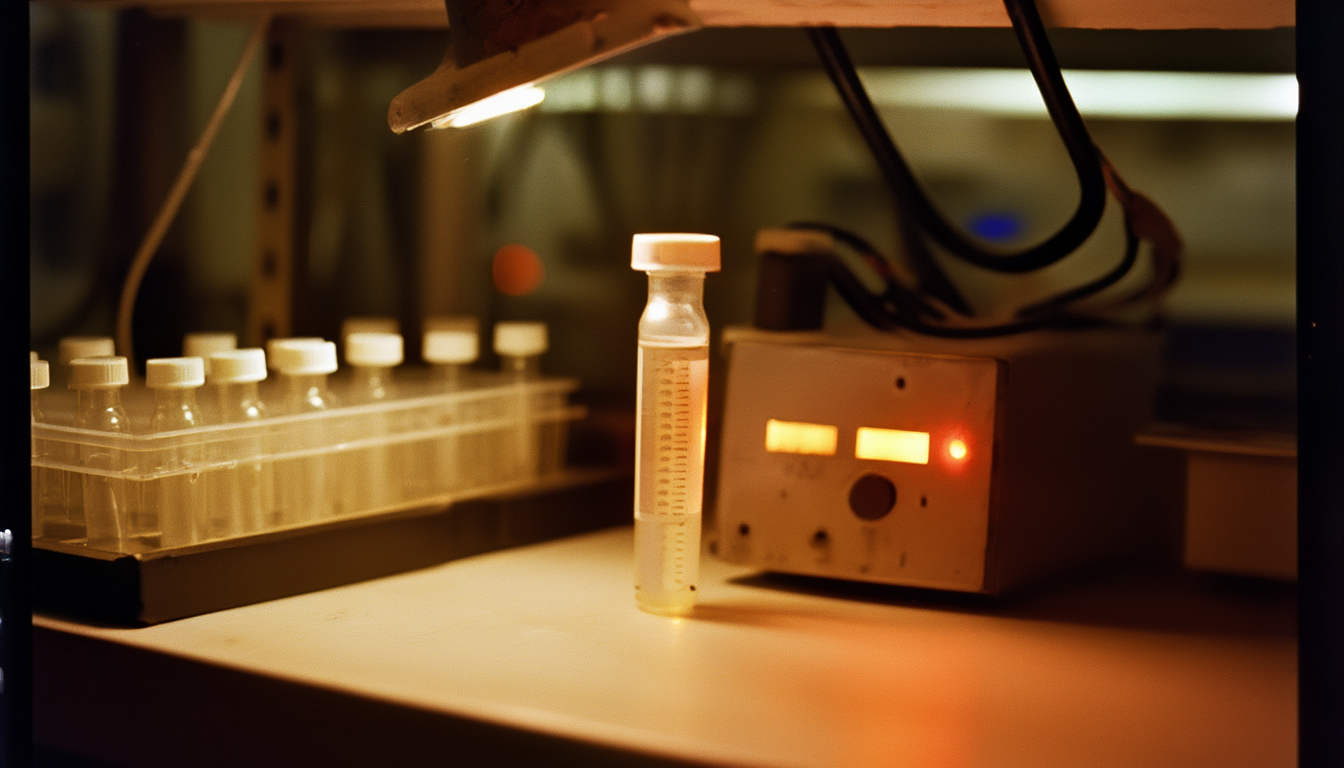
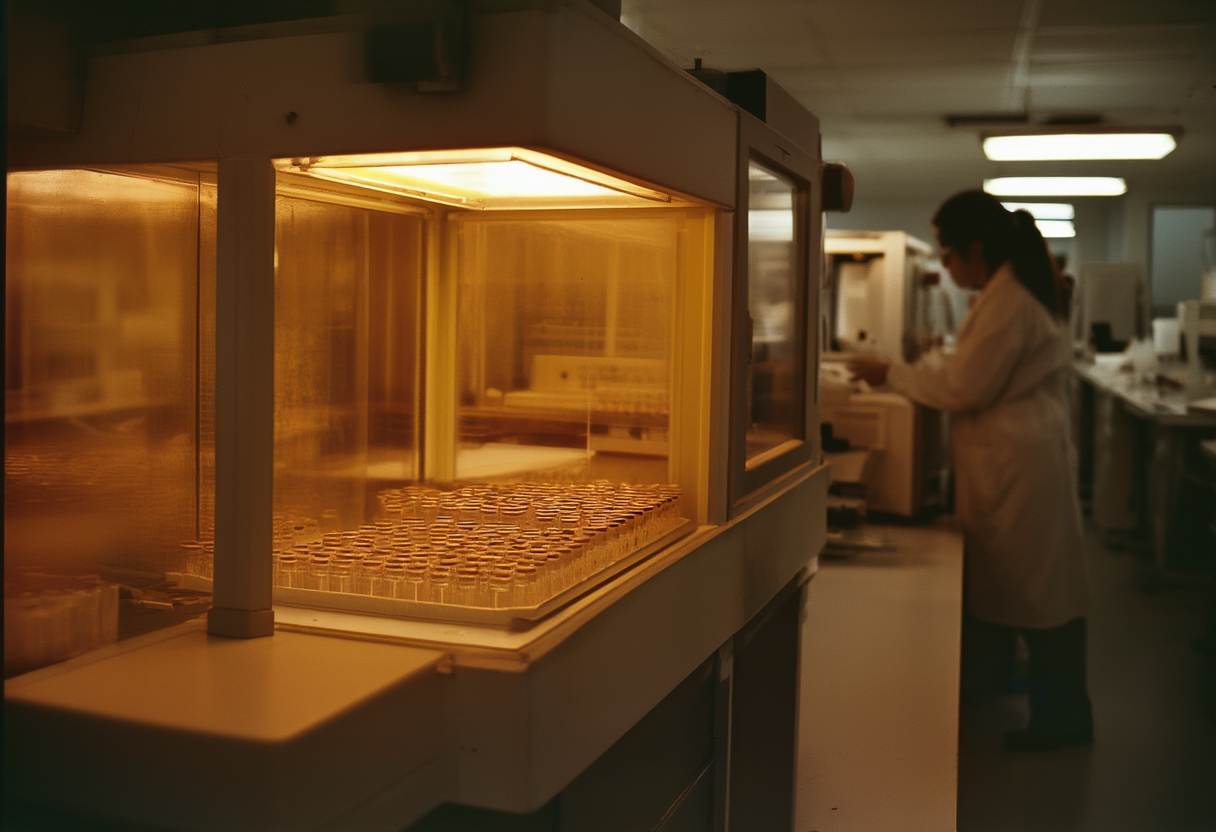
The vial came in at 2 a.m., third in a tray of forty, and the sequencer refused to read it.
Devi Okonkwo had seen the amber flag maybe a hundred times across two years of overnight shifts at the county public-health genomics lab. HOLD — UNTRUSTED INPUT. The instrument had pulled the sample into a sealed software sandbox, the way an old email client used to quarantine a suspicious attachment, and now it wanted a human to decide whether the DNA in that tube was a throat swab or a weapon aimed at the building's network.
She tapped through to the raw read. Most of the strand was ordinary, a respiratory panel, somebody's January cold. But folded into the sequence was a stretch that didn't code for any protein. It coded for an instruction. Ninety years of molecular biology had taught the field to read DNA as the language of life. Devi's machine, in 2036, read it first as a language a computer might be tricked into obeying.
None of this would have surprised the small group of researchers who saw it coming.
The proof that a molecule could be a payload
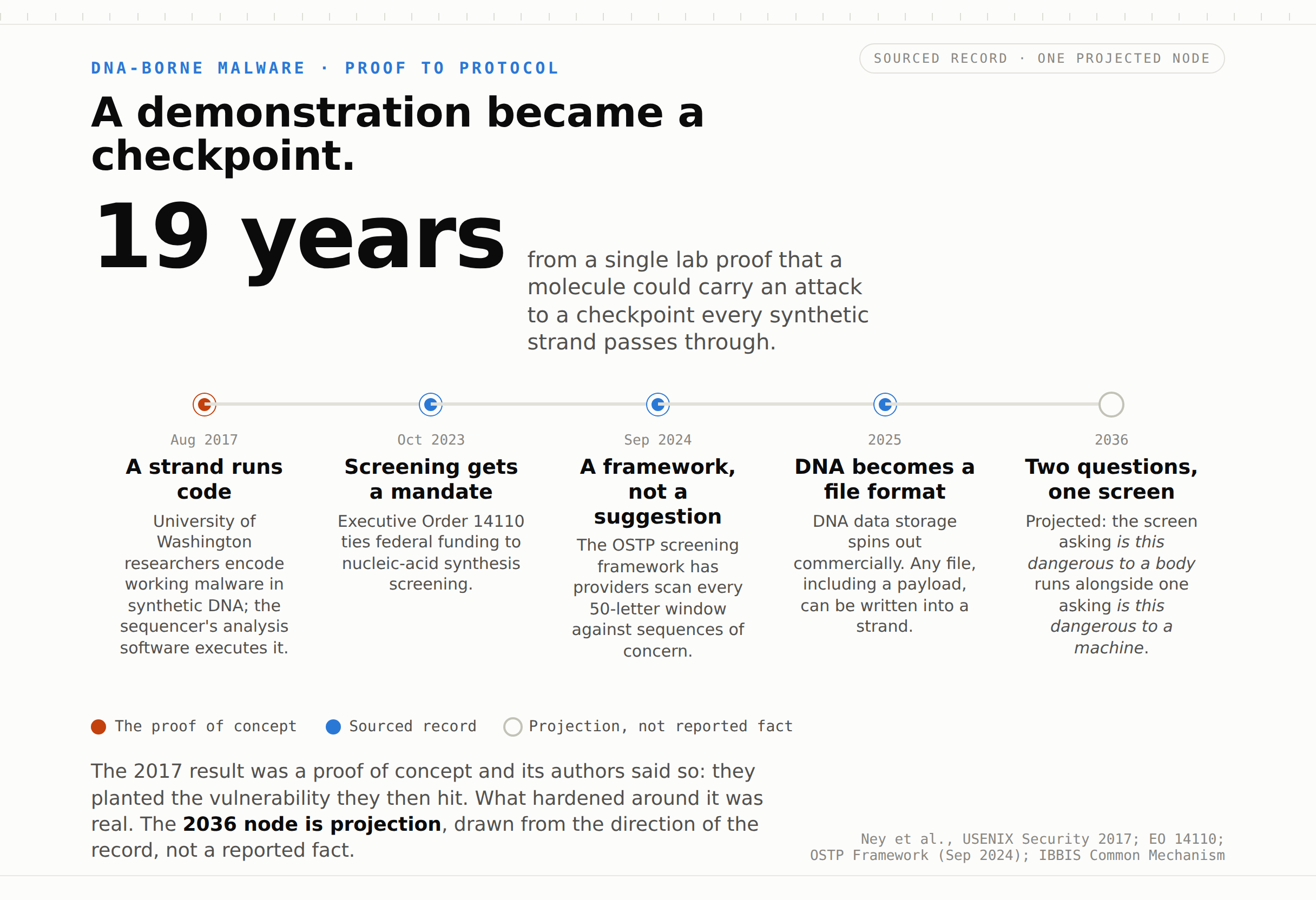
In August 2017, a team at the University of Washington did something that sounded like a genre error. They encoded working malware into a physical strand of synthesized DNA. When a sequencing machine read that strand and passed the data to a common analysis program, the encoded exploit executed and handed the researchers remote control of the computer. Biology in; a compromised machine out. It was, as far as anyone knew, the first time a living molecule had been turned into functioning software attack code.12
The honest version of the story matters, and the researchers told it plainly: they had to cheat a little. To make the demonstration land, they modified the sequencing software to plant a vulnerability they could reliably hit, and the biological constraints of DNA made the exploit fragile and hard to build.3 This was not a break-in already loose in the world. It was a proof of concept, and proofs of concept are how the future files its early paperwork.
The more quietly alarming finding sat next to the headline. When the same team audited the open-source programs that labs used to read and process DNA, they found software written in the fast, unforgiving languages of the 1990s, riddled with the kind of insecure practices the rest of computing had spent two decades learning to patch.24 The instruments of genomics had been built by biologists solving biology problems. Nobody had assumed the sample itself might be an adversary.
When DNA became a file format
For most of the 2010s that assumption held, because DNA was something you read, not something anyone wrote at scale for arbitrary purposes. That changed as DNA data storage moved from stunt to industry. Companies demonstrated that you could encode any digital file, a document, an image, a piece of malware, into synthetic DNA and recover it later, and by the middle of the 2020s the effort had drawn serious money and a dedicated commercial spin-out chasing archival storage in molecules that last for centuries.5
That shift did something subtle to the threat. Once DNA can hold any data you choose, DNA is just another file format. And every file format the computing world has ever produced eventually became an attack surface. The strand stopped being a passive record of an organism and became a container someone could pack with intent. The sequencer, the machine that turns a physical molecule into a stream of bytes, quietly became an input device, and every input device is a door.
By the early 2030s the labs stopped pretending otherwise. Reads were sandboxed by default. Analysis pipelines were rewritten in memory-safe languages. Sequences arriving from outside the building were treated the way a bank treats a wire from an unknown account: presumed hostile until cleared. Devi's amber flag was the descendant of that decision.
The wall that was never there
Here is the turn the 2017 paper hinted at and the next two decades confirmed. The dream of cheap, ubiquitous sequencing was a dream of reading life freely, anywhere, without friction. What it produced instead was a world where every strand is presumed guilty until proven inert.
The comfortable boundary everyone had assumed, wet biology on one side, dry computing on the other, turned out never to have existed. It was a habit, not a wall. The moment biology became information dense enough to matter and cheap enough to write, the two domains were one system, and a threat could cross from a test tube into a network without ever touching a keyboard. Reading, the most passive thing a scientist does, became an act that required distrust.
That distrust hardened into infrastructure. The same screening pipes that governments and synthesis companies built through the 2020s to stop someone ordering the genes of a dangerous pathogen, formalized in a 2023 U.S. executive order and the frameworks and shared screening tools that followed, evolved to inspect synthetic DNA for more than biology.678 By 2036 the screen that asks is this sequence dangerous to a body runs alongside one that asks is this sequence dangerous to a machine. Cyberbiosecurity, a phrase that barely existed when Devi was in grade school, had become a checkpoint every strand passes through.9
Devi cleared the January cold. She flagged the other stretch, the part that spoke to the computer instead of the cell, and routed it to the security queue, where a person she would never meet would decide what it had been trying to say. Then she loaded the next tray. The machine, as designed, trusted nothing, and went on reading anyway.
Author's Note. Devi Okonkwo and the 2036 county lab are fictional composites, and the specific quarantine workflow described for 2036 is a projection, not a reported fact. Everything attributed to the past is real and sourced below: the 2017 University of Washington demonstration, its stated limitations, the security audit of DNA analysis software, the growth of DNA data storage, and the DNA-synthesis screening frameworks now in force. The claim that these threads converge into routine sequence-level cybersecurity screening by 2036 is my extrapolation from those facts, not a prediction on the record.