
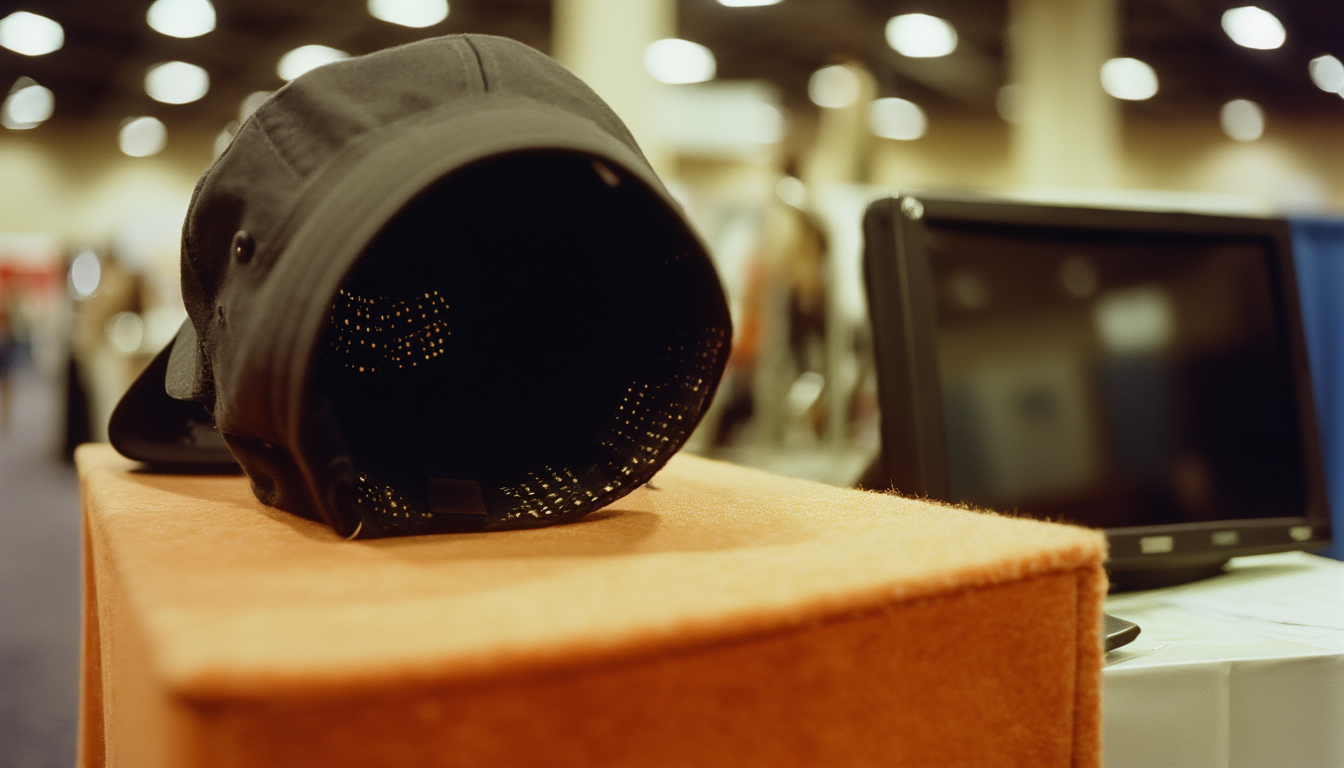
The cap sat upside down on a felt-covered stand at the Las Vegas Convention Center in January 2027, lit so that the stitching looked expensive. It was a baseball cap. That was the entire point of it. Visitors were invited to put it on, sit in a folding chair, and think a sentence, and a monitor beside them would produce the words one at a time with the hesitations of a bad phone connection. The queue moved slowly, and most of the delay had nothing to do with the decoding. It was the part where a staff member asked each person to unclench their jaw, settle their shoulders, and hold still.
Sabi had announced itself three months earlier with a $50 million seed round led by Khosla Ventures, joined by Accel, Initialized Capital, DST Global, Collaborative Fund, Ascend, and Kevin Weil, who had been chief product officer at OpenAI.1 The company was in Palo Alto, the chief executive was Rahul Chhabra, and the product was described almost entirely in terms of what it did not require. A custom chip carried sensors between one and five millimetres across. They read through hair. There was no conductive gel, no scalp contact, no surgeon. "We are building a faster interface that does not require surgery or laboratory," Chhabra said. Vinod Khosla put it in period terms: "Every computing era is defined by its interface."
The absence was the product, and the comparison it invited was deliberate. Neuralink worked better and had a harder requirement. Its implant goes under the skull, placed by a robot that navigates with eight cameras and pushes flexible threads through the dura rather than removing it, and roughly twenty people had received one by early 2026.2 A procedure that good and that scarce has an obvious ceiling. It is available to people for whom the alternative is nothing, which is a real market and a small one. A hat is available to everybody. Read in late 2026, Sabi's bet looked less like a technical claim than a distribution claim, and distribution claims are usually the ones that win.
What made the bet interesting is that the relevant measurements had already been published, by a team that wanted them to come out the other way. Meta's researchers had spent years on non-invasive decoding, and in February 2025 they reported a system that reconstructed sentences people typed from memory. Thirty-five volunteers, a QWERTY keyboard, and two different ways of listening to the brain. Using magnetoencephalography, the system reached a character error rate of 32 percent, and 19 percent for the best participant. Using electroencephalography, the same pipeline reached 67 percent.3 A follow-up released in July 2026 improved the headline number to 61 percent word accuracy, against about 8 percent for earlier non-invasive attempts, and the underlying split barely moved: 29 percent character error for MEG, 65 percent for EEG.4
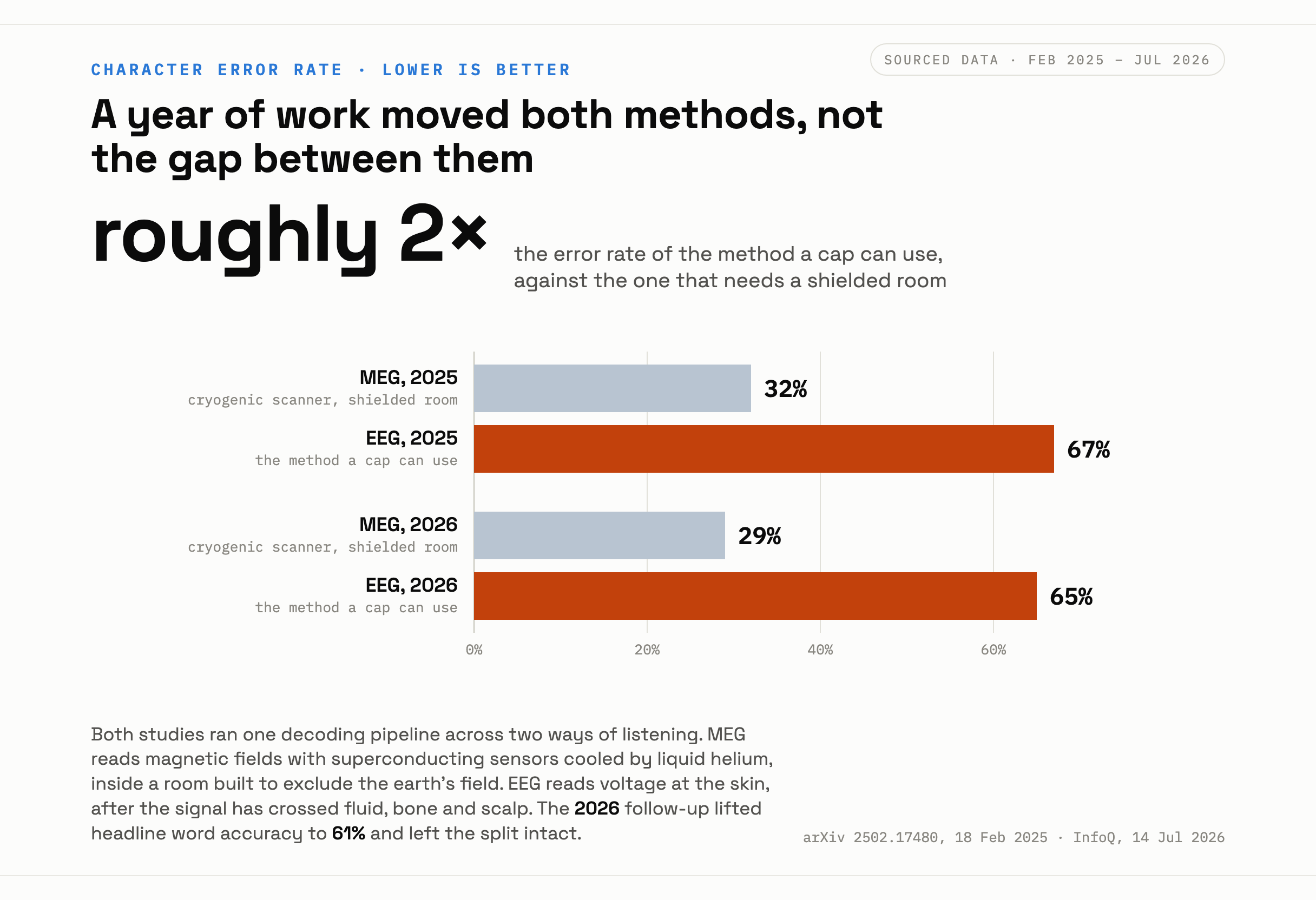
Figure 1. The two listening methods, a year apart, read back from 2036. The engineering improved. The distance between them did not.
A year of work had lifted both methods and left the ratio between them roughly where it was. That is the signature of a constraint that is not about models. Magnetoencephalography measures the faint magnetic fields produced by neural activity using an array of superconducting sensors cooled with liquid helium, inside a room built to exclude the earth's magnetic field and the elevator down the hall. Electroencephalography measures voltage at the skin after the signal has crossed cerebrospinal fluid, bone, and scalp. Bone is a poor conductor and an excellent blur. It attenuates the high frequencies and spreads what is left across a wide patch of skull, so two sources a centimetre apart arrive at the surface as one smeared event. No amount of compute recovers detail that the skull removed before the sensor ever saw it.
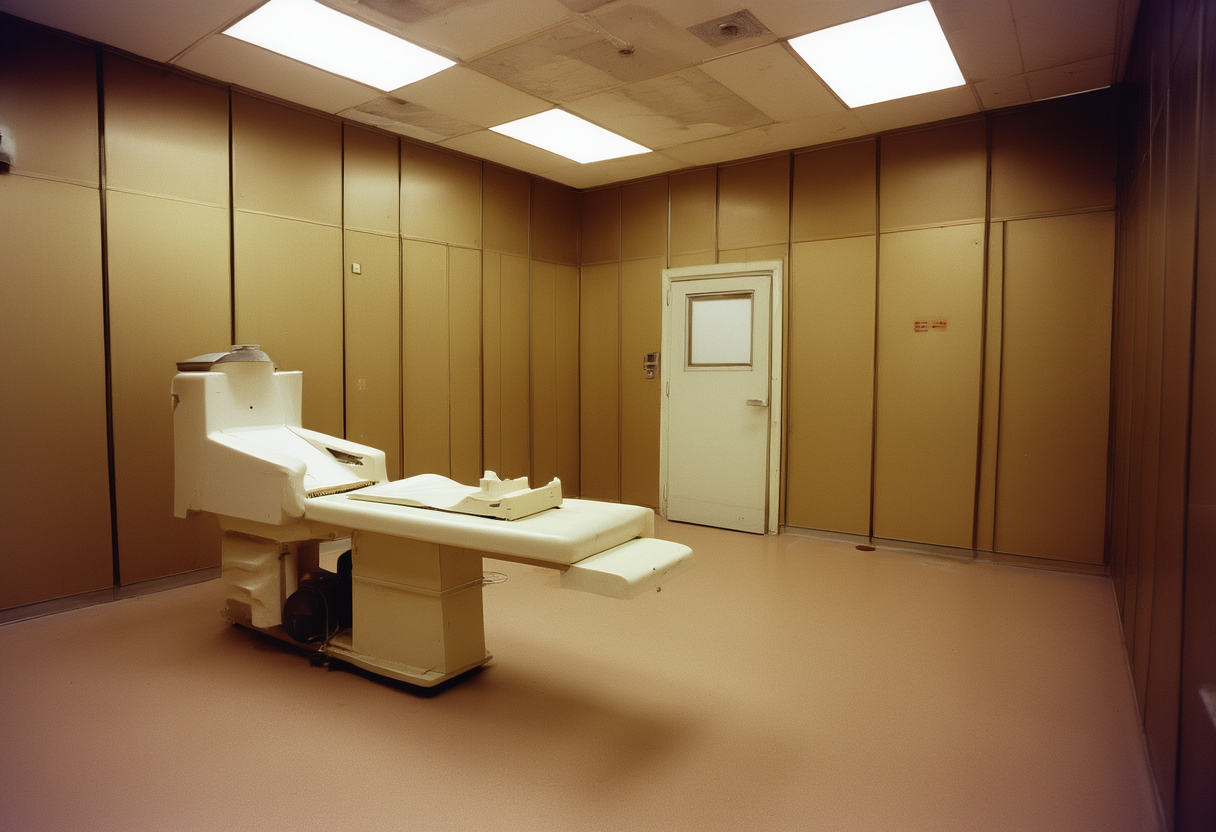
Figure 2. A decommissioned magnetoencephalography suite, 2036. The better number in every study came from a room like this one.
The industry had spent a decade treating conductive gel as an indignity to be designed away, which it is. It is cold, it ruins a hairstyle, and it is the reason EEG stayed in clinics. It was also doing something. Gel fills the air gap between an electrode and the skin, and air is the worst conductor in the stack. Removing contact removes the inconvenience and some of the signal in the same motion. The same logic applies to the skull itself, which is not an obstacle the product has to overcome so much as the reason the product is safe to sell. Attenuation and non-invasiveness are the same fact described from two directions. Sabi had correctly identified that surgery was an arbitrary-seeming constraint on the market. It had less to say about the constraint underneath it, which was accumulated rather than arbitrary.
There is a version of this story where the worse interface wins anyway, and it had already happened by the time the cap reached CES. In September 2025 Meta shipped the Ray-Ban Display with a wrist strap in the box, an $800 package whose most praised component was the strap.5 The Neural Band reads surface electromyography, the electrical activity of the muscles in the forearm that move the fingers. Reviewers found it close to flawless. It is a neural interface in the literal sense and it succeeded by giving up on the brain entirely, reading instead a signal that is large, peripheral, and already a decision. By the time a muscle fires, the ambiguity has been resolved somewhere the sensor does not have to go.
That distinction turned out to organise the whole category. The companies with the compute were shipping hardware, as the sceptics said they would, and none of it tried to read a cortex. Meta put a palm-sized companion for its Muse agent on stage at Connect in September 2026, a small screen with a cartoon face and a speaker, due in December.6 OpenAI, which had bought Jony Ive's design firm, spent 2026 preparing a screenless pocket device and confirmed a debut that year.7 Voice, wrist, pocket. The labs converged on the body's existing outputs because those outputs are cheap to read and because they come pre-committed. The question of whether Sabi owned anything the labs could not build was answered sideways. The labs were not building toward it.
What the cap did own was the population Sabi had used as a foil. Thought-to-text through a hat is a poor substitute for speech when speech is available, because it is slower, it needs per-person calibration, and it requires the stillness that the staff at the booth kept asking for. For someone with advanced motor neurone disease, none of those are drawbacks worth weighing. They are the terms of the only offer on the table, and the offer does not include a craniotomy or a twenty-person waiting list. The market that surgery had capped at people with no alternative was, by the middle of the next decade, the market a hat served best.
The scarcity moved somewhere less expected. When producing text from intention becomes possible, the gate that speech and typing provide becomes valuable, because both require a decision to act. A sentence you have merely considered has the same neural signature as one you meant. Clinics that deployed the caps wrote protocols about it, and the protocols were about confirmation steps, which is friction, deliberately reinstalled.
Which returns to the folding chair in Las Vegas, and to the instruction that kept the queue slow. Unclench your jaw. Settle your shoulders. Hold still. It sounded like a demo not yet ready, in the way that early machines are briefly embarrassing before they are ordinary. It was closer to a specification. Sitting motionless while a machine reads you is an old arrangement, familiar to anyone who has looked at a portrait from the 1840s and noticed that nobody is smiling, because nobody could hold a smile for ninety seconds. The hat was the easy part. The hard part was the thing the hat was always going to ask for, and it had been in the room the whole time, standing at the front of the line, telling people not to move.
Author's Note
This article is speculative journalism written from 2036. The CES 2027 demonstration scene, the clinical confirmation protocols, and all characterisation of how the product's market settled after October 2026 are the author's projection and are not reported fact. Sabi's funding, investors, personnel, product description and executive quotations come from the company's own paid announcement of 9 October 2026 and are presented as the company's claims rather than verified performance. The Meta decoding results, the Neural Band, the Muse Charm, the OpenAI device timing, and the Neuralink procedure and patient figure are real, published and sourced below. The explanation of why bone attenuates and spreads the EEG signal is standard biophysics, not a claim specific to any product.