
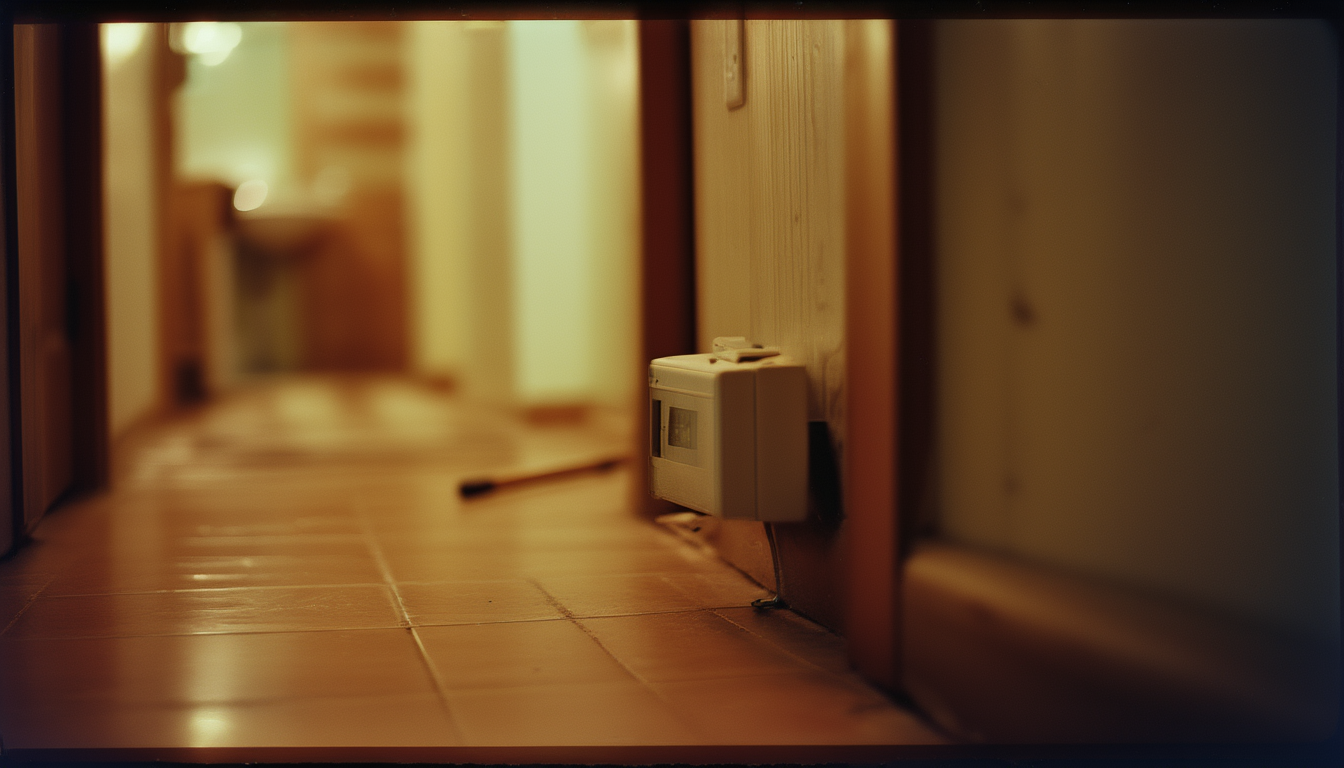
Priya Sharma's father falls at 3:14 in the morning. He has gotten up for the bathroom, the way he does, and his left knee buckles the way it has for months, and he goes down hard on the tile. It is the spring of 2036. No alarm sounds, because there is no alarm. Four nodes the size of matchboxes, screwed to baseboards in three rooms, feel the shape of him change against the air. The mesh pages Priya's phone before she has finished waking. By the time she calls back, an aide is already at the door.
Her father never wore a pendant. He refused one for three years — they made him feel like a patient in his own kitchen. The room took care of it instead. This is the best version of what the technology offers, and it is real, and it is not the whole of what the room knows.
For years the promise was simple and a little magical: the routers already in your walls could watch you without watching you. The science that made it credible arrived in a 2022 paper from Carnegie Mellon. Jiaqi Geng, Dong Huang, and Fernando De la Torre trained a neural network to map the phase and amplitude of ordinary WiFi signals onto the human body across 24 regions — pose estimation from radio, no camera in sight.1 The trick is in something the hardware already collects: Channel State Information, or CSI, the per-channel record of how a signal scatters on its way across a room. A body moving through that room bends dozens of those paths at once. Read the bending, reconstruct the body.
No lens. No wearable. No image, at any point in the pipeline.
What turned a paper into an appliance was standardization. For a decade WiFi sensing was a lab trick that needed coaxing out of each chipset by hand. Then the IEEE built sensing into the protocol itself — the 802.11bf task group, drafting the rules that let "every WiFi device easily and reliably extract the signal measurements," in the words of one researcher MIT Technology Review quoted in 2024. The founder of one sensing firm predicted the rollout would be "explosive."2 By the early 2030s he was, depending on how you counted, right. Sensing rode in on routers people bought for the internet.
The care case was the one everybody led with, and it was honest. More than one in four Americans over 65 falls each year, and falls are the leading cause of injury-related death in that age group.3 Pendants only work if the wearer wears them, remembers them, keeps them charged, and isn't too proud to push the button — and Priya's father failed that test on every count. Sensing didn't care whether he cooperated. It just felt him fall. By the mid-2020s researchers were already pairing CSI fall detection with a companion robot that could navigate to the person on the floor and summon help with no human in the loop.4 By 2036 a mesh that did all of this ran offline, on a handful of dollar microcontrollers, for less than the price of a good smoke detector.
Here is the thing nobody put on the box. The same mesh that caught the fall had to be watching the whole time to catch it.
That is not a flaw in the system. It is the system. To know that Priya's father hit the tile at 3:14, the room has to know where his body is at 3:13, and 3:12, and every minute of every night before. It knows when he wakes. It knows how long he lingers in the bathroom, whether his breathing changed overnight, whether his heart rate climbs at the same hour it always does. The fall alert and the behavior log are not two features. They are one stream of data, and which one you call it depends entirely on who is holding the dashboard.

This is where the technology pushed past its own promise and turned into its opposite. A camera leaves footage; footage is a record; records have law wrapped around them — disclosure rules, subpoenas, GDPR, CCPA. People can see a camera and ask what it's for. WiFi sensing produces none of that. No image, no recording, no line of sight required beyond a few nodes on a shelf. And so it fell into the one gap every privacy framework left open. The old rules governed lenses, wiretaps, and devices you chose to carry. CSI is none of those, so almost nothing reaches it — no consent step before a landlord, an employer, or a care facility switches it on.
What the technology meant to retrieve was the watchful house of an earlier age — the parent who could hear a child stir, the neighbor who knew when the lights went out. What it actually retrieved was the company town, the sense that the walls report to someone, the difference being that this time you can't tell whether they do.
The researchers saw it coming. In late 2025 a team at the Karlsruhe Institute of Technology showed that beamforming feedback — data every connected device already broadcasts in the clear — could identify a specific person with nearly 100 percent accuracy, no special hardware, no device on the target at all. "The technology is powerful," their lead researcher said, "but at the same time entails risks to our fundamental rights, especially to privacy." They asked the IEEE to write protections into 802.11bf before the chips shipped.5 The same year, a separate group published WhoFi, a system that re-identifies individuals by the radio-frequency signature of their own bodies, carrying them from one building to the next.6 The standards committee, asked about privacy, had already given its answer in 2024: real concern, outside our mandate.2
Governments noticed the routers — just not the sensing. On March 23, 2026, the FCC added foreign-made consumer routers to its Covered List, barring new overseas models from US sale on national-security grounds, citing the Volt, Flax, and Salt Typhoon intrusions into American networks.7 A real decision about a real threat. But it secured the supply chain and said nothing about the signal. The domestic routers built to fill the gap comply with 802.11bf too. They sense by default. The hardware got safer to buy and no quieter about the room.
By 2036 the open questions are not technical. Who owns the CSI a building emits? Does a tenant get to know when the WiFi is also watching? Does a worker get to refuse? A resident? None of it had a binding answer in 2025, and the answers have come slowly since, jurisdiction by jurisdiction, always a step behind the chips.
Priya's father got a faster response to his fall than any pendant could have given him. That is true, and it matters, and it is worth something real to the people who love him. The room also knew everything that came before the fall and everything that came after.
What the room is allowed to know — and who gets to ask — still depends on rules we are only now, late, beginning to write.
Author's Note
This is speculative journalism, set in 2036 and looking back. Priya Sharma and her father are fictional composites; no real person is depicted. Everything underneath the story is sourced and current as of early 2026 — the Carnegie Mellon pose-from-WiFi research, the 802.11bf sensing standard, the CDC fall statistics, the Karlsruhe and WhoFi identification studies, and the March 2026 FCC router ruling are all real and cited below. The trajectory is one plausible path, offered as a caution rather than a prediction. Whether we end up here depends on choices being made now about consent, surveillance law, and what privacy is supposed to mean once the walls can feel us move.