
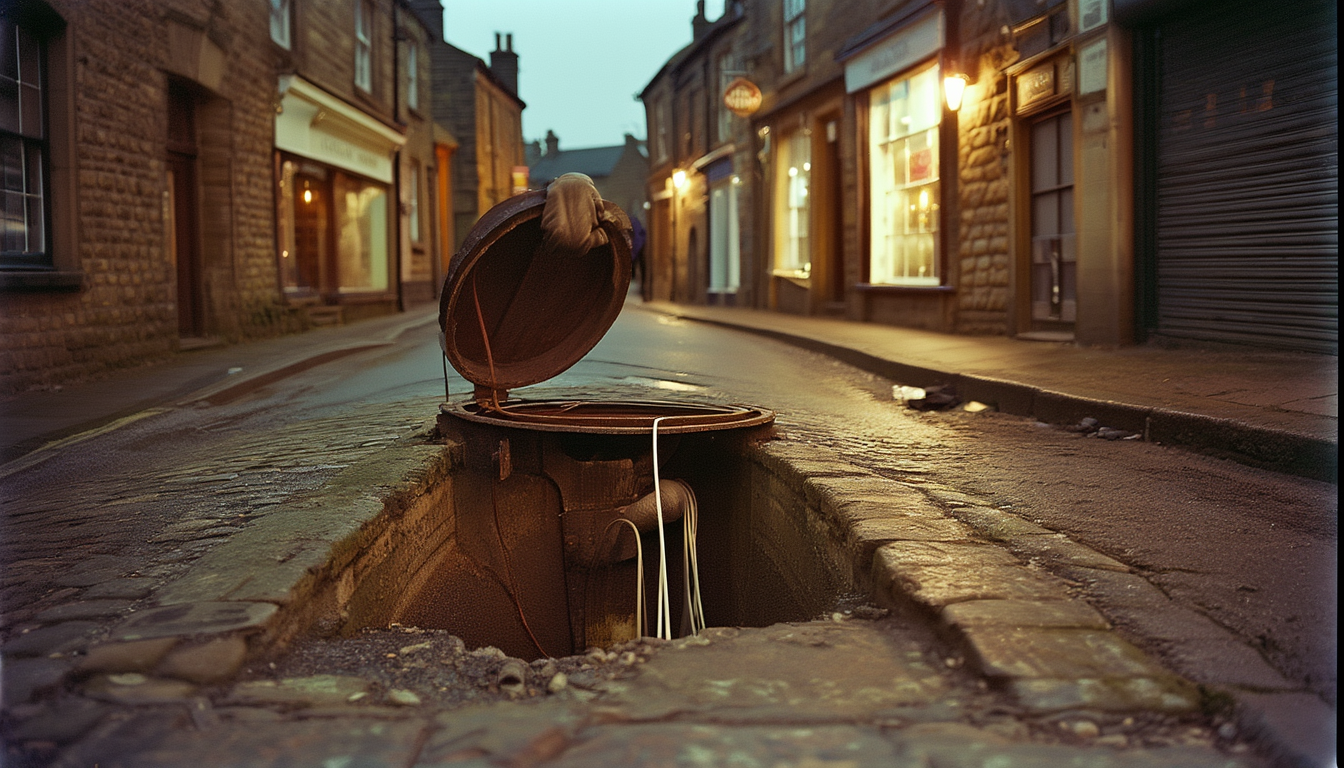
The constable knocks on a Tuesday, in the rain, and Mariam Okafor assumes it is about the bins.
It is February 2036, Penistone, a stone-terraced village west of Barnsley where the broadband now arrives the way the water does — through a 150-year-old cast iron main under the high street. The officer is polite and a little embarrassed. He has a printout. Yorkshire Water's monitoring system, he explains, flagged "anomalous usage" at her address: showers at odd hours, long afternoon draws when the house should be empty, a pattern the algorithm scored as consistent with an unlicensed rental or a cannabis grow.
Mariam has none of those. What she has, it turns out, is a husband who has been somewhere else. The pipes noticed before she did.
The promise
It began, as these things do, with a genuinely good idea.
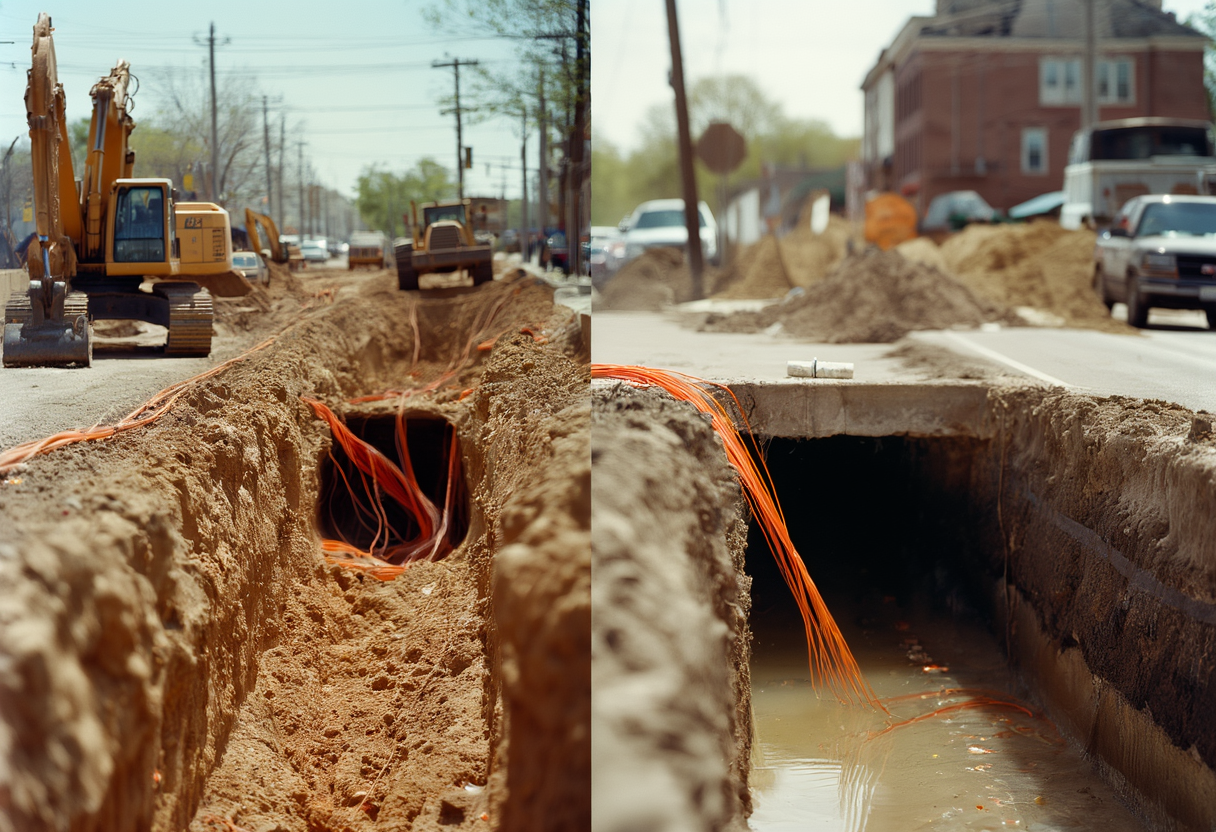
In the early 2020s, Britain wanted universal gigabit broadband and could not afford it. Trenching fibre to a remote village ran to roughly £60,000–£80,000 per mile, most of it the cost of digging up the street.1 The places that needed connection most were the ones the maths abandoned. Meanwhile the water companies were under their own pressure — ordered to slash leakage — and sitting on the one network that already reached almost everyone: the pipes.
So in 2022 a consortium led by Yorkshire Water proposed something elegant. Don't dig. Use the pipe you already have. Their project — TAWCO, for Telecoms and Water Combined Operations — won about £6.2 million in UK government funding to thread fibre through live drinking-water mains.2 The method was clever: send a slim "messenger pipe" into the main, let the water pressure pull a draw-line through, then blow the fibre cable down the messenger so it never touches the water.3 No excavators. No road closures. Gigabit to an estimated 8,500 rural homes and businesses along one route, and leak detection thrown in for free.2
On paper, the marriage of water and data was perfect. One trench, two utilities, half the carbon.
The mechanism
TAWCO ran from January 2022 to September 2023, and then — quietly — it stalled. Not because the fibre failed. It worked. The trial stopped because nobody could get the finished installation signed off: anything placed inside a drinking-water main needs Regulation 31 approval from the Drinking Water Inspectorate, and that approval never came.2 The regulators, not the physics, killed it.
But an idea that good doesn't die. It just moves to where the rules are thinner. Wastewater pipes carry no drinking-water duty, so that is where the fibre went. By the mid-2020s, Neos Networks had run some 17 kilometres of cable through Thames Water's London sewers — the same Victorian tunnels dug to stop cholera, now carrying data past the effluent.4 In the United States, Chattanooga's city-owned utility had already proved the public-infrastructure model, building a fibre network from 2010 that an independent study credited with $2.69 billion in local benefit over its first decade.5 By the 2030s, water districts everywhere were copying it. The economics that never worked for telecoms alone worked beautifully once you added leak savings, rural subsidy, and decades of wholesale fibre leasing. Convergence stopped being a clever option and started feeling inevitable.
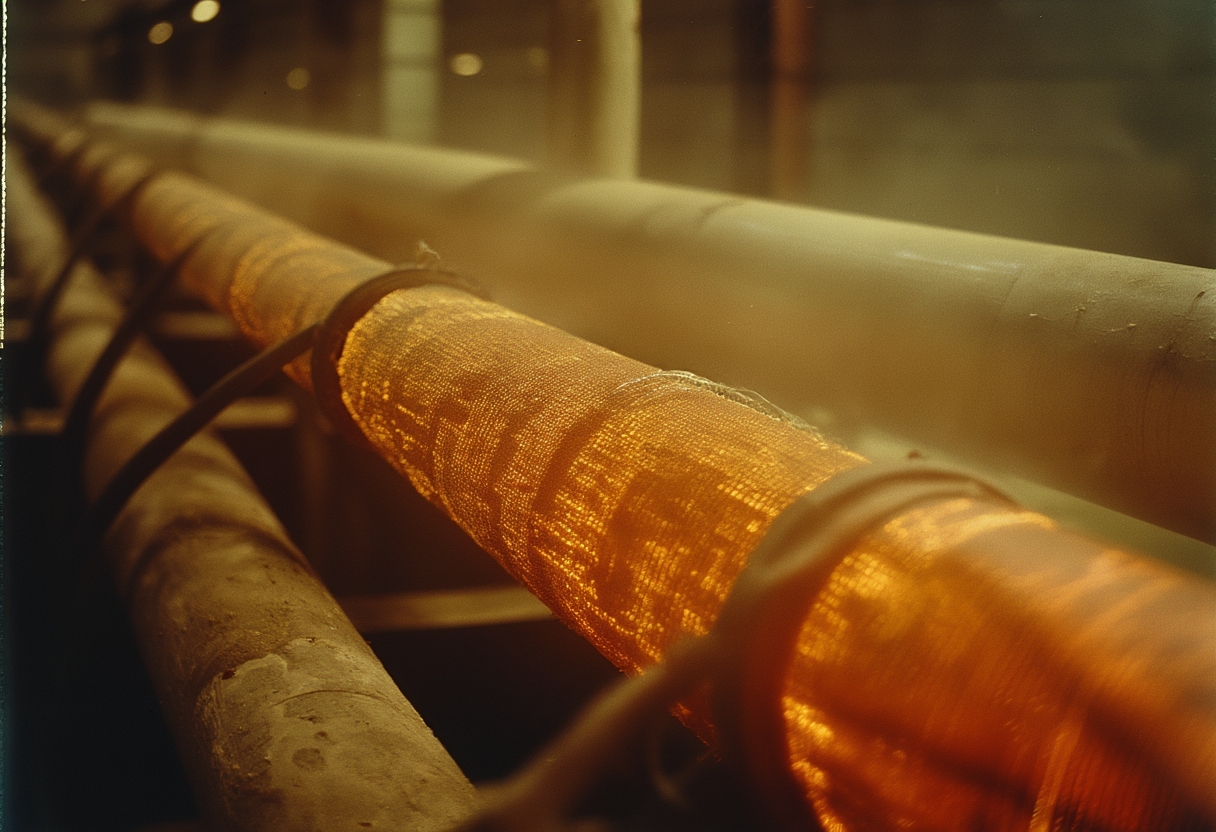
And the leak detection was real. Wrap a sensing fibre around a pipe and you get distributed acoustic sensing — the cable becomes a microphone tens of kilometres long, reading the faint vibration of water escaping a crack.6 That is the part the brochures sold.
Here is the part they didn't.
The turn
A fibre that can hear a leak can hear everything else.
Distributed acoustic sensing was built for security and infrastructure precisely because it is so sensitive: buried sensing cable can pick out footsteps, vehicles, and digging with roughly five-metre accuracy over tens of kilometres.7 The same physics that distinguishes a corroding joint from normal flow can distinguish an empty house from an occupied one, a Tuesday from a Saturday, one fixture from another down the hall. The pipe doesn't know it's spying. It just reports vibration, and someone downstream decides what the vibration means.
For most of the 2020s nobody had the legal appetite to look. Then the threat got concrete. Britain's water companies were hit by a string of real cyberattacks — Southern Water alone disclosed £4.5 million in costs after a 2024 ransomware breach, one of several incidents reported to the regulator.8 Water became, officially, critical national infrastructure that had to be watched in real time.
In this telling, the law that followed — a 2034 Water Security Act mandating continuous monitoring and data-sharing with the security services — is invented. But it is the obvious next step, and its logic is the trap. Nobody objects to monitoring water for terrorists. The objection is to what "monitoring" quietly grows to include. The sensors installed to save water become the sensors that watch the house. Privacy campaigners in this future call it pipe-tapping: a wiretap that needs no warrant, because legally it isn't surveillance at all. It's infrastructure maintenance.
Which is how a constable ends up on Mariam Okafor's step, holding a printout of her marriage, generated by a system designed to find a dripping joint.
Back on the high street
Mariam files a complaint with the Information Commissioner. Yorkshire Water answers, reasonably, that it was monitoring its own infrastructure under a national-security mandate, exactly as required. The case sits. Her husband moves out in March. The pipes record that too — fewer draws, the empty-house signature settling in over a once-busy home.
There is a second irony she only half registers. The same fibre that exposed her is the reason she can work from Penistone at all. Take it away and the village loses its surgery's records, the school's lessons, half the jobs that came home during the connected years. The thing watching her is also the thing holding her life together. You cannot unplug one without unplugging the other.
That is the whole story of the pipes beneath, compressed into one house. The infrastructure that was supposed to close a divide — to reach the village the trench could never afford — reached it so completely that it now hears everything inside it. The promise was connection. Pushed to its limit, connection reversed into capture.

The open question
The fibre works. The leak detection works. The connection works. None of that was ever in doubt.
What nobody built was the part that decides who gets to listen — who owns the acoustic record of a street, how long it's kept, and what counts as a threat versus a Tuesday. That was a governance choice, not a technical one, and in this future Britain made it by not making it.
The maintenance hatch on Penistone High Street is due to be opened next month, to inspect the cable sealed inside the old main. The engineers will find the fibre intact and the signal clean. They will not find the thing that's actually broken, because it was never down in the pipe. It was always up here, in the rules we didn't write before we turned the water on.
Author's Note
This is speculative journalism, set in 2036 and built on real, sourced foundations. Mariam Okafor, the Penistone scenario, the 2034 Water Security Act, and "pipe-tapping" are fictional composites and clearly-flagged extrapolations, not reporting. Everything outside that boundary is real and cited: the TAWCO fibre-in-water trial and why it stalled, the installation method, fibre-trenching economics, Neos Networks' fibre in Thames Water's sewers, Chattanooga's municipal network, the surveillance reach of distributed acoustic sensing, and the recent cyberattacks on UK water utilities. The reversal — leak sensor into household microphone — is a documented capability pushed to a plausible end, not a prediction.