
Maria Santos built a network no corporation could touch and no government could switch off. By 2036, the thing watching her isn't a company. It's the woman three nodes down.
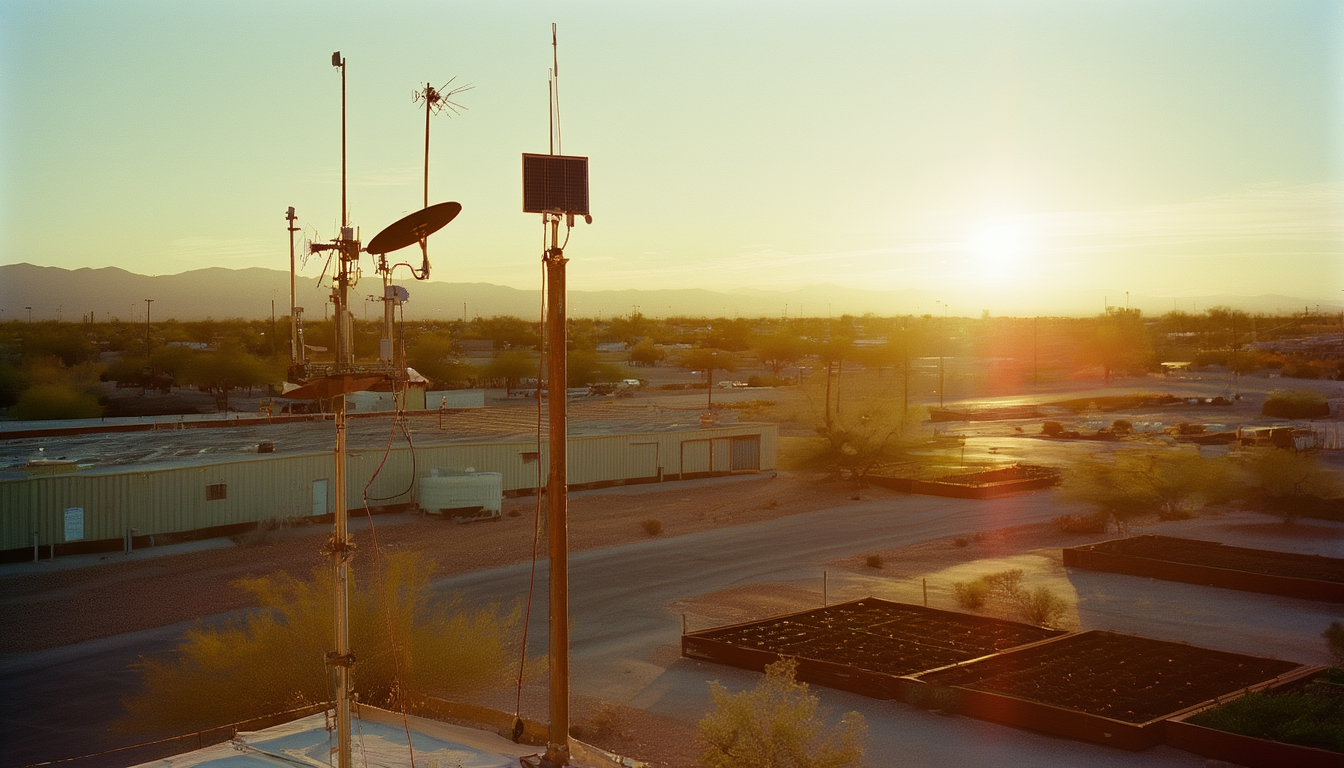
The router is bolted to a parking-lot light pole that hasn't carried a bulb since the store closed. Maria Santos climbs the maintenance ladder anyway, because the southern sector antenna has drifted again, and runs her thumb along the weatherproof seam while the panel above her ticks in the cold. It is a Tuesday in February 2036, and the building behind her — a dead Walmart in Duluth — now holds two hundred families who left Texas and Oklahoma when the summers stopped being survivable.
She remembers the sentence that started all of it. A regional carrier had told the housing co-op that running fiber out here didn't pencil out. Too few people, too poor, too far from the money. The math was older than the company saying it: rural America had fallen behind urban broadband by more than half, and most rural households still had no real choice of provider at all.1 Santos read the rejection letter twice and then asked the question that would reorganize her life. Why would we want to be on their internet anyway?
What they built
The hardware was almost embarrassingly simple. The community ran on LibreRouters — open, weatherproof boxes with three radios each, two of them long-range, designed so a non-technical neighborhood could stand up and maintain its own mesh.2 Each node found the others on its own. There was no headquarters, no account, no contract. Power came from a solar panel and a battery, which mattered, because the grid out here had become a rumor.
The routing was the quiet miracle. The community used B.A.T.M.A.N. Advanced, a protocol the German Freifunk movement built so that no single node has to hold a map of the whole network — knowledge of the best path stays decentralized, spread thin across everyone.3 For longer hops between neighborhoods they leaned on Meshtastic, the LoRa radio mesh where every device is also a relay, passing messages kilometer by kilometer with no cell tower in the loop.4
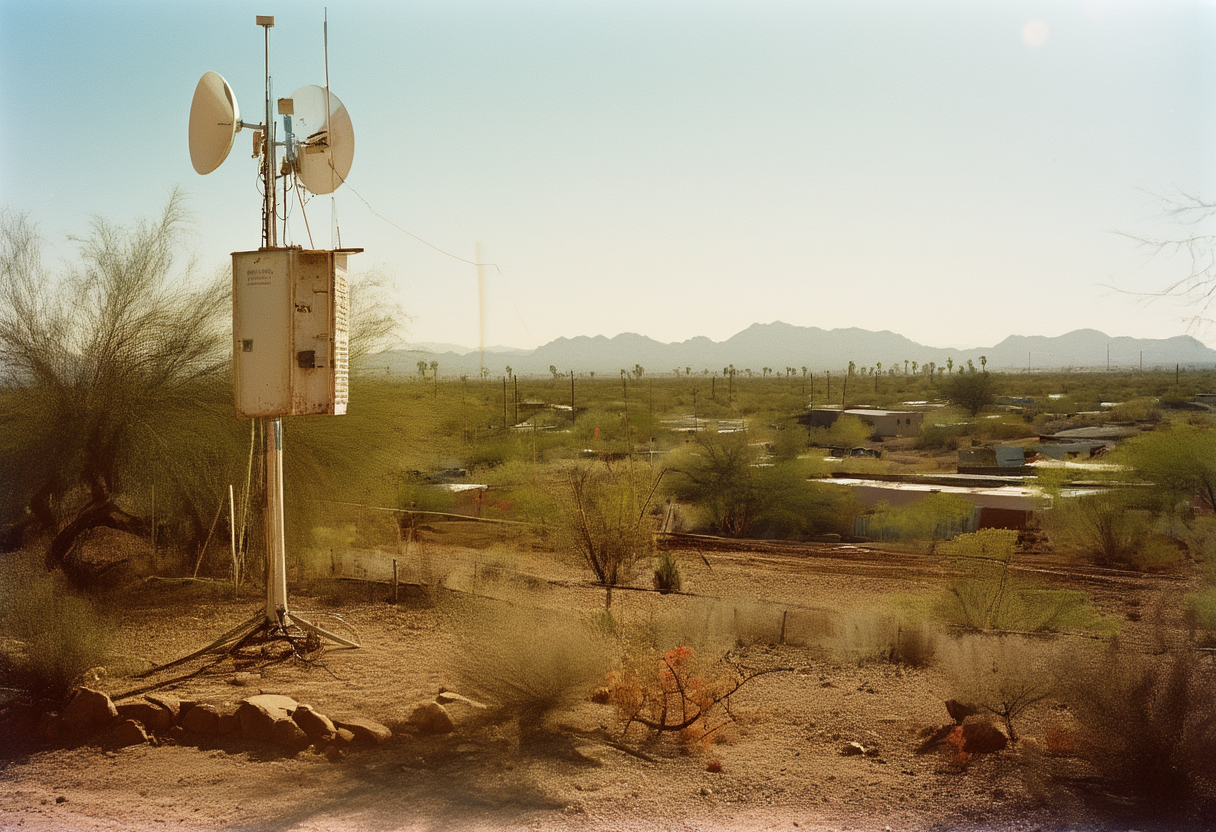
For a while it felt like the thing the internet had promised before it became a mall. The network coordinated mutual aid, shared weather data, mapped evacuation routes when the smoke came north. It healed itself when a node died. And it sat completely outside the surveillance machinery the old carriers had wired into everything — no central server logging who said what to whom. The co-op called it sovereignty, and for the first eighteen months, the word fit.
The thing they didn't read closely
The promise people repeated to each other was that mesh meant privacy. No company watching. What almost nobody read closely was the second half of the engineering.
Meshtastic encrypts the contents of a message with a strong key. It does not hide the metadata — who is talking, how often, from where. The protocol offers no real identity or trust model, and security researchers have spent years pointing out that mesh messengers leak exactly the pattern-of-life data that matters most, because radio is a broadcast medium and everyone nearby hears the envelope even when they can't read the letter.5 On the corporate internet, the watcher had been a distant company you could at least resent in the abstract. On the mesh, the watcher was whoever ran the node your traffic happened to cross.
Santos learned what that meant the winter a neighbor named the problem out loud. The woman three poles down kept a key relay running off her own roof, which made her, without anyone voting on it, the place a third of the co-op's packets passed through. She could see the shape of everyone's day — who messaged the clinic, who went quiet, who suddenly talked all night. Nobody had built her a dashboard. She didn't need one. In a network where your neighbor owns the infrastructure, privacy stops being a setting and becomes a negotiation with the people you live beside.
That was the reversal nobody put on the brochure. A tool built to end surveillance had not ended surveillance. It had relocated it — out of the data center and onto your block, where it was harder to see and far harder to leave. You can switch carriers. You cannot easily switch neighbors.
When you most need out
The second turn came the way these things do — at the worst possible moment. When wildfire jumped a ridge that August and three communities needed to coordinate at once, their networks couldn't talk to each other. Each had optimized its own stack, its own radios, its own assumptions, and the seams didn't line up. It is the oldest failure in networking: a thicket of mesh standards that each promised to be the solution and instead splintered into mutual incompatibility, devices on different frequencies and routing logics unable to join the same fabric without a bridge nobody had built.6
So the same independence that made each network resilient on a normal day made the region brittle on the worst one. Self-sufficiency, pushed all the way, had quietly become isolation.
Back on the ladder
Santos finishes re-aiming the antenna and watches the link light settle to green. She doesn't think the co-op got it wrong. The carrier was never coming, and the network it built is real — it feeds people, warns them, holds them together. But she has stopped saying sovereignty the way she used to. The co-op now runs a single shared satellite uplink for the moments only the wider world can reach, and a working group is trying to agree on common protocols with the other Great Lakes meshes, so the next fire finds them able to speak to each other.
What's still undecided is whether you can build a network that's genuinely yours without rebuilding, in miniature, the very thing you were fleeing — the watcher, the gatekeeper, the wall. The carriers obsolesced themselves out here. What came back wasn't the open frontier the early internet imagined. It was the village: connected, self-governing, and able to see you. The open question Santos turns over, climbing down, is whether the village can choose to look away — and whether it will know when to reconnect before it needs to.
Author's Note. This is speculative journalism written from an imagined 2036. Maria Santos, the Duluth housing co-op, and the scenes around them are fictional composites; no real person is depicted. The technologies and dynamics underneath are real and current as of 2026 — LibreRouter and LibreMesh hardware, the B.A.T.M.A.N. Advanced and Meshtastic protocols, the documented metadata and interoperability limits of mesh systems, and the rural broadband gap — and every such claim is sourced below.