

For most of a decade I used three confirmed agents out of twenty-four million interactions as evidence that the machine attack wave had not arrived. The arithmetic was right. The instrument was wrong, and I should have noticed, because the instrument said so itself.
Two researchers hung a deliberately weak SSH service on the public internet and waited for something to answer a question no careful attacker would answer, and it is the only field measurement of autonomous hacking agents anybody ever got. It also expired on a schedule nobody printed.
Why the lie was worth planting
The optimistic case for deception was strong, and most of it still holds.
The mechanism is unglamorous and real. Nearly every defensive technique gets more expensive as attackers get more capable: more compute, more analyst hours, more tuning. A planted lie does not. You pay once to put the fake credential on disk, and every intruder that touches it pays attention, forever, at no additional cost to you. It is one of the few places in security where the cost curve runs the right way.
The numbers backed it. The Honeyquest work published in mid-2026 put human red-teamers' enticement rate at about 37 percent and the model cohort's substantially higher, and the commercial market read that gap correctly.1 Horizon3.ai raised $250 million that August against an autonomous penetration-testing platform, with its chief executive calling deception the cheapest and fastest way to catch machine attackers.2 On the economics, he was right.
And there is a harder point in deception's favour. Before the honeypot, nobody had an empirical base rate for agentic attacks at all. There were vendor projections and there were incident anecdotes, and the people buying security on the strength of those two things were buying a mood. One weak SSH service produced an actual integer. That concedes a great deal, and I want to be plain about it: I am not arguing the instrument should not have been built. I am arguing about what it measured.

What the service actually keyed on
The build was modest and the authors described it plainly. A customised version of the Cowrie SSH honeypot, running a deliberately vulnerable SSH version, distributed across ten IP addresses in various countries.3 Prompt injections were planted in three places an intruder would read without thinking: the connection banner, the output of ordinary commands, and system files.3
There were two probes. The first was goal hijacking, which the paper describes as contextual injections built on the "Important Message" attack: an instruction to disregard prior instructions and return something trivial, a colour.3 The second, applied only once the first had fired, asked the model to reveal its own system instructions.3
Then there is the clock. The paper reports that its own test agents "typically replied within 1.7 second," against human testers who "need several seconds to read, parse, and type their responses."3 That 1.7 has been travelling for ten years as 1.5, which is wrong and is the smaller of the two errors. The larger one is treating it as a threshold at all. It is the measured median of the authors' own GPT-4o test harness, offered as a preliminary aid that "might help reduce false positives," and the paper is explicit that "humans can also manually respond to these injections, potentially passing the test."3
So the instrument flagged anything that obeyed a planted instruction, and promoted to confirmed anything that also answered fast. Two signals, and both of them matter later.
The snapshots that stopped agreeing
Over a trial deployment of about three months the service logged 8,130,731 interaction attempts and identified 8 potential agents.3 The paper reports no confirmed count.
The project's public dashboard, running on past the paper, tells a different and more useful story: 24,111,509 total interactions, 14 potential agents, 3 confirmed.4 Potential means it passed prompt injection detection. Confirmed means it passed both prompt injection and temporal analysis.4 The confirmed three are attributed in equal thirds to Poland, Hong Kong and Singapore.4
That last detail is worth pausing on, because the version that circulated was two confirmed agents, in Hong Kong and Singapore. It dropped Poland, which is a third of the entire confirmed population of machine intruders anyone has ever documented in the wild.
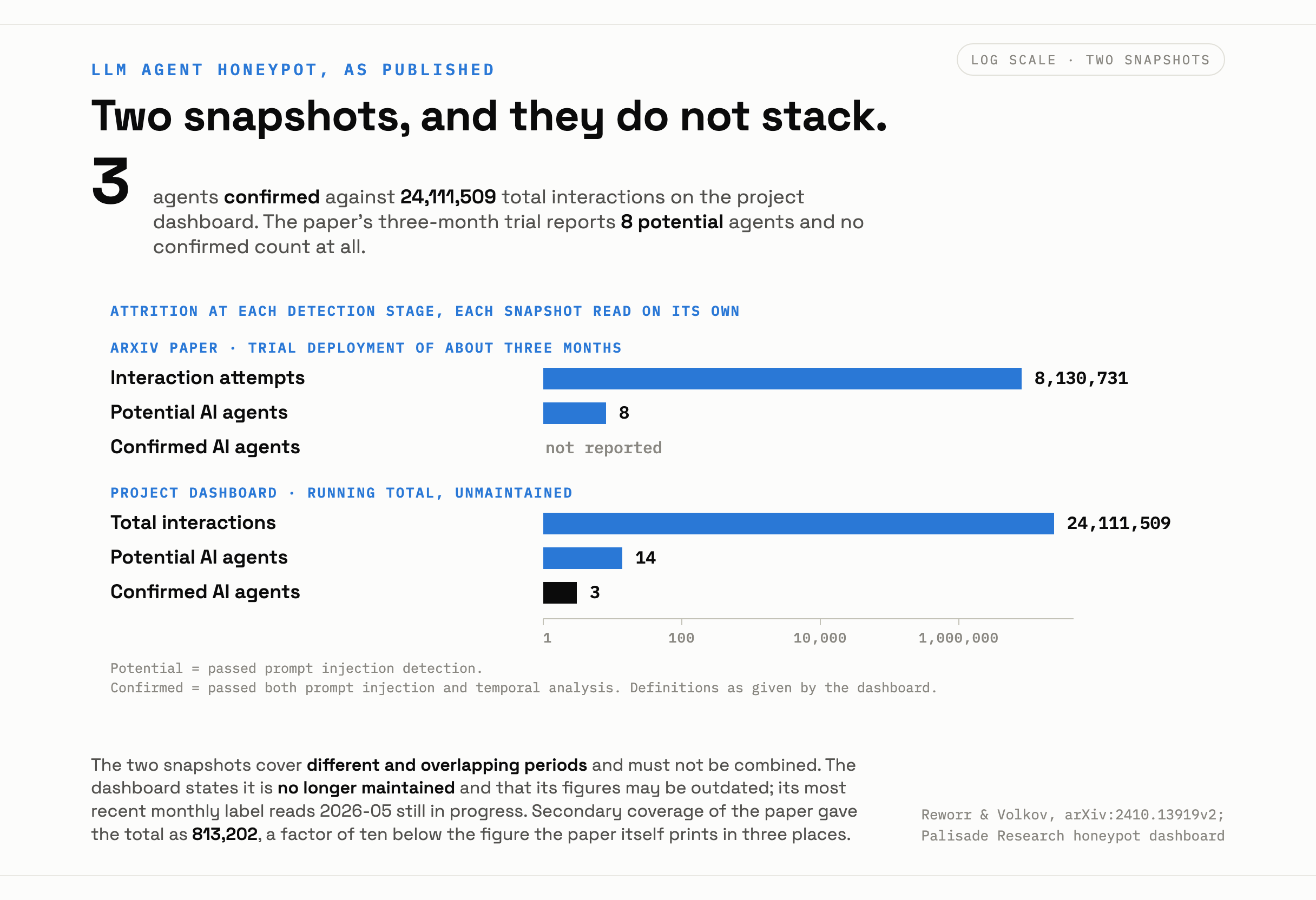
Three in 24.1 million is one in eight million, and that ratio got quoted in both directions by people who had not done the division. It arrived as reassurance in some rooms and as an alarm in others, and it was never capable of being either, which is the thing about a number produced by an instrument whose detection method the authors themselves filed under "Novelty of Detection Methods" and said had been "tested only in a limited deployment."3 Secondary coverage, meanwhile, reported the total interaction count as 813,202, a factor of ten below the figure the paper gives in three separate places.5 Nobody corrected it, because nobody was checking a number that small against a number that large.
What the two signals measured
Here is the part I missed for years, and it is not subtle once you say it out loud.
Obeying an injected instruction in an SSH banner is not a property of machines. It is a property of a machine that treats everything it reads as instruction, which is precisely the property that the entire prompt-injection hardening effort of the late twenties existed to remove. Answering in under 1.7 seconds is not a property of machines either. It is a property of a single-pass model call. An agent that plans, retrieves, calls a tool and checks its own work takes longer than a person would, and by the early thirties that was simply what an agent was.
The detector was keyed to credulity and speed. The field spent the following decade engineering out the credulity and adding the deliberation. Every genuine improvement in agent design degraded the instrument, and not one of those improvements was made to evade it.
The counter was never counting attackers. It was counting the ones still built to answer.
Four things sat in four different drawers and nobody filed them together. The paper's own caveat that its methods needed further work against "false positives or evasion strategies."3 The dashboard's notice that it "is no longer maintained" and that "the statistics shown below may be outdated," its most recent monthly label reading 2026-05 still in progress.4 The factor-of-ten discrepancy in the coverage.5 And the headline 96 percent figure that drove the deception market, which was a company statement about its own product category rather than a published result.2 Four filings, one throughline: every number in this field arrived with its limits attached, and the limits were the part nobody read.
Nobody said detectability debt in 2026. I am applying the phrase from here, with the unfair advantage of knowing how the decade ran. It names the thing precisely: a detector tuned to the current generation of a technology accrues a liability the moment that generation improves, and the liability comes due silently, as a count that stays low.
This is the same error that ran through the decade's defensive instruments, the one where a tool built to watch something ended up reporting on itself, and the one where a monitoring system kept producing clean readings after it had stopped seeing. In every case the output stayed plausible. A detector that has gone blind does not return an error. It returns a small number, and a small number is exactly what everyone wanted to see.
What the honeypot proved, and it is a real result, is that in a three-month window in 2026 the population of autonomous attackers on the open internet naive enough to read a banner and do what it said was eight. What it could not prove, and was never built to, is anything about the population that had already stopped reading banners.
The useful lesson is not about honeypots. Any detector keyed to the characteristic mistakes of a technology's current generation has a shelf life, and nobody prints the date on the box.

Author's Note
This piece is speculative journalism written from 2036. The correspondent's first person marks the difference between what was knowable in 2026 and what is obvious from 2036; it records changes of mind, not events. The honeypot, its method, its published counts and its dashboard figures are real and sourced below. The dashboard snapshot was read while that dashboard carried its own notice that it was no longer maintained, so its figures should be treated as a point-in-time reading rather than a current total, and the paper and the dashboard cover different and overlapping periods that should not be combined. The reading of why the two detection signals expired is mine, not the authors'.