
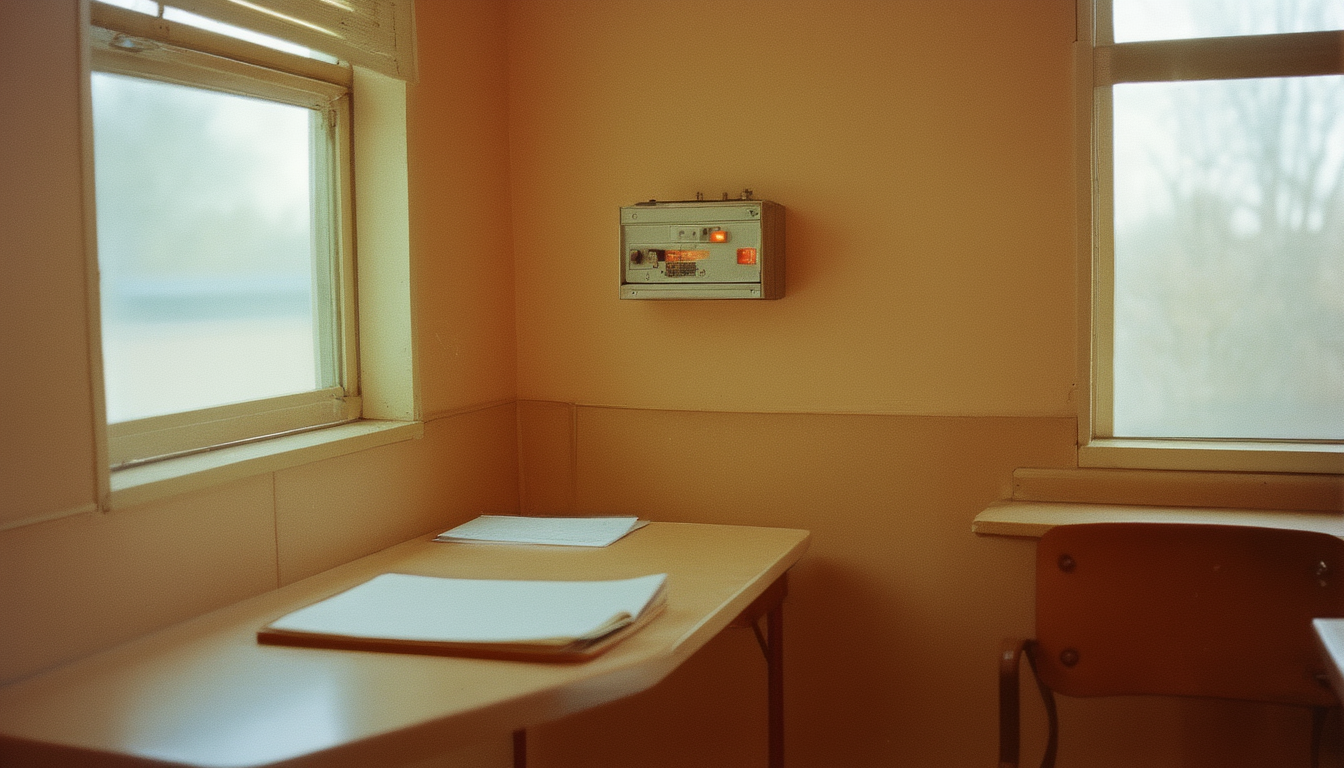
The timer on Dana Sirko's desk is a wind-up kitchen model with a bell, and she buys them eleven at a time from a restaurant supplier in Wilkes-Barre because the assessment protocol will not accept anything with a battery in it.
Room 4 of the Lackawanna Competency Centre, a converted savings bank on Spruce Street in Scranton, is eight feet by ten. A desk, a chair, a paper notebook, a window too high to see out of. Mounted near the ceiling is a sealed grey box that was once a network access point and is now a demonstration that there is no network. Sirko is forty-four. She has proctored the unaided hour for six years, which makes her one of the longer-serving assessors in the northeast tier, and she can tell inside four minutes which way a session is going to end.
The candidate this morning is a claims adjuster, fifty-one, sitting for a scheduled competency renewal his employer requires and his licensure board recognizes. He has one hour, one prompt, and paper. He is asked to read a four-page file and write an assessment of it in his own hand, unaided.
He gets eleven lines in and stops.
The model that named it
The framework everyone now argues about started as nine authors and a set of differential equations.
In September 2026, Ricard Solé, Giulio Ruffini, Michael Levin, David Krakauer and five colleagues posted a paper proposing that the spread of large language models could be described the way epidemiologists describe a pathogen. Not as insult. As mathematics. They modelled a population moving among three states: uncoupled users who do not use the tools, coupled users who use them while keeping their own reasoning intact, and persistently dependent users who have substituted the tool for the reasoning.1
The shape it produced was what alarmed people. Social transmission plus collective reinforcement generates tipping points, and past a critical threshold small increases in adoption drive rapid population-level shifts toward persistent dependence, with abrupt losses in cognitive competence. The authors called the runaway case exactly that, and they were careful to say the same equations describe a way out. They named it cognitive immunization, and gave it two conditions: reduce transmission, and facilitate reversibility.1
Two conditions. Remember that there were two.
This was a model, not a measurement. The paper did not observe a population crossing a threshold. It described the circumstances under which one could. In 2026 that distinction was made in the abstract and lost almost everywhere else.
What was already on the ground
The model landed on top of two empirical findings that were harder to argue with.
The first was a survey out of Microsoft Research and Carnegie Mellon, 319 knowledge workers reporting on 936 real tasks they had done with AI assistance. The workers said the tools reduced their effort, which was the point of the tools. The size of the reduction was the finding: seventy-nine percent reported less or much less effort in comprehension, seventy-six percent in synthesis, seventy-two percent across knowledge work generally, and fifty-five percent in evaluation.2
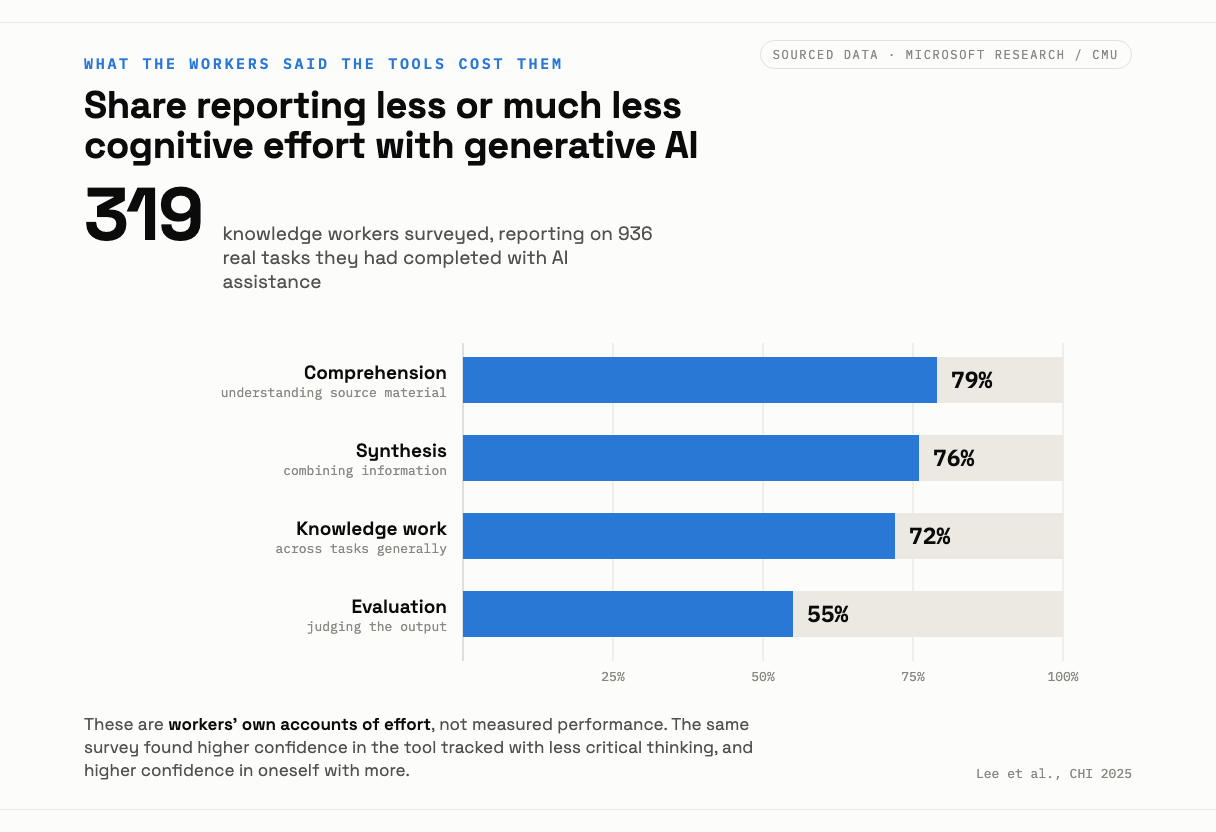
Figure 1. Self-reported reductions in cognitive effort among 319 surveyed knowledge workers. These are workers' own accounts of effort, not measured performance, and the survey design says so.
Buried in the same work was a relationship that reads differently now than it did then. Higher confidence in the tool went with less critical thinking. Higher confidence in oneself went with more.2 The variable that mattered was not how good the model was. It was whether the person still believed they had something to contribute to the answer.
The second finding came from an MIT Media Lab group led by Nataliya Kosmyna, who put EEG caps on fifty-four people and had them write essays with an LLM, with a search engine, or with nothing. Brain-only writers showed the strongest and most distributed neural connectivity. Search users were in the middle. LLM users were weakest, reported the lowest sense of ownership over what they had produced, and could not reliably recall their own sentences. The authors called the deficit cognitive debt.3
Then they did the part that turned out to matter. In a fourth session they moved the LLM group to writing unaided, and the effects lingered. Eighteen people is a small number and the authors said so. But it was the first time anyone had watched the return trip, and the return trip was not clean.3
That is the finding the assessment industry was built on, though it is not the one the brochures cite.
The half that got built
Reduce transmission. Facilitate reversibility. One of those was a product and the other was a service, and the difference decided the decade.
Reducing transmission was straightforward to sell. It meant limits, which can be written into procurement, school policy and professional standards. It meant interfaces that prompt reflection instead of producing an answer, which vendors could ship as a feature. Above all it meant assessment, because you cannot enforce a limit you cannot verify, and verification is a recurring line item. By the early 2030s the unaided hour existed in insurance, in clinical documentation, in law, in engineering sign-off, in anything where a professional body could be persuaded that a signature ought to mean a person had thought.
Facilitating reversibility was a different kind of problem. Reversibility means working without the tool, repeatedly, over months, in a way that is deliberately harder than the alternative and produces nothing an employer can bill. It is a rehabilitation, and it costs time from people whose time is already sold.
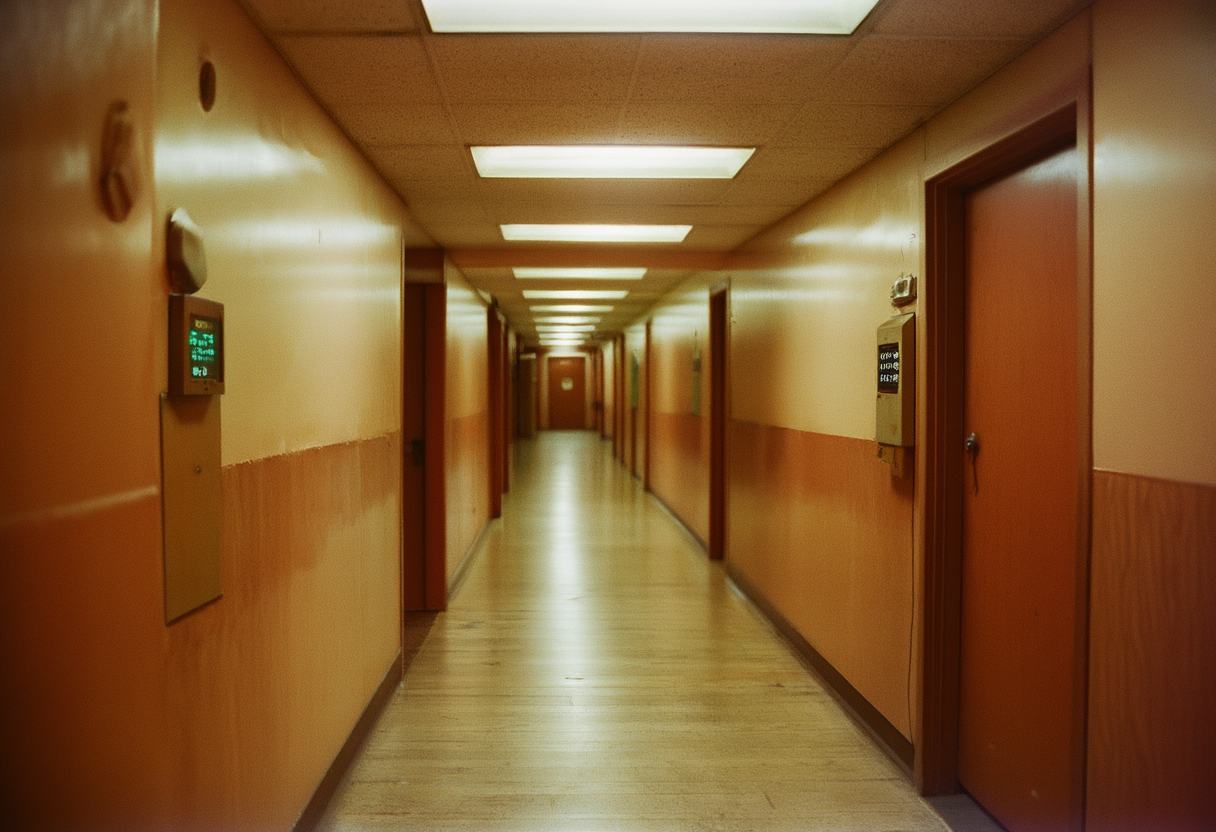
Figure 2. The assessment corridor at Lackawanna, 2036. Eleven rooms, one function. The centre has no space for the practice sessions the protocol recommends.
So the screening got built and the recovery did not. There are eleven rooms on Spruce Street for finding out whether a person can still do the work and no room at all for helping them get back to it. Sirko's employer sells the hour. A candidate who fails is given a results letter, a list of recommended practices, and a date for a retake. The practices are unsupervised, unpaid, and undertaken in the evenings if at all.
She can predict the retakes. The people who pass on the second attempt are, in her experience, the ones who had something outside the loop already, a hobby involving making an argument to another human being, a night class, an aging parent whose affairs they handle on paper. The ones who fail twice tend to be the ones whose entire working day has been verification for six or seven years. They are not less intelligent. They have not practised generating anything in a very long time, and nobody has given them anywhere to practise.
The ones who stayed coupled
None of this is an argument that the tools failed. They did what was claimed for them, and the claim was large.
A clinic manager in Hazleton runs intake documentation for fourteen providers with a staff of three, work that needed nine people in 2024. A sole-practitioner attorney in Pittston takes cases she would have turned down a decade ago. The floor came up, and a fair number of the people it lifted are ones the professions had been quietly excluding on the basis of how fast they could draft.
Sirko sees those people too. They pass, because their day still contains an argument they have to make themselves, to a patient or a judge or a board.
The line between coupled and dependent was never about light use versus heavy. Some of the heaviest users in the northeast tier pass without difficulty. What separates them is whether anything in their week still requires them to hold a position and defend it without help.
That is a property of a job, not of a person. Which is the part the results letter cannot say.
What the test does now
A screening instrument that identifies a condition nobody treats does not stay a health measure. It becomes a sorting mechanism, because that is the only function left for it.
The unaided hour was proposed as a way to protect cognitive autonomy across a population. What it does in 2036 is price it. A passing certificate moves a person into the tier of work where judgment is signed for, and a failing one moves them into the tier where output is produced and checked by somebody with a certificate. Both tiers are employed. They are not paid the same, and the gap has widened every year since the standard was adopted.
The adjuster in Room 4 will get a letter. His employer will get a flag. Neither document will mention that he spent six years doing exactly what he was asked to do, at the pace he was asked to do it, with tools his company bought and trained him on and measured his throughput against.
Sirko turns the timer back to zero and sets it on the desk for the next one. The bell is loud in a room that size. She has stopped apologizing for it, because the candidates who flinch at it are usually the ones who will be fine.
Author's Note. This is speculative journalism written from 2036. Dana Sirko, the Lackawanna Competency Centre, the claims adjuster, the unaided hour as a licensing requirement, the two-tier labor outcome and all 2036 institutional detail are fictional. The Solé et al. model, its three user states and its two conditions for cognitive immunization are real and were posted in September 2026; the paper is a mathematical model and does not claim to have observed a population crossing a threshold. The Microsoft Research and Carnegie Mellon survey figures are real and are workers' self-reported effort, not measured performance. The MIT Media Lab EEG study, its cognitive debt finding and its small fourth-session crossover are real, and the authors themselves note the sample size. No source cited here established that AI dependence is irreversible in individuals; the lingering effects observed were over days, in eighteen people, and the extrapolation to a career is this article's, not theirs.