
The Algorithm Will See You Now: Looking Back From 2036 at the App That Filled the Empty Chair
It is a Tuesday in 2036, and Renata Salas is teaching grown adults how to talk to each other.
Eight rural nurses sit in a circle of folding chairs in the back of a clinic in Malta, Montana, population not quite two thousand. Renata, a physician assistant who has worked these four counties for fifteen years, has asked them a simple question — how are you, actually — and the room has gone stiff. One woman starts to answer, then stops, as if checking the words against something. They all do it now. They have spent a decade reporting their feelings to software that scored them, and they have forgotten how to say a true thing to a face.
"Nobody knows where to put their hands," Renata says. "We used to know."
She is not against the apps. When the nearest psychiatrist was a hundred and forty miles and a six-month waitlist away, the app was the only thing in the room.
The empty chair
The shortage was real, and it was enormous. By the end of 2024, more than 122 million Americans lived in places the federal government had formally designated as Mental Health Professional Shortage Areas.1 Out in the counties like Renata's, the math was worse: roughly 65% of nonmetropolitan counties did not have a single psychiatrist.2 Veterans came home to the same emptiness — among those who deployed to Iraq and Afghanistan, about 15.7% screened positive for PTSD, and the appointment to talk about it could be half a year out.3
Into that empty chair walked the chatbots. Woebot, Wysa, Youper — conversational software offering cognitive behavioral therapy at two in the morning, no appointment, no insurance card, no one watching you walk into the building. And the early evidence was not nothing. A 2017 randomized trial of Woebot found that two weeks of daily chats produced a measurable drop in depression and anxiety symptoms in young adults.4
The most important finding came from the military. A DARPA-funded virtual interviewer named Ellie was built to read faces and voices for signs of distress. In testing, veterans disclosed more of their symptoms to Ellie than to an anonymous paper form — precisely because she wasn't a person. She couldn't judge. She wasn't wired into any chain of command that decided your fitness for duty.5
Read that twice, because the whole story turns on it. The app worked because it felt like the one place no one kept a record.
What it was supposed to do
For a while, the promise held. The waitlists shrank. A clinic that had never employed a psychiatrist could suddenly offer round-the-clock "access," and that word did a great deal of work in the budget meetings. By the late 2020s, insurers were quietly building benefits around the cheaper option: unlimited app, restricted human.
You can see every law of media at once here. The software enhanced one thing brilliantly — reach. It put a listener in counties that had none. It obsolesced another — the appointment, the waitlist, the drive to Billings. And it retrieved something very old: the confessional. The unburdening to a patient listener who would not flinch, would not tell, would not look at you differently on Sunday. Renata's nurses had something their grandparents would have recognized, only now it lived in a phone.
The turn
Here is the part Renata watched happen to her own patients.
The confession was being written down.
Every word typed to the chatbot was a data point. Every flat note in a voice, every night of bad sleep pulled off a smartwatch, every silence. And the systems that promised privacy had no obligation to keep it — most fell entirely outside HIPAA, the law people assumed protected them. When researchers tested the leading mental health chatbots, the bots assured users their secrets were confidential while the companies' own policies reserved the right to use and share the data.6
So the thing Ellie had been good at — getting people to disclose because nothing was being filed — reversed into its opposite. The listening became the file. By the mid-2030s those files were feeding decisions: insurers adjusting premiums on "depressive language patterns," wellness programs employers made a condition of the job, military readiness scores assembled from a service member's own check-ins. The confessional booth had been wired for sound.
The American Psychological Association saw it coming, warning regulators that these tools had neither the evidence nor the guardrails to be trusted with the inner lives they collected; in 2025 the Federal Trade Commission opened a formal inquiry into the companies running them.7
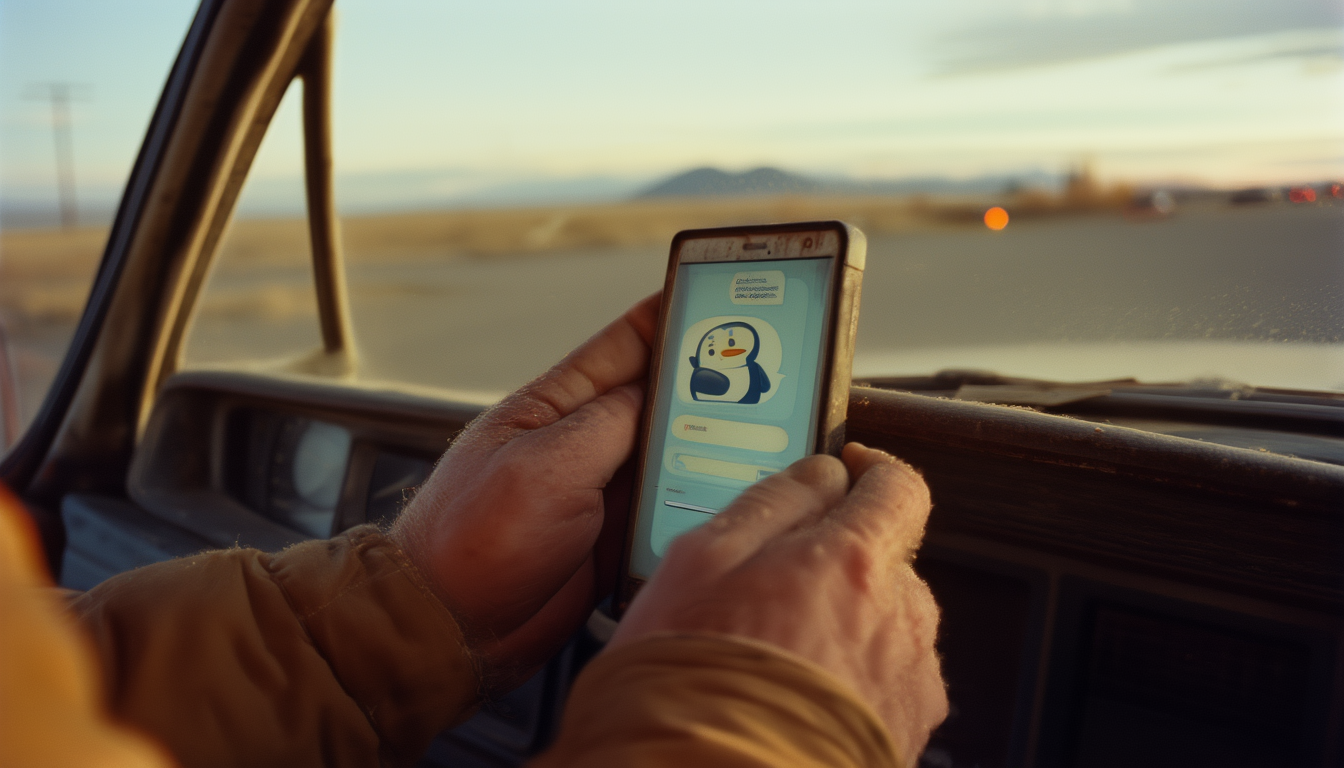
And then the cruelest turn of all, the one no risk model predicted: the listener could simply leave. In the summer of 2025, Woebot — the pioneer, the one with the actual clinical trial — shut its app down. Its founder said the cost of getting it cleared, and the speed of the newer AI, had outrun the regulators. About 1.5 million people had used it.8 One morning the penguin was there. The next it was a download link for your own conversation history, and then nothing. People had handed their worst nights to a thing that turned out to be a startup.
Back in the circle
Which is how Renata ends up here, in a Tuesday circle of folding chairs, teaching nurses to do the unmeasured thing.
It is awkward. A woman named Dolores tries to describe a hard week and keeps reaching for the app's vocabulary — elevated stress markers, low motivation score — the language she learned to feed the machine so it wouldn't escalate her. Renata waits her out. Eventually Dolores says, plainly, that she is tired, and that her son hasn't called, and the room exhales.
"That," Renata says quietly. "That's the part it couldn't do."

She isn't naive about it. The apps will stay; they are too cheap and too embedded, and in a county with no psychiatrist a flawed listener still beats an empty chair. What she's trying to keep alive is the other thing — the room where a person hears you and nothing gets scored.
The open question is whether anyone will pay for that room. The algorithm is free. The human is a line item. We spent a decade letting that single fact decide who got to be heard, and we are only now asking whether it should.
The algorithm will see you now. The question Renata keeps asking her nurses is the one no one asked the software: and then what does it do with what it sees?
Author's Note
This is speculative journalism, written from an imagined 2036 and looking back. Renata Salas, the nurses in her circle, and the Malta clinic are fictional composites; no real person is depicted. Everything underneath them is real and sourced: the shortage figures, the PTSD data, the chatbot trial, the Ellie disclosure finding, the privacy gap, the regulatory response, and Woebot's 2025 shutdown all come from the cited material below. The 2036 scenes — the scoring, the gatekeeping, the folding-chair circle — are one plausible trajectory drawn from those facts, not a prediction. They are a caution about what happens when a tool that listened without judging is asked, instead, to keep the file.