How forgetting became a luxury only the poor can afford — looking back from 2036
Two hours before her daughter's sixth birthday, Maya Chen cannot remember where she hid the presents.
The memory is there. She knows that the way you know a word is on the tip of your tongue. It's logged, indexed, sitting on a server in Virginia. She just can't reach it. Her Basic Archive plan retrieves on a three-day delay, and the friendly voice behind her left ear has quoted her a wait time of forty-seven minutes — unless she upgrades to Premium Recall, $2,400 a month, for instant access to her own past.
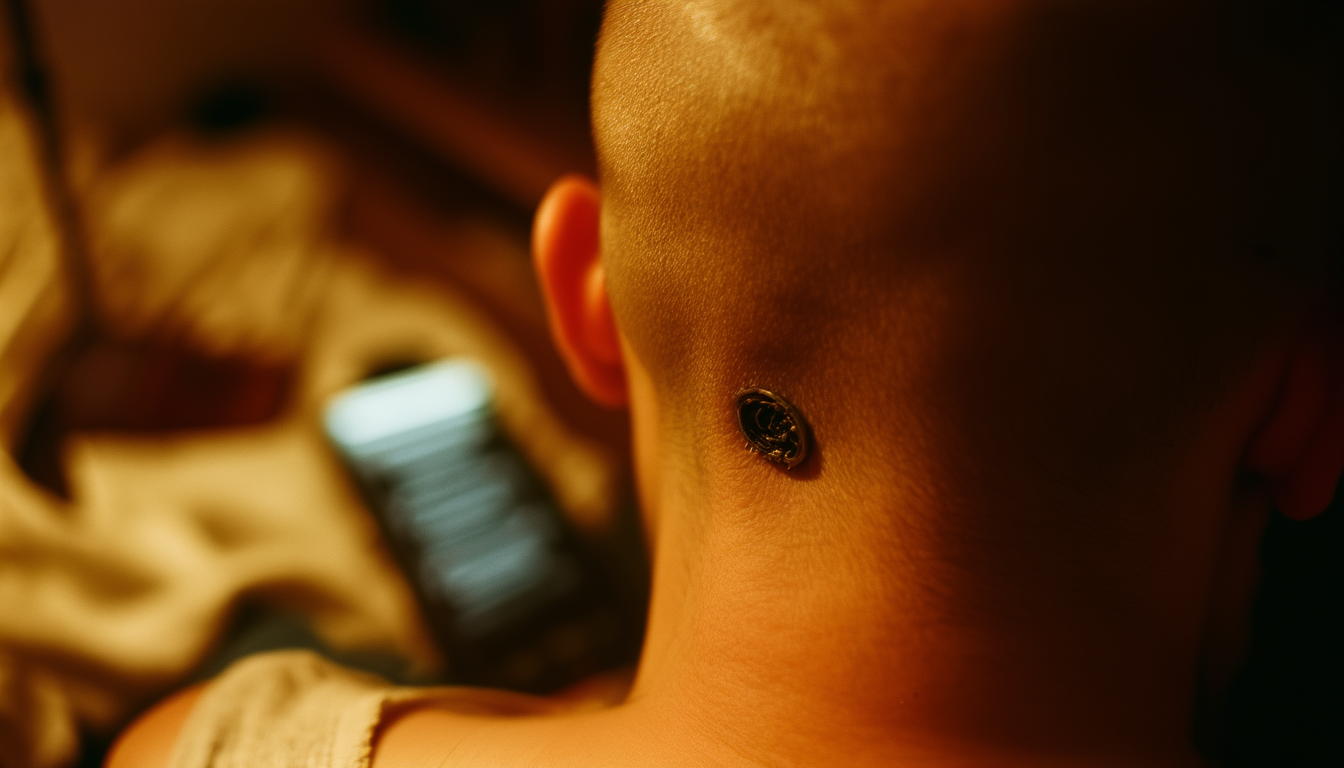
She closes her eyes in the kitchen. Forty-seven minutes. About the time it took her grandmother to bake cookies from a recipe she carried in her head until the day she died. Maya got her implant in 2034, the week her promotion to product manager required one. The company paid for the surgery. The subscription comes out of her paycheck.
It is a Tuesday, in 2036, and forgetting has become a thing you can no longer afford to do for free.
The promise was never sinister. It was medical. In May 2023, Neuralink got FDA clearance to put a brain-computer interface into a human being, and the goal was modest and good: let people with paralysis move a cursor with a thought.1 The first participant did exactly that — played chess, moved a mouse, all from the motor cortex.2 Nobody in that room was thinking about birthday presents.
But a device that can read the brain can, eventually, write to it. The arrays that restored movement could strengthen a failing memory, then store one, then store all of them. What began as a wheelchair became, by the 2030s, an upgrade — and in an economy that rewards perfect recall, an upgrade nobody can refuse becomes a requirement. Maya's productivity scores jumped the month she was wired. So did everyone's. After that, going without was the risk.
Here is what the brochures got right. The implants enhance memory the way the printing press enhanced literacy — suddenly everyone holds more than a human head was built to hold. They obsolesce the ordinary work of remembering: the mnemonic, the notebook, the discipline of paying attention because you knew you'd have to recall it later. And they retrieve something very old — the oral storyteller who once carried a whole culture in memory, except now the storyteller is a server farm and the culture is rented back to you by the month.
That last part is where the promise turns.
Because once a memory lives on a company's hardware, the company decides what it's worth. Storage isn't free, so the providers run algorithms that keep what they score as "significant" and compress the rest — the same recommendation logic that once ranked your feed, applied now to your own life. An afternoon with your kid gets read as redundant with last year's and quietly thinned to a timestamp.
This isn't a far-fetched leap. It's built on real science. Every time you recall a memory, it becomes briefly editable before it's stored again — a window neuroscientists call reconsolidation, and the basis for emerging trauma therapies that can soften a painful memory's emotional charge in up to 70% of cases.3 Therapeutic in a clinic. A product feature once it's metered: pay to dull the bad memories, pay more to keep the good ones, and trust the vendor's algorithm in between.
And the vendors are not built for trust. When the NeuroRights Foundation reviewed thirty consumer neurotechnology companies in 2024, twenty-nine of them had privacy terms that let them access users' neural data with no meaningful limit, and 96.7% reserved the right to hand brain data to third parties.4 The law arrived late and thin. Colorado became the first U.S. state to protect neural data, in April 2024; California amended its privacy act to follow that fall.5 Useful, narrow, and years behind the hardware.
Rafael Yuste, the Columbia neuroscientist who has spent a decade arguing for "neurorights," put the stakes plainly: neurotechnology reaches the one place that has no filter, no poker face, no door to close.6 Lose mental privacy, he asks, and what is left to lose?
This is the reversal, and it lands hardest here. A technology sold to liberate memory ends up owning it. The cure for forgetting becomes a meter on remembering. Cognitive freedom flips into the most intimate dependency ever built — not on a substance, but on a subscription to yourself.
None of this is speculative as a market. The hardware behind it is already a real, growing business: memory-augmenting neural devices were valued at $1.38 billion in 2024 and are projected to reach $5.55 billion by 2034.7 The 2036 in this story is just that curve, drawn forward, and handed a billing department.
Maya finds the presents. The location surfaces forty minutes later — not as a memory but as a fact, clean and weightless: garage, behind the camping gear. No sense of the evening she chose the spot, no small private thrill of planning a surprise. Just the coordinates.
She brings them in as the guests arrive — other parents with the same scar behind the same ear. They sing. Sophie blows out the candles. Maya takes the photo on her phone, because she no longer fully trusts the thing in her head to keep a birthday the algorithm might score as routine.
Sophie doesn't have an implant. She's six, below the age line. But Maya has already started a folder of pricing, because in a few years the choice won't feel like one: send your kid into school remembering everything she reads, or send her in on a bicycle to a car race. The hardest version of this isn't the surgery or the bill. It's that you decide for someone who can't yet, you decide out of love, and you may be wrong.
Sophie, frosting on her chin, asks why Maya doesn't remember things the way Grandma did.
"I'm trying to figure that out, baby," Maya says. "I'm trying."
Outside, the light goes. A whole street of people will have this evening backed up, indexed, and billed by morning — safe in the cloud, and not quite theirs.
Author's Note
This is speculative journalism: the year is 2036, looking back at choices being made now. Maya Chen, her daughter, and the named products are fictional composites. Everything underneath them is real and sourced — the FDA-cleared brain-computer interface, the reconsolidation science, the documented gaps in neural-data privacy, the market trajectory. The implants exist. The billing model is the part we still get to decide.