
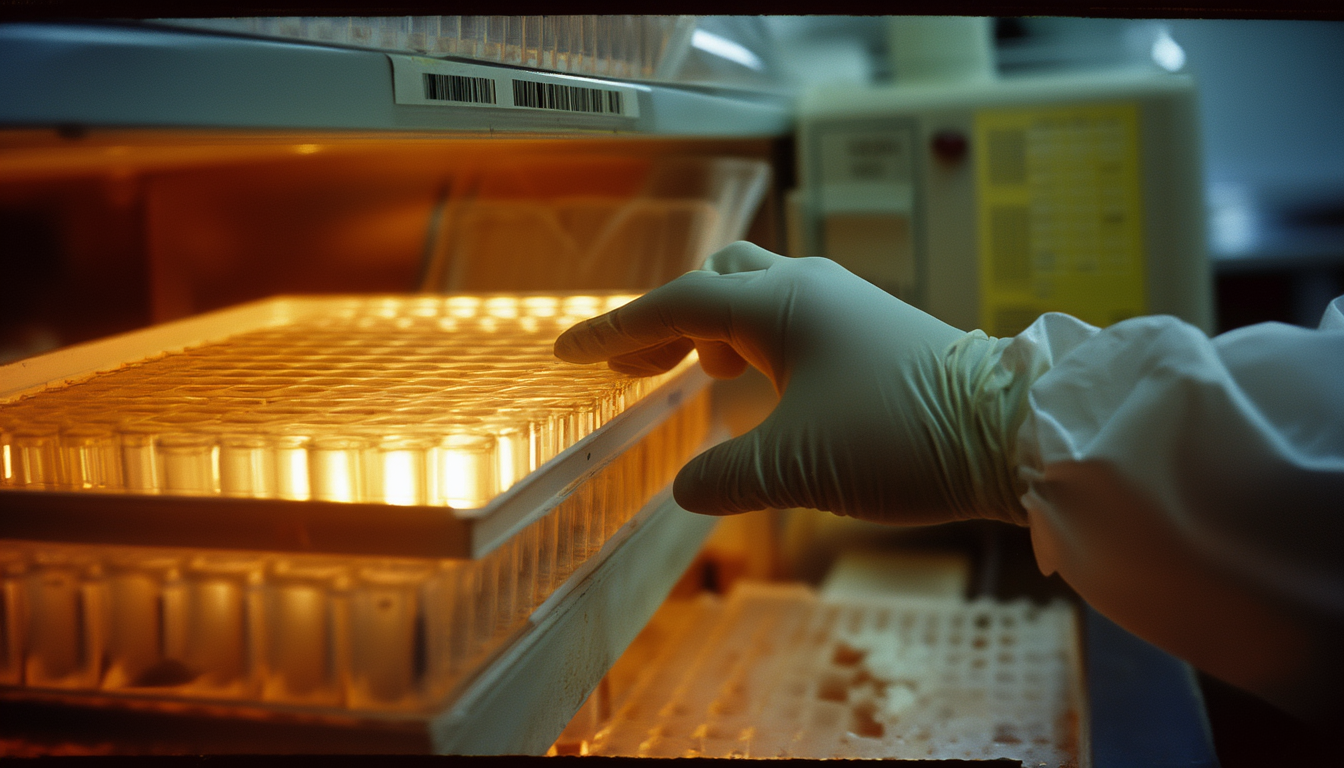
The plate reader finished at 03:40 and Sudha Kerkar read the result standing up.
Ninety-six wells, each one holding a few thousand human lung cells and a dose of a compound that had not existed twelve weeks earlier. On her tablet the molecule still carried its machine name, sixteen characters ending in K4, next to a confidence score of 0.93. A model had produced the design and the score in under a second. The cells had taken fourteen days to disagree.
She tagged it a non-mover, scanned the plate barcode into the freezer manifest, and slid the next tray out of the incubator rack. Shift target was six assays closed. She was on four.
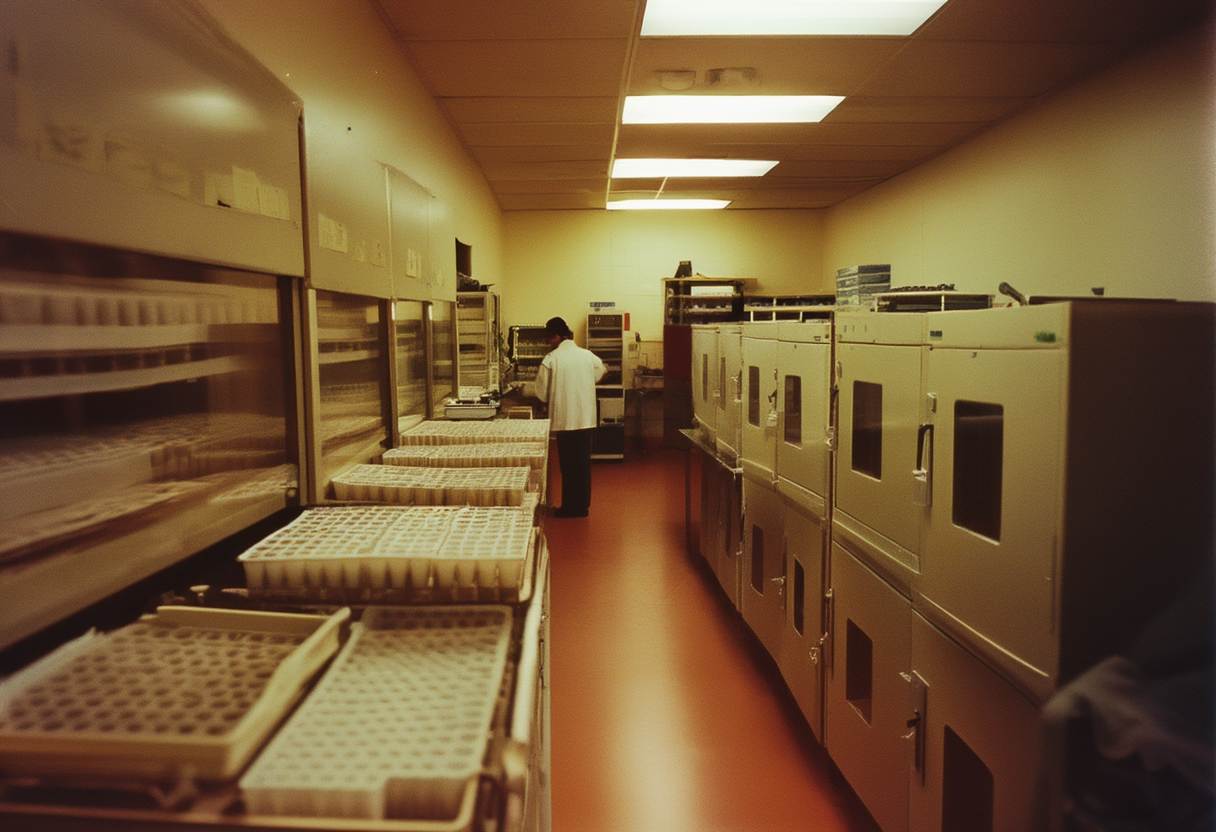
Figure 1. A contract validation laboratory in Genome Valley, north of Hyderabad, working an overnight assay queue for a frontier lab's pipeline, 2036.
The building had been a diagnostics franchise until the early thirties. Now it ran validation work on contract, and almost all of the queue arrived from one client: a company that a decade earlier had been known for a chatbot.
The prediction that got it right
Back in 2026 the blunt version of the forecast was that the frontier labs were never LLM companies at all, and that they would all become biotech companies. It was treated as a provocation. It was close to a schedule.
The moves came in a single run. In April 2026 OpenAI released GPT-Rosalind, which it described as a frontier reasoning model built to support research across biology, drug discovery and translational medicine, with Amgen, Moderna, the Allen Institute and Thermo Fisher named as partners and a strategic alliance with Novo Nordisk covering everything from drug discovery to commercial.1 Amazon had unveiled its own discovery platform days earlier.1 That June, Anthropic launched Claude Science and said something more consequential than the product: it was starting an internal drug discovery program, aimed at neglected diseases that conventional drugmakers would not find attractive.2 Its life sciences head put the reasoning plainly. "There's no substitute for having our own experiences alongside you all in the trenches trying to develop drugs."2 Alphabet had been there longest, through a DeepMind spin-off built on and beyond AlphaFold, carrying the stated mission of solving all disease,3 and in May 2026 it raised $2.1 billion, the largest round the field had seen.4
Why they went is not mysterious. Selling tokens was becoming a commodity business with a price that fell every quarter. A molecule was the opposite of a commodity. It could be owned, protected for twenty years, and sold at whatever a cure is worth. Moving from the tool business to the asset business was the obvious trade for anyone who believed their models were about to get very good at biology.
What the models were actually good at
They were good at it, and the evidence was better than the hype deserved.
The cleanest early signal came from a 2024 analysis of the clinical pipelines of AI-native biotechs. Of the AI-discovered molecules that had finished Phase I, success ran at 80 to 90 percent, well above the historic industry range of roughly 40 to 65 percent.5 Phase I asks a narrow question: is this compound tolerable in a human body, does it behave like a drug. A model trained on chemistry and structure turns out to be very capable of designing something that behaves like a drug.
The protein work was starker still. In January 2025 OpenAI and Retro Biosciences described a small protein-specialised model whose suggested redesigns made two of the Yamanaka factors, the proteins that turn ordinary cells back into stem cells, more than fifty times as effective.6 Twenty years of careful laboratory iteration, improved on in a few passes.
So the design step collapsed. On Sudha's tablet it showed up as abundance: a ranked queue that never emptied, hundreds of candidates a week, each one cheaper to generate than the plastic plate it would be tested in.
Where the clock stayed put
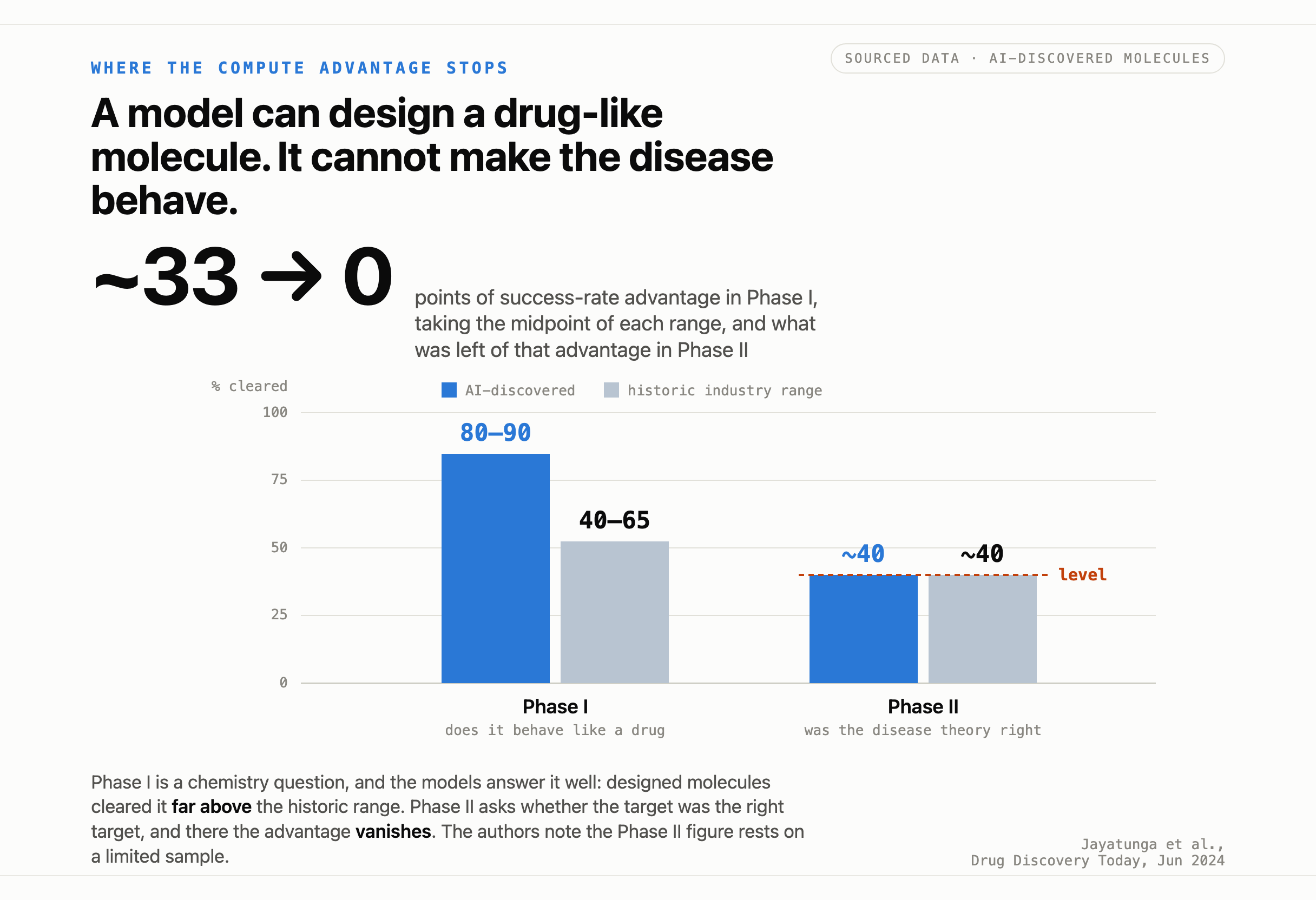
Figure 2. Where the compute advantage stops. AI-discovered molecules clear Phase I far above the historic range. In Phase II the advantage disappears. Drawn from Jayatunga et al., 2024, as read in 2036.
The same 2024 analysis carried the finding that mattered, and it was not the good news. In Phase II, the success rate for AI-discovered molecules was about 40 percent, comparable to historic industry averages.5 Phase II is where you learn whether the disease works the way you thought. It is the expensive question, and the models did not touch it.
The first proper test arrived in 2025, when a generative-AI-discovered inhibitor for idiopathic pulmonary fibrosis reported a randomised phase 2a trial in a major medical journal.7 A real molecule, found by a real model, put in front of real patients. That is the hinge. Design had become almost free, and proof had not moved at all.
It could not. A cell line grows at the speed a cell line grows. A fibrosis endpoint takes twelve weeks because lungs take twelve weeks. Patients enrol at the rate that patients with that diagnosis walk into that clinic. None of it responds to more compute.
None of which makes the Phase I result a trick. It was a real gain, and a humane one. A molecule that fails in Phase II has at least been tested against a plausible mechanism, in people who joined a trial that had a chance. The older failure mode was worse: compounds that washed out in the first human study, after years of work and a ward full of volunteers, because the chemistry was never going to hold. Fewer of those got built after 2026. That is a smaller victory than the launch posts claimed and a larger one than the skeptics allowed.
So the labs got what they bought. They had acquired the asset business, and the asset business turned out to be mostly the part they had not automated: wet-lab validation, trial sites, regulatory filings, long capital, portfolio bets against a failure rate nobody had improved. They bought trial networks. They hired for site monitoring and regulatory submission, roles with no analogue anywhere in a model company. One by one they rebuilt the apparatus drug development has always needed, because none of it was the part a model could absorb. By 2036 their org charts looked like the drugmakers they had expected to leapfrog, because the work was the same work. The companies that had promised to compress a twelve-year timeline were running on biology's timetable, and paying for it in the oldest currency the industry has: human bodies and human hands.
Sudha's hands. Her contract rate rose about nine percent over four years while the client's design throughput went up by a factor nobody at the lab could verify. The bottleneck had been handed to her, and the bottleneck did not come with a share of the upside.
The freezer
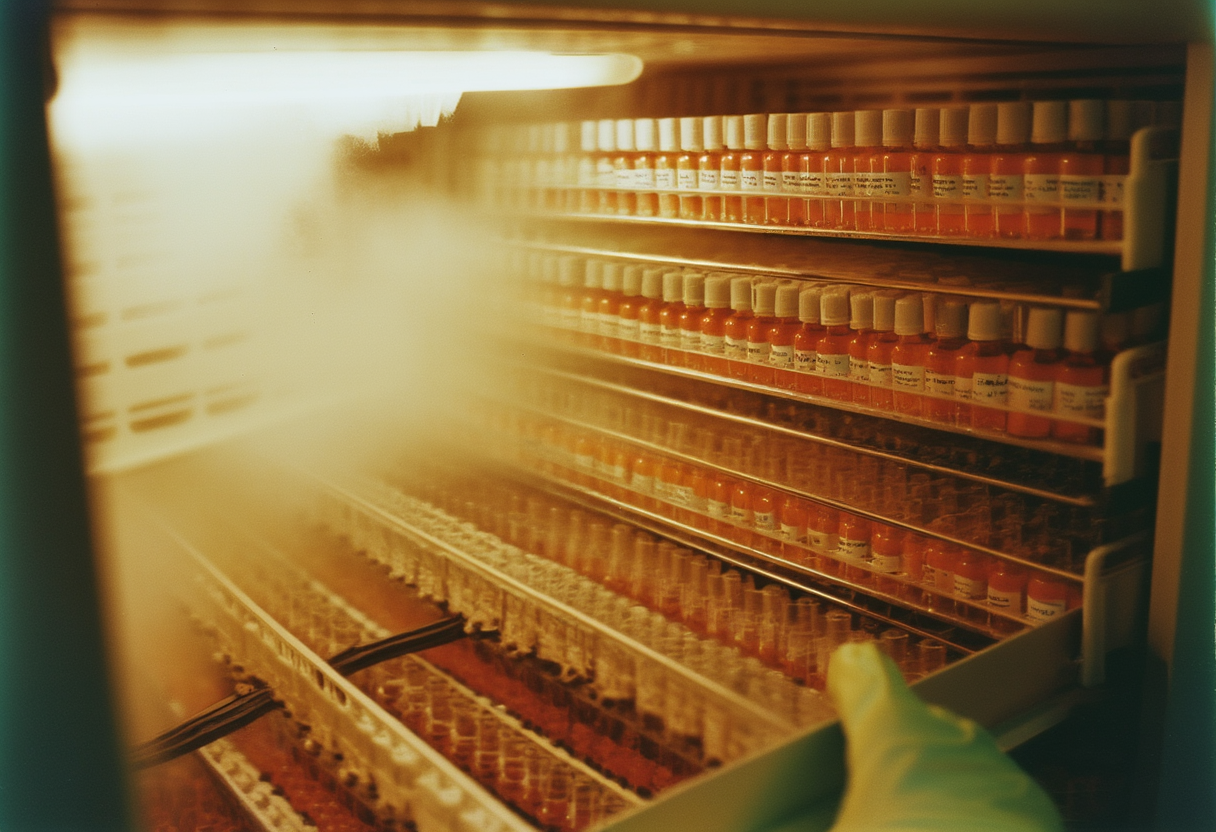
Figure 3. Designed and shelved. Candidate vials held against trial budgets that were never approved, in contract cold storage outside Hyderabad, 2036.
The part that stayed with her was two drawers down from her bench.
The neglected-disease promise had been real, and in one sense it was kept. The models did design for diseases with no market, exactly as announced. Visceral leishmaniasis. Buruli ulcer. Chagas. The designs existed, ranked and scored and frozen in vials with machine names, because designing them cost a few hours of inference and proving them cost a trial that no one had funded.
Scarcity had not been abolished. It had been moved. When design was the expensive step, a molecule for a disease of the poor never got drawn. Now it got drawn, beautifully, and then waited in a freezer in Hyderabad for a budget. Sudha had stopped reading the labels in that drawer. She said it was like a library of books nobody had been paid to read.
What is still open in 2036 is whether owning the molecule changes who gets cured or only who gets paid when a cure arrives. The labs now hold both the design engine and the asset, which is more leverage over the pipeline than any pharmaceutical company has ever had. They could spend it on the drawer. Nothing in the structure obliges them to, and the clock in the dish does not care either way.
At 05:10 Sudha closed her fifth assay, logged out, and walked into a morning that smelled of diesel and wet dust. Behind her, in the dark, the sixth tray sat in the incubator, thirteen days from having anything to say.
Author's Note
This is speculative journalism written from 2036. Sudha Kerkar and the Genome Valley contract lab are fictional composites, as are the specific candidate compounds, the shift targets and the contract rates. The trajectory underneath them is real and sourced: the 2026 moves by OpenAI, Anthropic and Alphabet into drug discovery, the measured gap between Phase I and Phase II success for AI-discovered molecules, the Yamanaka factor redesign, and the first randomised phase 2a trial of a generatively discovered drug. Where this piece projects (the 2036 contract-lab economy, the shelved neglected-disease candidates), it is projection, not reporting.