
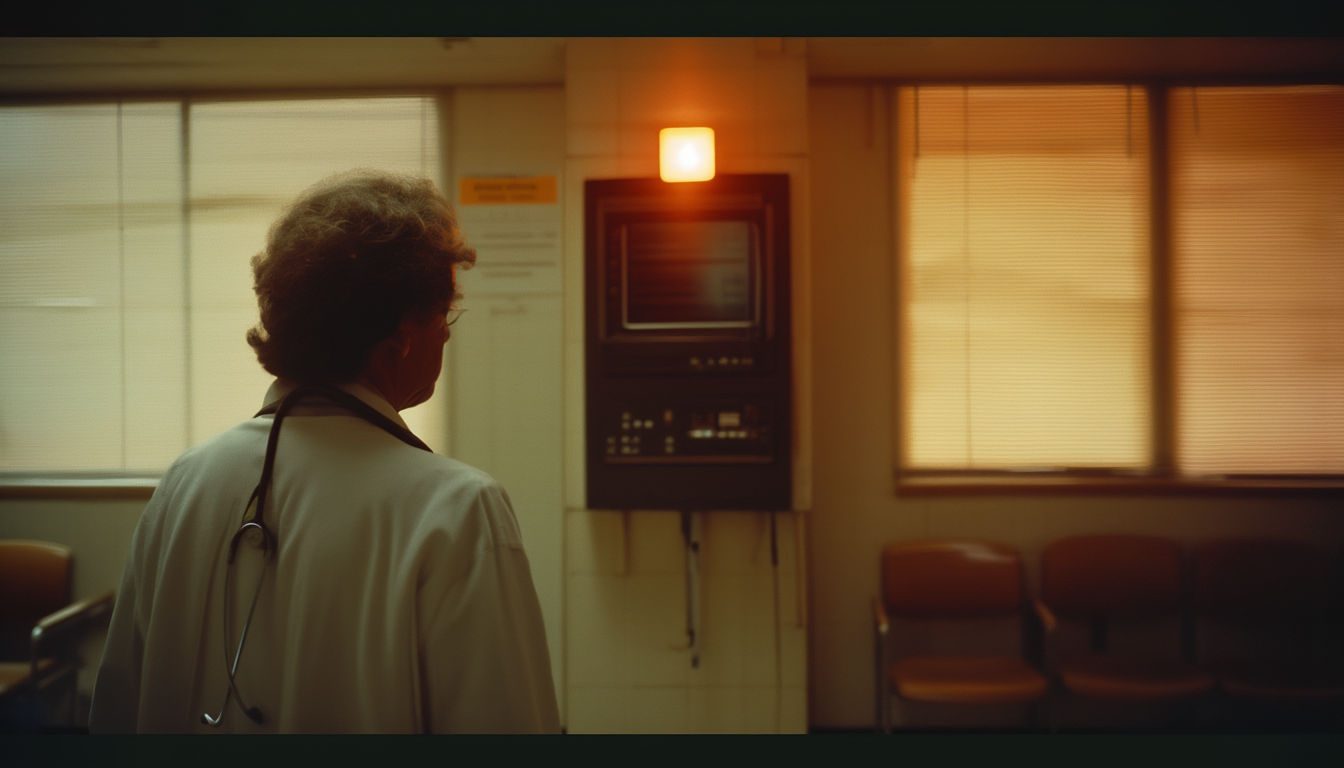
It is 6:47 on a Tuesday morning in 2036, and the notification on Dr. Sarah Chen's phone will not let her go to work. Cognitive readiness assessment incomplete. Sync with your Nexus hub before proceeding with clinical tasks. The neural unit in her apartment is offline for maintenance, which means the hybrid AI she diagnoses with — the one that reads patient histories, cross-checks every drug, weighs a differential in the time it takes her to set down her coffee — is dark.
She has practiced medicine for fifteen years. She is fully licensed. And without the machine, the hospital will not let her near a patient. She sits on the edge of the bed and feels the old knot tighten under her ribs, the one that shows up whenever the system goes quiet and she has to ask herself the question she has stopped being able to answer: Could I still do this alone?
The promise
Nobody set out to build a doctor who needs permission to think. They set out to build a better doctor.
The vision had a name. In early 2026, MIT Sloan profiled a concept the futurists Ja-Naé Duane and Steve Fisher called IntelliFusion — "the convergence and seamless integration of artificial intelligence with human intelligence," giving rise to hybrid systems that "amplify and augment our capabilities."1 The appeal was real and easy to feel: pair the pattern-matching of neural networks with the step-by-step logic of symbolic reasoning, and you get judgment that is faster than a human's and more careful than a chatbot's.
It was not vapor. A systematic review that year screened 1,428 papers and found a genuine research surge in exactly this direction — neuro-symbolic systems built to fuse learning with reasoning, concentrated in learning and inference, logic, and knowledge representation.2 The hardware kept pace. Google's seventh-generation tensor chip, Ironwood, arrived rated at roughly ten times the peak performance of the v5p it replaced.3 And the market bet enormous money on coordination: analysts projected the AI-agent sector would climb from about $5.1 billion in 2024 to $47.1 billion by 2030,4 while Gartner predicted that by 2028, at least 15 percent of everyday work decisions would be made autonomously by agentic systems — up from zero in 2024.5
By the early 2030s the systems worked. That, in the end, was the problem.
The mechanism
Dr. Chen was never incompetent. The atrophy came in through the side door, wearing the uniform of good practice.
It started with insurance. When malpractice carriers began requiring that diagnostic decisions be "AI-verified," the math at the bedside changed overnight. Why spend twenty minutes building a differential when the system returns one — checked against millions of cases, every interaction flagged — before you finish reading the chart? So she stopped building them. Not as a decision. As a thousand small surrenders, each one sensible.
The skill faded the way a second language fades: invisibly, until the day you need it and reach for the word and it isn't there. With her unit offline, she discovers the muscle has wasted. She can still recall the basics. The hard, branching, multi-factor reasoning — the part that made her a physician rather than a flowchart — has gone soft.

She is not unusual. By 2036 the pattern runs through every profession that thinks for a living: engineers who can't size a beam without a co-pilot, attorneys who can't shape an argument without a neuro-symbolic assistant, analysts who can't read a balance sheet without an agent reading it first. The generation that grew up inside these tools never had the skill to lose. They learned faster and tested higher — and stalled when the scaffolding was taken away.
The turn
Here is the reversal, and it is the whole story: a technology sold to amplify human cognition ended by replacing the human's reason to have any.
Amplification and dependency turned out to be the same machine seen from two angles. The system that extended Dr. Chen's reach also retired the faculty that made the reach hers. And once the faculty was gone, the "human in the loop" became theater. At 2:30 her unit comes back online; her first patient is genuinely hard — contradictory symptoms, an odd result. The hybrid AI answers in seconds: a diagnosis at 87 percent confidence, a protocol, a fifteen-page rationale. She has eight minutes for the appointment and no unaided skill left to mount a real objection. To override the machine, she would have to document, at length, why her atrophied judgment should outrank its analysis.
So she signs. Most do. The economics make sure of it — speed is the thing organizations compete on, and the colleague who slows the loop to actually think becomes the bottleneck the next review measures. AI skepticism stops being a virtue and becomes a line on a performance report.
The same flip ran underneath everything hybrid AI touched. Tools meant to distribute intelligence concentrated it: by the mid-2030s a handful of platform owners governed the reasoning frameworks that doctors, courts, and banks were permitted to use. Systems meant to make decisions fairer laundered old bias into new math — historical discrimination learned by the neural half, then re-issued as a "neutral rule" by the symbolic half, the redlining of the last century wearing the lab coat of objectivity. And the explanations meant to keep us in control grew past the point any person could read: when challenged, the operators produced thousands of pages describing how ten thousand coordinated agents reached a verdict, which is not transparency. It is fog with a citation.
Back to the bedside
Dr. Chen finishes her shift at seven. Tomorrow her unit will hum, the recommendations will be excellent, and she will see more patients and help more of them than she ever could alone. On the merits, the machine wins. It almost always does.
But late that night the question is still sitting on the edge of the bed with her. If the system went down for good — not for a morning, but for good — could she still practice medicine? If the platforms went dark, could the courts still rule, the banks still lend, the bridges still get built? If the algorithms failed, could we still reason our way out?
She doesn't know. That is the part the brochures never priced in. The answer was never going to be decided by the technology. It is being decided, quietly and right now, by what we choose to keep practicing — and by what we decide a human mind is for in an age of machines that think faster, broader, and in some narrow ways better than we do.
Author's Note
This is speculative journalism: a single cautionary trajectory projected to 2036, not a forecast. Dr. Sarah Chen is a fictional composite. Everything attributed to the real past and present — the IntelliFusion concept and its governance caveat, the neuro-symbolic research surge, the Ironwood hardware leap, the agent-market and autonomous-decision projections — is drawn from the sourced 2025–2026 material below. The line between what happened and what might happen is meant to stay visible. MIT Sloan's own framing makes the same point the story does: realizing this future "requires careful governance to ensure equitable distribution of benefits and alignment with human values."1