
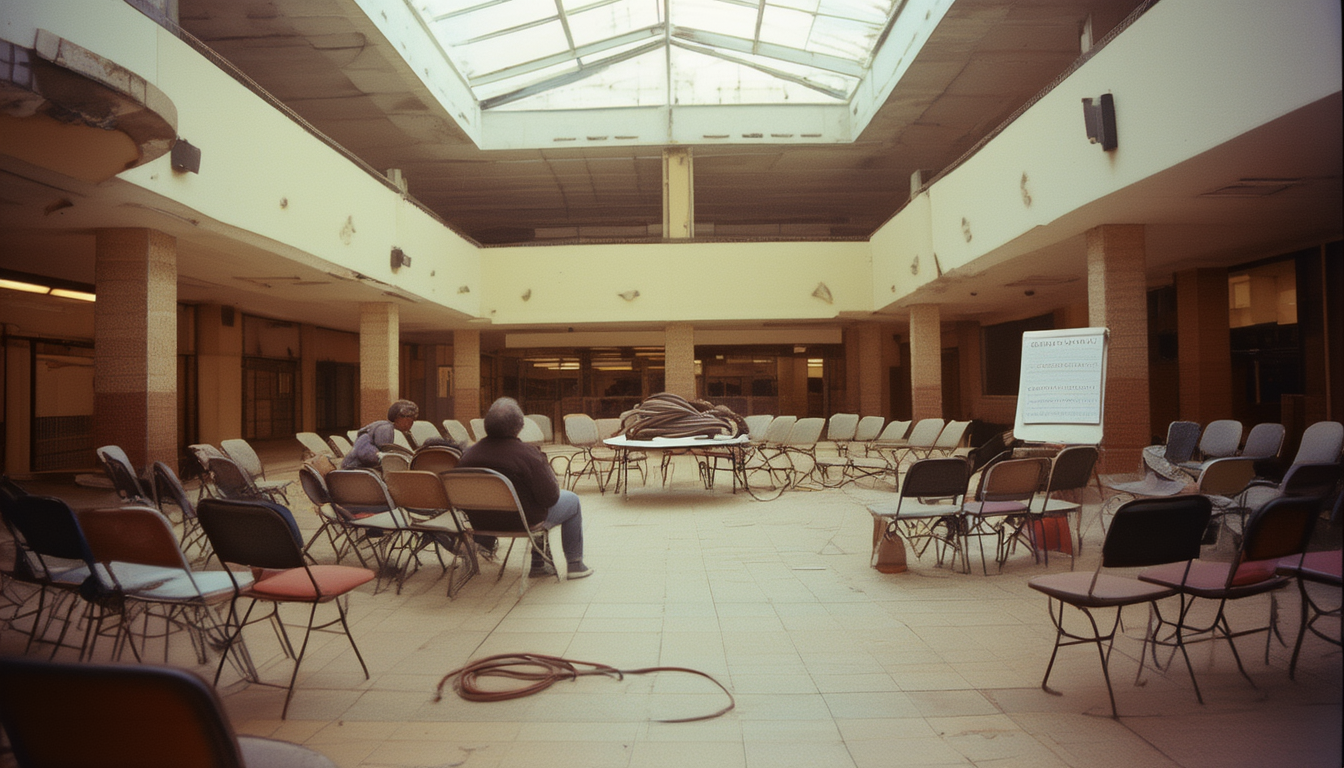
The espresso machine is long gone, but the counter is still there. Maria Gonzalez leans on it the way a manager once did, except the laminated sheet in front of her isn't a shift schedule — it's an agenda. It is a Tuesday evening in 2036, and forty-seven of her neighbors have folded themselves into the booths of what used to be a Starbucks on the east side of Columbus. They are here to decide where to bolt an antenna.
"Two hours, if we're lucky," she says, not looking up. The room smells like reheated coffee somebody brought from home. Somewhere a child is asleep across two chairs. The point of contention is a rooftop three blocks over — whose roof, whose sightline, whose router carries the load when the heat warps the air and the signal drops. Trivial, until you remember that the answer routes internet for roughly twelve thousand people.
Nobody in the room calls this democracy. They call it the meeting. But that is what it is.
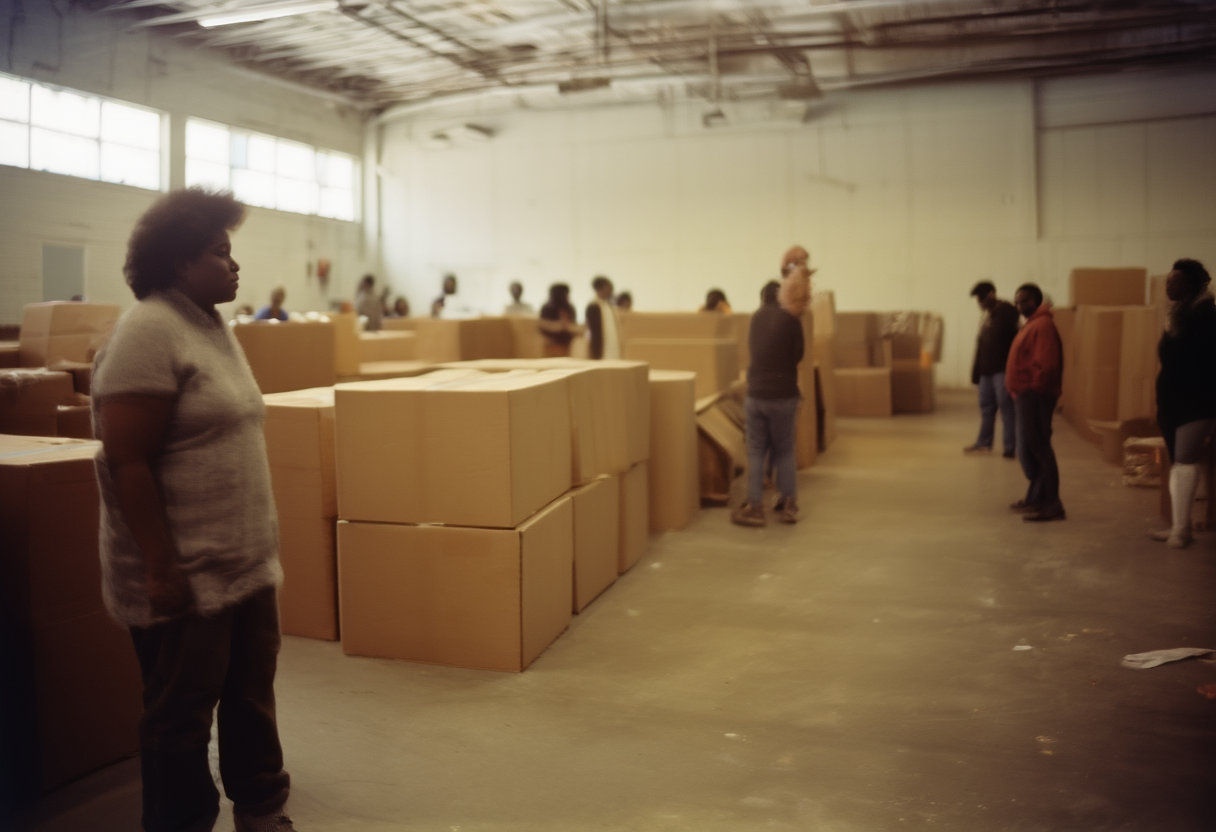
The promise
The thing Maria's network promised was simple: own the wires, and nobody can switch you off.
A mesh network is internet without a landlord. Instead of paying a corporation to pipe a signal into your home, neighbors each run a small radio, and the radios pass traffic to one another — a web of nodes rather than a single tower. When one fails, the others route around it. The template is real and old. Guifi.net began in rural Catalonia in 2004, after telecom companies decided the countryside wasn't worth wiring, and grew into the largest community network on Earth — tens of thousands of nodes, held not by a company but as a commons.1 In New York, NYC Mesh built the same idea into a dense city, governed by a Network Commons License borrowed partly from Guifi: use the network freely, understand how it works, offer services on your own terms, and extend the same freedom to anyone who joins.2
That last clause is the whole philosophy in a sentence. You don't subscribe to the commons. You join it, and joining obligates you.
The mechanism
What the early organizers discovered was that a network you own collectively is a network you have to argue about collectively. There is no customer-service number to call when the antenna points the wrong way. There is only the meeting.
The economists had a name for what should have gone wrong here. The "tragedy of the commons" predicts that anything everyone shares, everyone overuses and no one maintains. But Elinor Ostrom won a Nobel Prize for showing that real communities escape that trap all the time — not through markets or top-down rule, but through homemade institutions: clear boundaries, members who monitor each other, fast ways to settle disputes, and nested layers of authority kept accountable to one another.3 The mesh communities of the 2030s did not read Ostrom and then build. They built, hit her exact problems, and reinvented her answers one ruined meeting at a time.
Cost was the first. A network is cheap to start and expensive to grow, and growth has to be paid for fairly or people walk. The Missoula Valley Internet Cooperative in Montana settled on roughly $40 to $60 a month for symmetrical service — a fraction of the incumbent's price — by treating the network as a shared cost to be split, not a product to be sold.4 The fairer co-ops borrowed an idea from game theory called the Shapley value: a formula that divides a shared bill by what each member actually contributes to the whole.5 It is arithmetic, but it feels like justice, and that feeling is what kept people coming back to the meeting.

Scale was the second. Maria's network started with twelve households and a group text. At twelve, everyone votes on everything. At twelve thousand, that is a stadium and a riot. So the communities reached backward for old machinery. Some adopted sociocracy, a Dutch method from the 1980s built on consent rather than majority votes, where small circles hold clear authority and you can block a decision only if you can show it harms the shared aim.6 Others looked further back still — to the Haudenosaunee Confederacy, the centuries-old federation of six nations whose Great Law of Peace bound delegates to mandates from home and could recall them, a nested democracy that scaled without dissolving into one giant crowd.7 What looked like a frontier technology kept running on retrieved political furniture.
The turn
Here is what the brochures left out.
Owning the network does not erase power. It relocates it — to whoever understands the network.
By the mid-2030s the pattern was visible in network after network, including, quietly, in Maria's. The meeting was open. Anyone could come. But the decisions that mattered — which protocol, which hardware, which security patch — happened in working groups where you needed the vocabulary to follow along, and most people did not. So the founders, the engineers, the handful with the time and the jargon, kept deciding. Everyone else ratified. The vote was real. The choice had already been made upstairs.
This is the reversal, and it is the oldest one there is. A system built to take power away from distant corporations and unaccountable states ended up handing it to a local priesthood — the people who could read the machine. Ostrom warned about it in her own language: a commons survives only when authority is genuinely nested and accountable, not when it merely looks that way.8 Several networks decayed into what their own members called democratic theater — elaborate procedure draped over a technocracy of the few. The tool for self-rule reversed into a subtler kind of rule by those who could not be questioned because no one else understood the question.
The networks that survived this did not solve it. They contained it — by writing down what the working groups were allowed to decide, by rotating who sat in them, by making the experts explain themselves in plain language to the room. Maria spends half of every meeting doing exactly that translation. It is the least technical and most important thing she does.
Back to the counter
It is nearly nine. The antenna question gets settled the way most of them do — not by a vote, but by the one neighbor whose roof it is finally saying, fine, put it on mine, and the engineer promising to mount it so it doesn't leak. People stand, stretch, lift sleeping kids. Maria stacks the chairs that were the espresso line.
She has heard her network called a laboratory for post-capitalist governance, and she finds the phrase a little grand for a room that just spent twenty minutes on a downspout. What she knows is narrower and harder. The network runs because people keep showing up to argue about it, and it stays theirs only as long as the arguing stays real — only as long as the people who understand the machine keep agreeing to be understood.
The open question is whether that holds under pressure. These networks are growing into something incumbents and governments notice, and noticing tends to bring lawyers and surveillance. A commons can govern itself beautifully and still lose to a force that was never inside the meeting. Whether networked democracy is a genuine alternative or just a hopeful interval before power reassembles in its usual shape — that won't be settled in a converted Starbucks in Columbus.
But the lights there are still on. Maria locks up. The antenna goes up Thursday.
Author's Note. This is speculative journalism written from an imagined 2036. Maria Gonzalez and the Columbus assembly are fictional composites, built to carry a real and documented shift: community-owned mesh networks, their commons governance, and the genuine failure modes — free-riding, scaling strain, and capture by the technically fluent — that organizers already wrestle with today. Guifi.net, NYC Mesh, the Missoula Valley Internet Cooperative, sociocracy, the Haudenosaunee Great Law of Peace, Elinor Ostrom's commons research, and the Shapley value are all real and cited below. The 2036 scenes are imagined; the foundations under them are not.