
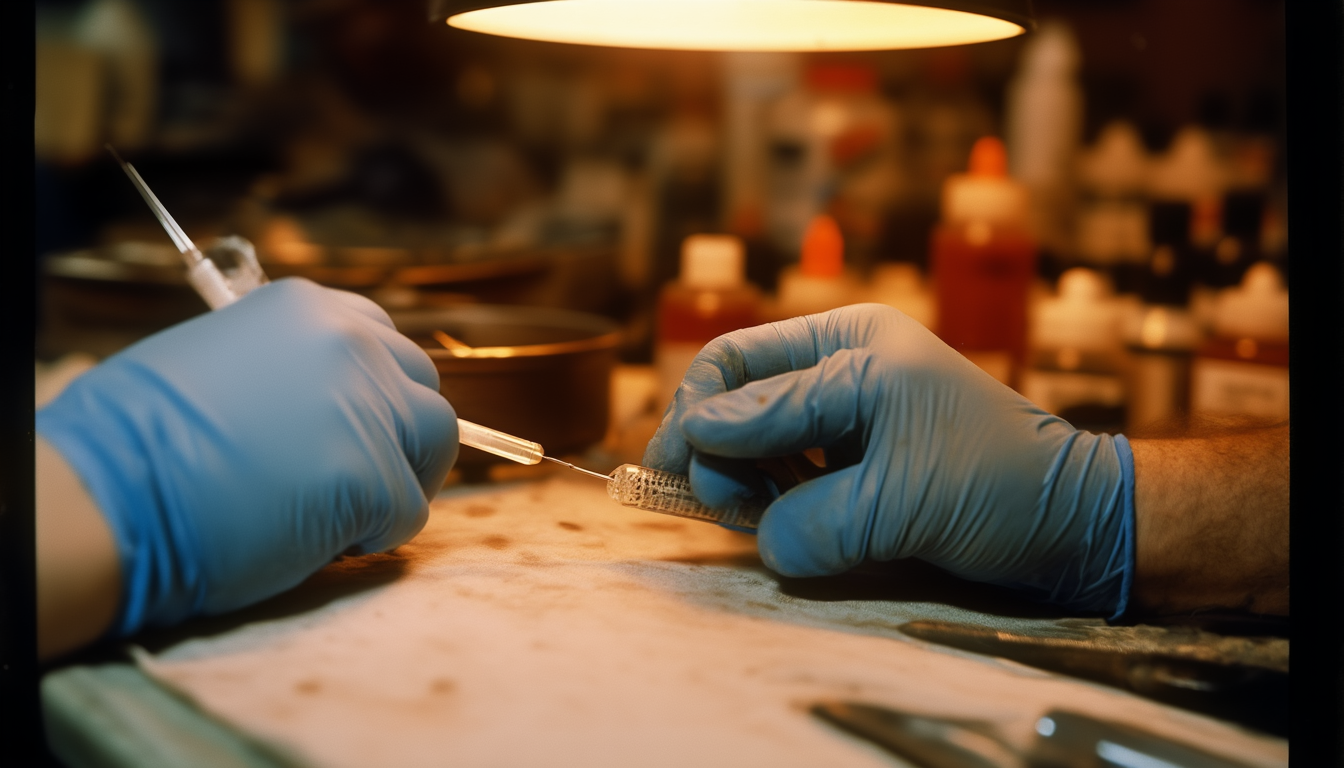
The body was never going to stay a closed system. That was the bet the biohackers made, and from 2036 it looks like the only part they got right. The surprise of the augmentation decade was not that people began installing computers under their skin in tattoo parlors and makerspaces. It was that a movement built on permissionless self-ownership turned out to be the fastest route to losing it.
Call it the open-source body. By the mid-2020s two adjacent subcultures had converged on the same premise: that the human organism is a platform you can read, fork, and modify without asking permission. On one side, the grinders — people implanting magnets, NFC chips, and homemade biosensors. On the other, DIY biologists working in community labs, downloading standardized genetic parts the way programmers pull code. Both treated the body as open infrastructure. The conventional read at the time was that this would democratize enhancement. The opposite happened.
The conventional wisdom
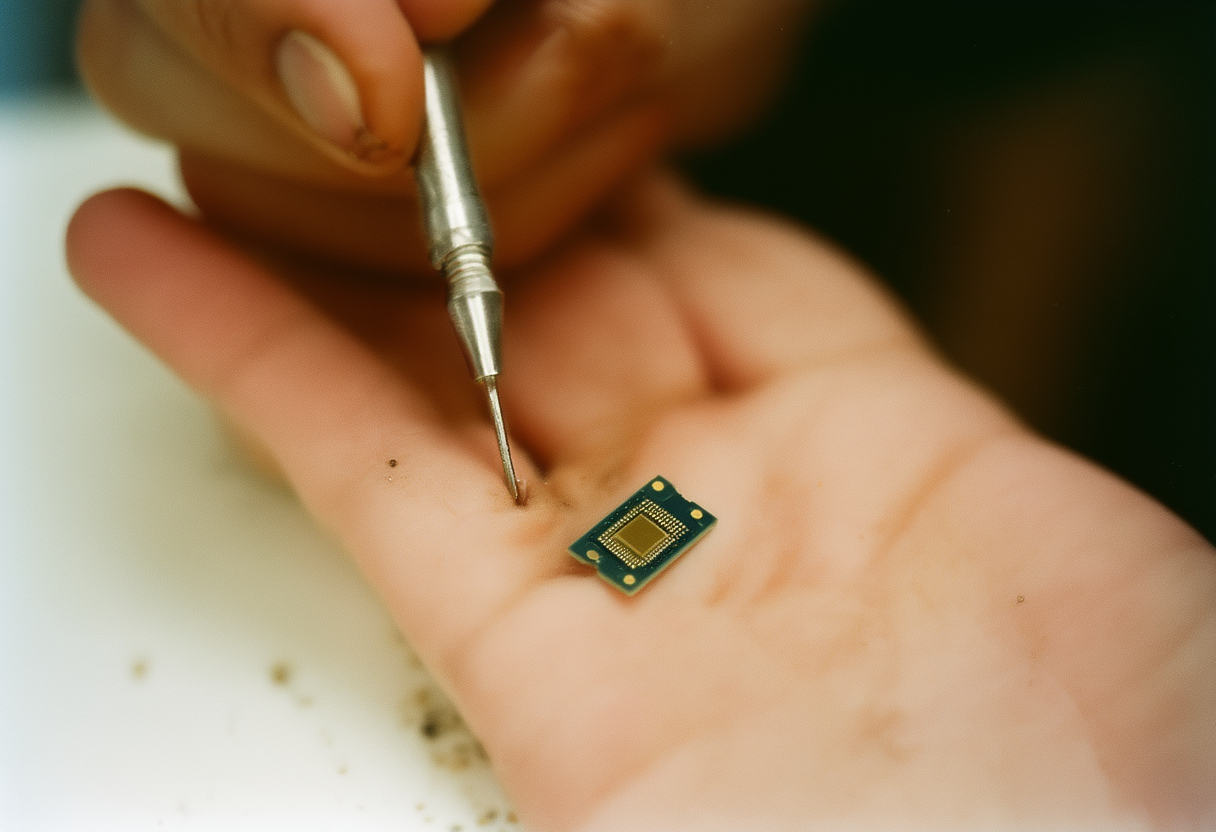
What almost everyone predicted in 2025 was liberation. The tooling was cheap and getting cheaper. An injectable RFID or NFC implant from a vendor like Dangerous Things cost on the order of tens of dollars, and a magnetic fingertip implant ran a few hundred.1 On the biology side, the iGEM Registry of Standard Biological Parts had grown to tens of thousands of catalogued genetic components, free to browse and reuse2 — GitHub for genes, as the slogan went. Genspace, the world's first community biolab, had been open in Brooklyn since 2009, charging roughly a hundred dollars a month for bench access.3 The story wrote itself: enhancement was escaping the university and the corporation, and ordinary people would author their own upgrades.
The forecast was not wrong about access. It was wrong about who access would serve.
Force one: standardization makes a body legible
The first force was the one the movement was proudest of. To share a body part — a chip, a gene, a sensor — you have to standardize it. Standardization is what let a grinder in one city use an implant designed in another, and what let a student drop a fluorescent-protein sequence into bacteria using a documented assembly method.
But standardization does to a body what it does to anything: it makes it legible to outside systems. A standardized implant is one an employer can specify, an insurer can read, and a manufacturer can patent. This is the enhance law of the medium running at full power — the open-source body amplifies how easily a person can be augmented, and in the same motion amplifies how easily that augmentation can be inventoried by someone other than the person wearing it.
The precedent was already on the record. In 2017 a Wisconsin firm, Three Square Market, held a "chip party" where roughly fifty of eighty employees took a voluntary grain-of-rice implant for door access and vending payments.4 Voluntary was the operative word, and the word that does not survive contact with a labor market.
Force two: openness eats its own quality control
The second force was subtler and showed up first in biology. Open registries grow faster than anyone can vet them. When a 2024 study put 301 BioBrick plasmids through controlled testing, it found that 19.6 percent imposed a measurable burden on their host cells, depleting the cell's limited resources and slowing its growth.5 Roughly one part in five misbehaved — a defect rate no closed lab would ship.
This is the obsolesce law, aimed inward. The open commons was built to obsolesce the gatekeeper. But unvetted abundance forces the gatekeeper back in through the side door: professional, characterized parts on one side, chaotic free ones on the other. The same split was visible in regulation. The International Gene Synthesis Consortium screened DNA orders for dangerous sequences, but its members covered only about 80 percent of global synthesis capacity — leaving a fifth of the world's gene-printing unscreened.6 Openness had quietly retrieved the very thing it set out to abolish: a tiered system, curated for those who can pay, unverified for everyone else.
The reversal
Here is where the medium flips into its opposite, and it is the part the early enthusiasts least wanted to see.
A capability that gives a competitive edge does not stay optional. It is a pattern with a long record: the smartphone went from luxury to job requirement inside a decade; email went from novelty to the basic infrastructure of employment. Augmentation followed the same arc — except the hardware is permanent and lives in your hand.7
So the reversal is this. The open-source body, sold as the ultimate act of self-ownership, became the mechanism by which self-ownership was revoked. Once enough workers carry an implant that authenticates faster, senses an electrical fault by touch, or logs attendance without a badge, the unaugmented worker is not free. They are simply slower, and "optional" curdles into "unemployable without one." The body that was a platform you controlled becomes a platform that controls for you.
The cruelest turn is definitional. The "natural" body gets reclassified as the deficient one — not by any medical diagnosis, but by competitive arithmetic. You are not sick. You are merely unmodified in a workplace that priced modification into the baseline. The grinder ethos held that pain was the price of autonomy. The reversal sends the bill to people who never wanted the surgery, and stamps it a condition of employment.
By 2036 this is the live argument, not a settled outcome — and the speculative half of it is exactly the half still being fought over. The market for human augmentation was already large and growing — market researchers were sizing it in the hundreds of billions of dollars by the mid-2020s and projecting that figure to roughly double within a decade.8 Money compounds, and so does neural adaptation: someone with fifteen years of magnetic sensing has reorganized their cognition around an input a latecomer cannot replicate by installing the same chip on a Tuesday. The gap, if it hardens, is not the kind redistribution easily closes. You can tax income. You cannot tax a decade of rewired perception back into parity.
The lesson
There is a durable principle in the wreckage, and it is older than the technology. Any capability that confers advantage will eventually be required, and any standard open enough to share a body part is open enough to mandate one. The grinders were right that the body is a platform. They were wrong about who writes to it. A tool built to let you author your own enhancement is, by construction, a tool that lets someone else specify it — and the difference between liberation and obligation was never in the implant. It was in who held the requirement.

Author's Note: This is speculative journalism written from a 2036 vantage, extrapolating from real technologies, companies, market figures, and studies documented through 2025. The trajectory described — voluntary augmentation hardening into workplace obligation — is one plausible path, offered as a caution rather than a forecast. Every present-day claim below is sourced; the 2036 framing and outcomes are deliberately speculative.