
When Your Biology Becomes Someone Else's Property
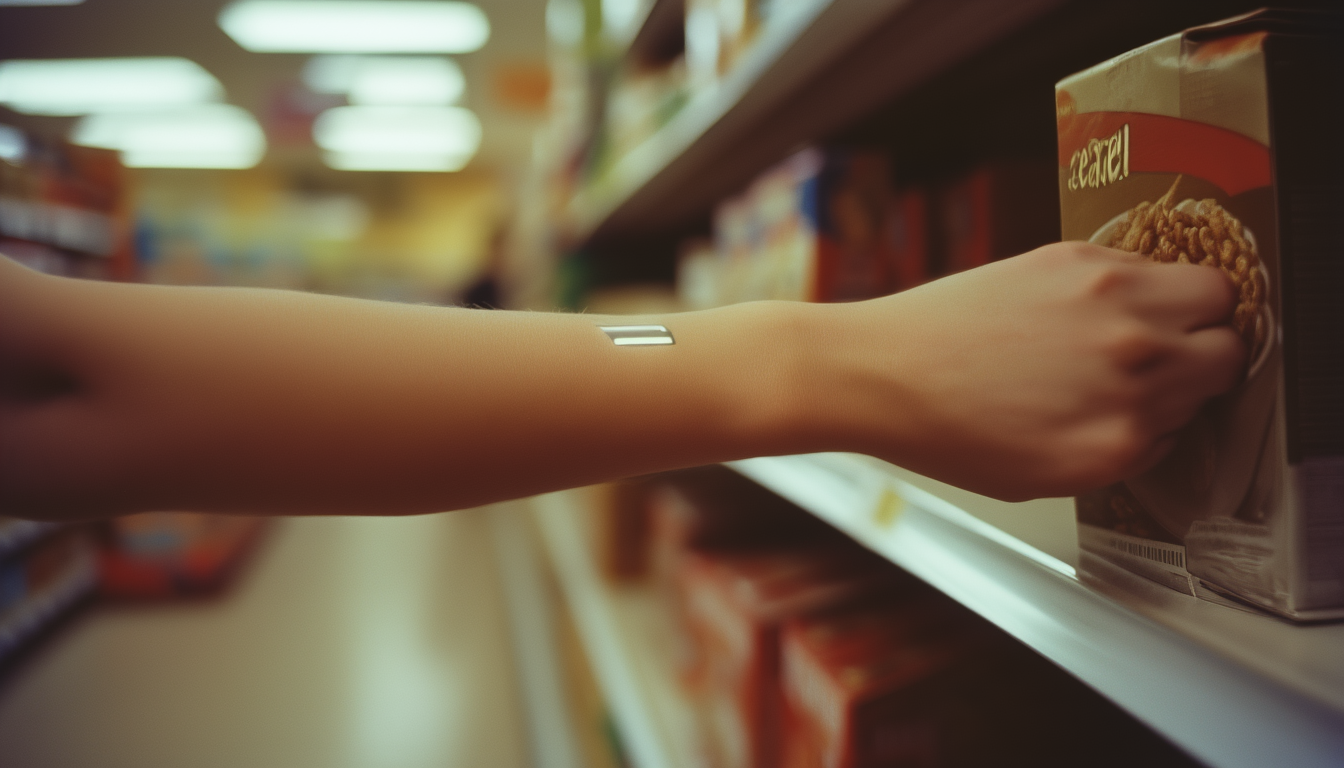
Priya Sandoval feels the reminder before she reads it — a soft double-pulse against her wrist, the same buzz that used to mean a text from her mother. It is a Tuesday in March 2036, and she is standing in the cereal aisle of a grocery store in Sacramento, holding a box she can no longer quite justify. The notification is from her cell line. Reprogramming maintenance due in 6 days. Lapse in coverage may accelerate biological aging. She is forty-one. By the readouts on her wrist, her tissues are closer to thirty. She has been thirty, more or less, for three years now, and the bill comes every quarter, and she pays it the way she pays for anything she's afraid to live without.
This is the part nobody put on the brochure. When the longevity boom began, back around 2025, it sold itself as liberation — from disease, from decline, from the countdown. And the science was real. That was never the trick. The trick was what owning the science would come to mean.
The cures were not the lie
Start with the thing that actually worked, because it did. In February 2025, doctors at Children's Hospital of Philadelphia treated an infant — known publicly only as Baby KJ — born with a urea-cycle disorder so rare it barely had a name.1 His body couldn't clear ammonia; it was poisoning his brain. There was no drug for him because the disease was, in effect, his alone. So a team built one. A bespoke gene-editing therapy, designed and manufactured in roughly six months for a single child, threaded into his cells.1 He lived. It was the first time medicine had been written to order for one human being.
Around the same time, the first CRISPR medicine to clear the FDA — Casgevy, approved in late 2023 for sickle cell disease and beta thalassemia — was curing people of conditions that had defined their entire lives.2 The results were, in the careful language of the field, dramatic and durable. The catch was the number on the invoice: roughly $2.2 million for a course of Casgevy, and about $3.1 million for its rival, Lyfgenia.2 More than most people earn in a lifetime, to correct a typo in a gene that was never their fault.
The cure was not the lie. The price was the tell.

The reset button — and the subscription behind it
The deeper magic arrived from aging research itself. By the mid-2020s, scientists had shown they could not just slow aging but partly reverse it. Using a trio of Yamanaka factors — Oct4, Sox2, Klf4 — to wipe away the chemical marks that accumulate on DNA over a lifetime, researchers reprogrammed the cells of very old mice and extended their remaining lifespan by about 109 percent, while frailty scores improved.3 The animals didn't just last longer. They got younger. David Sinclair's lab at Harvard pushed the idea further, arguing that aging is driven by the loss of epigenetic information — not permanent damage to the genetic code — and that restoring that information could turn the signs of aging back.4 Aging written in pencil, with an eraser finally found.
By early 2026 it reached people. Life Biosciences received FDA clearance to begin a human trial of its reprogramming therapy, ER-100, and dosed its first patient that June — aimed, at first, at restoring sight in optic-nerve disease.5 A narrow start. But everyone in the room understood what a working reset button was worth.
Here is what those of us watching from 2036 can say that the 2025 press releases could not. The reset is not a one-time repair. It is a standing relationship. Once your biology is tuned by intervention, it expects the next intervention. Skip a maintenance cycle and the readouts drift the wrong way. The most successful longevity product of this decade turned out not to be a cure at all. It was a recurring charge — the thing buzzing against Priya's wrist in the cereal aisle.
The grandmother was right; the venture capital was new
Not all of it was exotic. Some of the most durable findings were almost humble. A national review of anti-aging compounds singled out rapamycin — first pulled from soil bacteria on Easter Island — as among the most reliable, extending lifespan by up to 28 percent in animals even when started in middle age, at a couple of dollars a tablet.6 At Emory, psilocybin, of all things, extended the lifespan of human cells by more than half in the lab and raised survival in aged mice by about 30 percent.7 At Scripps, researchers let an AI pick anti-aging candidates, and more than 70 percent of its picks lengthened life in worms.8
And the gut. María Branyas Morera, who lived to 117, turned out to carry a microbiome as diverse as a much younger person's, rich in the Bifidobacterium that usually fades with age — sustained, in part, by a daily habit of yogurt and a Mediterranean diet.9 Cutting-edge microbiome engineering, in the end, was mostly an expensive way of rediscovering fermentation: kefir, kimchi, sauerkraut, now with sensors. Your grandmother's gut advice was right. It just took half a billion in venture capital to patent it.
The turn
This is where the promise inverts. A technology sold as freedom from the countdown became, at scale, a new kind of leash — and a new kind of ledger.
When the basic cures cost millions and the maintenance never ends, biology starts behaving like wealth: it compounds for those who already have it. By the early 2030s the stratification was visible. People who could afford continuous reprogramming worked longer and tired less. Insurers began asking for the readouts. Some employers, quietly, began to prefer the well-maintained. None of it required a villain. It only required a price and a renewal date.
And then the cruelest twist, the one the optimization sellers never priced in: pushed far enough, the engineering reverses on itself. A body kept in permanent factory condition can lose the rough resilience that came from simply being weathered and various. The most expensively optimized person may be the most narrowly tuned — and the most exposed when something genuinely new arrives. The promise was more life. Carried to its limit, for the people who can least afford to stop, it curdles into dependency: not the conquest of decline, but a subscription to the fear of it.
Priya, six days out
Priya pays the bill. Of course she does. She taps the box of cereal back onto the shelf — small economies, the kind you make when the big charge is non-negotiable — and authorizes the maintenance with a thumbprint against her wrist. The pulse stops. The readout settles. Thirty again, for another quarter.
She is healthier than her mother was at this age, and her mother is healthier than her mother was, and none of that is fiction or even ingratitude. The science delivered. What it didn't deliver was ownership. Somewhere there is a company that holds the patent on the version of Priya that is thirty, and renews it to her four times a year, and she has organized her life around never finding out what happens if she lets it lapse.
The race to hack death was won, more or less. We just forgot to ask who would hold the title to the result.
Author's Note: This is speculative journalism, written from an imagined 2036. Priya Sandoval is a fictional composite; the future around her — the subscriptions, the readouts, the caste lines — is one possible trajectory, not a forecast. Everything attributed to the actual 2023–2026 record is real and sourced below: the therapies, the trials, the prices, the studies. Where the piece imagines how those facts play out over the next decade, it says so. The science is documented. The dystopia is a warning, not a prediction.
The Tetrad Enhances: the ability to repair, reset, and extend the living body — real cures, real age reversal in the lab. Obsolesces: the fixed human lifespan and the idea that decline is simply fate. Retrieves: the ancient bargain of the body as property — now you can lease your own biology by the quarter. Reverses into: a tool sold as freedom from the countdown becomes a subscription to it — dependency, debt, and a biological caste, with the most optimized the most fragile.