
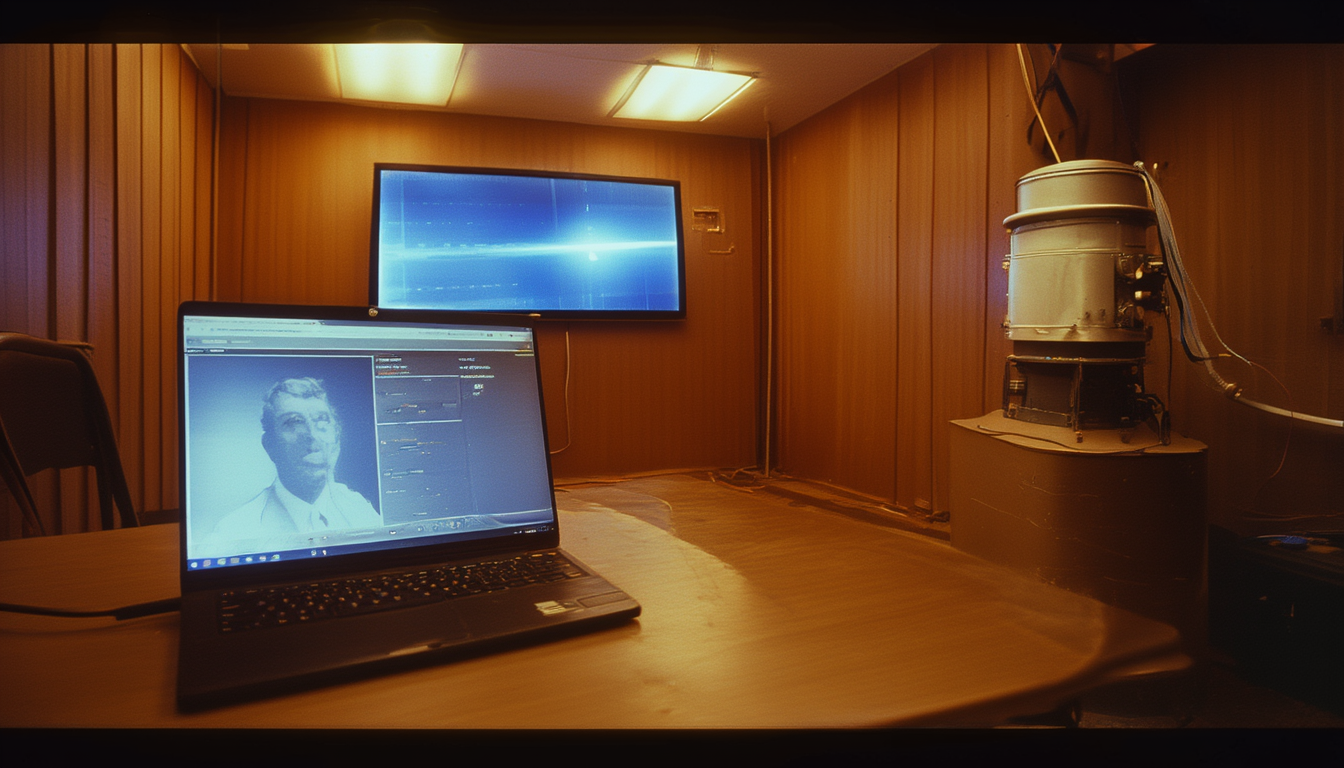
The engine sat in a clean room in Pasadena, humming, and Mara Sandoval knew it wasn't moving anything.
She was the one who ran the solver. On the wall screen a lattice of numbers folded into a smooth blue shell, a pocket of flat space wrapped in curved space, exactly the shape the founders had promised the venture partners on the call. In the next room the hardware waited behind glass: a shielded cavity the size of a microwave, a rack of processors, a cryo line breathing fog onto the floor. The pitch deck called it the Spacetime Distortion Engine. Mara called it the box, because that was closer to true.
"Give me the field," the founder said, on speaker, for the benefit of an investor in Singapore.
Mara pressed a key. The shell on the screen tightened. The number that mattered, the one nobody on the call watched, held steady near the bottom of the frame. Subluminal. Slower than light. It always had been.
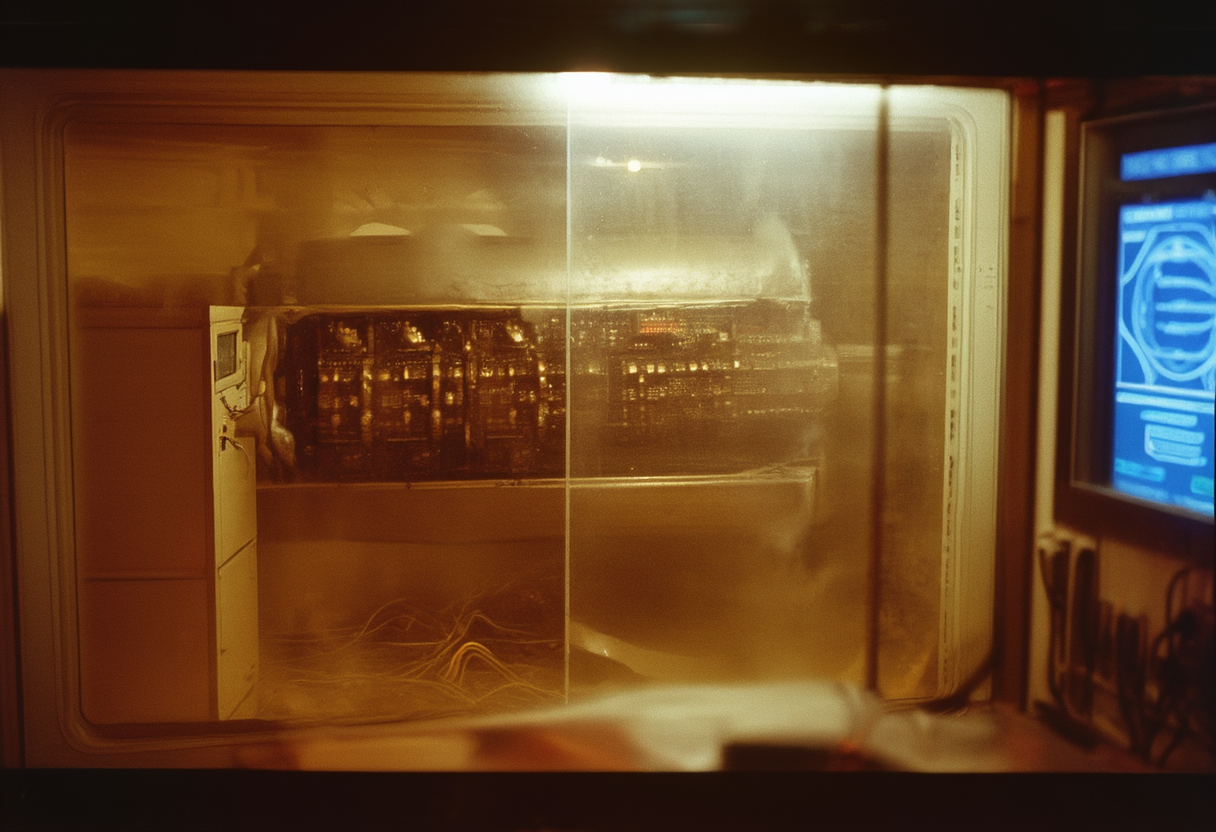
Figure 1. A "spacetime distortion engine" on display at a Pasadena propulsion startup, 2034. The hardware cools a nanoscale cavity and runs a metric solver. The warp field exists only in the software.
The promise
In 1994 a Mexican physicist named Miguel Alcubierre wrote down a solution to Einstein's equations that let a ship cross space faster than light without ever breaking the cosmic speed limit where it sat. You didn't move through space. You moved space. Spacetime would contract ahead of the ship and stretch behind it, and you would ride the flat bubble in the middle. It was elegant, and it was in a real journal.1 For a generation, "warp drive" meant that picture.
There was a catch, and Alcubierre named it himself. To bend space that way you needed exotic matter: stuff with negative energy density, a kind of anti-gravity fuel that no one had ever held.1
The mechanism
For decades the catch looked fatal. In 1997 Michael Pfenning and Lawrence Ford ran the bubble through the quantum rules that limit negative energy. They found the bubble wall would have to be only a few hundred Planck lengths thick, and the negative energy required would run to something near the mass of the visible universe. They called the drive unphysical, and for a while that was the last word.2 Negative energy is real, but the universe hands it out in slivers, never in tanks.3
Then, around 2021, the story turned hopeful again. Alexey Bobrick and Gianni Martire, working under a research group called Applied Physics, stopped trying to build Alcubierre's exact bubble. Instead they defined warp drives as a whole family of shapes: a calm region for passengers, wrapped in a shell of curved space. Inside that family they found something new. A warp shell that moves slower than light can be built from ordinary, positive-energy matter. No exotic fuel required.4 In 2024 the same circle published a fully worked example: a warp bubble that holds a steady speed and obeys every classical energy condition, powered by a plain shell of positive mass.5
The headlines wrote themselves. Warp drive, no exotic matter needed. The word doing the quiet work in those stories was subluminal, meaning slower than light. The honest version went like this. The math now allows a bubble of bent space to carry you along, as long as you never try to beat a photon, and as long as you can supply energy on the order of a planet's worth of mass to move something a few meters wide.6 It is a real result, but it is not a road to the stars, and it is certainly not an engine. A metric is only a mathematical description of a spacetime, not a machine, and no one has yet built the machine that description would require.
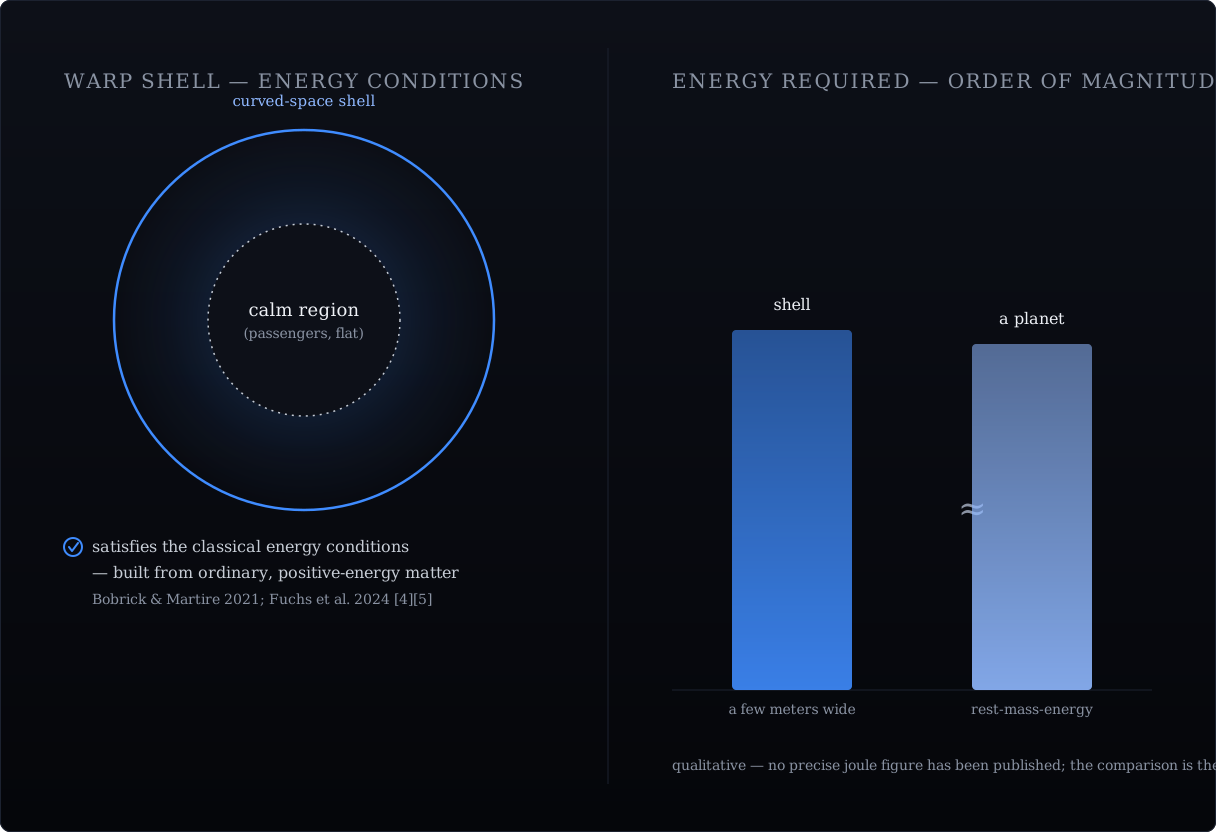
Figure 2. A warp-metric solver's output, 2036. On the left, a shell that obeys the energy conditions. On the right, the energy it would demand, measured against a planet's mass.
The turn
Here is where it bent. The subluminal breakthroughs were genuine physics, and they were also perfect fuel for a different kind of engine: the kind that turns a footnote into a countdown. Strip the word subluminal, add a render, and a careful, modest result becomes an imminent revolution you can raise money against.
The experimental part, in most of these rooms, amounted to a nanoscale trick. In 2021 a NASA-linked team led by Harold White reported that a custom Casimir cavity, modeled entirely on a computer, produced a microscopic well of negative energy whose shape happened to resemble the warp metric.7 It was a resemblance, appearing inside a simulation, at the scale of a billionth of a meter. Not a warp field. Not a bubble. That distinction did not survive the retelling.
The physicists pushed back. When some researchers claimed positive-energy drives that could still beat light, Jessica Santiago, Sebastian Schuster, and Matt Visser showed that any realistic warp drive breaks the null energy condition, which drags negative energy right back into the picture.8 The loudest faster-than-light claim, Erik Lentz's 2021 soliton, stayed contested.9 The careful voices lived in the journals. The countdown lived in the pitch decks.
So who won. The theorists got a real research program and more than a decade of funding. The startups got renders and term sheets. Defense-adjacent money got a moonshot to point at. And who paid. Graduate students who chased a mirage into a dead end. Public trust, spent one "breakthrough" headline at a time. The honest physicists, whose every caveat got sanded off before the story reached anyone's phone.
Return
Mara stayed after the call, in the blue light of the solver. She believed in the box, more or less. The geometry on her screen was true. Somewhere in it sat a real discovery, a proof that spacetime could, in principle, be shaped to carry a body gently through it. She also knew what the box could do in 2036, which was hum, hold a nanoscale cavity cold, and produce a number that never once climbed toward the speed of light. The engine ran. It just didn't go anywhere. What moved was the money, and the belief, and her own next contract.
The unresolved part is not whether the math is beautiful. It is. The question is whether a description of a spacetime can ever cross the distance to a working drive, when the fuel it wants has never been made and the energy it needs is measured in planets. That gap has not closed since 1994. By 2036 it has a research budget, a startup sector, and a name that sounds like it already exists.
Author's Note. This is speculative journalism written from an imagined 2036. Mara Sandoval, her employer, and the Pasadena demo are fictional composites, and no functioning "spacetime distortion engine" exists as of this writing in 2026 or is claimed to exist in 2036. Everything about the underlying physics is real and sourced: the Alcubierre metric and its exotic-matter requirement, the quantum limits on negative energy, the 2021 and 2024 subluminal "physical warp drive" solutions, the 2021 Casimir-cavity modeling result, and the energy-condition critiques. The line to hold is the one the field keeps blurring: a self-consistent equation is not an engine, and every solution that respects known physics is slower than light.