
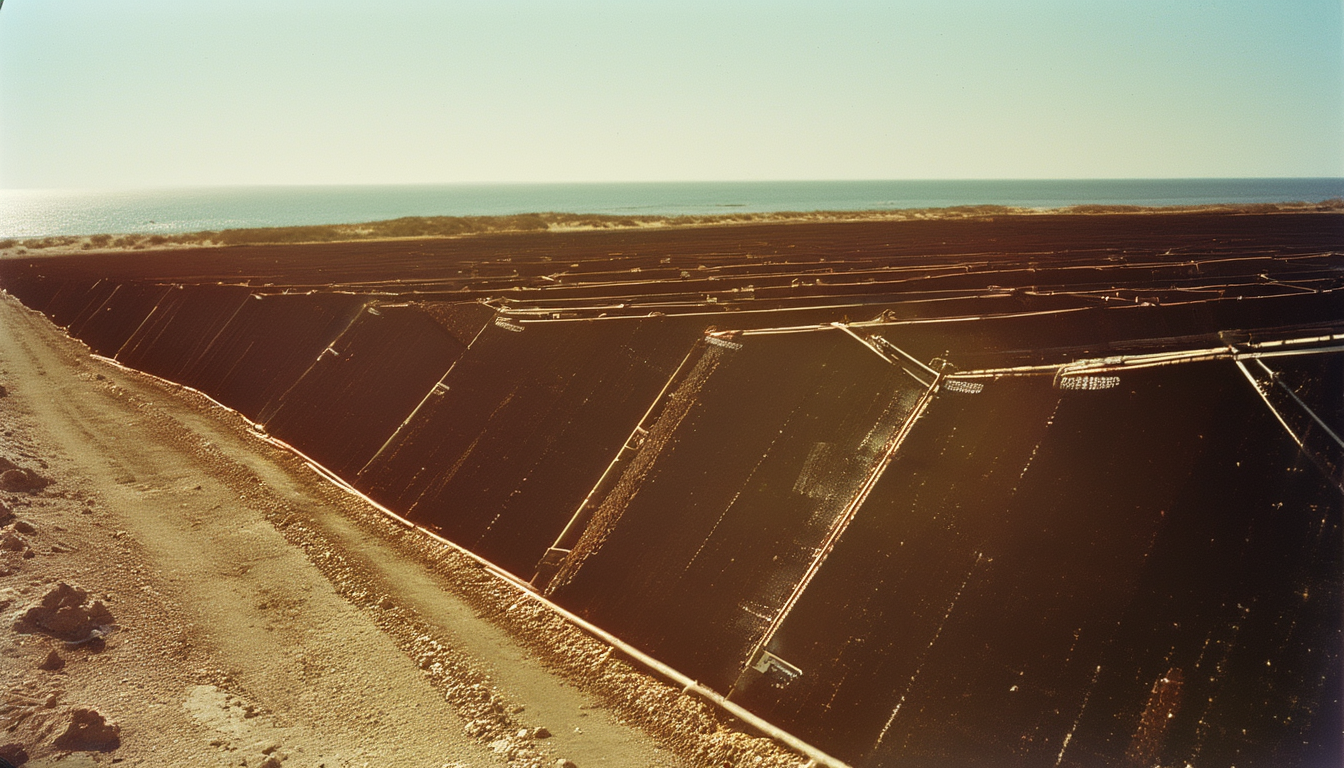
I read the 2026 result as an environmental story, and I was wrong for a decade. A lab at the University of Rochester etched black metal with a femtosecond laser until the surface drank a thin film of seawater, boiled it off as clean vapor and pushed the salt out to its margins, with no membranes, no pumps and no toxic plume.1
I saw a coastline stop being poisoned. I should have seen an inventory notice, because a machine that stops making waste has started making stock, and stock gets priced. The water was never the point.
What a passive panel promised
The case for reading this as a water story deserves full strength before anyone takes it apart. Reverse osmosis, the membrane process behind most of the world's desalination, is not merely dirty, it is infrastructural. Pumps require a dependable grid, membranes require a supply chain and technicians, and capital at that scale requires a utility or a sovereign fund, so plants land where money and grid already sit. The wicking panel deleted all three. No pumps, no grid. No membranes, no consumables. Sunlight on a sheet of etched metal, and the unit cost slides toward the price of the metal.
The energy line said it louder. The global fleet burned something like 100 terawatt-hours a year to make its water, a cost that grows with every plant added and that only a state carries comfortably.34 A passive panel has no such line: whatever it costs to build, it costs close to nothing to run.
Now point that at the population it was for. In 2024, 2.1 billion people, one in four humans alive, lacked safely managed drinking water, and 106 million were drinking straight from untreated surface sources.5 That second number still makes me angry, because those 106 million are not waiting on a discovery. They are waiting on a delivery form. A device running on sunlight that needs nothing replaced was aimed straight at that gap. That concedes a great deal, and I want to be plain about it. Reporters called the result the end of desalination's dirty secret, and on the evidence then available that was a fair reading.2 So was mine.
The villain everyone agreed on
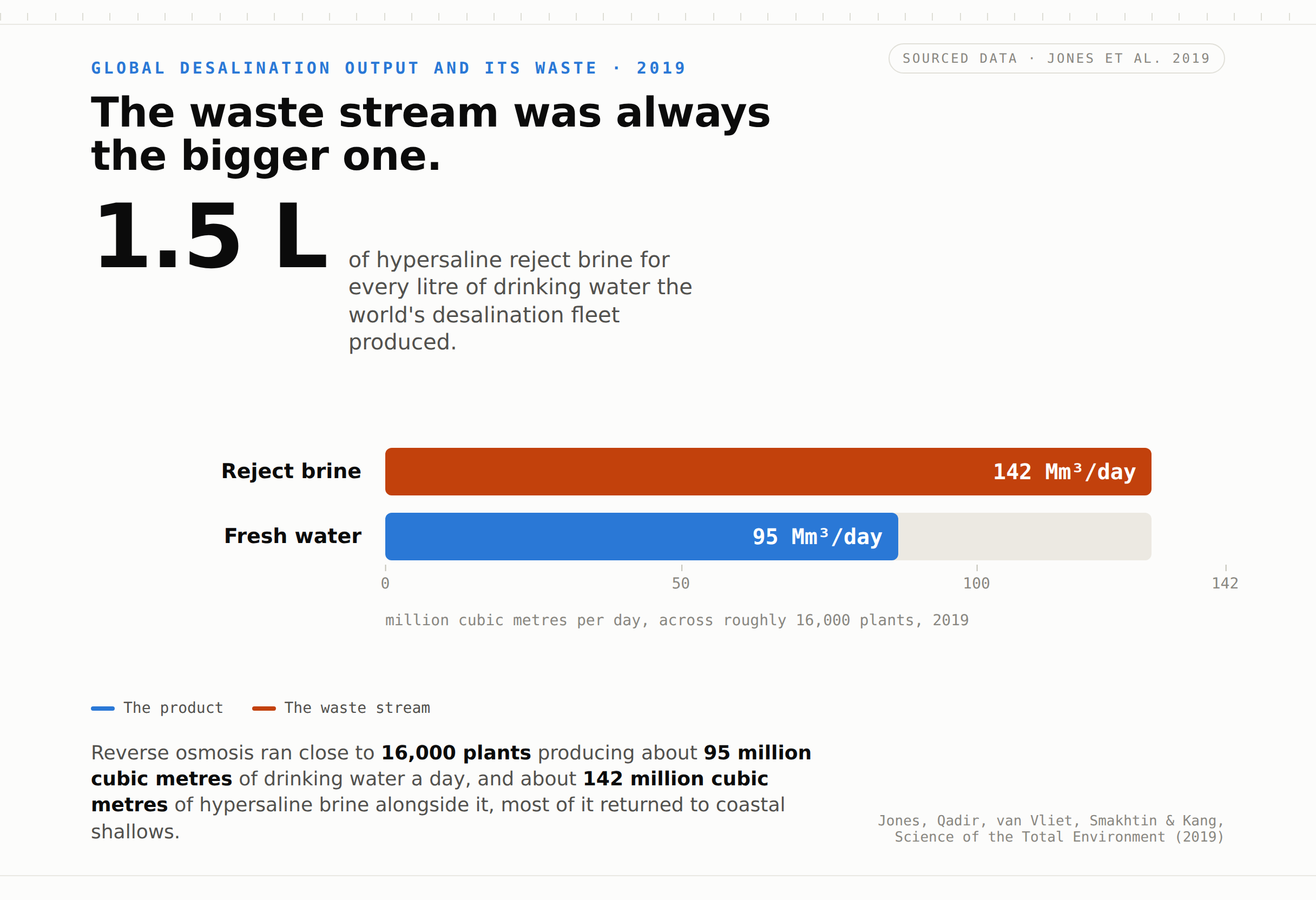
For thirty years the bad guy was easy to name. Reverse osmosis ran the world's desalination fleet, close to 16,000 plants pushing about 95 million cubic meters of drinking water a day, and it was filthy at the back end. Every liter of fresh water came with roughly 1.5 liters of hypersaline brine, about 142 million cubic meters a day worldwide, most of it poured back into coastal shallows where it sank and smothered the seabed.34 Solve the brine and you solve desalination. That was the entire logic of the field, and it was not a foolish one.
What the Rochester panel actually beat was not salt in general, it was the clog. Seawater is not salt water, it is a chemistry set. Sodium chloride behaves, but magnesium sulfate and calcium carbonate crystallize in awkward shapes that foul an evaporator until it stops evaporating.6
The fix was geometry, and it is the best part of the paper. A femtosecond laser fires pulses lasting a few quadrillionths of a second, brief enough to carve metal without melting the metal around the cut, and the lab used it to shape structures too small to see. Size those structures correctly and water climbs the surface faster than the awkward minerals can lock up, so the crystals form where you send them, out on the pale untreated margins, while the dark working zone stays wet and stays hot.1 The panel does not fight the scale, it walks the scale to the rim and leaves it standing there in the sun.
The goal was not fringe, either. Zero liquid discharge, the target of returning nothing at all to the sea, had been an active line of research in interfacial solar evaporation for years beforehand, that being the trick of heating only the thin surface layer where evaporation actually happens instead of the whole tank.9 The 2026 panel was the version that finally cleared the clog, which is exactly why it read like an ending. Quiet, and clever.
Then came the second paper
The result that mattered most got a fraction of the coverage. In a companion study, the same group seeded the panel's grooves with hydrogen titanate nanoparticles and showed the surface would do more than reject salt. It would sort it, drawing lithium away from the other minerals as the brine dried.7 The leftover stopped being waste the moment it stopped being a mixture, and an unmixed mineral is not residue but ore.
None of that was speculative even then. Reject brine from coastal plants was already being pitched as a lithium feedstock, with pilots running in Japan and along the Chilean coast and techno-economic assessments arguing the case in print.8 What the panel added was co-location: one surface, one input, two products walking off it in opposite directions. Fresh water sold for pennies a liter, and lithium did not.
Think about what that does to a spreadsheet. Under reverse osmosis, brine is a disposal cost, a permit and an outfall pipe and a monitoring obligation, a line that only ever subtracts. Turn the surface into a sorter and the same 1.5 liters per liter moves to the top of the model as feedstock. Two revenue lines also change who lends. A water plant borrows against a tariff a municipality sets, a mineral operation borrows against a commodity price the world sets, and the second raises money the first never could. Nothing about the sea itself changed, only the column the brine was written into, and the column decides where the shovel goes.
The 2026 work looked like the end of desalination's waste problem and it was the start of something else entirely. We call these arrays mineral rigs now, which is retrospective naming, since nobody used the phrase in 2026. The words were already loaded in the chamber, sitting in the discussion section of a materials paper that most water reporters, myself included, skimmed. The brine had a price.
What the money optimized
Give an industry a machine that turns its waste into treasure and it will optimize for the treasure. That is not cynicism, it is arithmetic about returns.
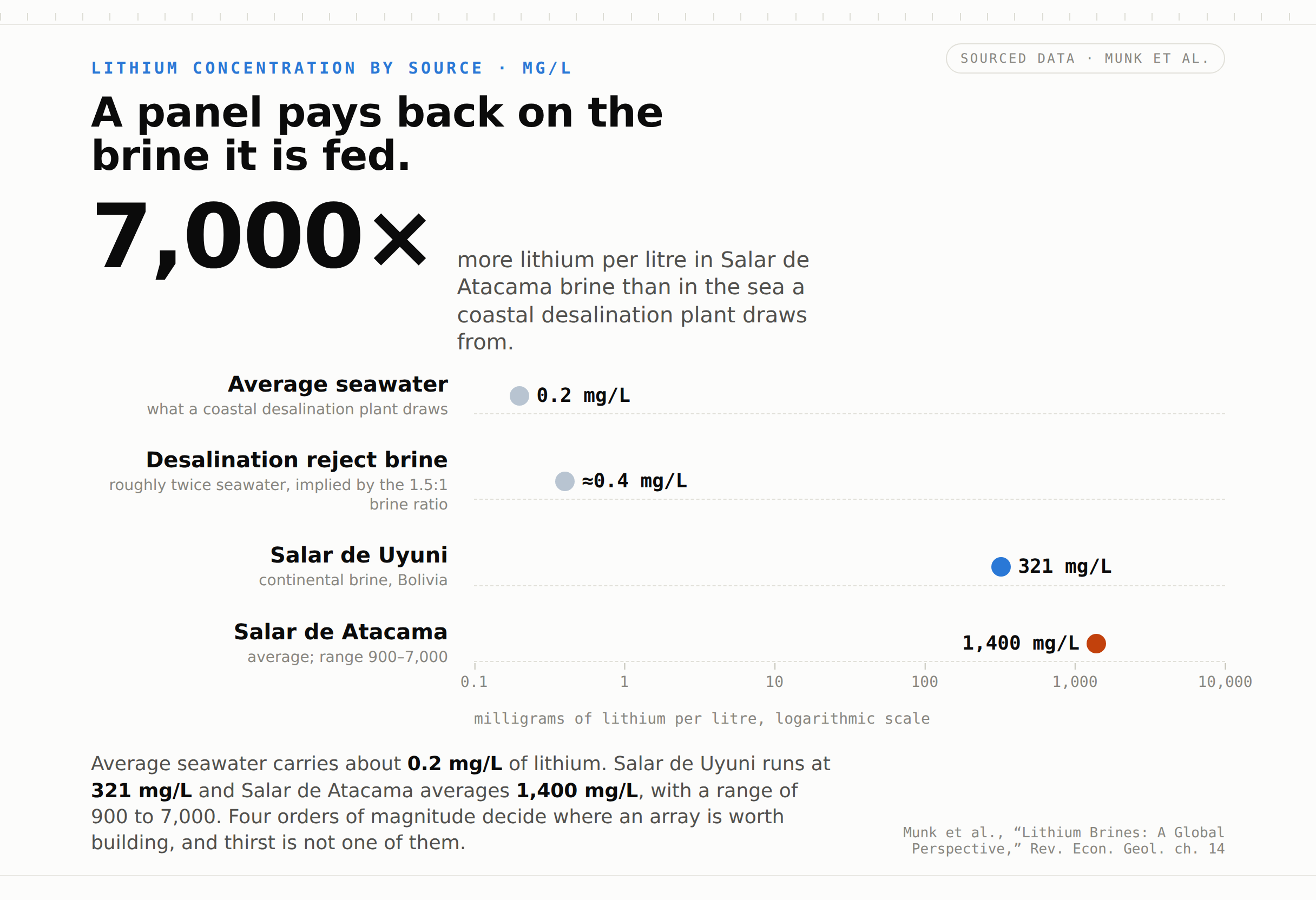
Through the 2030s the arrays went up where the brine chemistry paid best rather than where the taps ran dry. Figure 3 shows the gradient that makes that decision for you: ordinary seawater sits four orders of magnitude below the richest continental brines, and an array pays back on whatever it is fed. A coast rich in lithium drew capital, engineers, road access and a water plant nobody there had asked for. A coast rich only in thirst drew a pilot and a photograph.
Here is the part I filed in the wrong drawer for ten years. Four things were sitting in four separate places, and not one of them cited another. An environmental engineering paper counted 142 million cubic meters of daily brine as a pollution problem. A materials journal described a laser-etched surface that sorts metals. A battery supply chain literature hunted for lithium outside the existing producers. A health bulletin counted the people without safe water. Lay them on one table and the outcome stops looking like a surprise and starts looking like a schedule.
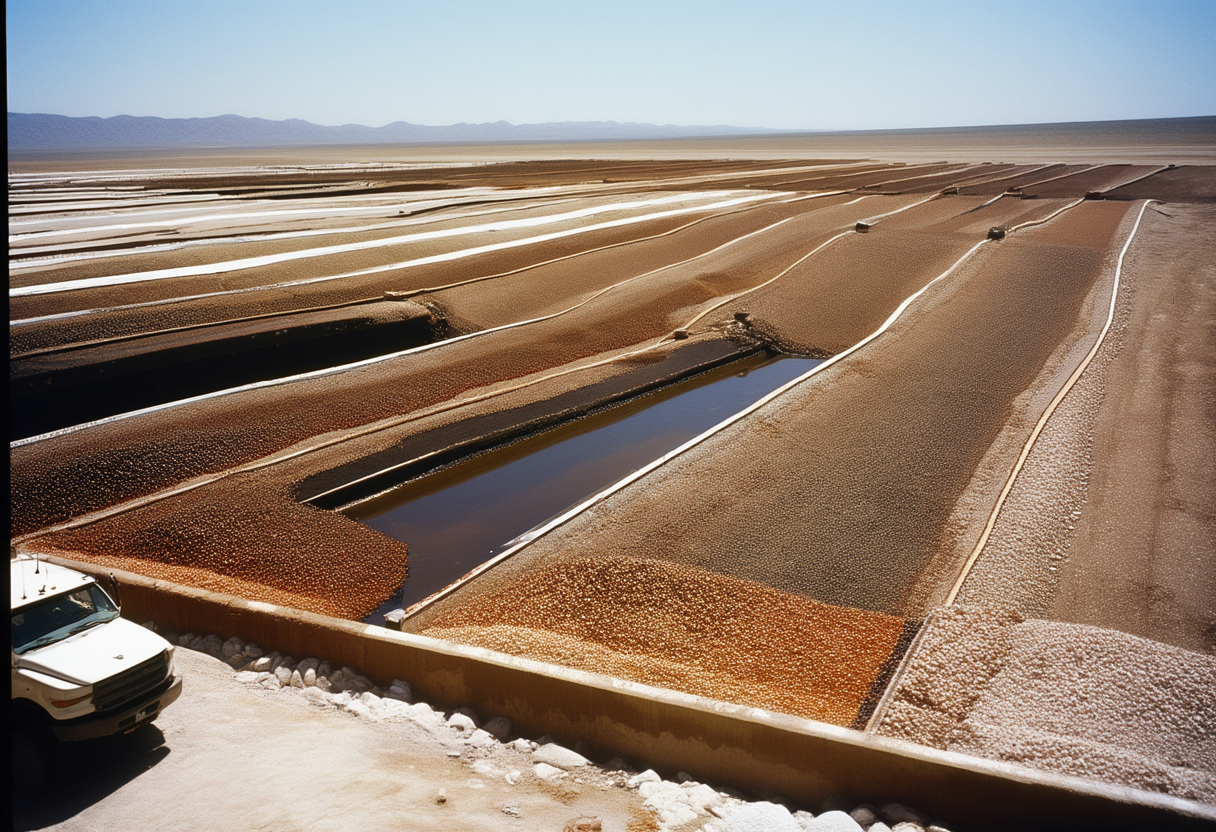
The oldest thing in the story came back too. Long before membranes, coastal towns built fortunes on the saltern, the flat evaporation pan where the sun did all the work and the harvest was whatever the sea left behind. The wicking array is that salt pan with a laser finish and a mineral target, and it inherited the old trade's habit of caring more about the crust than the vapor.
Make the byproduct valuable and the product becomes the byproduct.
Water follows money the way it follows gravity, downhill and reliably, and it did it again. The panel that was supposed to democratize fresh water followed the metal instead.
None of this was a failure of the science. The science did exactly what it said it would do, and the chemistry still stands up in 2036. It was a failure to notice that chemical-free and zero-waste are engineering claims rather than economic ones. A market reads a machine by its most valuable output, never by its most needed one, and once the waste stream carries a price, the waste stream sets the map.
That is the durable lesson and it is cheap to state. A machine serves whoever holds the richest input, not whoever holds the deepest need. We priced the metal.
Author's Note (fact vs. projection). The Rochester super-wicking crystallizer, its salt-margin design and the companion lithium-separation work are real and published as of 2026, cited below. The 2036 arc, arrays sited for mineral yield with water as the loss-leader, is a reasoned projection from the technology's economics and the existing brine-to-lithium pilots. It is argument, not reporting. Figure 2 illustrates that projection rather than a real site; Figure 3's concentration data are real and sourced, but the siting outcome it is framed against is projected. No composite characters appear here. The correspondent's first person marks the difference between what was knowable in 2026 and what is obvious from 2036; it records changes of mind, not events.