
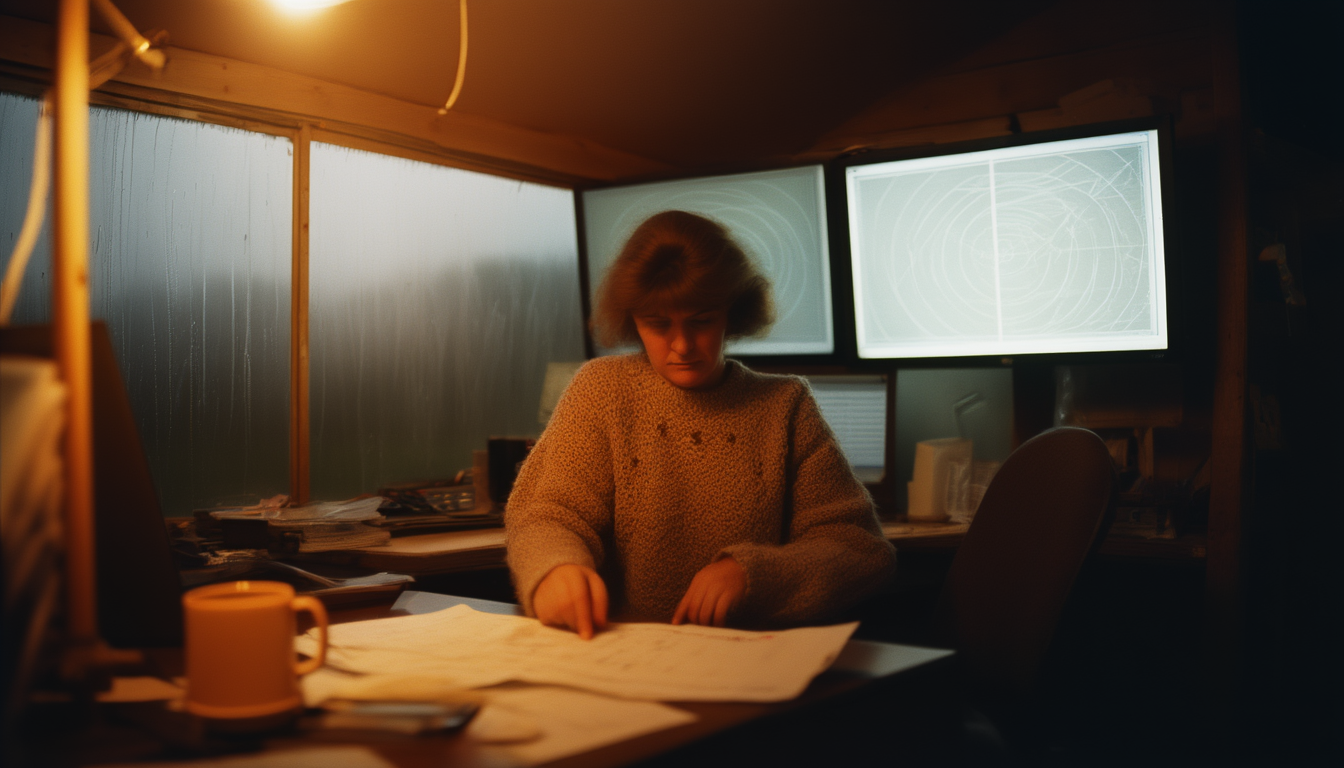
The attestation is one page long, and Nell Orvik has been looking at it for eleven minutes.
It sits on a screen in a converted equipment shed off the Sterling Highway in Soldotna, Alaska, on a warm morning in October 2036. Outside, the rain is doing what rain does here. Inside, Nell is deciding how much of it counted.
The document is a precipitation attestation. A header, a polygon over the western flank of the Kenai Mountains, a three-hour window, one figure in acre-feet. An acre-foot is what it takes to put a foot of water over an acre of ground, about 326,000 gallons. That figure gets multiplied by a contract rate and becomes an invoice.
Nell signs it, which means she is the one who is wrong if it is wrong.
"The physics is the boring part," she says. "The physics has been settled since the nineteen forties. What I do is arithmetic with a lawyer reading over my shoulder."
She is fifty-one, and spent nineteen years as a radar technician for the National Weather Service. She talks about the sky the way a mechanic talks about an engine she has had apart. Her title is precipitation auditor. There were four in the state when she started. There are sixty-one now.
The morning that changed the business
On 23 August 2026, a company called Rainmaker flew ten drone sorties over the Kenai Peninsula in three hours, releasing nineteen silver iodide flares, roughly 374 grams, into clouds between 3,500 and 4,300 metres. Its validation report found seven distinct seeding signatures on the Anchorage radar and put the net new precipitation at 45 to 65 acre-feet, mean 57.6.12
Fifty-seven acre-feet is about nineteen million gallons. That is the number that travelled.
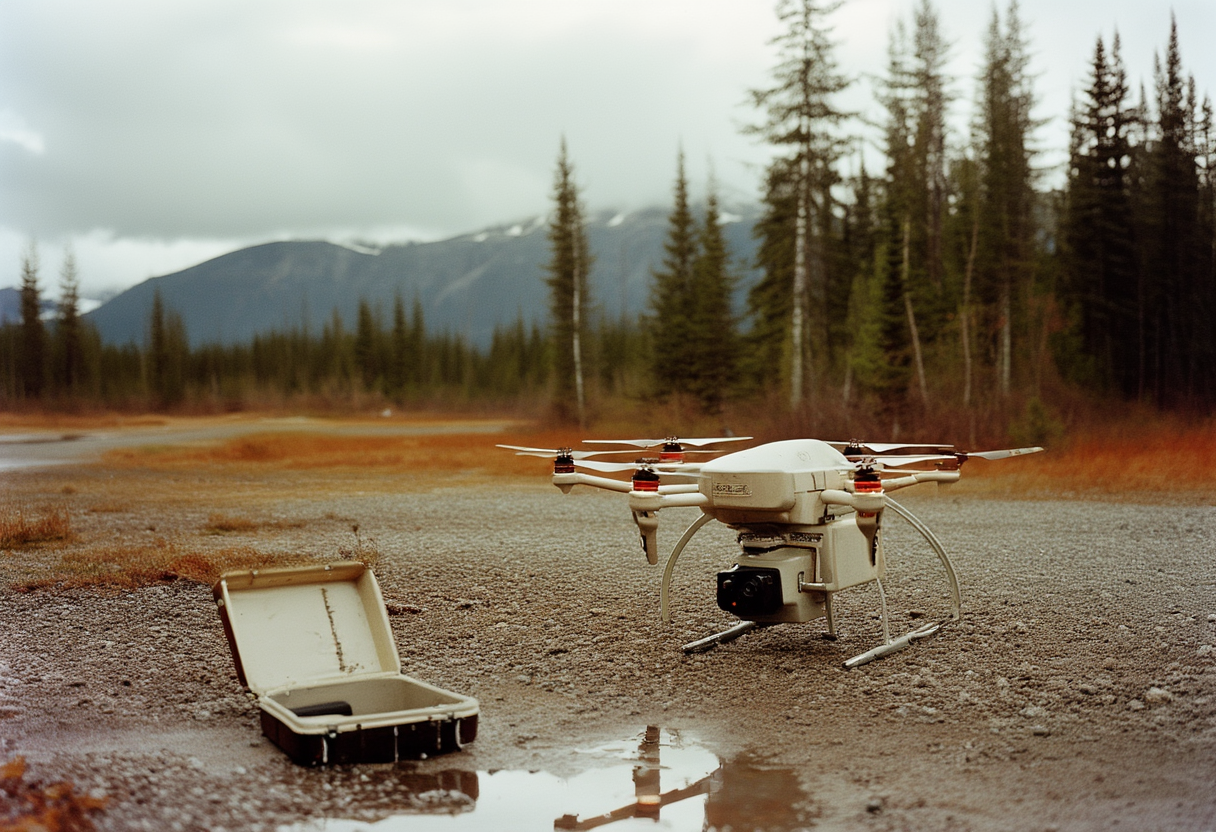
Rainmaker was three years old, based in El Segundo, California, founded by Augustus Doricko, who was twenty-four when he raised his seed round. It had taken $6.3 million in 2024 and a $25 million Series A in 2025 led by Lowercarbon Capital. Its drone is a three-foot quadcopter with heated propellers that de-ice while measuring the liquid water around them.34 Four months before Alaska, it announced 143 million gallons produced for customers in Oregon and Utah, off 82 seeding signatures.5
The public read this as a story about making rain. It was not. Rain had been made, in a small way, for seventy years. What was new was the receipt.
Doricko said as much in the April announcement, calling his the first company in human history to unambiguously measure and validate a cloud seeding operation.5 Strip the superlative and the claim is modest and correct. A volume you can defend on paper is a volume you can sell.
The money understood this before the public did. Lux Capital had been telling anyone who asked that it turns sci-fi into sci-fact.6 The reference text everyone had in hand was Kim Stanley Robinson's 2020 novel about a lethal Indian heat wave around 2025 that kills millions in a fortnight, after which India deploys sunlight-blocking aerosols on its own authority, in public, using its air force.7
The fiction imagined a state doing this at planetary scale to stop people dying. What arrived was a private company doing it at watershed scale for a fee, and an auditor to certify the volume.
What seeding can and cannot do
The mechanism is old and unglamorous. Some clouds hold supercooled liquid water, droplets still liquid below freezing because nothing has offered them a surface to freeze onto. Silver iodide crystals resemble ice closely enough to serve. Ice forms, grows at the expense of the droplets around it, gets heavy, and falls.
In 2017 the SNOWIE campaign over Idaho's Payette Basin isolated three cases with no natural precipitation falling, so anything that fell could be attributed. The seeded snow came to between 0.05 and 0.3 millimetres of liquid equivalent: about 100 acre-feet from twenty minutes of seeding, 275 from twenty-four.8
Those are real numbers, and they are small. The 2024 federal assessment put seasonal gains from cold-season mountain seeding at zero to twenty percent, noted that estimates vary widely for reasons nobody has explained, and stated the binding limit plainly: seeding only works when the right kind of cloud is already there.9
That sentence is the whole shape of the thing. Seeding cannot break a drought, because a drought is the absence of the clouds it needs. It harvests a little more from weather that showed up anyway.
The same arithmetic settles the accusation that has followed the industry since July 2025, when a Rainmaker flight near Runge, Texas preceded catastrophic flooding 125 miles away. The flood delivered on the order of four trillion gallons. The seeding run, at its outside estimate, produced ten million.10 The technology is not powerful enough to be the villain people wanted.
The number that could be owned
Look again at Rainmaker's Alaska report and you find the sentence that built Nell's profession. The 57.6 acre-feet was a mean drawn from a 27-member ensemble, and the full range ran from 41.70 to 89.35 acre-feet.2
That is an uncertainty of better than a factor of two. It is an honest disclosure, and a normal one for radar hydrology. It is also unbillable, because an invoice cannot carry a range. So the mean went on the invoice, and the spread went where spreads go, onto whoever is not holding the contract.
The law was waiting for this. Colorado has claimed, since the middle of the last century, the right to all moisture in the atmosphere that falls or is artificially induced to fall inside its borders, and declared it property of the people of the state.11 Five other states made comparable claims, and by 2021 twenty-three states regulated seeding in some form.12
Federal oversight was never a gate. The 1971 statute and its rules require an operator to file before starting, again while continuing, and at the end, with a maximum penalty of $10,000 for a knowing violation. The rules state outright that a federal notification is neither approval nor disapproval.13 Florida, meanwhile, made weather modification a third-degree felony in 2025, up to five years and a $100,000 fine.14
So by the mid-2030s the map of where rain gets manufactured is not a map of thirst. It is a map of two conditions overlapping: a jurisdiction that permits it, and a party solvent enough to buy an acre-foot. Alaska in 2026 had no general weather-modification statute, which is why ten drone flights over the Kenai needed nobody's permission. The peninsula was not short of water. It was short of objections.
Downwind claims went nowhere, as they had since the 1950s, when Texas ranchers won an injunction against hail-suppression seeding and everyone learned how hard causation is to prove in the sky.15 To show rain fell on a contract holder instead of on you, you must prove your way through the same 41.70-to-89.35 band Nell narrows for a living. Nobody has managed it.
The volumes never mattered hydrologically. On 29 August 2026, Lake Mead hit its lowest level on record, and eight days earlier the Interior Department had finalised cuts of 1.25 million acre-feet a year across the Lower Basin.16 Against a shortfall like that, fifty-seven acre-feet is a rounding error.
But a rounding error you can meter, certify and convey is a commodity. That was the invention. Not water from nothing, but a unit of weather with a name on it.
Back in the shed
Nell narrows the band. Gauge cross-checks, a correction for what evaporates below the radar beam, a hard rule about weak natural precipitation contaminating a polygon. This morning her defensible figure lands under the ensemble mean, and she signs the lower one, which will annoy someone by lunchtime.
She keeps a second column in a file she has never shown anyone. For each attestation it records how much of the spread she actually resolved, and how much she simply picked a point inside. Over eleven years the second category runs a little over half.
"They call me an auditor," she says. "An auditor checks a number against something that happened. I check a number against a distribution."
Outside it is still raining, and none of it is billable, because nobody bought it.
The open question is not whether the drones work. They work, inside limits that are measured, published and narrow. It is what happens the first time a state with a moisture-ownership statute and a serious shortage decides seeding is not a service to be bought but a resource to be allocated. Weather has been metered. Nothing metered stays unrationed for long.
Author's Note
This is speculative journalism written from 2036. Nell Orvik, her Soldotna office, the precipitation-auditor profession and the 2036 scenes are fictional composites. Everything else is real and sourced: Rainmaker's Kenai campaign and its own validation figures, the company's funding and hardware, the SNOWIE results, the 2024 federal assessment, the Colorado moisture statute, the federal reporting rules, Florida's ban, the 1950s Texas litigation, and the August 2026 Colorado River decisions. Company claims are labelled as such.