

Sofia Martinez watches the number settle. EUAs — European Union Allowances, the right to put one tonne of carbon dioxide into the sky — close at €71.23 on her screen. It is a Tuesday in September 2036, and from the trading floor at Intercontinental Exchange in London the commodity is invisible: no warehouse, no tanker, nothing you can touch. What changes hands here, millions of tonnes a day, is permission to warm the planet.
She has been doing this for nine years. She is good at it. She no longer believes in it.
"The theory was beautiful," she says over a flat white near the exchange. Set a cap, make the right to pollute scarce, let a market find the cheapest tonne to cut first. "Price discovery does the rest. Everyone wins." She read Coase as a student, absorbed Pigou — the economists who argued you could solve pollution by attaching a price to it rather than banning it outright. She believed the invisible hand could be laid gently on the thermostat.
What she did not price in was that the hand keeps flinching.
The promise, and the proof it half-kept
The case for carbon markets was never empty. The EU's Emissions Trading System — the oldest and largest compliance market — did move the needle. In its 2024 Carbon Market Report, the European Commission recorded a historic 16.5 percent single-year drop in emissions from power and industry, pulling covered installations to roughly 47.6 percent below 2005 levels, driven mainly by wind, solar, and gas displacing coal.1 Globally, the World Bank counted carbon-pricing revenues at a record $104 billion in 2023, with instruments covering about 24 percent of emissions.2 The machine worked. Tonnes had a price, and the price did something.
Then look at what the price itself did. EUAs broke €100 for the first time in early 2023, then slid to around €50 by February 2024 after the Commission released extra allowances from its reserve to raise money for the REPowerEU energy plan.3 The political answer to an expensive carbon price was to make carbon cheaper. By the mid-2020s prices had settled into a band — roughly €60 to €95 — high enough to fund budgets, too low to force the deep rebuild of steel, cement, and chemicals.4
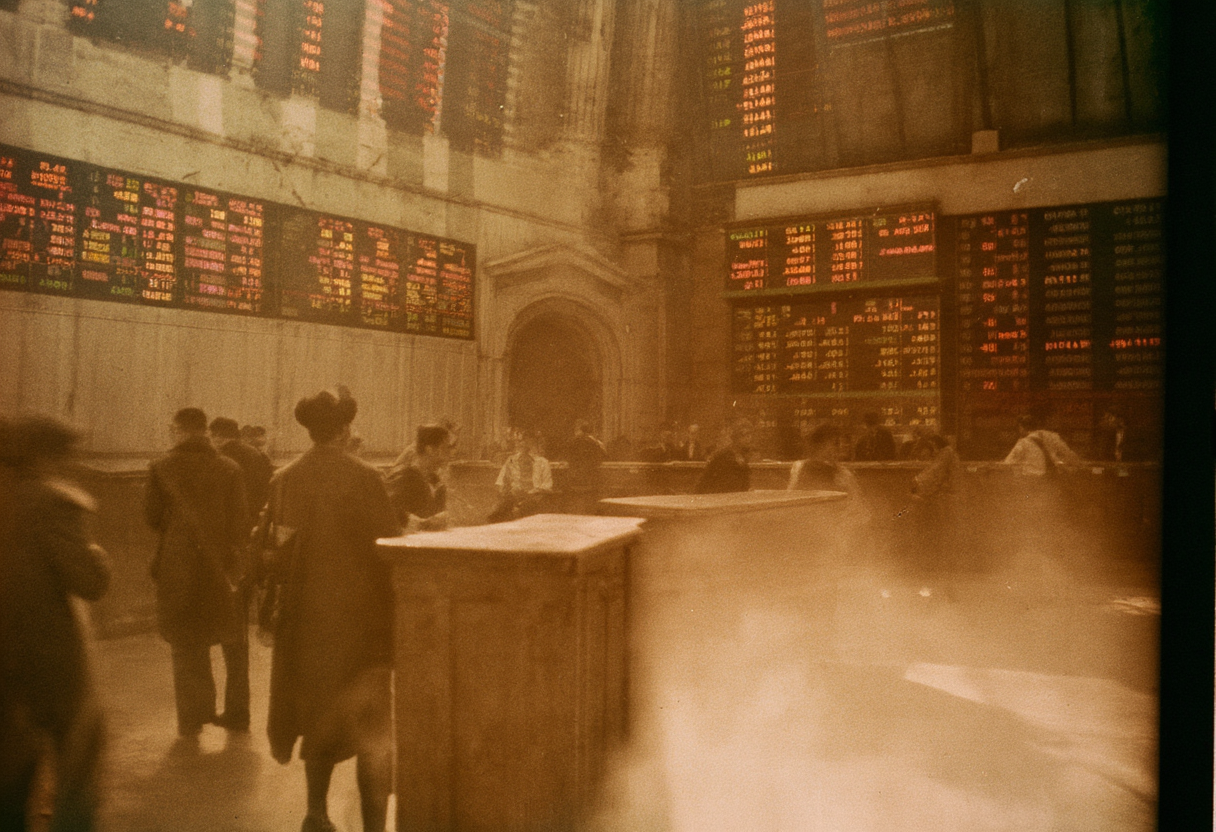
The market enhanced something real: it made a tonne of carbon legible, tradeable, fundable. It obsolesced the blunt instrument of command-and-control regulation — the old idea that a ministry would simply order a factory to stop. And quietly, it retrieved something much older: the enclosure of the commons. We took the atmosphere's shared capacity to absorb carbon, fenced it, handed out title deeds, and called the deeds allowances.
The turn
Here is where it flips.
A carbon market is supposed to make itself obsolete. Drive emissions to zero and the thing you are selling — permission to emit — ceases to exist. But somewhere between the policy memo and the budget spreadsheet, that logic ran in reverse. Every tonne eliminated is a tonne of auction revenue gone. The EU ETS raised €43.6 billion in 2023 alone, money governments have folded into climate programs, social funds, and general budgets.5 Decarbonization, pursued to completion, defunds itself.
So nobody pursues it to completion. Caps decline, but on a schedule built for fiscal comfort. The EU sped its annual cap reduction from 1.74 percent to 2.2, then to 4.3 percent, with 4.4 promised for later in the decade — aggressive on paper, carefully calibrated to keep allowances flowing and revenue steady.6 The market that was meant to price carbon out of existence becomes a machine that needs carbon to keep existing. That is the reversal: a tool for ending emissions matures into an institution that quietly depends on them.
The reach problem makes it worse. By 2036 carbon prices cover a far larger slice of the world than they did a decade earlier — but coverage is not cutting. As far back as 2024 the World Bank found that less than one percent of global emissions were priced at or above the level its own expert commission said was needed to hold warming well below two degrees.7 The world got very good at charging for carbon. It never got serious about charging enough.
The free stuff tells the same story. To guard against "carbon leakage" — industry fleeing to cheaper jurisdictions — heavy emitters got billions in allowances at no cost, grandfathered on historical pollution. The more you emitted, the more free permission you received. Europe legislated a slow phase-out tied to its border tariff, the CBAM factor inching from near-total free allocation toward zero only across 2026 to 2034.8 A decade of reform, and the polluters were still, in part, being paid in the currency they were meant to be charged.

The border, and the South
Then the market grew a wall. The EU's Carbon Border Adjustment Mechanism, sold as leak-prevention, lands on the world as a tariff. To dodge it, a country must build a carbon market the EU recognizes as "equivalent" — registries, monitoring, verification — infrastructure that costs billions and runs on expertise many nations don't have. China's system, the largest on Earth by emissions covered at roughly eight billion tonnes, didn't qualify, because it priced intensity rather than absolute tonnes and priced it low.9 Brazil, India, and South Africa took the measure to the WTO as discriminatory and unilateral — the rich world, they argued, pulling the ladder up behind two centuries of free emitting.10
The same suspicion shadows the global offset market. The Paris Agreement's Article 6, finalized at COP29 in 2024, let countries meet their targets by paying for cuts somewhere cheaper — usually somewhere poorer. Watchdogs warned the rules could let wealthy nations bank on paper reductions while their own smokestacks kept running.11 Enclose the commons, hand most of it to the people who filled it, then sell the rest back to everyone else. Critics had a phrase for it: carbon colonialism with a UN logo.
Back to Sofia
By 2036 Sofia has left the desk. She moved to a renewable-energy fund — one of the firms that stopped buying offsets and started cutting its own tonnes instead.
She couldn't keep trading a thing whose whole point was to get cheaper. "I thought we were building infrastructure for transformation," she says. "Turned out we were building infrastructure for managed decline. The market captured us before we captured it. And by the time we understood that, we'd wired everything around it — budgets, pensions, treaties. You can't unplug it without breaking things."
She looks out at the skyline, where somewhere the floor still hums and the prices still settle. The newest futures contracts assume EUAs keep climbing — analysts pencil in numbers well above today's by the end of the decade.12 Higher. Just never high enough, fast enough.
The open question is the one we should have asked in 2005: can a market designed for political acceptability ever deliver a transformation that is politically unacceptable to the people it's transforming? The evidence from 2036 is not encouraging. Markets do what their incentive structure tells them to. We built the structure to manage the problem. So it manages it — beautifully, efficiently, forever.
The invisible hand on the thermostat has a light touch. Too light, it turns out, to turn the heat down before the room gets warm.
Author's Note
This is speculative journalism written from a 2036 vantage. Sofia Martinez and the scenes around her are fictional composites; the €71.23 price, the 2036 details, and the trajectory are imagined. Everything load-bearing — the market mechanisms, the policy moves, the price history, the structural critiques, and the figures attributed to the EU, the World Bank, and the WTO process — is drawn from real, sourced reporting on carbon markets as of 2024–2026, cited below. The reversal it describes is not a prediction. It is the failure mode current designs make easy: a system priced for fiscal and political comfort rather than for zero.